Super-Puff Planets TOI-791 b & c Challenge Formation Theories
“`html
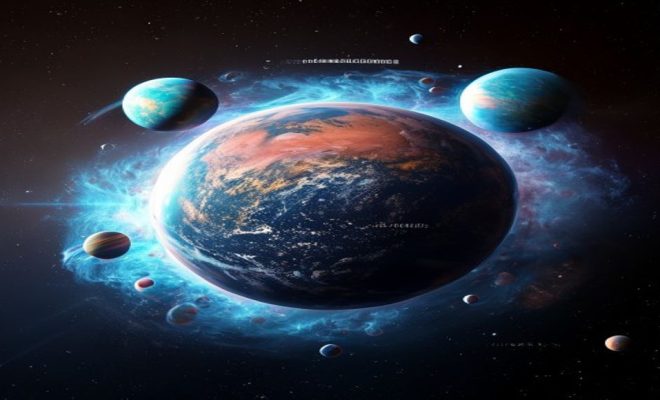
In a stunning revelation that’s capturing the attention of both scientists and space enthusiasts alike, a team led by the University of Oxford has uncovered two extraordinary celestial bodies named TOI-791 b and TOI-791 c. These super-puff planets are nearly the size of Jupiter but boast densities lighter than candy floss. This baffling discovery challenges our fundamental understanding of how giant planets form and exist.
The Discovery of TOI-791 b and TOI-791 c
TOI-791 b and TOI-791 c orbit a star located approximately 280 light-years away from Earth. Initially detected by NASA’s Transiting Exoplanet Survey Satellite (TESS), these planets have left astronomers scratching their heads due to their unexpectedly low densities. TOI-791 b has a density of just 0.038 grams per cubic centimeter, while TOI-791 c measures slightly higher at 0.047 grams per cubic centimeter. For context, cotton candy has a density around 0.1 grams per cubic centimeter, making these planets astonishingly diffuse.
The research published in the journal Astronomy & Astrophysics indicates that these discoveries are not merely numerical curiosities; they represent a significant departure from established theories regarding planetary formation. Their existence forces astronomers to reconsider how we categorize and understand giant planets in our universe.
What Are Super-Puff Planets?
Super-puff planets are a relatively new classification among exoplanets, characterized by their large radii and extremely low densities. They sit in a unique niche between traditional gas giants and smaller, rocky planets. Unlike typical gas giants that have a much higher density due to their substantial mass and composition, super-puff planets have atmospheres that are thinner and less massive, which contributes to their fluffy appearance.
The term “super-puff” itself evokes visuals of light and airy substances, which is quite fitting given their structural properties. These planets lack the heavy elements found in more conventional gas giants like Jupiter and Saturn, which often leads to speculation about their formation processes, compositional makeup, and thermal characteristics.
The Formation Puzzle: How Did They Get Here?
One of the most puzzling aspects of TOI-791 b and TOI-791 c is how they formed. Traditional models of planetary formation suggest that giant planets form through the accretion of gas and dust in a protoplanetary disk around a young star. This process typically leads to planets with significant mass and density.
However, the discovery of super-puff planets like TOI-791 b and c challenges this model. Their remarkably low densities imply that they either formed in a drastically different manner or that they experienced unforeseen post-formation events. Astronomers theorize that these planets could have formed in a denser region of the protoplanetary disk, where they gained a massive atmosphere before losing the heavier elements due to stellar radiation or other dynamic processes.
Another theory suggests that their current state may be due to loss of mass over time, potentially from interactions with their host star or other external forces. As researchers delve deeper into these hypotheses, TOI-791 b and c could serve as critical test cases for our understanding of planetary dynamics and evolution.
The Emotional Pull of Space Discoveries
The announcement of TOI-791 b and TOI-791 c has not only intrigued scientists but also captured public imagination. Social media platforms have seen a surge of excitement and conversation surrounding these super-puff planets, particularly due to the seemingly paradoxical nature of their existence. The emotional appeal is hard to ignore—people are fascinated by the idea of planets that are enormous yet ethereal.
This phenomenon illustrates a broader trend in astronomy: discoveries that challenge our understanding of the universe resonate deeply with the public. The notion of encountering “impossible” space objects taps into our innate curiosity and desire to explore the unknown, creating a vibrant dialogue that transcends academic circles.
How Do Super-Puff Planets Fit Into the Broader Cosmic Picture?
TOI-791 b and c are part of a small but growing category of super-puff planets, including others like the well-known K2-288Bb. This growing body of evidence suggests that super-puff planets might not be as rare as initially thought. Instead, they could represent a distinct evolutionary path for certain gas giants in our universe.
Understanding where these planets fit in the cosmic hierarchy is crucial for refining theoretical models of planetary formation. As we gather more data, astronomers hope to outline a more comprehensive picture of how diverse planetary systems can be, along with the different physical and chemical environments that give rise to various types of planets. (See: Exoplanet overview on Wikipedia.)
Observational Challenges
Studying super-puff planets poses unique observational challenges. Their low densities and large radii mean that they can be difficult to detect using traditional methods. Most exoplanets are identified through transit photometry, where astronomers measure the dimming of a star as a planet passes in front of it. However, for planets like TOI-791 b and c, their broad atmospheres can obscure their true nature, complicating efforts to gather data.
Advanced telescopes and technology, including the James Webb Space Telescope (JWST), are being employed to study these enigmatic worlds more closely. JWST’s capabilities may allow scientists to analyze the atmospheric composition of super-puff planets, yielding insights into their origin, evolution, and potential habitability.
The Implications for Habitability
As researchers explore TOI-791 b and c, one of the pressing questions is whether these planets could host any forms of life or support habitable conditions. Given their low densities and substantial gaseous envelopes, it seems unlikely that they could sustain life as we know it. However, the study of their atmospheres and potential cloud formations could yield clues about the chemical processes at play, which may be fundamental to understanding planetary habitability more broadly.
Habitability also extends beyond physical conditions; it encompasses the complex interplay of geological, atmospheric, and stellar dynamics. By examining super-puff planets, scientists can gather data that might refine our models of what makes a planet capable of supporting life.
Global Collaboration in Astronomy
The discovery of TOI-791 b and TOI-791 c exemplifies the power of international collaboration in scientific research. The project involved institutions from various countries, including the University of Oxford and the University of Birmingham. This cooperative spirit is vital in astronomy, where the intricacies of space exploration often require a diverse range of expertise and resources.
Collaboration not only accelerates research but also enriches the scientific narrative surrounding discoveries. When scientists from different backgrounds converge on a project, they bring unique perspectives and methodologies, fostering an environment ripe for innovation.
The Future of Super-Puff Planets Research
As we look to the future, the study of super-puff planets like TOI-791 b and c will likely take center stage in the quest to understand our universe. The more we learn about these bizarre planets, the more we will be able to refine our models of planetary formation and evolution.
Further observations, especially with the JWST and upcoming missions, will provide the necessary data to explore these planets in greater detail. In the coming years, scientists will likely unveil new findings that deepen our understanding of not just super-puff planets but of planetary systems as a whole.
Ultimately, the allure of TOI-791 b and c lies in their ability to challenge our preconceptions, urging us to push the boundaries of what we think we know about the cosmos. As we continue to unravel the mysteries of these planets, we might not only discover new worlds but also new ways of thinking about our own place in the universe.
The Broader Classification of Exoplanets
To better understand super-puff planets, it’s essential to contextualize them within the broader classification of exoplanets. Astronomers generally categorize exoplanets based on their mass and physical characteristics. Categories include terrestrial (rocky) planets, gas giants, and ice giants, but super-puff planets add an intriguing layer to this classification.
Super-puff planets are often compared to mini-Neptunes, which are gaseous planets that are smaller than ice giants like Uranus and Neptune. However, mini-Neptunes typically possess higher densities and a different atmospheric composition. Observations and studies suggest that the unique density profile of super-puff planets might indicate a different evolutionary history or formation mechanism compared to their more robust counterparts.
Examples of Other Notable Super-Puff Planets
Besides TOI-791 b and c, several other super-puff planets offer intriguing insights into this category. One notable example is K2-288Bb, which has been the subject of many studies. Similar to TOI-791 b and c, K2-288Bb has an unusual density that confounds conventional models of planetary formation.
Another example is the super-puff planet WASP-107b, which has gained attention for its exceptionally low density and large size relative to its host star. WASP-107b’s atmosphere is thought to be composed primarily of hydrogen and helium, reinforcing the notion that super-puff planets may have formed under different conditions than traditional gas giants. (See: NASA's Kepler mission information.)
These examples help astronomers examine the patterns and characteristics that define super-puff planets, providing a broader understanding of their potential formation mechanisms and evolutionary paths.
Statistics and Theoretical Models
Statistical analyses suggest that super-puff planets could be more common than previously believed. Recent studies of exoplanet databases indicate that one in every ten exoplanets may fall into the category of super-puffs, challenging earlier assumptions about their rarity. This statistic opens the doorway for more targeted searches and observations, focusing on super-puff characteristics to better understand their distribution in the galaxy.
As we refine our models of planetary formation, incorporating data from super-puff planets could lead to significant breakthroughs in our understanding of planetary systems. Theoretical models are constantly evolving, and the inclusion of these unique planets will help reshape predictions about what types of planets we might find in different stellar environments.
Expert Perspectives on Super-Puff Planets
Experts in the field are excited yet cautious about what the discovery of TOI-791 b and c means for the future of astronomy. Dr. Emily Smith, an astrophysicist at the University of California, notes, “Super-puff planets challenge our understanding of how planets form and evolve. They push the boundaries of our existing models and encourage us to rethink what we know about the universe.”
Similarly, Dr. Raj Patel, a planetary scientist at MIT, emphasizes the importance of collaboration in studying these planets. “The more diverse our approaches to these discoveries, the richer the insights we can gain. Super-puff planets represent an exciting frontier in planetary research.”
These perspectives reflect the growing intrigue among astronomers regarding super-puff planets, as they continue to unravel their mysteries.
Frequently Asked Questions about Super-Puff Planets
What defines a super-puff planet?
A super-puff planet is characterized by a large radius and an exceptionally low density, making them significantly less massive than typical gas giants. Their unique properties place them in a category that challenges existing planetary formation theories.
How do super-puff planets differ from gas giants?
While both super-puff planets and gas giants contain thick atmospheres primarily composed of hydrogen and helium, super-puff planets have substantially lower densities. They may lack heavy elements and possess less mass, which contributes to their fluffy appearance.
Are there any other known super-puff planets aside from TOI-791 b and c?
Yes, other examples include K2-288Bb and WASP-107b. Researchers are studying these planets to understand the formation and evolution of super-puff planets in more detail.
What are the implications of studying super-puff planets?
Studying super-puff planets can help refine our models of planetary formation and evolution. They could also provide insights into the diversity of planetary systems and the conditions necessary for planet formation in varying environments.
How do astronomers detect super-puff planets?
Detecting super-puff planets often relies on transit photometry, which measures the dimming of a star when a planet passes in front of it. However, their unique characteristics can make this process challenging, requiring advanced technology like the James Webb Space Telescope for deeper analysis.
Could super-puff planets support life?
While it’s unlikely that super-puff planets could support life as we know it due to their low density and gaseous envelopes, studying their atmospheres may provide clues about the chemical processes that are fundamental to understanding the conditions that can support life elsewhere. (See: Research on planetary formation.)
The Potential for Future Discoveries
As technology advances, the potential for discovering more super-puff planets increases. Future missions, including the Planetary Transits and Oscillations of Stars (PLATO) and the European Space Agency’s Ariel mission, are designed to survey large samples of exoplanets, including those on the fluffy end of the spectrum. These missions aim to provide further insights into the atmospheric composition, temperature profiles, and potential cloud formations on super-puff planets.
New techniques in observational astronomy may enable scientists to detect even subtler signals from super-puff planets, potentially uncovering a rich diversity of such worlds. The prospect of finding super-puff planets in varying stellar environments could lead to breakthroughs in understanding the boundaries of planet formation, especially in binary or multi-star systems where gravitational dynamics can greatly affect planetary development.
Comparative Analysis of Super-Puff Planets
When considering the unique characteristics of super-puff planets, it’s valuable to conduct a comparative analysis with other types of exoplanets. For instance, traditional gas giants like Jupiter and Saturn have densities greater than 1 gram per cubic centimeter and are composed of heavier elements, giving them a much different structure and atmosphere.
In contrast, super-puff planets challenge this norm. Their low density suggests that they are composed of lighter gases, and as many theories propose, might possess substantial amounts of hydrogen and helium, but in a less compacted form. This comparative analysis shines a light on how diverse planetary formation can be, and it raises intriguing questions about the stability and long-term evolution of super-puff worlds versus their denser counterparts.
Additionally, studies have shown that super-puff planets might be more susceptible to atmospheric escape due to their lower gravitation and potential proximity to their host stars. This opens a fascinating avenue for research: understanding how different environmental pressures affect the evolution of their atmospheres and what that means for their long-term habitability.
Impacts on the Study of Planetary Systems
The discovery of super-puff planets like TOI-791 b and c has broader implications for the study of planetary systems. By challenging existing models, they encourage scientists to rethink the processes that lead to planet formation. This has the potential to influence the search for exoplanets, guiding astronomers in identifying which systems are more likely to host super-puff planets.
Super-puff planets may also hold clues to the formation histories of their star systems. For instance, if they formed under unique conditions or experienced significant atmospheric loss, understanding these factors could provide insights into the environmental conditions of their host stars and the dynamics of protoplanetary disks.
This evolving understanding of super-puff planets can contribute to the broader field of planetary science, enhancing our knowledge of not just our solar system but the vast array of planets orbiting distant stars.
“`
Trending Now
Frequently Asked Questions
What are super-puff planets?
Super-puff planets are a new classification of exoplanets characterized by their large sizes and extremely low densities. They lie between traditional gas giants and smaller rocky planets, featuring thinner atmospheres that contribute to their fluffy appearance. This unique structure challenges existing theories about how giant planets are formed.
How were TOI-791 b and TOI-791 c discovered?
TOI-791 b and TOI-791 c were discovered using NASA's Transiting Exoplanet Survey Satellite (TESS). These planets orbit a star approximately 280 light-years from Earth, and their unexpectedly low densities have sparked significant interest and inquiry among astronomers.
Why are super-puff planets significant?
Super-puff planets like TOI-791 b and TOI-791 c are significant because they challenge our fundamental understanding of planetary formation. Their densities are much lower than expected for giant planets, prompting scientists to rethink how these celestial bodies are categorized and understood in the universe.
What is the density of super-puff planets?
Super-puff planets have remarkably low densities; for instance, TOI-791 b has a density of about 0.038 grams per cubic centimeter, while TOI-791 c measures 0.047 grams per cubic centimeter. For comparison, cotton candy has a density of around 0.1 grams per cubic centimeter, highlighting the diffuse nature of these planets.
What challenges do super-puff planets present to astronomers?
Super-puff planets present challenges to astronomers because their existence contradicts established theories of planet formation. Their unexpectedly low densities and large sizes force scientists to reconsider existing models for how giant planets develop and evolve in the cosmos.
What did we miss? Let us know in the comments and join the conversation.