JWST Reveals Exoplanet Weather on Hot Jupiter WASP-94A b
“`html
The quest to understand exoplanet atmospheres has taken a remarkable turn, thanks to the groundbreaking capabilities of the James Webb Space Telescope (JWST). A recent study led by Sagnick Mukherjee and David Sing at Johns Hopkins University unveils an extraordinary atmospheric phenomenon on the hot Jupiter WASP-94A b. This revelation not only enriches our knowledge of distant worlds but also highlights the complex, dynamic nature of exoplanet atmospheres. The dramatic day-to-day atmospheric split observed on this exoplanet presents a vivid example of weather patterns, making the subject more relatable and engaging for both scientists and the public alike.
Understanding WASP-94A b: A Hot Jupiter
WASP-94A b, located approximately 500 light-years from Earth in the constellation Crater, is classified as a hot Jupiter due to its gaseous composition and proximity to its host star. Hot Jupiters are known for their immense sizes and high temperatures, often leading to unique atmospheric conditions unlike those found on our own planet. Typically, these exoplanets are tidally locked, meaning one side perpetually faces their star while the other remains in darkness, creating extreme temperature contrasts across the surface.
The extreme heat of WASP-94A b can reach upwards of 1,700 degrees Fahrenheit (about 925 degrees Celsius), conditions that have long intrigued astronomers. Understanding the atmospheric dynamics of such a hostile environment can provide critical insights into the formation and evolution of planetary systems beyond our own.
Revealing the Atmospheric Split
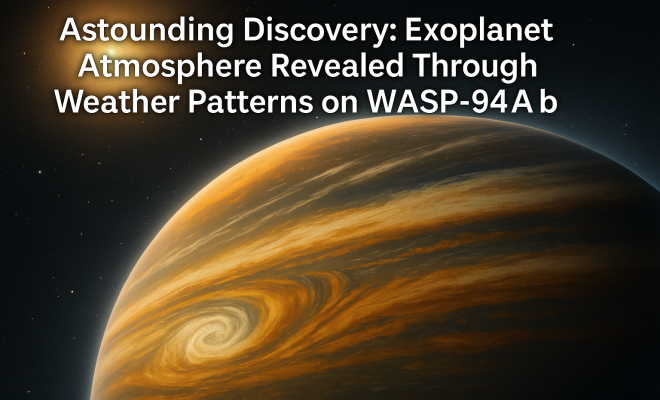
The research conducted by Mukherjee, Sing, and their team has unveiled a fascinating atmospheric phenomenon: an asymmetric weather pattern that significantly alters the conditions between the morning and evening sides of WASP-94A b. Using JWST’s advanced spectroscopic capabilities, the scientists observed a stark difference in cloud cover between the two halves of the planet.
According to their findings, the morning side of WASP-94A b experiences extreme cloudiness, while the evening side boasts a much clearer atmosphere. This variation is driven primarily by the movement of materials within the planet’s atmosphere, a process that appears to be influenced by the intense heat radiating from the star.
How JWST Observed the Weather Cycle
The James Webb Space Telescope, launched in December 2021, has quickly established itself as a powerful tool for exoplanet research. Equipped with a suite of sophisticated instruments, JWST can analyze the atmospheres of distant planets with unmatched precision. The observational data from JWST not only confirmed the existence of clouds on WASP-94A b but also provided insights into the composition and behavior of these clouds.
By studying the transmission spectra of WASP-94A b during its transit across its host star, the researchers were able to determine how light interacts with the planet’s atmosphere. This method allowed them to isolate specific wavelengths that indicate the presence of various molecules, helping them trace the complex interactions that lead to the observed weather patterns.
The Day-Night Cycle and Atmospheric Dynamics
At the heart of this discovery lies the unique day-night cycle of WASP-94A b. The tidal locking of the planet means that the side facing the star receives constant sunlight, creating intense heating that drives atmospheric circulation. As air moves from the cooler, cloud-covered morning side toward the hotter, clearer evening side, it undergoes significant changes in temperature and pressure.
This dynamic movement of atmospheric material results in a planet-wide cloud cycle, illustrating a complexity that challenges the traditional view of exoplanet atmospheres as uniform and static. Instead of a simple, homogenous layer of gas, WASP-94A b showcases a vibrant and ever-changing climate.
Implications for Exoplanet Research
The implications of this research are vast, providing exciting prospects for future studies of exoplanets. The notion that exoplanet atmospheres can exhibit complex weather patterns akin to those found on Earth raises critical questions about the diversity of planetary climates throughout the universe.
Moreover, such findings can inform our understanding of climate dynamics on other planets, including those that may harbor life. If hot Jupiters like WASP-94A b can have intricate atmospheric behaviors, one can only imagine the potential complexities that might exist on Earth-like planets located in the habitable zones of their stars. (See: Understanding exoplanets and their atmospheres.)
Comparing WASP-94A b to Other Exoplanets
As scientists continue to explore the vast landscape of exoplanets, it’s essential to compare the atmospheric characteristics of WASP-94A b with other known worlds. For instance, exoplanets like HD 209458 b and WASP-121 b have also shown evidence of atmospheric dynamics, including the presence of clouds and various chemical compositions.
However, the specific day-to-day variation observed on WASP-94A b sets it apart. This asymmetric weather pattern not only demonstrates the influence of stellar radiation on atmospheric behavior but also indicates that other exoplanets may have similarly intricate weather systems waiting to be discovered.
The Role of Cloud Formation
Clouds play a crucial role in the atmosphere of any planet, influencing temperature, pressure, and ultimately the climate. The research on WASP-94A b highlights the significance of cloud formation processes in exoplanet atmospheres. The distinct cloudiness observed during the morning versus the evening provides insights into how these formations respond to changing temperatures and pressures.
On WASP-94A b, the morning clouds may form from rising air that cools as it ascends, leading to condensation and cloud creation. As the air flows towards the hotter evening side, the clouds dissipate, contributing to clearer skies. Understanding these processes is essential for constructing accurate models of exoplanet atmospheres and predicting their long-term behavior.
The Future of Exoplanet Atmosphere Studies
Looking ahead, the findings from WASP-94A b pave the way for more detailed studies of exoplanet atmospheres. As JWST continues to operate, researchers will undoubtedly expand their observations to other exoplanets, searching for similar weather patterns and atmospheric dynamics.
Future missions, including the upcoming European Space Agency’s ARIEL (Atmospheric Remote-sensing Infrared Exoplanet Large-survey), aim to study the atmospheres of numerous exoplanets in a systematic manner. By comparing data across various worlds, scientists will gain a deeper understanding of the factors that govern atmospheric behavior.
The Vivid Reality of Atmospheric Science
The study of exoplanet atmospheres is transforming our understanding of planetary science. Unlike anything seen in our solar system, these alien atmospheres are rich with phenomena that challenge our existing models. The findings from WASP-94A b highlight just how much we still have to learn about these worlds, including their potential for hosting life.
What’s especially exciting is the potential for future discoveries. As we refine our observational techniques and develop more advanced instruments, we may uncover more intricate atmospheric dynamics, even on planets similar to Earth. There’s a real chance we might find atmospheres teeming with activity, perhaps even climatic patterns that allow for the existence of life as we know it.
Exploring Diverse Exoplanet Atmospheres
The universe is home to a wide array of exoplanets, each exhibiting unique atmospheric conditions. For instance, the super-Earth LHS 1140 b, found in the habitable zone of its star, has sparked interest due to its potential to harbor water vapor in its atmosphere. In contrast, the ultra-hot Jupiter WASP-121 b has been observed with signs of metal vapor in its atmosphere, providing a glimpse into the extreme conditions that can exist on these distant worlds.
These examples illustrate that exoplanet atmospheres can differ dramatically in composition and behavior, influenced by factors such as distance from their host stars, mass, and internal heat. By leveraging the power of JWST and future missions, scientists can begin to create a more comprehensive picture of how diverse planetary atmospheres can be, and what that means for the possibility of life elsewhere in the universe.
Statistics and Trends in Exoplanet Research
Since the discovery of the first exoplanet around a sun-like star in 1995, the field has witnessed an explosion of findings. As of October 2023, over 5,000 exoplanets have been confirmed, with thousands more candidates awaiting verification. Among these, a significant portion are gas giants like WASP-94A b, illustrating the prevalence of such planets in the cosmos.
According to NASA, about 25% of the known exoplanets are categorized as hot Jupiters. This statistic underscores the importance of studying their atmospheres, as they can offer clues about atmospheric processes that may also occur on smaller, rocky planets. As observational technology advances, the expectation is that more complex atmospheres will be detected, revealing a greater diversity of atmospheric phenomena. (See: James Webb Space Telescope capabilities.)
Expert Perspectives on Exoplanet Atmospheres
Experts in the field of exoplanet research provide valuable insights into the significance of studying these distant atmospheres. Dr. Elisa Quintana, an astrophysicist at NASA’s Goddard Space Flight Center, notes, “Understanding exoplanet atmospheres is pivotal in our quest to determine habitability. The varied climates we observe can lead us to new theories about how planets evolve over time.”
Similarly, Dr. Nikole Lewis from the Space Telescope Science Institute emphasizes the implications of such findings. “The discovery of dynamic weather patterns on exoplanets challenges our assumptions about what makes a planet hospitable. It opens the door for considering life in environments we may have previously ruled out,” she explains.
Frequently Asked Questions (FAQ)
What is an exoplanet atmosphere?
An exoplanet atmosphere is the layer of gases surrounding a planet outside our solar system. These atmospheres can vary widely in composition, pressure, and temperature, influencing the planet’s climate and potential for hosting life.
How do astronomers study exoplanet atmospheres?
Astronomers primarily study exoplanet atmospheres through transit spectroscopy, where they observe the light from a star that passes through the planet’s atmosphere during a transit. This allows them to analyze the light’s spectrum and identify specific molecules present in the atmosphere.
What have we learned about exoplanet atmospheres so far?
Research has revealed that exoplanet atmospheres can exhibit a range of characteristics, including the presence of clouds, varying temperatures, and complex weather patterns. Studies of planets like WASP-94A b have demonstrated that atmospheric conditions can change dramatically between day and night.
How might exoplanet atmospheres inform our search for extraterrestrial life?
By understanding the atmospheric conditions of exoplanets, scientists can identify which planets might be able to support life. The presence of certain gases, such as oxygen and methane, can be indicative of biological processes, leading researchers to prioritize these planets for further study.
What role does the James Webb Space Telescope play in exoplanet research?
The James Webb Space Telescope provides unprecedented capabilities for observing exoplanet atmospheres, allowing for detailed analysis of their chemical compositions and weather patterns. Its advanced instruments enable the detection of faint signals that can reveal complex atmospheric dynamics, significantly advancing our understanding of these distant worlds.
What Lies Ahead in Exoplanet Atmosphere Research?
The future of exoplanet atmosphere research is bright and filled with potential breakthroughs. With advancements in technology and a growing number of telescopes dedicated to this field, the next few years might yield discoveries that reshape our understanding of the universe. Projects like the Extremely Large Telescope (ELT) and the upcoming Nancy Grace Roman Space Telescope are set to complement JWST’s capabilities, enabling astronomers to study exoplanet atmospheres in unprecedented detail.
Researchers are particularly interested in the atmospheres of Earth-sized exoplanets located in the habitable zone, where conditions might be suitable for life. By examining spectral signatures and atmospheric compositions, scientists hope to identify planets that not only have the right conditions but also potentially exhibit signs of life.
The Importance of Weather Patterns
Studying the weather patterns of exoplanets like WASP-94A b not only helps in understanding their atmospheres but also has broader implications for planetary science. For instance, weather systems can influence surface conditions and climate stability, which are critical factors when considering habitability. Observations of atmospheric dynamics can provide insights into the processes that govern the climate on these distant worlds. (See: Atmospheric dynamics of hot Jupiters.)
For example, the discovery of extreme weather systems, such as those observed on WASP-94A b, prompts scientists to rethink how similar processes might operate on smaller, rocky exoplanets. Researchers are beginning to form theories suggesting that dynamic weather patterns could exist on Earth-like planets, potentially enabling a diverse range of climatic conditions that could support life in ways we have yet to fully comprehend.
Planetary Formation and Atmospheric Evolution
The study of exoplanet atmospheres isn’t just about current conditions; it’s also about understanding the history and evolution of these distant worlds. The composition of an exoplanet’s atmosphere can reveal clues about its formation and the processes it has undergone since. For instance, gas giants like WASP-94A b may have formed further from their stars and migrated inward, influencing their atmospheric composition and structure over time.
Analyzing the atmospheres of exoplanets can also shed light on the chemical processes that take place on these worlds. For example, the presence of certain molecules can indicate volcanic activity or the breakdown of water vapor due to intense radiation from the star. Such insights help scientists piece together the geological and atmospheric histories of these planets, enhancing our understanding of their potential for hosting life.
Public Engagement and Education
The growing interest in exoplanet atmospheres has spurred public engagement and education initiatives aimed at increasing awareness of this fascinating field. Science communicators and educators are working to translate complex scientific concepts into accessible content. This includes podcasts, articles, and interactive events that invite the public to explore the intricacies of exoplanet research.
Moreover, as discoveries continue to unfold, there is a unique opportunity to engage the next generation of scientists. Programs that encourage students to participate in science projects related to astronomy and astrophysics can stimulate interest and inspire future careers in these fields. By making science approachable and exciting, we can foster a community that supports and drives further exploration of exoplanets and their atmospheres.
Conclusion: The Vivid Reality of Distant Worlds
The discovery of a dramatic atmospheric split on WASP-94A b underscores that exoplanet atmospheres are far from trivial; they can be intricate and dynamic, influenced by a range of factors. As researchers continue to probe the mysteries of these distant worlds, we are reminded of the importance of understanding their complex climates. The everyday weather patterns observed on WASP-94A b serve as a powerful metaphor, making these far-off planets feel more tangible and relatable.
As we strive to unlock the secrets of the universe, the continued exploration of exoplanets promises to bring forth more astonishing revelations that could reshape our understanding of our place in the cosmos.
“`
Trending Now
Frequently Asked Questions
What is WASP-94A b?
WASP-94A b is a hot Jupiter located about 500 light-years from Earth in the constellation Crater. It is characterized by its gaseous composition and extreme temperatures, reaching up to 1,700 degrees Fahrenheit, making it a subject of interest for astronomers studying exoplanet atmospheres.
How does the James Webb Space Telescope study exoplanets?
The James Webb Space Telescope (JWST) uses advanced spectroscopic capabilities to analyze the atmospheres of exoplanets. It can detect and study various atmospheric phenomena, such as weather patterns, by observing the light that passes through a planet's atmosphere, revealing its composition and dynamics.
What did the recent study on WASP-94A b reveal?
The recent study led by researchers at Johns Hopkins University revealed an asymmetric weather pattern on WASP-94A b, showing significant differences in cloud cover between its morning and evening sides. This finding highlights the dynamic nature of exoplanet atmospheres.
Why are hot Jupiters like WASP-94A b important to study?
Hot Jupiters, such as WASP-94A b, are important for understanding planetary formation and evolution beyond our solar system. Their extreme conditions provide insights into atmospheric dynamics and the potential for diverse planetary systems, enhancing our knowledge of the universe.
What are the temperature extremes on WASP-94A b?
WASP-94A b experiences extreme temperatures that can reach up to 1,700 degrees Fahrenheit (about 925 degrees Celsius). These high temperatures create unique atmospheric conditions that differ significantly between the sunlit and dark sides of the planet.
What did we miss? Let us know in the comments and join the conversation.