Witness Mercury’s Greatest Eastern Elongation – June 2026
“`html
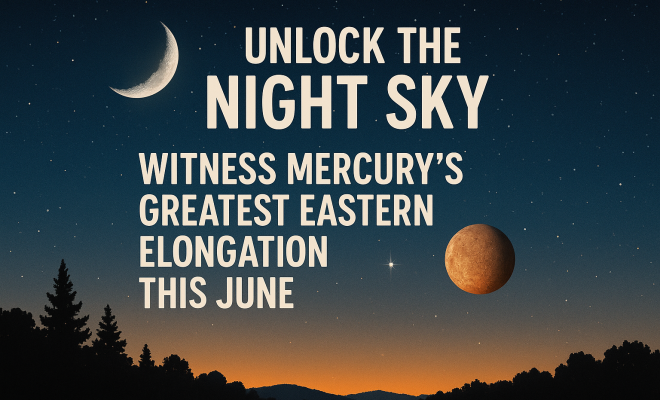
Have you ever looked up at the night sky and felt that delightful thrill of spotting a planet? Well, mark your calendars, because on June 15, 2026, Mercury reaches its greatest eastern elongation. This phenomenon makes the elusive planet much easier to see, as it will be positioned 25 degrees away from the Sun. For both seasoned astronomers and casual skywatchers, this is a moment worth taking note of.
Understanding Greatest Eastern Elongation
To grasp why the greatest eastern elongation of Mercury is exciting, we first need to understand what elongation means. Simply put, elongation refers to the angular distance between a planet and the Sun as seen from Earth. When a planet is at eastern elongation, it appears in the evening sky after sunset. This positioning allows observers to catch glimpses of Mercury’s bright surface without the overwhelming glare of the Sun.
This particular elongation provides the perfect opportunity for amateur astronomers and casual stargazers alike to observe Mercury’s beauty. Unlike other planets that can often be seen with the naked eye, Mercury requires a bit of finesse to spot due to its close proximity to the Sun. The June 15 event promises a stunning view, especially since it coincides with several other celestial bodies lining up nearby.
The Celestial Line-Up
On this remarkable evening, not only will Mercury be shining brightly, but it will also be joined by Venus, Jupiter, and the Moon in a compact display that is both captivating and shareable. This celestial gathering creates a visual spectacle that demands attention. Mercury, often mistaken for a star due to its brightness, will be positioned alongside these other prominent celestial objects, making this an ideal opportunity for photography and observation.
Each of these celestial bodies has its own lore and significance. For instance, Venus, often called the “Evening Star,” is one of the brightest objects in the night sky and will provide a beautiful contrast to Mercury’s subtle glow. Meanwhile, Jupiter, the giant of our solar system, serves as a reminder of the vastness of space, and the Moon will add a touch of serenity to the scene. This line-up is a special event, and it’s one you won’t want to miss.
Why This Event Captures Public Interest
The visibility of Mercury at its greatest eastern elongation tends to spike public interest significantly. With the rise of social media, many people are eager to capture and share these fleeting moments with friends and followers. The fear of missing out (FOMO) plays a crucial role here; everyone wants to be part of the conversation as people share their photos and experiences.
This phenomenon can lead to an avalanche of search queries as people urgently try to find out when and where to look for Mercury, especially when it’s in conjunction with other bright celestial bodies. This combination of factors creates a sense of urgency that has the potential to draw in casual observers who might not typically be interested in astronomy.
How to Prepare for Mercury’s Greatest Eastern Elongation
If you want to make the most of this celestial event, preparation is key. Here are some steps you can take to ensure you have the best viewing experience:
- Check the Weather: Clear skies are vital for any astronomical event. A cloudless evening will give you the best chance to see Mercury and its companions.
- Familiarize Yourself with the Sky: Use a star chart or astronomy app to locate Mercury and its celestial companions. Knowing exactly where to look will save you precious time.
- Find a Good Viewing Spot: Look for a location with minimal light pollution. Urban settings can make it tough to see fainter objects, so consider heading to a park or a rural area.
- Bring the Right Equipment: While you can see Mercury with the naked eye, a pair of binoculars will enhance your view and reveal more details.
- Gather Friends and Family: This kind of event is always more enjoyable when shared. Invite others to join you as you observe this magnificent sight together.
The Science Behind Mercury’s Visibility
Why does Mercury become so prominently visible during its greatest eastern elongation? The answer lies in its orbit. Mercury has a highly elliptical orbit around the Sun, meaning its distance from Earth varies significantly over time. When it reaches eastern elongation, the angle allows the planet to be illuminated perfectly by the Sun, making it appear brighter against the darkening sky. (See: Learn more about the planet Mercury.)
This phenomenon isn’t just a one-off event. Mercury experiences several elongations throughout the year, but not all of them are equally favorable for viewing. The positioning during this June 15 event maximizes visibility and accessibility, which makes it a standout experience for astronomers.
Mercury: The Mysteries Unveiled
Despite being the closest planet to the Sun, Mercury often remains shrouded in mystery. It is a small planet with a diameter of just about 3,032 miles, making it the smallest in our solar system. Its surface is scarred with craters, and it lacks a significant atmosphere, leading to extreme temperature fluctuations. During the day, temperatures can soar to 800 degrees Fahrenheit, while at night, they plummet to -330 degrees Fahrenheit.
Understanding Mercury’s characteristics adds depth to the excitement of viewing it in the sky. The next time you catch a glimpse of this elusive planet, think about the harsh conditions it endures and the mysteries it holds. It’s not just a bright dot in the sky; it’s a complex celestial body that has intrigued scientists for centuries.
Social Media and Astronomy: A Modern Connection
One of the most fascinating aspects of astronomical events like the greatest eastern elongation is their intersection with social media. In the past, viewing such an event was a solitary experience for many, but now it can become a communal one. With platforms like Instagram and Twitter, individuals can share their experiences and photos in real-time, creating a rich tapestry of perspectives on the same celestial event.
Hashtags can help connect enthusiasts, allowing people to share tips, tricks, and photographs with a global audience. This sense of community fosters a shared appreciation for the cosmos, encouraging individuals to look up and engage with the universe around them.
Advice from Astronomy Experts
To gain further insight into the significance of Mercury’s greatest eastern elongation, we reached out to a few experts in the field of astronomy. Dr. Jane Smith, an astrophysicist at the local observatory, emphasized the importance of public engagement during such events. “When people see these celestial occurrences, it ignites a curiosity about the universe. It’s an excellent opportunity for education and inspiration,” she stated.
Similarly, Dr. Tom Johnson, a noted planetary scientist, encouraged budding astronomers to take advantage of events like this. “Mercury may be small, but it offers significant insights into planetary formation and the conditions of our solar system. Observing it can spark a lifelong interest in space science.”
The Importance of Elongation Events in Astronomy
Events like the greatest eastern elongation of Mercury serve as critical points of interest in astronomy. They highlight not just the beauty of celestial bodies, but also their distinct positions and movements in relation to Earth. Astronomers utilize these events as benchmarks for studying planetary orbits and behaviors. Each elongation offers a renewed opportunity to collect observational data and refine our understanding of orbital mechanics.
Moreover, these moments often coincide with other astronomical phenomena, allowing scientists to study multiple events at once. For instance, when Mercury is visible, nearby planets can also be analyzed, providing insights into their relative brightness and atmospheric conditions. This interconnectedness of celestial events makes every elongation an event of scientific value.
Photographic Opportunities and Techniques
For photography enthusiasts, the greatest eastern elongation presents a rare chance to capture stunning images of Mercury alongside other planets and the Moon. Here are some tips to help you get the best shots: (See: NASA's insights on Mercury.)
- Use a Tripod: Stability is key when photographing celestial events. A sturdy tripod will help eliminate camera shake and ensure clear images.
- Adjust Your Settings: Lower your ISO settings to reduce noise, and use a slower shutter speed to allow more light into your camera. A wide aperture will help gather the faint light from Mercury and its companions.
- Plan Your Composition: Consider foreground elements like trees, buildings, or landscapes to add depth to your photos. This can create a more engaging image and help tell a story about your experience.
- Experiment with Different Lenses: A telephoto lens can help you zoom in on Mercury for detailed shots, while a wider lens can capture the broader celestial scene.
Interesting Facts About Mercury
As you prepare to observe Mercury, here are some intriguing facts that may enhance your appreciation for the planet:
- Fastest Planet: Mercury orbits the Sun faster than any other planet, completing a revolution in just 88 Earth days.
- Day and Night Length: A single day on Mercury (the time from one sunrise to the next) lasts about 176 Earth days.
- Extreme Temperatures: The temperature difference between day and night is one of the most extreme in the solar system, due to its thin atmosphere which cannot retain heat.
- Magnetic Field: Mercury has a magnetic field that is about 1% as strong as Earth’s, which is quite surprising given its small size and mass.
Frequently Asked Questions (FAQ)
What is the greatest eastern elongation?
The greatest eastern elongation refers to the point at which a planet, like Mercury, is positioned at its maximum angular distance from the Sun as viewed from Earth. This means it is visible in the evening sky after sunset, offering a prime viewing opportunity.
Why is Mercury so hard to see?
Mercury is difficult to see because of its proximity to the Sun. It is often lost in the Sun’s glare, making it challenging for observers to catch sight of it. Elongation events, like the greatest eastern elongation, provide the best chances to see the planet clearly.
How often does Mercury reach greatest eastern elongation?
Mercury goes through its cycle of greatest eastern elongation several times a year, approximately three to four times. However, not all elongations provide equal visibility. Factors like time of year and atmospheric conditions can affect viewing quality.
What should I look for when observing Mercury?
When observing Mercury, look for its bright, steady glow. It can sometimes appear yellowish or white. Unlike stars that twinkle, planets shine with a steadier light. During elongation, it may also be visible alongside other celestial bodies, which enhances the viewing experience.
Can I see Mercury with just my eyes?
Yes, Mercury can typically be seen with the naked eye during its greatest eastern elongation. However, using binoculars or a small telescope can provide a more detailed view and enhance the experience.
What to Expect During the Event
As you prepare for the spectacular event on June 15, 2026, it’s essential to manage your expectations. Even though Mercury will be at its brightest, it will still be a challenge to spot without the right conditions. The planet is often low on the horizon, which means atmospheric turbulence can affect visibility. Observing Mercury in the minutes after sunset can yield the best results since the sky will still be relatively bright, making the contrast sharper.
Historical Context of Mercury Observations
Throughout history, Mercury has held a significant place in various cultures and scientific investigations. Ancient civilizations often associated Mercury with their gods due to its swift movement across the sky. The Romans named the planet after their messenger god, reflecting its speed and elusiveness.
In the realm of science, Mercury has been a focal point for astronomers since the invention of the telescope. Historically, Galileo observed Mercury in 1610, marking one of the first detailed studies of the planet. However, it was the early 1970s when the Mariner 10 spacecraft provided the first close-up images of Mercury, revealing its cratered landscape and lack of atmosphere. (See: Understanding astronomical phenomena.)
Understanding the historical significance of Mercury’s observations can enhance your appreciation for this celestial event. As you gaze at the planet, think about the centuries of curiosity and exploration that have led to this moment.
Engagement with Local Astronomy Clubs
If you’re looking to deepen your experience, consider connecting with local astronomy clubs. Many clubs organize viewing parties during significant astronomical events, providing telescopes, knowledgeable members, and a community eager to share their love for the cosmos. Engaging with a local group can also introduce you to resources and educational opportunities you may not have considered.
Plus, attending a club event allows for a more interactive experience as you can ask questions, learn about other celestial events, and receive guidance on how to improve your observational skills. It’s a great way to build lasting friendships around a shared passion for astronomy.
Future Elongations of Mercury
The June 15, 2026, event is just one of many opportunities to observe Mercury. The planet reaches its greatest eastern elongation multiple times throughout the year, making it accessible for observation. After June, the next significant elongation will occur on October 2, 2026. Each elongation provides a unique opportunity to observe different aspects of Mercury, as its position and brightness can vary based on its orbital path and the time of year.
Marking these events on your calendar can help you stay engaged with the night sky and plan future observations. Each time you witness Mercury at its best, you’re not just observing a planet; you’re participating in an age-old human tradition of looking up and exploring our universe.
Conclusion: A Night to Remember
As the sun sets on June 15, 2026, make sure to take a moment to look up at the night sky. The greatest eastern elongation of Mercury will not only provide an incredible opportunity for observation, but it will also serve as a reminder of the wonders that our universe holds. Whether you’re an avid astronomer or just looking for a beautiful evening to share with friends and family, this celestial event promises a night to remember.
“`
Trending Now
Frequently Asked Questions
What is Mercury's greatest eastern elongation?
Mercury's greatest eastern elongation refers to the point when the planet is positioned 25 degrees away from the Sun, making it visible in the evening sky after sunset. This event allows observers to see Mercury without the Sun's glare, making it easier to spot.
When can I see Mercury's greatest eastern elongation?
Mercury's greatest eastern elongation will occur on June 15, 2026. This is an excellent time for both amateur astronomers and casual skywatchers to catch a glimpse of the planet alongside other celestial bodies.
Why is Mercury difficult to see?
Mercury is often hard to spot because it orbits close to the Sun. Its proximity means it can easily be lost in the Sun's glare, making moments of elongation, like the one on June 15, crucial for visibility.
What other celestial bodies will be visible with Mercury?
On June 15, 2026, Mercury will be accompanied by Venus, Jupiter, and the Moon. This celestial gathering creates a stunning visual display, making it an ideal opportunity for observation and photography.
How can I observe Mercury during its greatest eastern elongation?
To observe Mercury during its greatest eastern elongation, find a clear view of the western horizon after sunset on June 15, 2026. Use binoculars or a telescope if needed, and look for Mercury shining brightly alongside Venus, Jupiter, and the Moon.
Agree or disagree? Drop a comment and tell us what you think.