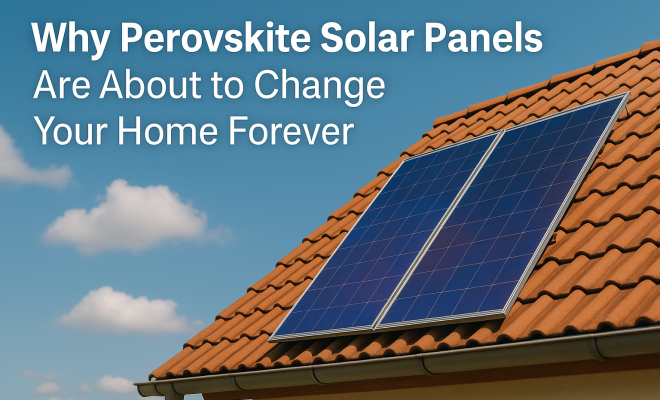
Why Perovskite Solar Panels Are About to Change Your Home Forever
Imagine a future where nearly any surface on your home could generate electricity. No more sprawling, rigid solar arrays dominating your roofline, but rather discreet, highly efficient energy producers seamlessly integrated into your property. Sounds a bit like science fiction, doesn’t it? Well, what if I told you that future is rapidly approaching, thanks to a revolutionary technology called perovskite solar cells?
For years, traditional silicon solar panels have been the undisputed champions of residential renewable energy. They’ve done a fantastic job, don’t get me wrong, but they come with their own set of limitations – think bulky aesthetics, manufacturing complexities, and performance plateaus. Now, we’re on the cusp of a paradigm shift, with perovskites poised to offer a compelling alternative. Recent breakthroughs, particularly in surface treatment technology, are pushing these cells from the lab to industrial reality, making the vision of “any surface becoming a power plant” remarkably tangible.
As homeowners, you’re probably wondering what all the fuss is about and, more importantly, which of these cutting-edge options might be the best perovskite solar panels for homeowners like you. That’s exactly what we’re going to dive into. We’ll explore the advancements that have cleared major hurdles, look at specific applications, and help you understand what to expect as this exciting technology becomes more widely available, potentially as early as 2026.
1. The Efficiency Revolution: Pushing Past Silicon’s Limits
When you’re talking about solar panels, efficiency is the name of the game. It dictates how much electricity your panels can generate from a given amount of sunlight. For a long time, silicon has been the benchmark, slowly creeping up into the low 20% range for commercial modules. But perovskites are different; they’re showing an almost unheard-of leap in performance.
We’re talking about certified efficiencies hitting an impressive 24% for large-area perovskite modules. That’s already competitive with, and in some cases surpassing, many high-end silicon panels on the market today. But here’s where it gets truly exciting: for high-efficiency tandem cells – where a perovskite layer is stacked on top of a silicon cell – researchers have reached an astonishing 28.80%. This ‘tandem’ approach allows the combined layers to capture a broader spectrum of sunlight, squeezing even more energy out of every photon. This kind of efficiency means you could generate more power with fewer panels, or even smaller panels, which is a huge advantage for residential installations where space might be limited.
To put this into perspective, consider a typical residential roof. If you’re limited by space, higher efficiency means you can fit more power generation capacity into that footprint. For example, if you need 5 kW of power, a 20% efficient panel might require 25 square meters, while a 25% efficient panel could achieve the same output in just 20 square meters. That 5 square meter difference could be crucial for homeowners with complex rooflines, chimneys, or shaded areas. This direct impact on usable space makes efficiency a top priority when looking for the best perovskite solar panels for homeowners, especially in urban or densely populated areas.
2. Durability Dilemmas Solved: Withstanding the Elements
One of the biggest knocks against early perovskite research was its perceived fragility, particularly its susceptibility to moisture and rapid performance degradation. Who wants solar panels that break down after a few rainy seasons? This was a critical hurdle that absolutely needed to be overcome before perovskites could ever be considered viable for your home.
Fortunately, recent advancements have tackled these issues head-on. A significant breakthrough involves the use of lead dioleate for surface passivation. Now, before your eyes glaze over with scientific jargon, think of surface passivation as creating a protective shield around the delicate perovskite material. This shield dramatically reduces defects on the surface of the cell, which are often the culprits behind moisture sensitivity and rapid degradation. This innovative treatment helps the perovskite cells maintain their high efficiency over extended periods, bringing them much closer to the long lifespans we expect from traditional solar technology. This improved durability is paramount for the best perovskite solar panels for homeowners, ensuring your investment stands the test of time.
Beyond moisture, thermal stability has also been a focus. Perovskites can be sensitive to prolonged exposure to high temperatures, which is a common occurrence on rooftops, especially in sunny climates. Researchers are now developing encapsulation methods and material compositions that can withstand extreme heat fluctuations, ensuring that the panels perform reliably whether it’s a scorching summer day or a frosty winter night. These advancements in both moisture and thermal resilience are transforming perovskites from laboratory curiosities into robust, real-world energy solutions, giving homeowners confidence in their long-term performance.
3. Self-Assembled Monolayers: A Game Changer for Stability
Beyond lead dioleate, another key technical milestone in enhancing perovskite stability comes from the development of innovative self-assembled monolayers (SAMs). These aren’t just fancy scientific terms; they represent a fundamental shift in how we protect these sensitive materials.
Imagine tiny, specially designed molecules that, when applied to a surface, automatically arrange themselves into a perfect, tightly packed, single-layer shield. That’s essentially what SAMs do. They provide an incredibly effective barrier against environmental factors like oxygen and moisture, which are notorious for degrading perovskite performance. By integrating these SAMs into the cell structure, researchers have significantly bolstered the long-term stability of perovskite solar cells, making them robust enough to endure the varying conditions of an outdoor residential environment. This kind of stability is non-negotiable for any homeowner considering a solar investment, and it’s a major reason why perovskites are now being taken seriously for widespread adoption.
Think of SAMs as a microscopic, custom-fitted raincoat for each individual perovskite crystal. This precise molecular engineering allows for protection at an atomic level, far more effective than simply coating the entire panel. This targeted protection not only fends off environmental threats but also helps maintain the structural integrity of the perovskite material itself, preventing internal defects from forming over time. The result is a solar cell that doesn’t just work well on day one but continues to deliver consistent power output year after year, offering the kind of reliability that homeowners demand from any major investment in their property. (See: Perovskite solar cell overview.)
4. Flexible and Lightweight Design: Aesthetics and Versatility for Homeowners
Traditional silicon panels are, let’s face it, rigid and heavy. This limits where and how they can be installed. Perovskites, however, offer a completely different design paradigm. They can be manufactured on flexible substrates, making them incredibly lightweight and adaptable.
Think about the possibilities: solar cells that can be integrated into curved roof tiles, flexible window films, or even painted onto building facades. This versatility means homeowners won’t be limited to just south-facing roof installations. You could have solar-generating awnings, carports with integrated power, or even fences that contribute to your home’s energy supply. This flexibility also opens up architectural possibilities that were simply impossible with silicon, allowing for a more aesthetically pleasing integration of solar technology into your home’s design. The best perovskite solar panels for homeowners won’t just be efficient; they’ll be beautiful and practically invisible. For more context, see the unseen EV battery recycling boom.
The weight factor alone is a game-changer. Standard silicon panels can weigh anywhere from 40 to 50 pounds each, requiring robust roof structures and complex mounting hardware. Flexible perovskite films, on the other hand, could be a fraction of that weight, making installation simpler, faster, and less structurally demanding. This lightweight nature also reduces shipping costs and the carbon footprint associated with transportation. For homeowners considering a new roof or a renovation, the ability to integrate solar directly into roofing materials or even apply it as a thin, adhesive film offers unprecedented design freedom, blending energy generation seamlessly into the home’s existing aesthetic rather than making it an obvious add-on.
5. Low-Cost Manufacturing Potential: Making Solar More Accessible
One of the most attractive aspects of perovskite technology is its potential for significantly lower manufacturing costs compared to silicon. Silicon production is an energy-intensive process that requires high temperatures and complex purification steps. Perovskites, on the other hand, can often be processed from solution at much lower temperatures.
This means simpler manufacturing techniques, potentially using roll-to-roll printing processes similar to how newspapers are printed. Imagine printing solar panels like wallpaper! This scalability and reduced energy input during production could drive down the final cost of perovskite solar panels, making solar energy more accessible to a broader range of homeowners. A lower upfront cost for installation could accelerate the transition to renewable energy for many families, removing a significant financial barrier that often deters potential adopters.
This cost advantage isn’t just about the raw materials, it’s also about the entire production chain. Silicon wafer production involves multiple high-temperature stages, including melting quartz, refining metallurgical-grade silicon, and then growing and slicing monocrystalline ingots. Each step is energy-intensive and requires specialized, expensive equipment. Perovskite manufacturing, by contrast, can leverage existing printing technologies, significantly reducing capital expenditure for new factories. This potential for ‘printable’ solar cells could lead to highly automated, continuous production lines, further driving down unit costs. Ultimately, this means that the best perovskite solar panels for homeowners won’t just be high-tech, they’ll also be affordable, democratizing access to cutting-edge solar power.
6. Performance in Low Light Conditions: Powering Through Cloud Cover
Traditional silicon solar panels tend to see a significant drop in performance under cloudy skies or during dawn and dusk. This is because they’re optimized for direct sunlight. Perovskites, however, have shown impressive performance even in less-than-ideal lighting conditions.
Their unique bandgap properties allow them to absorb light more effectively across a broader spectrum, including diffuse light. This means your perovskite solar panels could continue generating a useful amount of electricity even on overcast days, extending your daily generation window and providing a more consistent power output throughout the year. For homeowners living in regions with frequent cloud cover, this could be a major advantage, making solar a more reliable energy source than ever before. This inherent ability to perform well in varying light conditions is a strong contender for what makes the best perovskite solar panels for homeowners in many climates.
Consider the cumulative effect of this improved low-light performance. Over the course of a year, particularly in northern latitudes or areas prone to long winters, the incremental power generated during sub-optimal conditions can add up to a substantial increase in overall energy yield. This translates directly to lower electricity bills and greater energy independence. Instead of your solar system largely shutting down when the sun isn’t shining brightly, perovskites offer a more consistent, day-long energy harvest. This reliability is a key factor for homeowners who want to maximize their solar investment and reduce their reliance on grid electricity, regardless of the weather forecast.
7. Tandem Cell Technology: The Best of Both Worlds
We touched on tandem cells earlier, but it’s worth emphasizing just how revolutionary this approach is. It’s not about replacing silicon entirely, but rather enhancing it. By stacking a perovskite layer on top of a conventional silicon cell, you’re essentially creating a super-efficient solar panel that can capture almost all available light energy.
The perovskite layer absorbs the higher-energy blue and green light, while the underlying silicon cell captures the lower-energy red and infrared light that the perovskite might miss. This synergistic effect pushes overall efficiency figures to near 30%, a level previously thought to be almost impossible for single-junction cells. For homeowners, this means maximum power generation from a minimal footprint, potentially reducing the number of panels needed and further lowering installation costs. It represents a practical and incredibly powerful pathway to bring these advanced efficiencies to residential systems without completely reinventing the existing solar infrastructure.
The beauty of tandem cells lies in their ability to overcome the fundamental efficiency limits of single-material solar cells. Every solar material has a “bandgap” that determines which wavelengths of light it can efficiently convert into electricity. Silicon is great at red and infrared, but less so for blue and green. Perovskites excel at blue and green. By combining them, you’re essentially creating a broader “net” to catch more of the sun’s energy spectrum. This intelligent design allows for a significant leap in performance without requiring a complete overhaul of the existing silicon solar industry, making the transition to ultra-high efficiency more accessible and economically viable for widespread adoption, including for the best perovskite solar panels for homeowners.
8. The “Any Surface” Vision: What This Means for Your Home
The ultimate promise of perovskite technology, and perhaps its most exciting long-term implication for homeowners, is the vision of “any surface becoming a power plant.” This isn’t just about putting panels on your roof anymore. It’s about a fundamental shift in how we integrate energy generation into our built environment.
Imagine windows that generate electricity while still allowing light to pass through. Picture building facades that are not just decorative but actively contribute to your home’s energy independence. Envision garden sheds, patio covers, or even outdoor furniture embedded with discreet solar cells. This level of seamless integration will redefine the aesthetics of residential solar, making it less of an add-on and more of an inherent part of your home’s design. It opens up possibilities for homeowners who might have previously thought solar wasn’t an option due to roof orientation, shading, or aesthetic concerns. The best perovskite solar panels for homeowners will be those that empower us to think beyond traditional limitations, turning our homes into distributed power generators in ways we’ve only dreamed of. (See: Recent advancements in perovskite technology.)
This “any surface” concept extends beyond just aesthetics; it’s about maximizing available real estate for energy production. Many homes have limited ideal roof space, or perhaps a portion of their roof is consistently shaded. With perovskites, those limitations diminish. South-facing walls, carports, awnings, even fences can become active energy producers. This distributed generation model could significantly increase a home’s overall solar capacity without requiring additional land or compromising existing architectural features. It’s a leap towards true energy self-sufficiency, where the entire property contributes to a cleaner, greener energy footprint.
9. Environmental Considerations & Sustainability: A Greener Footprint
Beyond efficiency and cost, it’s crucial to look at the environmental impact of solar technology. Traditional silicon panel manufacturing, while increasingly cleaner, still involves high-temperature processes and can generate hazardous waste. Perovskites offer a potentially greener alternative. For more context, see breakthroughs in technology that could revolutionize treatment.
As mentioned, the low-temperature, solution-based manufacturing processes for perovskites require less energy, significantly reducing the carbon footprint associated with their production. Furthermore, researchers are actively exploring less toxic and more abundant materials for perovskite formulations, moving away from lead-based compounds to tin or bismuth alternatives. While lead-based perovskites are currently the most efficient, the industry is committed to finding environmentally benign substitutes that maintain high performance. The long-term goal is to create solar cells that are not only highly efficient but also fully recyclable and made from earth-abundant materials, ensuring a truly sustainable energy future for homeowners.
10. Smart Home Integration: The Future of Energy Management
As perovskite solar panels become more prevalent, their flexible and integrated nature will naturally lend itself to advanced smart home systems. Imagine your home’s energy management system not just monitoring your roof panels, but also drawing power from your solar windows, smart awnings, and even energy-generating exterior paint.
This level of granular energy harvesting will allow for incredibly sophisticated optimization. Your smart home could prioritize which surfaces to draw power from based on real-time sunlight conditions, energy demand, and even electricity prices. For instance, on a cloudy day, it might prioritize power from a tandem roof panel, but on a sunny afternoon, it could also leverage the output from your east-facing solar windows. This intelligent integration will empower homeowners to achieve unprecedented levels of energy independence and efficiency, turning their entire property into a dynamic, responsive power plant managed effortlessly by their smart home system.
What to Expect by 2026 and Beyond
While the October 2026 date for these breakthroughs is exciting, it’s important to understand the typical timeline for new technology to hit the consumer market. Lab breakthroughs need to be scaled up to mass production, and that takes time. However, given the rapid pace of development in perovskite research and the significant investment from both governments and private industry, we can realistically expect to see early commercial applications, particularly in niche markets, by 2026.
For residential homeowners looking for the best perovskite solar panels, the initial offerings might be premium products, perhaps in flexible forms for specific architectural needs or as part of those high-efficiency tandem cells. As production scales up and costs come down, we’ll likely see more widespread adoption. It won’t be an overnight switch, but a gradual integration into the existing solar landscape. Keep an eye on companies that are partnering with research institutions and those that specialize in advanced material science. They’ll be the ones leading the charge.
The initial market entry will likely focus on high-value applications where their unique properties, like flexibility or high efficiency in a small footprint, offer a distinct advantage. Think specialized building-integrated photovoltaics (BIPV) for new construction or premium renovations. As manufacturing processes mature and economies of scale kick in, the cost gap between perovskites and traditional silicon will narrow, paving the way for broader consumer adoption. It’s a journey from specialized innovation to mainstream solution, and homeowners who are early adopters will be at the forefront of this energy revolution.
Choosing Your Sustainable Energy Path
As you consider your options for sustainable energy, perovskite solar panels are definitely a technology to watch. Their impressive efficiency, improved durability, flexible form factors, and potential for lower costs present a compelling argument for their future dominance in the residential market. While silicon panels remain a solid, proven choice today, the advancements in perovskite technology are making the future of home energy look brighter, more efficient, and far more integrated than ever before.
The promise of turning almost any surface into a power plant isn’t just a catchy phrase; it’s a very real future that’s rapidly approaching. For homeowners eager to embrace the next generation of renewable energy, understanding these developments will be key to making informed decisions and truly harnessing the power of the sun.
Frequently Asked Questions About Perovskite Solar Panels for Homeowners
Q1: When can I actually buy perovskite solar panels for my home?
While lab breakthroughs are happening rapidly, commercial availability for homeowners is still a couple of years away. We anticipate early commercial products, likely in specialized or premium applications, appearing around 2026. Widespread adoption for typical residential roof installations will likely follow a few years after that, as production scales and costs come down. For more context, see reshaping tech accountability. (See: Review of solar energy technologies.)
Q2: Will perovskite panels be more expensive than silicon panels initially?
Yes, likely so. New technologies typically enter the market at a premium. However, the inherent low-cost manufacturing potential of perovskites suggests that their prices will drop more rapidly than silicon once mass production is established. Early adopters might pay more for the cutting-edge efficiency and unique form factors.
Q3: Are perovskite solar panels safe, especially with concerns about lead?
Researchers are very aware of the lead content in some perovskite formulations. While current designs use lead, it’s encapsulated within the cell, similar to how lead is managed in other electronics. Crucially, significant research is ongoing to develop lead-free perovskites using elements like tin or bismuth, which have shown promising results in terms of efficiency and stability. Safety and environmental impact are major priorities for widespread adoption.
Q4: How long do perovskite solar panels last compared to silicon?
This has been a major focus of recent research. While early perovskites had stability issues, advancements like surface passivation and self-assembled monolayers are significantly extending their lifespan. Researchers are now achieving stability comparable to early silicon cells, with a goal to match the 25-30 year lifespan warranties common with today’s silicon panels. It’s an area of continuous improvement.
Q5: Can I combine perovskite panels with my existing silicon system?
Potentially, yes. The most exciting development here is “tandem cell” technology, where a perovskite layer is stacked on top of a silicon cell. This creates a single, ultra-efficient panel. If perovskites are offered as standalone panels, they could theoretically be integrated into a hybrid system, but this would depend on inverter compatibility and overall system design. Consult with a solar installer for specific recommendations.
Q6: What’s the main advantage of perovskite panels for my home, specifically?
For homeowners, the key advantages are higher efficiency (meaning more power from less space), superior low-light performance (more energy on cloudy days), and incredible design flexibility (solar that can be integrated into windows, curved surfaces, or even painted on). These factors can lead to greater energy independence and a more aesthetically pleasing solar installation.
Q7: Will I need a special inverter or other equipment for perovskite panels?
It’s likely that early perovskite panels, especially if they are part of tandem systems, will work with standard solar inverters. However, as the technology evolves, there might be optimized inverter solutions designed to maximize the unique characteristics of perovskite output. This is a detail that manufacturers will address as products come to market.
Q8: What kind of warranty can I expect on perovskite solar panels?
Warranties will be a crucial factor for homeowner confidence. As the technology matures and durability is proven in real-world conditions, expect manufacturers to offer warranties similar to those for silicon panels (e.g., 25-year performance warranties). Initial products might have shorter warranties as the technology establishes its long-term reliability.
Q9: How will perovskite panels handle extreme weather like hail or high winds?
Just like silicon panels, perovskite modules will need to meet stringent industry standards for weather resistance. Manufacturers will encapsulate the delicate perovskite material within robust glass or polymer layers, designed to withstand hail, wind, and temperature extremes. The flexible nature of some perovskite designs might even offer advantages in terms of impact resistance compared to rigid glass panels.
Q10: Where can I find more information about companies developing perovskite solar panels?
Keep an eye on major solar research institutions, university spin-offs, and established solar panel manufacturers who are investing in R&D. Companies like Oxford PV, Saule Technologies, and Solliance are at the forefront of commercializing perovskite technology. Industry news outlets and renewable energy trade publications are also good sources for updates.
Trending Now
- this guide on this new novo nordisk obesity drug is showing 25% weight loss – but there’s a catch
- the complete explanation
- this guide on the billion-dollar ai drug discovery problem nobody’s talking about
- read the full story
- our breakdown of brandon stirrup’s ai stance: why this xbox strategist deletes account and what it means
Frequently Asked Questions
What are perovskite solar panels?
Perovskite solar panels are a new type of photovoltaic technology that uses perovskite materials to convert sunlight into electricity. They promise higher efficiencies and more versatile applications compared to traditional silicon solar panels, allowing for integration into various surfaces of a home.
How do perovskite solar panels compare to silicon panels?
Perovskite solar panels outperform traditional silicon panels in terms of efficiency, achieving certified efficiencies around 24%. They also address issues like bulkiness and manufacturing complexities, making them a more attractive option for homeowners looking for discreet energy solutions.
What are the advantages of using perovskite solar cells?
The advantages of perovskite solar cells include higher efficiency rates, flexibility in application, and potential for lower manufacturing costs. This technology allows for the possibility of generating electricity from almost any surface, transforming homes into energy-producing structures.
When will perovskite solar panels be available for homeowners?
Perovskite solar panels are expected to become widely available to homeowners as early as 2026. Recent advancements in technology are paving the way for these innovative solar solutions to enter the residential market.
Can perovskite solar panels be integrated into existing homes?
Yes, perovskite solar panels can be integrated into existing homes due to their versatility and potential for application on various surfaces. This means homeowners can generate electricity without the need for traditional bulky solar arrays.
What's your take on this? Share your thoughts in the comments below — we read every one.