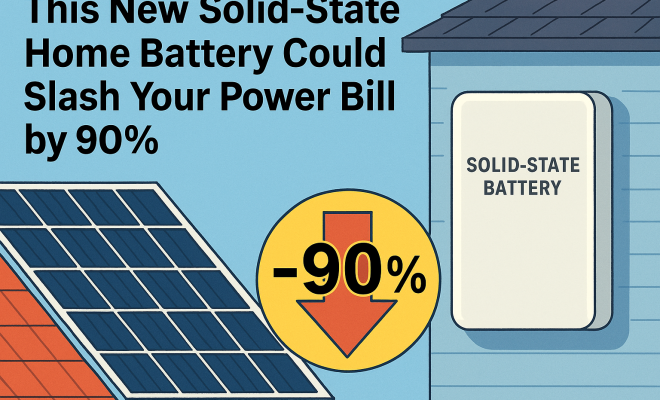
This New Solid-State Home Battery Could Slash Your Power Bill by 90%
Imagine a future where your home effortlessly powers itself, shrugging off power outages and insulating you from the relentless creep of utility bills. For years, that vision felt like a distant dream, a sci-fi fantasy. But what if I told you it’s closer than you think? A new player on the scene, QuantumCharge, just dropped a bombshell that could fundamentally alter how we consume and store energy at home. Their recently unveiled ‘PowerCell’ solid-state home battery promises an astonishing leap forward, boasting claims that could make residential grid independence a widespread reality within the next five years. This isn’t just about saving a few bucks; it’s about reclaiming control over one of our most essential household expenses.
The buzz surrounding QuantumCharge’s announcement is palpable, and for good reason. They’re talking about a 70% increase in energy density compared to current market leaders and a projected 25-year lifespan for their PowerCell. Think about that for a moment: a battery that lasts a quarter-century, holding significantly more power in a smaller footprint. This isn’t just an incremental improvement; it’s a monumental shift that directly addresses the pain points homeowners have faced with existing battery storage solutions. We’re talking about a genuine disruption to traditional energy providers, offering consumers a real pathway to lower electricity costs and greater environmental sustainability. Let’s dig into why this solid-state home battery is such a big deal and what it could mean for you.
1. The Grid Independence Dream: A New Reality for Homeowners
For decades, the idea of truly disconnecting from the electrical grid has been a romantic notion for many, often associated with remote cabins or extreme self-sufficiency. However, with the rising costs of electricity and increasing concerns about grid reliability – think about the rolling blackouts in California or the devastating Texas freeze – the desire for energy independence has moved squarely into the mainstream. Current home battery systems, while effective, often come with limitations in terms of capacity, cost, and longevity, making complete grid independence a challenging and expensive endeavor for the average homeowner.
QuantumCharge’s PowerCell, with its claimed 70% higher energy density, changes this equation dramatically. More energy in a smaller, more efficient package means homes can store significantly more power generated from solar panels or off-peak grid electricity. This increased capacity is absolutely crucial for achieving true independence, allowing a household to ride out multiple days of cloudy weather or extended grid outages without a hitch. If their claims hold true, we’re looking at a future where your home could generate and store nearly all the power it needs, drastically reducing or even eliminating your reliance on external utility companies. That’s not just a convenience; it’s a powerful economic and lifestyle shift.
2. Unprecedented Lifespan: 25 Years of Reliable Power
One of the biggest hurdles for widespread adoption of home battery storage has been the lifespan of existing technologies, primarily lithium-ion batteries. While these batteries are good, they typically come with warranties ranging from 10 to 15 years, and their performance tends to degrade over time. This creates a psychological barrier for homeowners, who might hesitate to invest tens of thousands of dollars in a system that they’ll potentially need to replace or significantly refurbish within a decade or so.
QuantumCharge’s bold claim of a 25-year lifespan for their solid-state home battery is, quite frankly, a game-changer. Imagine installing a battery system that could last as long as many roofs or major appliances. This extended longevity fundamentally alters the return on investment calculation for homeowners. Over a quarter-century, the initial cost of the PowerCell could be amortized over a much longer period, leading to substantial long-term savings on electricity bills. It also provides peace of mind, knowing that your energy storage solution is built to last, offering reliable power for a significant portion of your home’s lifetime. This isn’t just about technical specs; it’s about making renewable energy storage a truly durable and sustainable investment.
3. Solid-State Technology: The Core of the Breakthrough
The term ‘solid-state’ might sound like jargon, but it’s the fundamental reason why QuantumCharge’s PowerCell is generating such excitement. Traditional lithium-ion batteries use a liquid or gel electrolyte to transport ions between the electrodes. While effective, this liquid component has inherent limitations, including safety concerns (flammability), susceptibility to temperature fluctuations, and limitations on energy density. Solid-state batteries, by contrast, replace this liquid electrolyte with a solid material, usually a ceramic or polymer.
This seemingly simple change unlocks a cascade of benefits. A solid electrolyte is inherently more stable and less prone to dendrite formation – tiny, tree-like structures that can grow within liquid electrolytes, leading to short circuits and reduced battery life. This enhanced stability is what allows for higher energy density, faster charging capabilities (though QuantumCharge hasn’t explicitly detailed charging speeds for the PowerCell yet), and, crucially, a much longer lifespan. It also significantly reduces the risk of thermal runaway, making solid-state batteries inherently safer than their liquid counterparts. For a solid-state home battery, these safety advantages are paramount, especially when housing large energy reserves within a residential setting.
4. Economic Impact: Slashing Your Electricity Bills
Let’s be honest, for most homeowners, the primary driver for considering solar panels and battery storage isn’t just environmental altruism; it’s the desire to save money. Electricity prices have been on a steady upward trajectory in many regions, making utility bills a significant and unpredictable household expense. QuantumCharge’s PowerCell directly addresses this financial pain point by promising to dramatically reduce, if not eliminate, your monthly electricity costs.
With a 70% increase in energy density, homes can store a much larger surplus of solar-generated electricity during peak sunlight hours. This stored energy can then be used to power the home during the evening and overnight, when grid electricity is often most expensive (thanks to time-of-use tariffs). By minimizing reliance on grid power during these high-cost periods, homeowners can see their utility bills plummet. Over a 25-year lifespan, these cumulative savings could amount to tens, if not hundreds, of thousands of dollars, making the initial investment in a solid-state home battery a genuinely compelling financial decision. It’s a powerful hedge against future energy price hikes and a tangible step towards personal financial resilience. (See: energy storage advancements and trends.)
5. Environmental Sustainability: A Greener Footprint
Beyond the economic advantages, the environmental benefits of a highly efficient, long-lasting solid-state home battery are immense. Every kilowatt-hour of electricity generated by your solar panels and stored in a PowerCell means one less kilowatt-hour purchased from a grid that still relies heavily on fossil fuels. This directly translates to a reduced carbon footprint for individual households, contributing to broader efforts to combat climate change.
Furthermore, the extended 25-year lifespan of the PowerCell means fewer batteries will need to be manufactured and disposed of over time. This reduces the demand for raw materials and minimizes waste, making the entire energy storage ecosystem more sustainable. As global efforts shift towards decarbonization, innovations like QuantumCharge’s solid-state home battery play a critical role in accelerating the transition to a cleaner, more sustainable energy future. It’s not just about what you save; it’s about what you contribute to a healthier planet. For more context, see the unseen EV battery recycling boom.
6. Disruption to Traditional Energy Providers: A Power Shift
The implications of a technology like the PowerCell extend far beyond individual homes. Traditional energy providers operate on a centralized model, generating power at large plants and distributing it across vast grids. This model has served us for over a century, but it’s increasingly facing challenges from decentralized renewable energy solutions.
If residential grid independence becomes widespread, as QuantumCharge suggests, it could lead to a significant reduction in demand for grid electricity. This ‘demand destruction’ could force utility companies to fundamentally rethink their business models. They might need to pivot towards offering grid services, managing microgrids, or becoming facilitators of distributed energy resources rather than just wholesale power sellers. While this presents challenges for incumbents, it also opens up opportunities for innovation within the energy sector. The PowerCell isn’t just a product; it’s a potential catalyst for a structural transformation of the energy market, shifting power, quite literally, into the hands of consumers.
7. Investment and Market Confidence: The Backing of Big Names
A startup making bold claims is one thing; a startup backed by prominent clean energy investors is another entirely. The fact that QuantumCharge has secured significant backing from major players in the clean energy investment space lends considerable credibility to their announcement. These investors aren’t just throwing money at moonshots; they conduct extensive due diligence, scrutinize technical specifications, and evaluate market potential before committing capital.
This strong financial endorsement suggests that QuantumCharge’s solid-state home battery isn’t just hype, but a technology with genuine promise and a clear path to commercialization. It signals confidence from those who understand the energy market deeply, indicating that they believe the PowerCell has the potential to deliver on its ambitious promises and capture a significant share of the rapidly growing home energy storage market. This kind of institutional validation is often a precursor to widespread adoption and market impact.
8. The Road Ahead: From Announcement to Widespread Adoption
While the excitement around QuantumCharge’s PowerCell is justified, it’s important to remember that this is an announcement, not yet a mass-market product. The company aims for widespread residential grid independence within five years, which is an ambitious but potentially achievable timeline given the nature of the breakthrough. The next steps will involve rigorous testing, scaling up manufacturing, navigating regulatory approvals, and establishing distribution channels. We’ll also need to see independent verification of their claims regarding energy density, lifespan, and safety.
Pricing will also be a critical factor. While the long-term savings are compelling, the initial cost of a PowerCell system will determine its accessibility to the average homeowner. However, given the competitive nature of the clean energy market and the potential for economies of scale, it’s reasonable to expect that costs will become more attractive over time, much like we’ve seen with solar panels themselves. The journey from groundbreaking innovation to ubiquitous household staple is often complex, but if QuantumCharge can deliver on its promises, the PowerCell could indeed redefine home energy storage for a generation.
9. Beyond Residential: The Broader Impact on Energy Infrastructure
While we’re focusing on the solid-state home battery, it’s worth considering how this kind of breakthrough could ripple through the larger energy sector. Imagine communities equipped with these robust, long-lasting batteries. We could see the rise of true microgrids, where neighborhoods or even small towns operate largely independent of the main grid, increasing resilience against natural disasters or cyberattacks. This localized energy infrastructure would be a game-changer, shifting power generation closer to where it’s consumed.
Furthermore, the high energy density and safety of solid-state technology could unlock new possibilities for electric vehicle (EV) charging infrastructure. Faster charging and more compact battery designs in homes could mean less strain on the grid during peak EV charging times. It’s a holistic shift where residential storage doesn’t just benefit homeowners but strengthens the entire energy ecosystem, making it more robust, efficient, and decentralized. This isn’t just about individual homes; it’s about fundamentally rethinking how we power our world.
10. Smart Home Integration and Energy Management
The PowerCell isn’t likely to operate in a vacuum. Modern homes are becoming increasingly smart, with interconnected devices managing everything from lighting to climate control. A solid-state home battery with advanced capabilities would seamlessly integrate into this ecosystem, becoming the brain of your home’s energy management system.
Think about artificial intelligence optimizing when to charge the battery from solar, when to draw from the grid during off-peak hours, and when to discharge stored energy to power your appliances. This level of intelligent energy management could further maximize savings and efficiency. Your home could automatically prioritize powering essential devices during an outage or even participate in virtual power plant programs, selling surplus energy back to the grid when prices are high. This goes beyond simple storage; it transforms your home into an active participant in the energy market, making every electron count. (See: solid-state battery technology overview.)
11. The Role of Government Incentives and Policy
While QuantumCharge’s technology is revolutionary, the speed of its adoption will also depend heavily on external factors, particularly government incentives and supportive energy policies. Many regions already offer tax credits, rebates, or feed-in tariffs for solar installations and battery storage. These policies make the initial investment more palatable for homeowners, accelerating the transition to renewable energy.
As solid-state home batteries become more available, we might see new, tailored incentives emerge to specifically encourage their uptake. Policies that support grid modernization, microgrid development, and demand response programs will also play a crucial role. Governments recognizing the immense benefits – from grid stability to energy security – can provide the necessary push to move these innovations from niche products to mainstream solutions. It’s a partnership between technological breakthrough and smart policy that will truly unlock the potential of residential energy independence. For more context, see the $15 billion AI healthcare startup.
12. Addressing the Raw Materials Challenge
Any discussion about battery technology needs to touch upon raw materials. Current lithium-ion batteries rely on materials like cobalt and nickel, which can have supply chain complexities and ethical concerns. While solid-state batteries still use lithium, their unique architecture often allows for reduced reliance on some of these other critical minerals, or even the use of alternative, more abundant materials in the future.
QuantumCharge’s focus on longevity (25 years!) directly impacts the raw materials equation. A battery that lasts twice as long means half as many batteries need to be produced over a given period, significantly reducing the overall demand for these resources and the environmental impact associated with their extraction and processing. This inherent sustainability is a silent but powerful advantage, aligning perfectly with the broader goals of a circular economy and responsible resource management. It’s about making our energy future not just clean, but also responsibly sourced.
13. What to Look for When Considering a Solid-State Home Battery
Once products like the PowerCell hit the market, how do you, as a homeowner, evaluate them? Here are some key factors to consider:
- Verified Performance: Don’t just rely on manufacturer claims. Look for independent testing and certifications for energy density, cycle life, and safety.
- Capacity and Power Output: Does the battery have enough capacity (kWh) to meet your home’s needs for desired periods of grid independence? Is the power output (kW) sufficient to run your high-demand appliances?
- Inverter Compatibility: Ensure the battery system is compatible with your existing or planned solar inverter.
- Warranty and Support: A 25-year lifespan is great, but what does the warranty actually cover? Look at the degradation clause and the manufacturer’s reputation for customer service.
- Installation Requirements: Consider the physical footprint, weight, and any specific environmental requirements for installation (indoor/outdoor, temperature ranges).
- Cost and ROI: Calculate the total upfront cost versus the projected long-term savings. Factor in any available incentives.
- Scalability: Can you easily add more battery capacity later if your energy needs grow?
Doing your homework will be crucial to making an informed decision once these advanced solid-state solutions become widely available.
Frequently Asked Questions (FAQ) about Solid-State Home Batteries
Q1: What exactly is a solid-state home battery, and how is it different from existing home batteries?
A solid-state home battery uses a solid material (like a ceramic or polymer) as its electrolyte, rather than the liquid or gel electrolyte found in traditional lithium-ion batteries. This fundamental difference makes them safer, more energy-dense (meaning they store more power in a smaller space), and significantly longer-lasting, often promising lifespans of 20-25 years compared to 10-15 years for liquid lithium-ion batteries.
Q2: How much more energy can a solid-state home battery store?
Companies like QuantumCharge are claiming energy density increases of up to 70% compared to current market leaders. This means a solid-state battery of the same physical size could store nearly twice as much usable energy, allowing homes to achieve much greater grid independence.
Q3: Are solid-state batteries safer than traditional lithium-ion batteries for home use?
Yes, inherently. The solid electrolyte eliminates the flammable liquid component that can lead to thermal runaway in traditional lithium-ion batteries. This makes solid-state batteries significantly more stable and safer for installation in residential environments, greatly reducing fire risks.
Q4: What kind of lifespan can I expect from a solid-state home battery?
This is one of the biggest advantages. Manufacturers are projecting lifespans of 20 to 25 years, and potentially even longer. This is a considerable improvement over the typical 10-15 year warranties seen with current liquid lithium-ion home batteries, meaning fewer replacements and a better long-term return on investment. For more context, see breakthroughs in cancer treatment. (See: understanding solid-state batteries.)
Q5: How will a solid-state home battery impact my electricity bill?
By storing more solar energy and discharging it during peak utility rates, a solid-state home battery can dramatically reduce your reliance on grid electricity, especially during expensive time-of-use periods. Over its extended lifespan, this can lead to tens, if not hundreds, of thousands of dollars in savings, potentially eliminating your electricity bill entirely for much of the year.
Q6: Will solid-state home batteries be compatible with my existing solar panel system?
Generally, yes. Most modern home battery systems are designed to integrate with standard solar panel setups. However, as with any new technology, it’s always wise to confirm compatibility with your specific solar inverter and energy management system when considering a purchase.
Q7: When can I expect to buy a solid-state home battery like QuantumCharge’s PowerCell?
While some companies have announced groundbreaking technology, mass-market availability for solid-state home batteries is still a few years away. QuantumCharge aims for widespread residential grid independence within five years, suggesting commercial products could be available within that timeframe, following rigorous testing and manufacturing scale-up.
Q8: Will solid-state home batteries be expensive?
Initial costs for cutting-edge technology are often higher. However, the significantly longer lifespan, greater energy density, and long-term savings on electricity bills should provide a compelling return on investment. As production scales up and competition increases, prices are expected to become more accessible over time, mirroring the trajectory of solar panels themselves.
Q9: What are the environmental benefits of these batteries?
Beyond reducing reliance on fossil fuels, the extended lifespan of solid-state batteries means fewer units need to be manufactured and disposed of over time, reducing demand for raw materials and minimizing waste. This contributes to a more sustainable energy ecosystem and a smaller carbon footprint for individual households.
Q10: Can a solid-state home battery truly make my home independent from the grid?
With their significantly higher energy density and durability, solid-state home batteries bring true grid independence much closer to reality for the average homeowner. Combined with a robust solar array, a properly sized solid-state battery system could allow your home to generate and store nearly all the power it needs, providing reliable energy even during extended grid outages.
The potential for a solid-state home battery like QuantumCharge’s PowerCell to fundamentally alter our relationship with energy is immense. From slashing utility bills and providing genuine grid independence to fostering environmental sustainability and disrupting traditional power structures, the implications are far-reaching. Keep an eye on QuantumCharge; they might just be powering your home sooner than you think.
Trending Now
- our breakdown of this new novo nordisk obesity drug is showing 25% weight loss – but there’s a catch
- read the full story
- our breakdown of the billion-dollar ai drug discovery problem nobody’s talking about
- read the full story
- our breakdown of brandon stirrup’s ai stance: why this xbox strategist deletes account and what it means
Frequently Asked Questions
How does a solid-state home battery work?
A solid-state home battery, like QuantumCharge's PowerCell, uses solid electrolytes instead of liquid, enhancing energy density and safety. This technology allows for higher energy storage capacity in a smaller size, making it more efficient for homeowners seeking to reduce reliance on the electrical grid.
What are the benefits of using a home battery?
Home batteries provide numerous benefits, including reduced electricity bills, increased energy independence, and protection against power outages. With advancements like the PowerCell, homeowners can achieve up to a 90% reduction in utility costs while storing renewable energy for later use.
How long do solid-state batteries last?
QuantumCharge's PowerCell boasts a projected lifespan of 25 years, significantly longer than traditional batteries. This longevity helps homeowners save money over time, as they won’t need to replace their battery frequently, making it a cost-effective energy solution.
Can a home battery really help during power outages?
Yes, a home battery can provide backup power during outages. The PowerCell is designed to store energy for use when the grid fails, ensuring that homeowners maintain electricity for essential appliances, thereby enhancing overall energy security.
What impact do home batteries have on the environment?
Home batteries, especially solid-state options like the PowerCell, contribute to environmental sustainability by enabling homeowners to store renewable energy and reduce reliance on fossil fuels. This shift not only lowers carbon footprints but also promotes cleaner energy consumption.
What's your take on this? Share your thoughts in the comments below — we read every one.