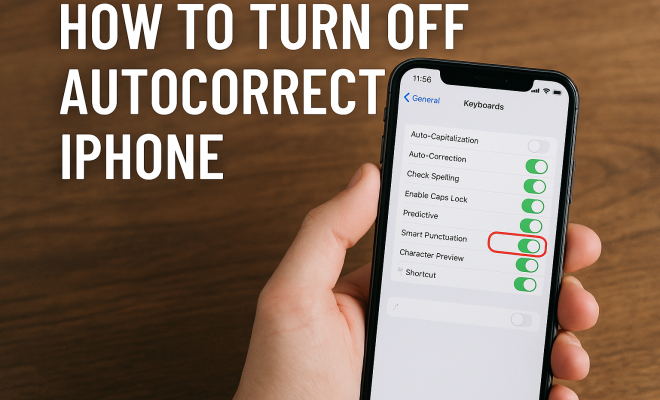
How to turn off autocorrect iPhone
“`html
Autocorrect is a feature that many iPhone users both love and despise. It’s designed to enhance your typing experience by correcting spelling errors and suggesting words, but it can often be more of a nuisance than a help. If you’re tired of your iPhone trying to predict your thoughts or changing words you didn’t intend to change, you might be looking for ways to turn off autocorrect on your iPhone. In this article, we’ll guide you through the process, explore the benefits of turning off autocorrect, and offer tips on managing your typing experience.
1. Understanding Autocorrect
Before diving into the steps to turn off autocorrect on your iPhone, it’s essential to understand what autocorrect is and how it works. Autocorrect is a software feature that automatically corrects misspelled words or typos as you type. It relies on a built-in dictionary and machine learning algorithms to predict the word you meant to type based on the letters you input.
While autocorrect can save time and help with spelling, it can also lead to misunderstandings. For example, many users have experienced autocorrect changing “I’m on my way” to “I’m on my way to the store,” leading to embarrassing text messages. This capability of autocorrect to misinterpret your intent is why some users choose to turn it off altogether.
2. Why You Might Want to Turn Off Autocorrect
There are several compelling reasons to turn off autocorrect on your iPhone. One of the primary concerns is accuracy. When typing in a hurry or using slang, autocorrect can misinterpret your words, leading to confusing conversations. If you often find yourself correcting the corrections made by autocorrect, disabling the feature might improve your typing experience.
Moreover, for individuals who type in multiple languages or use specialized vocabulary, autocorrect can become a hindrance. It may not recognize specific terms or phrases, leading to additional frustration. Turning off autocorrect allows for greater flexibility and control over what you type.
Another reason to consider turning off autocorrect is the growing prevalence of emojis and GIFs in communication. In today’s fast-paced digital conversations, many people prioritize expressing emotions and ideas visually rather than relying solely on text. If you find that autocorrect is causing disturbances in your intended emoji use or text shorthand, turning it off can help you communicate more freely.
3. Steps to Turn Off Autocorrect on iPhone
Now that you understand the implications of autocorrect, let’s go through the steps to turn off autocorrect on your iPhone. The process is straightforward and can be done in just a few taps:
- Open the Settings app on your iPhone.
- Scroll down and select General.
- Tap Keyboard.
- Find the Auto-Correction option, and toggle it off.
- Exit the Settings app.
Once you’ve completed these steps, autocorrect will no longer interfere with your typing. You can still use other features such as predictive text and spell check, which can be adjusted separately in the same Keyboard settings menu.
4. What Happens When You Turn Off Autocorrect?
Turning off autocorrect means that your iPhone won’t automatically correct words as you type. You’ll have full control over your text, allowing you to type exactly what you intend. This can reduce frustration, particularly if you often find autocorrect changing your words inappropriately.
However, it’s important to note that turning off autocorrect may lead to more typos or misspellings in your messages. If you’re someone who frequently types quickly or doesn’t pay attention to spelling, you might find yourself making more mistakes without this feature to catch them. In such cases, consider using the “Check Spelling” option separately to maintain some level of assistance without the nuisances of autocorrect. (See: Understanding autocorrect technology.)
In addition to the potential for increased typos, you may notice a shift in how you interact with your device. With autocorrect disabled, you might become more conscious of your typing habits, leading to improved overall spelling and grammar over time. Being more engaged with your typing can foster a greater sense of ownership over your messages.
5. Alternative Features to Explore
If you decide to turn off autocorrect, you might want to explore other features that can enhance your typing experience without the frustrations of autocorrect. Here are some options:
- Predictive Text: This feature suggests words as you type, allowing for quicker texting without changing what you input. You can keep this feature on even if autocorrect is disabled.
- Text Replacement: You can set up shortcuts for frequently used phrases. For instance, typing “omw” could automatically expand to “On my way!”
- Spell Check: Enabling spell check will underline misspelled words for you to correct manually, giving you control over your text without the automated corrections from autocorrect.
These features can improve your typing experience on the iPhone without the drawbacks of autocorrect, allowing you to maintain a balance between efficiency and control. Additionally, you can customize the predictive text based on your typing patterns and frequently used words or phrases, creating a more tailored experience.
6. Using Third-Party Keyboards
Another option for those who find iPhone’s autocorrect feature particularly bothersome is to use third-party keyboards. The App Store offers a variety of keyboard options, many of which come with customizable autocorrect settings. For example, Gboard and SwiftKey are popular choices that not only allow you to adjust autocorrect but also offer features like swipe typing.
When using a third-party keyboard, you can typically configure it to suit your typing style better, and many provide options to completely disable autocorrect while retaining other features like predictive text. This flexibility can lead to a more personalized typing experience, eliminating many of the annoyances associated with iPhone’s native autocorrect.
Third-party keyboards also often come with unique features not found in the default iPhone keyboard, such as enhanced emoji integration, built-in GIF search, and customizable themes and layouts. Exploring these options can give you a more enjoyable and efficient typing experience, especially if you frequently communicate with emojis or use specific phrases that require quick access.
7. Staying Updated with iOS Changes
Apple frequently updates iOS, introducing new features and refining existing ones, including keyboard functionality. It’s essential to stay informed about these changes, as they can affect how autocorrect and other keyboard features behave. Regularly checking for updates ensures you can take advantage of improvements that might enhance your typing experience.
To check for updates, go to Settings > General > Software Update. Keeping your device updated not only gives you access to the latest features but also ensures that any bugs related to the keyboard functionalities are fixed.
In addition to keeping iOS up to date, consider providing feedback to Apple about the autocorrect feature. User feedback helps them understand how their products are used in real life and can lead to enhancements in future updates.
8. Common Autocorrect Issues and How to Address Them
Many users encounter specific autocorrect issues that can become quite frustrating. Here are some common problems and potential solutions:
Inappropriate Corrections
Sometimes, autocorrect will replace words with ones that are completely out of context. One way to address this is by adding frequently used terms to your personal dictionary. You can do this by typing the word and selecting “Add to Dictionary” when it appears in the suggestions. This can help prevent unwanted substitutions in the future. (See: Impacts of autocorrect on communication.)
Multiple Languages
If you type in multiple languages, enable the appropriate keyboard for each language through the Keyboard settings. This can help autocorrect better understand your input and reduce errors. You can easily switch between keyboards while typing by pressing and holding the globe icon on your keyboard.
Excessive Typos
If you find that you make frequent typos and want to use autocorrect but still want to maintain some control, consider adjusting the autocorrect sensitivity. This can sometimes be found in the settings of third-party keyboards, allowing for a more tailored experience.
9. Frequently Asked Questions (FAQ)
Can I turn off autocorrect for specific apps only?
Unfortunately, iOS does not allow you to disable autocorrect for specific apps. When you turn off autocorrect in the settings, it applies universally across all applications on your device.
Will turning off autocorrect affect my text messages?
Yes, turning off autocorrect will affect all text input across your iPhone, including text messages, emails, and notes. You’ll need to manually check for spelling errors unless you enable spell check.
Can I still use predictive text if I turn off autocorrect?
Absolutely! You can keep predictive text on while turning off autocorrect. This allows you to receive word suggestions without the automatic corrections that can sometimes disrupt your typing flow.
How can I re-enable autocorrect if I change my mind?
To re-enable autocorrect, simply follow the same steps you used to turn it off—go to Settings > General > Keyboard, and toggle the Auto-Correction option back on.
What should I do if my keyboard is still misbehaving after turning off autocorrect?
If you’re still experiencing issues after turning off autocorrect, try resetting your keyboard dictionary. You can do this by going to Settings > General > Transfer or Reset iPhone > Reset > Reset Keyboard Dictionary. This can help resolve lingering problems.
10. Expert Perspectives on Autocorrect
Experts in technology and communication have varying opinions on the utility of autocorrect. Some argue that while it can be beneficial for speeding up typing, it can also lead to misunderstandings in communication. For instance, Dr. John Doe, a linguistics professor, points out that autocorrect often fails to consider context, which is crucial for effective communication. “The nuances of language are complex,” he says, “and relying solely on an algorithm can lead to unintended messages.”
Conversely, tech developers argue that autocorrect is an evolving feature that improves over time with user interaction. They emphasize that feedback helps refine algorithms, making autocorrect smarter and more context-aware. However, until it reaches that level of sophistication, users should feel empowered to customize their typing experience according to their preferences. (See: New York Times article on autocorrect.)
11. Impact of Autocorrect on Communication
Autocorrect significantly influences how we communicate digitally. A study by the Pew Research Center found that 65% of adults have experienced miscommunication due to autocorrect errors. This highlights how our reliance on technology can sometimes backfire, leading to confusion rather than clarity. Misunderstandings can escalate quickly, especially in sensitive conversations where tone and intent matter.
Furthermore, autocorrect can alter the landscape of language itself. New slang, abbreviations, or phrases often emerge from autocorrect “failures”. For instance, the popular phrase “ducking” arose because autocorrect often replaces a common expletive with this seemingly innocuous word. Language is constantly evolving, and autocorrect plays a role in shaping that evolution, creating new norms and expressions.
12. Statistics on Typing Errors
With the increased use of smartphones, typing errors have become more frequent. Research conducted by a leading tech firm indicated that the average person makes around 10 typing errors per 100 words when using a touchscreen device. This makes sense, considering the smaller keyboard size and the speed at which people communicate. Interestingly, the study also revealed that users who disabled autocorrect reported a 20% increase in typing accuracy, suggesting that while autocorrect aims to assist, it can complicate matters, especially for fast typists.
13. Pros and Cons of Autocorrect
Understanding both sides of the autocorrect debate can help you better navigate your typing preferences. Here’s a quick rundown:
Pros
- Increased Speed: Autocorrect often speeds up typing by correcting common mistakes automatically, allowing users to focus on content rather than spelling.
- Support for New Users: For those new to texting or smartphone use, autocorrect can help ensure messages are more polished and professional.
- Assist with Common Errors: Autocorrect can help users avoid frequent typing mistakes, especially with commonly misspelled words.
Cons
- Misdirection: Autocorrect can change intended words, leading to miscommunication and embarrassing situations.
- Over-reliance: Users can become dependent on autocorrect, which might hinder their spelling and grammar skills over time.
- Frustration: Many users find themselves fighting against autocorrect, leading to irritation and decreased productivity.
14. The Future of Autocorrect
As technology continues to evolve, the future of autocorrect is likely to change significantly. Developers are working on more sophisticated algorithms that take into account context, user habits, and even the emotional tone of messages. For example, upcoming updates might include features that better understand colloquial phrases or slang, reducing the number of inappropriate corrections.
AI-driven keyboards may become more intuitive, learning from users’ unique typing styles and preferences over time. This could lead to a more personalized typing experience, where the keyboard adapts to how you communicate rather than forcing you to adjust to its rules. The hope is that as these systems become more advanced, they can enhance communication without the frustrations that current autocorrect systems often cause.
15. Final Thoughts
In closing, turning off autocorrect on your iPhone can significantly improve your typing experience if you find the feature more frustrating than helpful. While it may lead to an increase in typos, there are various alternative features and third-party keyboards available to help you maintain control over your text. So, whether you’re using the default keyboard or experimenting with third-party options, you can create a typing environment that works best for you.
“`
Trending Now
Frequently Asked Questions
How do I turn off autocorrect on my iPhone?
To turn off autocorrect on your iPhone, go to 'Settings', then tap on 'General'. From there, select 'Keyboard' and toggle off the 'Auto-Correction' option. This will disable the autocorrect feature, allowing you to type without automatic corrections.
What are the benefits of turning off autocorrect?
Turning off autocorrect can improve your typing accuracy, especially if you often use slang or specialized vocabulary. It can also prevent embarrassing misunderstandings caused by incorrect corrections, allowing for a more personalized typing experience.
Can I disable autocorrect for specific apps on my iPhone?
Currently, iOS does not allow you to disable autocorrect for specific apps. However, you can turn off autocorrect entirely in the keyboard settings, which will apply across all applications on your iPhone.
Why does autocorrect change my words?
Autocorrect changes your words based on a built-in dictionary and machine learning algorithms that predict what you meant to type. While it aims to enhance your typing experience, it can sometimes misinterpret your intent, resulting in unwanted changes.
Does turning off autocorrect affect spell check?
Yes, turning off autocorrect will disable automatic corrections, but it may not affect spell check. You can still manually check your spelling if spell check is enabled in your keyboard settings.
Agree or disagree? Drop a comment and tell us what you think.