The Tech Edvocate

Top Menu

  • Advertisement
  • Apps
  • Home Page
  • Home Page Five (No Sidebar)
  • Home Page Four
  • Home Page Three
  • Home Page Two
  • Home Tech2
  • Icons [No Sidebar]
  • Left Sidbear Page
  • Lynch Educational Consulting
  • My Account
  • My Speaking Page
  • Newsletter Sign Up Confirmation
  • Newsletter Unsubscription
  • Our Brands
  • Page Example
  • Privacy Policy
  • Protected Content
  • Register
  • Request a Product Review
  • Shop
  • Shortcodes Examples
  • Signup
  • Start Here
    • Governance
    • Careers
    • Contact Us
  • Terms and Conditions
  • The Edvocate
  • The Tech Edvocate Product Guide
  • Topics
  • Write For Us
  • Advertise

Main Menu

  • Start Here
    • Our Brands
    • Governance
      • Lynch Educational Consulting, LLC.
      • Dr. Lynch’s Personal Website
      • Careers
    • Write For Us
    • The Tech Edvocate Product Guide
    • Contact Us
    • Books
    • Edupedia
    • Post a Job
    • The Edvocate Podcast
    • Terms and Conditions
    • Privacy Policy
  • Topics
    • Assistive Technology
    • Child Development Tech
    • Early Childhood & K-12 EdTech
    • EdTech Futures
    • EdTech News
    • EdTech Policy & Reform
    • EdTech Startups & Businesses
    • Higher Education EdTech
    • Online Learning & eLearning
    • Parent & Family Tech
    • Personalized Learning
    • Product Reviews
  • Advertise
  • Tech Edvocate Awards
  • The Edvocate
  • Pedagogue
  • School Ratings

logo

The Tech Edvocate

  • Start Here
    • Our Brands
    • Governance
      • Lynch Educational Consulting, LLC.
      • Dr. Lynch’s Personal Website
        • My Speaking Page
      • Careers
    • Write For Us
    • The Tech Edvocate Product Guide
    • Contact Us
    • Books
    • Edupedia
    • Post a Job
    • The Edvocate Podcast
    • Terms and Conditions
    • Privacy Policy
  • Topics
    • Assistive Technology
    • Child Development Tech
    • Early Childhood & K-12 EdTech
    • EdTech Futures
    • EdTech News
    • EdTech Policy & Reform
    • EdTech Startups & Businesses
    • Higher Education EdTech
    • Online Learning & eLearning
    • Parent & Family Tech
    • Personalized Learning
    • Product Reviews
  • Advertise
  • Tech Edvocate Awards
  • The Edvocate
  • Pedagogue
  • School Ratings
  • The Shocking Truth: ESG Training Programs Are Quietly Reshaping Your Career Path

  • Why Millions of People Are Switching to These Green Energy Certifications Right Now

  • The green skills gap in 2026: How to address this growing problem

  • The Shocking Truth: Your Degree Won’t Land You the Best IT Jobs in 2026

  • The Brutal Truth About Degrees: Why Micro-Credentials Are Quietly Dominating Careers by 2026

  • Why 96% of Employers Now Prefer Skills Over Degrees: The Micro-Credential Revolution

  • This Crucial Mistake With AI Is Stunting Student Minds: Here’s How to Fix It

  • The AI ‘Cognitive Surrender’ Crisis: 7 Tools Every Educator Needs NOW

  • This Crucial Mistake Is Quietly Killing Students’ Brains, Says MIT

  • The Sneaky Truth About RTO: How to Negotiate Flexible Work Without Losing Your Job

Digital & Mobile Technology
Home›Digital & Mobile Technology›16-Bit vs. 24-Bit vs. 32-Bit Audio

16-Bit vs. 24-Bit vs. 32-Bit Audio
By Matthew Lynch
June 12, 2023
0
Spread the love

As music lovers, we all want to experience the highest possible audio quality for our favorite tunes. The quality of your audio files can make the difference between an average sound and a breathtaking one. With the advent of digital audio, the talk of bits and audio resolutions become essential to understand. In this article, we’ll distinguish the differences between the most popular audio resolutions: 16-bit, 24-bit, and 32-bit audio.

What Are Audio Bits?

First, let’s clarify that audio bits are a measure of audio resolution. An audio file is made up of individual pieces of data called samples or audio frames. A bit is the smallest unit of digital audio data that can be recorded or processed in audio production. Each audio file gets broken down into a stream of bits, which correspond to the loudness levels, Hz frequencies, and left/right balance of the sound.

16-Bit Audio

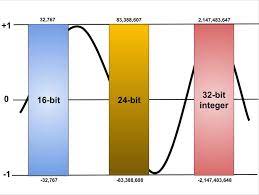
When CDs were first introduced back in the 1980s, they offered 16-bit audio resolution, which meant there were 65,536 levels of loudness that could be recorded. This produced a relatively high-quality audio sound, which was still miles ahead of analog tapes in terms of clarity and sound quality.

16-bit audio is still quite common and is used in most popular audio file formats like MP3, WMA, and FLAC. It’s ample for streaming services and mobile devices for daily usage. While the quality is better than many analog recordings, some audiophiles and recording studios believe it is the bare minimum audio quality.

24-Bit Audio

24-bit audio is typically reserved for higher-end audio mastering and recording. The audio performs at double the resolution of 16-bit audio, which equates to 16.7 million possible levels of loudness. The audio quality is more refined, and the audio file size is more significant than 16-bit audio as it gives audio engineers more room to manipulate sound during the mixing and mastering process.

The audio retains a more dynamic range, and the sound is generally seen as more natural and clearer than 16-bit audio. However, these audio files are often traded off by file size, as they tend to be large.

32-Bit Audio

32-bit audio is commonly leveraged in specialized audio production and restoration processes. They are often used to capture even the slightest of audio details, and the audio quality is unrivaled. A 32-bit audio file has a resolution that is 256 times larger than 16-bit audio, making it the highest possible audio format available.

However, the need for 32-bit audio files is often niche and limited to professional audio engineers or sound editors, so there isn’t much need for them on a consumer level.

Wrap Up

In summary, your choice of audio depends on your needs, resources, and level of expertise. 16-bit audio files are suitable for casual music lovers, while 24-bit audio files offer excellent sound quality for music producers and professionals in the music industry.

It’s essential to note that the quality of the audio isn’t dependant on the bit rate alone, but on other factors like the recording device, microphone, and the studio equipment. In conclusion, the sound quality you get from an audio depends on a range of factors and not just the bit rate, but it is still essential to understand the differences between them when making your choice.


Previous Article

How to Put Your PS5 DualSense Controller ...

Next Article

Ways to Permanently Disable Microsoft Defender in ...

Matthew Lynch

Related articles More from author

  • Digital & Mobile Technology

    How Does Snapchat Score Work? How to Increase Your Score

    June 7, 2023
    By Matthew Lynch
  • Digital & Mobile Technology

    Spotify Is Discontinuing Duo Mix: Here’s What You Need to Know

    June 12, 2023
    By Matthew Lynch
  • Digital & Mobile Technology

    How to Fix a Broken Charger

    June 1, 2023
    By Matthew Lynch
  • Digital & Mobile Technology

    Addictive Logo Games and Quizzes

    June 9, 2023
    By Matthew Lynch
  • Digital & Mobile Technology

    How to Change a Windows 10 Login Screen

    June 6, 2023
    By Matthew Lynch
  • Digital & Mobile Technology

    Best Free Remote Access Software Tools

    May 30, 2023
    By Matthew Lynch

Search

Login & Registration

  • Log in
  • Entries feed
  • Comments feed
  • WordPress.org

Newsletter

Signup for The Tech Edvocate Newsletter and have the latest in EdTech news and opinion delivered to your email address!

About Us

Since technology is not going anywhere and does more good than harm, adapting is the best course of action. That is where The Tech Edvocate comes in. We plan to cover the PreK-12 and Higher Education EdTech sectors and provide our readers with the latest news and opinion on the subject. From time to time, I will invite other voices to weigh in on important issues in EdTech. We hope to provide a well-rounded, multi-faceted look at the past, present, the future of EdTech in the US and internationally.

We started this journey back in June 2016, and we plan to continue it for many more years to come. I hope that you will join us in this discussion of the past, present and future of EdTech and lend your own insight to the issues that are discussed.

Newsletter

Signup for The Tech Edvocate Newsletter and have the latest in EdTech news and opinion delivered to your email address!

Contact Us

The Tech Edvocate
910 Goddin Street
Richmond, VA 23231
(601) 630-5238
[email protected]

Copyright © 2026 Matthew Lynch. All rights reserved.