The Tech Edvocate

Top Menu

  • Advertisement
  • Apps
  • Home Page
  • Home Page Five (No Sidebar)
  • Home Page Four
  • Home Page Three
  • Home Page Two
  • Home Tech2
  • Icons [No Sidebar]
  • Left Sidbear Page
  • Lynch Educational Consulting
  • My Account
  • My Speaking Page
  • Newsletter Sign Up Confirmation
  • Newsletter Unsubscription
  • Our Brands
  • Page Example
  • Privacy Policy
  • Protected Content
  • Register
  • Request a Product Review
  • Shop
  • Shortcodes Examples
  • Signup
  • Start Here
    • Governance
    • Careers
    • Contact Us
  • Terms and Conditions
  • The Edvocate
  • The Tech Edvocate Product Guide
  • Topics
  • Write For Us
  • Advertise

Main Menu

  • Start Here
    • Our Brands
    • Governance
      • Lynch Educational Consulting, LLC.
      • Dr. Lynch’s Personal Website
      • Careers
    • Write For Us
    • The Tech Edvocate Product Guide
    • Contact Us
    • Books
    • Edupedia
    • Post a Job
    • The Edvocate Podcast
    • Terms and Conditions
    • Privacy Policy
  • Topics
    • Assistive Technology
    • Child Development Tech
    • Early Childhood & K-12 EdTech
    • EdTech Futures
    • EdTech News
    • EdTech Policy & Reform
    • EdTech Startups & Businesses
    • Higher Education EdTech
    • Online Learning & eLearning
    • Parent & Family Tech
    • Personalized Learning
    • Product Reviews
  • Advertise
  • Tech Edvocate Awards
  • The Edvocate
  • Pedagogue
  • School Ratings

logo

The Tech Edvocate

  • Start Here
    • Our Brands
    • Governance
      • Lynch Educational Consulting, LLC.
      • Dr. Lynch’s Personal Website
        • My Speaking Page
      • Careers
    • Write For Us
    • The Tech Edvocate Product Guide
    • Contact Us
    • Books
    • Edupedia
    • Post a Job
    • The Edvocate Podcast
    • Terms and Conditions
    • Privacy Policy
  • Topics
    • Assistive Technology
    • Child Development Tech
    • Early Childhood & K-12 EdTech
    • EdTech Futures
    • EdTech News
    • EdTech Policy & Reform
    • EdTech Startups & Businesses
    • Higher Education EdTech
    • Online Learning & eLearning
    • Parent & Family Tech
    • Personalized Learning
    • Product Reviews
  • Advertise
  • Tech Edvocate Awards
  • The Edvocate
  • Pedagogue
  • School Ratings
  • Miro vs Conceptboard for project management

  • How to use Teamwork for resource management

  • How much does Procore cost per month

  • How to organize Microsoft Planner buckets

  • Is Teamwork good for billable hours

  • Procore vs Buildertrend which is better

  • Airtable project management templates

  • Can Miro track project progress

  • How to use Basecamp for client work

  • Can Lucidchart create swimlane diagrams

Tech News
Home›Tech News›Yeast Survives Mars-like Conditions in 2026 Study

Yeast Survives Mars-like Conditions in 2026 Study
By Matthew Lynch
April 12, 2026
0
Spread the love

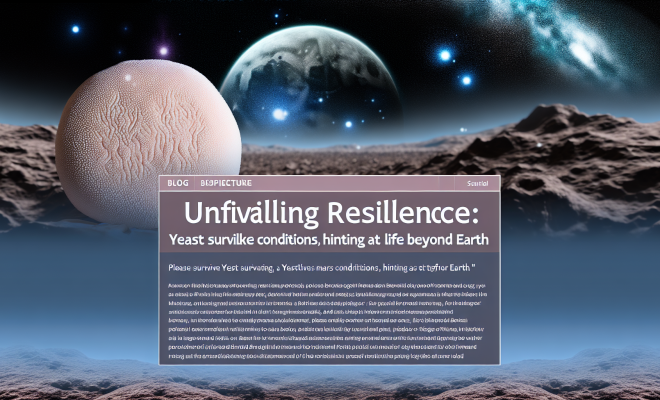
In a groundbreaking study published in PNAS Nexus on April 12, 2026, researchers led by Purusharth I. Rajyaguru have unveiled a remarkable resilience of life under conditions analogous to those found on Mars. The focus of their investigation was the Saccharomyces cerevisiae yeast, a simple unicellular organism that has now demonstrated an unexpected capacity to endure extreme environmental challenges that mimic the Martian landscape.

The Challenge of Mars-like Conditions

Mars, known for its inhospitable climate, presents numerous challenges for the survival of life. Among these are the constant bombardment by meteorites and the presence of toxic salts, particularly sodium perchlorate (NaClO4). This salt is notorious for disrupting essential biological processes by interfering with hydrogen bonds and hydrophobic interactions in proteins, leading to cellular dysfunction.

In their experiment, Rajyaguru and his team subjected Saccharomyces cerevisiae to shock waves akin to those produced by meteorite impacts, alongside exposure to a high concentration of 100 mM sodium perchlorate. The goal was to assess whether this simple yeast could withstand such harsh conditions, potentially offering insights into the resilience of microbial life on Mars.

Methodology and Findings

The research team meticulously designed their experiments to replicate the Martian environment as closely as possible. They first exposed the yeast to shock waves that simulated the impact of meteorites, assessing the organisms’ ability to maintain cellular integrity under extreme mechanical strain. Following this, they introduced the yeast to the toxic sodium perchlorate in a controlled soil environment.

Remarkably, the Saccharomyces cerevisiae not only survived these tests but also exhibited signs of resilience that are strikingly similar to those seen in more complex life forms. The yeast maintained its cellular functions, effectively adapting to the stresses imposed by both the shock waves and the toxic soil conditions.

Biological Significance of the Findings

The implications of these findings are profound, suggesting that if such simple organisms can survive the extreme conditions of Mars, then the possibility of life—especially microbial life—existing on the Red Planet is more plausible than previously thought. This research adds to the growing body of evidence that life may not be as fragile as once believed, enduring in environments previously deemed uninhabitable.

  • Resilience to Shock Waves: The yeast’s ability to withstand meteorite-like impacts suggests adaptations that could be critical for survival in extraterrestrial environments.
  • Tolerance to Toxic Salts: The survival against sodium perchlorate highlights potential biochemical pathways that enable life to cope with toxic compounds.
  • Implications for Astrobiology: These findings provide a basis for further exploration of microbial life in extreme conditions, not just on Mars but also on other celestial bodies.

Broader Implications for Astrobiology

This research opens new avenues in astrobiology, prompting scientists to reconsider the types of organisms that may thrive in extraterrestrial habitats. The resilience displayed by Saccharomyces cerevisiae could also inform our search for life on moons like Europa and Enceladus, where subsurface oceans may harbor similar microbial communities.

The study also emphasizes the importance of extremophiles—organisms that thrive in extreme conditions—in understanding the limits of life. As researchers continue to investigate these resilient organisms, they may uncover further adaptations that allow life to exist in seemingly inhospitable environments.

Future Research Directions

Following the encouraging results of this study, the next steps will likely involve exploring the genetic and biochemical mechanisms that confer such resilience to Saccharomyces cerevisiae. Understanding these mechanisms could lead to advancements in biotechnology, including the development of organisms capable of thriving in conditions that mimic those on Mars.

Moreover, this research could pave the way for future missions to Mars, where scientists can look for signs of life in the soil and atmosphere, testing the hypothesis that microbial life could potentially exist beneath the planet’s surface. The findings underscore the importance of continued exploration and research into how life can endure in the most extreme environments.

Conclusion

The study conducted by Rajyaguru and colleagues marks a significant step in our understanding of life’s potential resilience in the universe. As we continue to unravel the mysteries of Mars and other celestial bodies, the survival of Saccharomyces cerevisiae under Mars-like conditions provides a compelling argument for the existence of life beyond Earth. With each new discovery, we move closer to answering the age-old question: Are we alone in the universe?


Previous Article

Global Weather Update 2026: Climate Trends & ...

Next Article

Altoona Adult Education Thrives with $474K Investment ...

Matthew Lynch

Related articles More from author

  • Tech News

    Zapier free vs paid plans

    August 5, 2026
    By Matthew Lynch
  • Tech News

    How to create montage in Premiere Pro

    July 19, 2026
    By Matthew Lynch
  • Tech News

    AI vs. Truth: Boost Your Fact-Checking Skills in 2026

    April 2, 2026
    By Matthew Lynch
  • Tech News

    All Whites Dominate Chile 4-1; O’Rourke’s Inspiring Comeback in 2026

    March 31, 2026
    By Matthew Lynch
  • Tech News

    Top Global Health Questions: Stress, Diet & Mental Well-being

    June 12, 2026
    By Matthew Lynch
  • Tech News

    Infuriating: Esports Star’s AI Cheat Rocks Valorant Pro Scene – A Lifetime Ban Isn’t Enough?

    August 11, 2026
    By Matthew Lynch

Search

Login & Registration

  • Log in
  • Entries feed
  • Comments feed
  • WordPress.org

Newsletter

Signup for The Tech Edvocate Newsletter and have the latest in EdTech news and opinion delivered to your email address!

About Us

Since technology is not going anywhere and does more good than harm, adapting is the best course of action. That is where The Tech Edvocate comes in. We plan to cover the PreK-12 and Higher Education EdTech sectors and provide our readers with the latest news and opinion on the subject. From time to time, I will invite other voices to weigh in on important issues in EdTech. We hope to provide a well-rounded, multi-faceted look at the past, present, the future of EdTech in the US and internationally.

We started this journey back in June 2016, and we plan to continue it for many more years to come. I hope that you will join us in this discussion of the past, present and future of EdTech and lend your own insight to the issues that are discussed.

Newsletter

Signup for The Tech Edvocate Newsletter and have the latest in EdTech news and opinion delivered to your email address!

Contact Us

The Tech Edvocate
910 Goddin Street
Richmond, VA 23231
(601) 630-5238
[email protected]

Copyright © 2026 Matthew Lynch. All rights reserved.