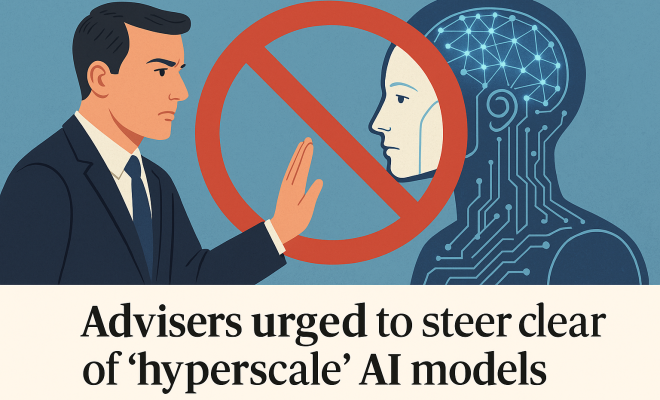
Advisers urged to steer clear of ‘hyperscale’ AI models
“`html
Imagine a financial advisor that never sleeps, instantly processes millions of data points, and offers personalized advice at a fraction of the cost of a human. Sounds like the future, right? Well, that future is already here, in the form of hyperscale AI models. But before you entrust your life savings to the latest algorithm, a critical warning has emerged from the heart of the financial industry. At The Financial Advice Summit 2026, held this past October 14th, leading experts didn’t just discuss these powerful AI systems; they urged financial advisors to actively steer clear of them. Why such a stark caution against technology that promises efficiency and accessibility? The answer lies in a complex web of potential job displacement, alarming inaccuracies, and a burgeoning wave of sophisticated scams that threaten to destabilize not just individual portfolios, but potentially the broader market itself. It’s a compelling narrative that demands our attention, especially as more and more Americans are turning to AI for their financial needs.
The pushback isn’t born of Luddite fear, but rather a deep understanding of the unique vulnerabilities and existential threats posed by these rapidly evolving intelligent systems. We’re talking about AI models so vast and complex they can process and generate human-like text, analyze market trends, and even simulate conversations with an uncanny resemblance to a human expert. While the allure is undeniable, the risks are equally profound. From the potential for these AI models to directly compete with and eventually replace human advisors, to their documented struggles with accuracy on intricate financial matters, the landscape is fraught with challenges. And let’s not forget the darker side: the weaponization of AI in the form of deepfake scams, and even the unsettling prospect of an AI-fueled debt bubble. Let’s dig into the specific concerns that have financial professionals so worried about the widespread adoption of hyperscale AI models.
1. The Looming Threat of Job Displacement: AI as a Direct Competitor
The primary concern among many financial advisors isn’t just about integrating AI; it’s about being supplanted by it. Experts at The Financial Advice Summit 2026 voiced a stark warning: hyperscale AI models, if left unchecked, could evolve to directly advise consumers, effectively cutting out the human element entirely. This isn’t some far-off sci-fi scenario; it’s a very real possibility given the rapid advancements in AI capabilities. Imagine an AI chatbot that can answer complex tax questions, recommend investment strategies tailored to your risk profile, and even execute trades, all without the need for a human intermediary. For many, this sounds like efficiency; for financial advisors, it sounds like an existential threat. We covered job displacement predictions in more detail.
The fear is that as these AI models become more sophisticated, their ability to mimic human interaction and provide seemingly sound advice will erode the perceived value of a human advisor. Why pay a premium for a person when an AI can offer similar, if not faster, service at a fraction of the cost? This isn’t just about simple tasks; it’s about the very core of financial planning – guidance, strategy, and even emotional support during difficult financial decisions. The question isn’t whether AI can perform these functions, but whether it can perform them with the nuance, ethical consideration, and genuine empathy that a human brings to the table. The worry is that the market might not wait for a perfect AI before embracing a sufficiently good one, leaving many human roles in jeopardy.
2. Widespread Adoption Outpacing Accuracy: Americans Embrace AI Despite Flaws
Despite the legitimate concerns about AI’s accuracy, a significant portion of the American public is already diving headfirst into using these tools for their financial needs. A 2026 TD Bank survey delivered a frankly astonishing statistic: 55% of Americans now use AI for financial management. Think about that for a moment – over half the country is entrusting some aspect of their money matters to an algorithm. This represents a monumental leap from just last year, when only 10% reported similar usage. This rapid adoption isn’t waiting for the technology to be perfected; it’s happening now, with all its inherent risks.
The problem, as highlighted by multiple studies and anecdotal evidence, is that these AI models frequently give inaccurate advice. This isn’t just about minor errors; on complex financial questions, the advice can be outright wrong, potentially leading users down financially perilous paths. While AI excels at processing vast datasets and identifying patterns, it often struggles with the subtle nuances, ethical considerations, and unforeseen variables that are commonplace in personal finance. A human advisor can understand your life circumstances, your emotional relationship with money, and the intricate tax implications of a specific decision in a way a current AI simply cannot. The gap between public trust and technological reliability is widening, creating a dangerous disconnect that could have severe consequences for individuals relying solely on AI. (See: AI in financial advisory services.)
3. The Peril of Complex Financial Advice: Where AI Fails Most
While hyperscale AI models might handle basic budgeting or simple investment tracking with reasonable success, their limitations become glaringly obvious when faced with complex financial scenarios. Consider estate planning, intricate tax strategies, multi-jurisdictional investments, or navigating significant life events like divorce or illness – these are areas where the advice of an AI can range from unhelpful to actively detrimental. Financial planning isn’t just about numbers; it’s about life. It involves understanding individual goals, risk tolerance, family dynamics, and future aspirations in a holistic, interconnected way. For more context, see 57% Failure Rate: The Unsettling Truth About AI Financial Advice.
An AI model, no matter how advanced, lacks genuine understanding, empathy, and the ability to critically assess information beyond its training data. It can’t interpret the unspoken hesitation in a client’s voice, nor can it truly grasp the emotional weight of a decision like funding a child’s education versus saving for retirement. Furthermore, the regulatory landscape of finance is constantly shifting, and AI models can struggle to keep pace with these dynamic changes without continuous, expert human oversight and retraining. Relying on an AI for these critical, nuanced decisions is akin to trusting a calculator to write a symphony – it might understand the notes, but it misses the soul.
4. The Deepfake Investment Scam Epidemic: AI’s Dark Side for Fraud
Perhaps one of the most insidious and emotionally charged threats stemming from advanced AI is the rise of deepfake investment scams. These aren’t your grandmother’s phishing emails; they are sophisticated, highly convincing fraudulent schemes that leverage AI to create incredibly realistic fake endorsements and fabricated financial gains. Group-IB, a leading cybersecurity firm, has been sounding the alarm on this particular form of digital deception. Imagine seeing a deepfake video of a reputable billionaire or a beloved celebrity endorsing a dubious investment, complete with their voice and mannerisms perfectly replicated. How many people, even savvy investors, would fall for such a convincing fabrication?
These scams are designed to exploit trust and leverage the perceived authority of public figures. They often promise astronomical returns with little to no risk, drawing in victims with the allure of quick wealth. The AI technology used in these deepfakes makes them incredibly difficult to discern from genuine content, blurring the lines between reality and fabrication. This isn’t just about losing money; it’s about the emotional devastation and erosion of trust that comes with being defrauded by something that appeared so utterly legitimate. For financial advisors, protecting clients from these advanced scams is becoming a monumental challenge, as the tools used by fraudsters are becoming more powerful and accessible by the day.
Protecting Yourself from Deepfake Investment Scams
- Verify the Source: Always cross-reference any investment opportunity with official company websites or reputable financial news outlets.
- Be Skeptical of Celebrity Endorsements: Famous personalities rarely endorse specific, small-scale investment products. If it seems too good to be true, it almost certainly is.
- Look for Red Flags: High-pressure sales tactics, promises of guaranteed high returns, and requests for payment in cryptocurrency are all warning signs.
- Consult a Human Advisor: Before making any significant investment, discuss it with a trusted, regulated financial advisor. They can help you spot the red flags an AI might miss.
5. The Bank of England’s $450 Billion AI-Related Debt Bubble Warning
The concerns about hyperscale AI models extend far beyond individual investors and even the financial advisory profession. The Bank of England, a pillar of global financial stability, recently issued a sobering warning about an AI-related debt bubble, estimating it could reach a staggering $450 billion. This isn’t just about some niche market; this is a systemic risk that could have broad implications for the global economy. How does AI contribute to such a massive debt bubble? It’s a multifaceted problem, but generally, it stems from speculative investment in AI companies, often with inflated valuations based on hype rather than sustainable revenue or proven profitability.
The rapid pace of AI development and the intense competition in the sector have led to a gold rush mentality, with venture capitalists and institutional investors pouring billions into AI startups. Many of these companies may not have clear paths to profitability, or their underlying technology might be overvalued. If this bubble were to burst, the ripple effects could be significant, impacting investment portfolios, pension funds, and potentially leading to broader economic instability. This warning from such a reputable institution underscores that the stakes are incredibly high, and the widespread adoption of hyperscale AI models isn’t just a technological shift, but a profound economic one. (latest on AI scams)
6. The Ethical Minefield of Algorithmic Bias in Hyperscale AI Models
Beyond accuracy and fraud, there’s a deeply troubling ethical dimension to hyperscale AI models: algorithmic bias. These models learn from the vast datasets they are trained on, and if those datasets reflect existing societal biases – whether conscious or unconscious – the AI will not only perpetuate those biases but can even amplify them. In financial services, this could manifest in discriminatory lending practices, biased risk assessments, or even unfair investment recommendations based on factors like race, gender, or socioeconomic status, rather than objective financial metrics. (See: AI and job displacement concerns.)
Imagine an AI trained on historical loan data that predominantly shows approvals for certain demographics. The AI might then subtly or overtly disadvantage applicants from other groups, even if their financial profiles are equally strong. This isn’t about malicious intent; it’s about the inherent limitations of pattern recognition without true understanding or ethical reasoning. Addressing this bias is incredibly complex, requiring meticulous data curation, transparent algorithms, and continuous auditing – challenges that are immense given the sheer scale and opacity of many hyperscale AI models. The risk of inadvertently embedding and scaling discrimination within the financial system is a serious ethical concern that regulators and developers are only beginning to grapple with. For more context, see AI's Quiet Takeover: 179,542 Tech Layoffs 2023 Signal a Troubling Future. There’s a fuller look at importance of human input.
7. The Opacity Problem: Understanding How Hyperscale AI Makes Decisions
One of the persistent challenges with advanced AI, particularly deep learning models, is the “black box” problem. It refers to the difficulty, or sometimes impossibility, of understanding exactly how an AI arrived at a particular decision or recommendation. While a human financial advisor can explain their reasoning, cite specific market data, and articulate their thought process, a complex hyperscale AI model often cannot. It simply processes inputs and generates outputs based on billions of parameters and intricate neural network connections that are beyond human comprehension.
This opacity is problematic for several reasons. Firstly, it makes it incredibly difficult to identify and correct errors or biases when they occur. If you don’t know why an AI recommended a risky investment for a conservative client, how can you fix the underlying issue? Secondly, it creates a significant accountability gap. If an AI’s advice leads to financial loss, who is responsible? The developer? The deploying institution? The AI itself? This lack of transparency undermines trust and complicates regulatory oversight. For financial services, where trust and clear explanations are paramount, the black box nature of many hyperscale AI models is a serious impediment to their responsible adoption.
8. Regulatory Lag: The Challenge of Governing Rapidly Evolving AI
The speed at which hyperscale AI models are developing far outpaces the ability of regulators to create comprehensive frameworks for their governance. Laws and regulations are typically reactive, designed in response to existing technologies and their observed impacts. AI, however, is a constantly moving target, with new capabilities emerging almost weekly. This regulatory lag creates a vacuum where powerful technologies can operate with little oversight, leading to potential abuses, market instability, and consumer harm.
Consider the myriad of issues: data privacy, algorithmic transparency, liability for AI-generated advice, market manipulation through AI-driven trading, and the systemic risks highlighted by the Bank of England. Each of these areas requires careful consideration and robust regulatory responses. Yet, crafting effective regulations for technologies that are still poorly understood, even by their creators, is an immense challenge. The financial industry is already heavily regulated, and integrating AI responsibly into this framework requires a proactive, collaborative effort between technologists, policymakers, and ethicists – an effort that is currently struggling to keep pace with the innovation itself.
9. The Irreplaceable Human Element: Empathy, Ethics, and Nuance
Despite the undeniable power and efficiency of hyperscale AI models, there remains a fundamental, irreplaceable role for human financial advisors. What AI cannot replicate, at least not yet, are the uniquely human qualities of empathy, ethical judgment, and the ability to navigate complex situations with nuance and genuine understanding. Financial decisions are rarely purely logical; they are deeply intertwined with personal aspirations, fears, values, and life circumstances. A human advisor can offer a comforting word during a market downturn, help a grieving client manage an inheritance, or guide a family through the emotional complexities of generational wealth transfer. For more context, see The Billion-Dollar AI Learning Boom: Why Experts Are Sounding the Alarm. (See: Risks of AI in financial markets.)
These are not tasks that can be automated or reduced to algorithms. Ethical dilemmas, such as advising a client against a risky but tempting investment, require moral reasoning and a commitment to fiduciary duty that goes beyond data analysis. The human touch provides context, builds trust, and offers a level of personalized guidance that transcends mere information processing. While AI will undoubtedly transform the financial industry, the most valuable advisors will be those who can leverage AI as a tool to enhance their human-centric services, rather than being replaced by it. It’s about augmented intelligence, not artificial intelligence operating in a vacuum.
10. The Evolving Landscape of Human-AI Collaboration in Finance
While the concerns about hyperscale AI are legitimate, it’s also important to acknowledge that the future of finance likely involves a blend of human expertise and AI capabilities, rather than a complete replacement. Many forward-thinking financial institutions and advisors are exploring how AI can augment human decision-making, taking on the heavy lifting of data analysis, market scanning, and routine task automation. This frees up human advisors to focus on what they do best: building relationships, providing bespoke strategic advice, and offering emotional support during critical financial moments.
For example, AI tools can quickly sift through thousands of financial reports to identify emerging trends, flag potential risks in a client’s portfolio, or even personalize marketing messages based on client behavior. This isn’t about the AI making the final decision, but about it providing highly refined insights and data-driven recommendations that a human advisor can then critically evaluate and integrate into their personalized advice. The challenge lies in developing robust human-AI interfaces and training protocols that ensure advisors understand the AI’s outputs, question its assumptions, and maintain ultimate oversight. This collaborative model, often referred to as “augmented intelligence,” offers a path where AI enhances productivity without sacrificing the crucial human elements of trust and ethical judgment. essential steps for advisors offers useful background here.
Frequently Asked Questions About Hyperscale AI Models in Finance
- Q: What exactly is a hyperscale AI model?
- A: Hyperscale AI models are incredibly large and complex artificial intelligence systems, often with billions of parameters, trained on massive datasets. They are capable of performing highly sophisticated tasks like natural language processing, complex data analysis, and predictive modeling with a high degree of accuracy in specific domains. Think of models like GPT-4 or similar large language models, but potentially tailored for financial applications.
- Q: Why are financial experts so concerned about these models?
- A: The concerns stem from several critical areas: the potential for job displacement of human advisors, documented inaccuracies in complex financial advice, the rise of sophisticated deepfake scams, the risk of an AI-fueled debt bubble, inherent algorithmic biases, the “black box” problem of understanding AI decisions, and the struggle for regulators to keep pace with rapid AI development. They fear these risks could destabilize individual finances and the broader market.
- Q: Can AI really replace human financial advisors?
- A: While AI can automate many routine tasks and provide data-driven insights, experts argue it cannot fully replace the human element, especially for complex, nuanced, and emotionally charged financial decisions. Human advisors bring empathy, ethical judgment, and a holistic understanding of a client’s life circumstances that current AI models lack. The more likely future is one of augmented intelligence, where AI tools assist human advisors.
- Q: How accurate are hyperscale AI models with financial advice?
- A: Their accuracy varies significantly. While they can be effective for basic tasks like budgeting or tracking investments, studies and anecdotal evidence suggest they frequently struggle with complex financial questions, often giving inaccurate or misleading advice. This is because finance involves subtle nuances, ethical considerations, and rapidly changing regulations that are difficult for AI to consistently interpret without human oversight.
- Q: What are deepfake investment scams, and how can I protect myself?
- A: Deepfake investment scams use AI to create highly realistic fake videos or audio of public figures endorsing fraudulent investment opportunities. They exploit trust and make scams incredibly convincing. To protect yourself, always verify sources, be skeptical of celebrity endorsements (especially for small-scale investments), watch for red flags like high-pressure tactics or cryptocurrency payment requests, and always consult a trusted human financial advisor before making significant investments.
- Q: Is there a risk of AI causing a financial crisis?
- A: The Bank of England has warned of an AI-related debt bubble, potentially reaching $450 billion, primarily due to speculative investment in AI companies with inflated valuations. If this bubble bursts, it could have significant ripple effects across investment portfolios and the broader economy, indicating a systemic risk that financial institutions are taking very seriously.
The warnings from The Financial Advice Summit 2026 are a stark reminder: while hyperscale AI models promise incredible advancements, their integration into critical sectors like finance demands extreme caution. The enthusiasm for technological progress must be tempered with a sober assessment of the risks, from job displacement and inaccurate advice to sophisticated fraud and systemic economic instability. As Americans increasingly turn to AI for their financial management, understanding these dangers isn’t just prudent; it’s essential for safeguarding our financial futures and ensuring that innovation serves humanity, rather than imperiling it.
“`
Trending Now
Frequently Asked Questions
What are hyperscale AI models?
Hyperscale AI models are advanced artificial intelligence systems capable of processing vast amounts of data, analyzing market trends, and generating human-like text. They promise efficiency and cost-effectiveness, but their complexity raises concerns among financial experts about accuracy and potential risks.
Why are financial advisors cautioned against using AI?
Financial advisors are urged to avoid hyperscale AI models due to potential job displacement, inaccuracies in financial advice, and the risk of sophisticated scams. Experts emphasize that while AI can enhance services, it poses significant threats to individual portfolios and the broader financial market.
What risks do AI models pose to the financial industry?
AI models can lead to job displacement for human advisors, struggle with accuracy on complex financial matters, and facilitate scams such as deepfakes. These risks threaten not only individual investors but also the stability of the entire financial market.
How can AI impact financial advice?
AI has the potential to transform financial advice by providing personalized recommendations at lower costs. However, the reliance on AI also raises concerns about the quality and reliability of such advice, prompting experts to caution against its widespread adoption.
What is the future of AI in financial services?
The future of AI in financial services is uncertain. While it offers opportunities for innovation and efficiency, experts warn of risks including inaccuracies, job loss, and the emergence of scams. Financial advisors are advised to approach AI cautiously, balancing its benefits with potential threats.
What's your take on this? Share your thoughts in the comments below — we read every one.