The Billion-Dollar Space Gold Rush: Why Asteroid Mining Laws Are a Mess
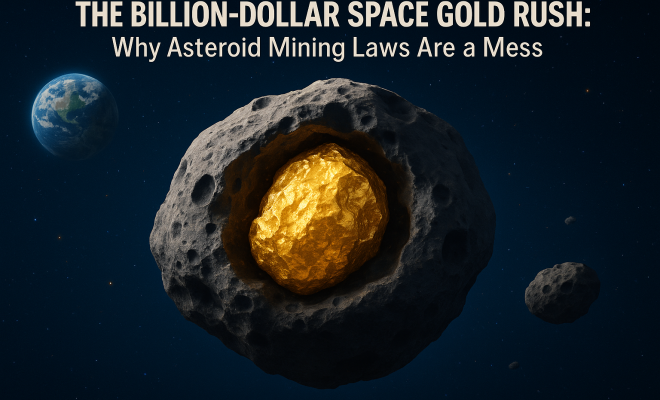
Imagine a future where the resources that power our world — platinum for electronics, rare earth elements for advanced tech, even water for rocket fuel — aren’t dug from Earth’s scarred surface, but plucked from space. This isn’t science fiction anymore. Companies like AstroForge are gearing up to launch deep-space asteroid mining missions as early as late 2026, targeting celestial bodies potentially laden with trillions of dollars worth of these invaluable materials. It’s a prospect that’s ignited what many are calling a ‘space gold rush,’ and it’s creating an enormous, complicated tangle when it comes to asteroid mining private companies vs government regulations.
The sheer scale of potential wealth is staggering, and it’s no wonder that nations and corporations alike are scrambling to stake a claim. But who owns a chunk of rock floating millions of miles away? Can a private company simply go out, extract resources, and call them their own? These aren’t abstract legal hypotheticals; they’re urgent questions that the international community is struggling to answer. The stakes couldn’t be higher, blending immense financial opportunity with profound ethical debates about ‘cosmic colonialism’ versus shared global prosperity. It’s a wild west scenario playing out on an astronomical scale, and the legal frameworks are struggling to keep pace.
1. The Deep Space Gold Rush: A New Frontier for Fortune
Let’s talk about the allure of asteroid mining. We’re not just talking about shiny rocks here; we’re talking about platinum-group metals (PGMs) like platinum, palladium, and rhodium, essential for catalytic converters, electronics, and medical devices. Then there are the rare earth elements, critical components in everything from smartphones to electric vehicle batteries. Beyond that, some asteroids contain significant amounts of water ice, which can be broken down into hydrogen and oxygen – perfect propellants for rockets, making deep-space travel far more economical.
The numbers are almost unbelievable. A single, relatively small asteroid, just a few hundred meters across, could contain more platinum than has ever been mined on Earth. The total value of resources in the asteroid belt is estimated to be in the quintillions of dollars. This isn’t just about supplementing Earth’s dwindling resources; it’s about fundamentally transforming our economy and enabling a truly spacefaring civilization. It’s a vision that has venture capitalists and space entrepreneurs salivating, and it’s why discussions around asteroid mining private companies vs government regulations are so heated.
2. AstroForge and the Pioneers: Leading the Charge
While many companies talk a good game about space mining, AstroForge is one of the more tangible players. They’re not just sketching out plans on paper; they’re actively developing technology and aiming for launches in the very near future. Their focus on platinum-group metals is particularly telling, as these are some of the most valuable commodities on Earth, with relatively high demand and limited supply.
AstroForge represents a new breed of private space company, distinct from the traditional government-funded space agencies. They’re driven by profit, innovation, and the audacious goal of making space resources commercially viable. Their impending missions are a wake-up call, forcing the world to confront the reality that private entities are not waiting for international consensus; they’re moving forward, creating facts on the ground (or rather, in space). This entrepreneurial spirit is both exciting and, for some, deeply concerning given the current void in global governance.
3. The 1967 Outer Space Treaty: A Foundation Under Strain
At the heart of the international debate lies the 1967 Outer Space Treaty (OST). This landmark agreement, signed by over 110 nations, forms the bedrock of international space law. Its core principles include the idea that outer space, including the Moon and other celestial bodies, is ‘not subject to national appropriation by claim of sovereignty, by means of use or occupation, or by any other means.’
The problem? The treaty was written in an era when space exploration was solely the domain of superpowers, and the idea of private companies mining asteroids for profit seemed like pure science fiction. It explicitly prohibits nations from claiming territory, but it’s conspicuously silent on whether a private entity, under the jurisdiction of a signatory nation, can extract and own resources. This ambiguity is the crack in the foundation that the current space gold rush is exploiting, fueling the conflict over asteroid mining private companies vs government regulations.
4. Conflicting Interpretations: The Core of the Legal Battle
This silence in the OST has led to wildly different interpretations. On one side, nations like the U.S., Luxembourg, and the UAE argue that while nations can’t claim territory, the treaty doesn’t prohibit private companies from extracting and owning resources once they’ve been removed from a celestial body. They draw an analogy to international waters: no nation owns the ocean, but a company can fish in international waters and own the catch.
On the other side, countries like China and Russia contend that allowing private ownership of extracted resources is a de facto appropriation of space resources, violating the spirit, if not the letter, of the OST. They worry about ‘cosmic colonialism,’ where wealthy nations and their corporations monopolize extraterrestrial wealth, leaving others behind. This fundamental disagreement is why the UN Committee on the Peaceful Uses of Outer Space (COPUOS) is currently paralyzed, unable to forge a new consensus. (See: Asteroid mining overview.)
5. National Legislation: A Patchwork of Laws
In the absence of clear international guidelines, some nations have decided to take matters into their own hands. The U.S. passed the SPACE Act of 2015, which explicitly states that U.S. citizens engaged in commercial recovery of space resources are entitled to own, possess, transport, use, and sell those resources. Luxembourg followed suit in 2017 with similar legislation, positioning itself as a hub for space mining companies. The UAE has also introduced laws designed to support and regulate private space resource utilization.
These national laws are a bold move, but they’re also highly controversial. While they provide a legal framework for companies operating under their jurisdiction, they don’t solve the international problem. If a U.S. company extracts resources from an asteroid, and China or Russia don’t recognize the legality of that act, what happens then? It sets the stage for potential international disputes and challenges to ownership, making the issue of asteroid mining private companies vs government regulations even more complex. For more context, see data mining and security implications.
6. The ‘Shared Heritage’ Argument: Benefits for All
A significant part of the opposition to unilateral national laws comes from the ‘shared heritage of mankind’ principle, often invoked by critics of private resource appropriation. This principle suggests that space and its resources belong to all humanity and that any benefits derived from their exploitation should be shared equitably among all nations, not just those with the technological capability and financial muscle to reach them.
Advocates for this view argue that allowing a few private companies from wealthy nations to monopolize space resources would exacerbate global inequalities and create new forms of economic disparity. They push for a robust international regulatory framework that ensures transparency, sustainability, and equitable distribution of wealth, perhaps through a system of licenses, taxes, or a global fund for development. This ethical dimension adds significant weight to the debate, moving beyond mere legal interpretation into moral philosophy.
7. Economic Impact and Investment: Trillions at Stake
The financial incentives driving this debate are truly colossal. We’re talking about resources that could be worth trillions, even quadrillions, of dollars. For perspective, the entire global GDP is currently around $100 trillion. The potential for wealth generation is so immense that it could reshape global economies, create entirely new industries, and perhaps even solve some of Earth’s resource scarcity issues.
This isn’t just about the raw materials; it’s about the entire ecosystem that will develop around asteroid mining: advanced robotics, propulsion systems, refining technologies, space logistics, and even orbital infrastructure. The investment community is watching closely, with venture capital pouring into promising space startups. The allure of being at the ground floor of what could be the biggest economic boom in human history is undeniable, and it further intensifies the urgency in resolving the asteroid mining private companies vs government regulations conundrum.
8. Challenges in International Consensus: A UN Stalemate
The UN Committee on the Peaceful Uses of Outer Space (COPUOS) is the primary forum for international discussions on space law, but it’s currently at an impasse. With nations holding such divergent views on resource ownership, reaching a new, comprehensive treaty seems incredibly difficult. The process is slow, requiring consensus among a large and diverse group of nations, each with its own national interests, technological capabilities, and ethical perspectives.
The longer this stalemate continues, the more likely it becomes that private companies will simply forge ahead under the protection of national laws, creating a de facto system that could be incredibly difficult to unwind later. This ‘race to regulate’ by individual nations, rather than a unified global approach, risks creating a fragmented and potentially conflict-prone future in space. It’s a classic case where rapid technological advancement is outstripping the slow pace of international diplomacy.
9. The Future of Space Governance: Towards a New Framework?
So, where do we go from here? The current situation is unsustainable in the long run. Eventually, there will need to be some form of international agreement, whether it’s an amendment to the OST, a new treaty, or a series of bilateral and multilateral agreements. Some possible pathways include a licensing regime overseen by an international body, where companies pay royalties for extracted resources, or a framework that balances private enterprise with a commitment to shared benefits.
The debate over asteroid mining private companies vs government regulations isn’t just about rocks and money; it’s about defining the future of humanity’s relationship with space. Will it be a free-for-all, dominated by a few powerful players, or a collaborative effort that benefits all? The decisions made in the coming years will set precedents that will echo for centuries, shaping not just who gets rich, but what kind of civilization we become as we expand beyond Earth.
10. Ethical Dilemmas and ‘Cosmic Colonialism’: More Than Just Profit
Beyond the legal and economic arguments, there’s a powerful ethical dimension to the asteroid mining debate. Critics often raise the specter of ‘cosmic colonialism,’ arguing that allowing a handful of wealthy nations and corporations to claim vast resources in space mirrors historical patterns of exploitation on Earth. They worry that this new frontier will simply replicate old injustices, concentrating power and wealth in the hands of a few while leaving developing nations further behind.
This isn’t an easy concern to dismiss. The idea that space should be a domain of peace and cooperation, a ‘province of all mankind,’ is a powerful one. Finding a way to harness the immense potential of space resources while upholding these ethical principles is perhaps the greatest challenge facing policymakers and space entrepreneurs today. It requires a delicate balance: fostering innovation and investment while ensuring equity and preventing a new era of resource wars, this time among the stars. (See: NASA's asteroid exploration.)
11. Technological Hurdles: It’s Not Just About Law
While the legal and ethical questions are paramount, we can’t ignore the immense technological challenges that asteroid mining presents. It’s not as simple as sending a robot arm to grab a rock. We’re talking about missions that travel millions of miles, operate autonomously for extended periods, and perform complex tasks in a vacuum, under extreme temperatures, and with significant time delays in communication. The engineering feats required are mind-boggling.
For instance, asteroid prospecting involves sophisticated remote sensing, spectroscopy, and potentially in-situ analysis to identify resource-rich targets. Extraction methods could range from robotic drills to sophisticated thermal processing, depending on the asteroid’s composition and the desired resources. Then there’s the challenge of processing those materials in space or transporting them back to Earth – a logistical nightmare. These technological barriers, coupled with the regulatory vacuum, make asteroid mining an incredibly high-risk, high-reward endeavor. Companies like AstroForge are investing heavily in these areas, but success isn’t guaranteed, and the cost of failure is astronomical. For more context, see AI's role in future technologies.
12. Environmental Concerns: Protecting Extraterrestrial Ecosystems?
It might sound strange to talk about environmental impact in the vacuum of space, but it’s a legitimate concern. While asteroids don’t harbor life as we know it, they are unique celestial bodies with their own geological and scientific value. What happens if a mining operation inadvertently contaminates an asteroid, or disrupts its orbit? What about space debris created by mining activities? The current legal frameworks offer little guidance on these issues.
Imagine the potential for a “tragedy of the commons” in space, where multiple private actors operate without coordinated oversight, leading to a polluted orbital environment or damaged celestial bodies. Scientists are also concerned about preserving pristine asteroids for research, as they hold clues to the early solar system. A balanced approach would need to consider not just extraction, but also preservation and responsible stewardship of these cosmic resources. This adds another layer of complexity to the asteroid mining private companies vs government regulations discussion, moving beyond purely economic or territorial concerns.
13. The Role of Major Space Agencies: Collaboration or Competition?
While private companies are driving the commercial push, government-backed space agencies like NASA, ESA (European Space Agency), JAXA (Japan Aerospace Exploration Agency), and CNSA (China National Space Administration) still play a crucial role. They’ve been pioneers in deep-space exploration, developing much of the foundational technology and scientific understanding that private entities now leverage.
The question is, how will these agencies interact with private miners? Will they become regulators, ensuring compliance with international norms? Will they be collaborators, sharing data and technology? Or will they become competitors, pursuing their own resource extraction programs? For example, NASA’s Artemis program aims to return humans to the Moon and establish a sustained presence, which will undoubtedly involve lunar resource utilization. This intersection of government exploration and private exploitation creates both opportunities for synergy and potential for conflict, especially if there aren’t clear rules about who does what, where, and under what authority.
14. Security Implications: A New Frontier for Conflict?
The immense value of space resources, combined with a lack of clear international law, unfortunately raises security concerns. If a private company from one nation successfully extracts billions of dollars worth of resources from an asteroid, what prevents a rival nation or even another private entity from attempting to interfere, disrupt, or even seize those resources? This isn’t just about terrestrial geopolitical rivalries; it’s about projecting power into space.
The militarization of space is an ongoing concern, and asteroid mining could inadvertently accelerate it. Protecting assets in deep space would require significant capabilities, potentially leading to a space arms race. Establishing clear international rules and enforcement mechanisms is vital to prevent disputes over space resources from escalating into conflicts. Without such frameworks, the ‘wild west’ analogy could become frighteningly literal, posing a severe threat to the peaceful exploration and use of outer space.
Frequently Asked Questions About Asteroid Mining, Private Companies, and Government Regulations
Q1: What exactly are “space resources”?
Space resources generally refer to any non-terrestrial materials that can be extracted and utilized. This primarily includes water ice (valuable for rocket fuel and life support), platinum-group metals (PGMs like platinum, palladium, rhodium, used in electronics and catalytic converters), rare earth elements (critical for advanced technologies like smartphones and EVs), and structural materials (like iron, nickel, cobalt for in-space construction).
Q2: Why are private companies so interested in asteroid mining now?
Several factors converge: rapidly advancing space technology (cheaper launches, better robotics), increasing demand and dwindling supply of critical resources on Earth, and significant private investment. The potential for immense profits is a huge driver, coupled with the vision of enabling a sustainable space economy and expansion beyond Earth. For more context, see impact of environmental policies on resource management.
Q3: What’s the main conflict between private companies and government regulations?
The core conflict lies in the interpretation of the 1967 Outer Space Treaty (OST). While the OST prohibits national appropriation of celestial bodies, it’s silent on private entities owning resources extracted from them. Some nations (like the U.S. and Luxembourg) have passed domestic laws affirming private ownership, while others (like Russia and China) argue this violates the spirit of the OST and the “shared heritage of mankind” principle. This creates a legal vacuum and potential for international disputes over ownership.
Q4: What is the “Shared Heritage of Mankind” principle?
This principle, often invoked in international law, suggests that certain global resources (like the deep seabed or outer space) belong to all humanity, and their exploitation should benefit everyone, not just a few powerful actors. Critics of private asteroid mining argue that allowing private companies to claim space resources for profit violates this principle and could exacerbate global inequalities.
Q5: Is there any international body currently regulating asteroid mining?
Not effectively. The UN Committee on the Peaceful Uses of Outer Space (COPUOS) is the primary forum for space law discussions, but it’s currently at an impasse due to nations’ conflicting interpretations of the Outer Space Treaty. There’s no comprehensive, legally binding international framework specifically for space resource extraction and ownership.
Q6: What are the potential benefits of successful asteroid mining?
The benefits are enormous: a vast new supply of critical resources for Earth, reducing our reliance on dwindling terrestrial reserves; potentially cheaper and more accessible space travel through in-space fuel production; new industries and job creation; and the long-term enablement of human expansion and self-sufficiency in space.
Q7: What are the risks or downsides?
Risks include: potential for international conflict over resource ownership; exacerbation of global economic inequalities; unknown environmental impacts on celestial bodies; technological failures; and the creation of space debris. There’s also the ethical concern of “cosmic colonialism” and who ultimately benefits from this new frontier.
Q8: How soon could asteroid mining become a reality?
Companies like AstroForge are targeting missions as early as late 2026. These initial missions are likely to be prospecting and demonstration flights, with full-scale commercial extraction and processing still a decade or more away. However, the foundational steps are happening now, putting immense pressure on policymakers to establish clear regulations.
The ‘space gold rush’ is upon us, whether the international community is ready or not. With companies like AstroForge pushing the boundaries of what’s possible, the legal and ethical questions surrounding asteroid mining private companies vs government regulations are no longer theoretical. They demand immediate, serious attention, because the future of space, and perhaps even the future of humanity, hangs in the balance.
Trending Now
Frequently Asked Questions
What is asteroid mining and why is it important?
Asteroid mining involves extracting valuable resources like platinum, rare earth elements, and water from asteroids in space. This practice is important because it offers a potential solution to resource scarcity on Earth, while also providing materials necessary for advanced technology and deep-space exploration.
What are the legal issues surrounding asteroid mining?
Asteroid mining raises complex legal questions regarding ownership and extraction rights in space. The current international laws, such as the Outer Space Treaty, are outdated and do not clearly define how resources from asteroids can be claimed, leading to debates over 'cosmic colonialism' and equitable resource sharing.
Who can claim ownership of resources mined from asteroids?
Ownership of resources mined from asteroids is a contentious issue. Currently, there is no clear legal framework that allows private companies to claim ownership, leading to uncertainty about whether nations or corporations can stake claims on celestial bodies and their resources.
What materials can be mined from asteroids?
Asteroids are believed to contain a variety of valuable materials, including platinum-group metals like platinum and palladium, rare earth elements essential for modern technology, and water ice, which can be converted into rocket fuel for deep-space missions.
What companies are involved in asteroid mining?
Several companies, such as AstroForge, are preparing to launch asteroid mining missions. These companies are at the forefront of what many are calling a 'space gold rush,' aiming to extract valuable resources from asteroids as early as late 2026.
Have you experienced this yourself? We'd love to hear your story in the comments.