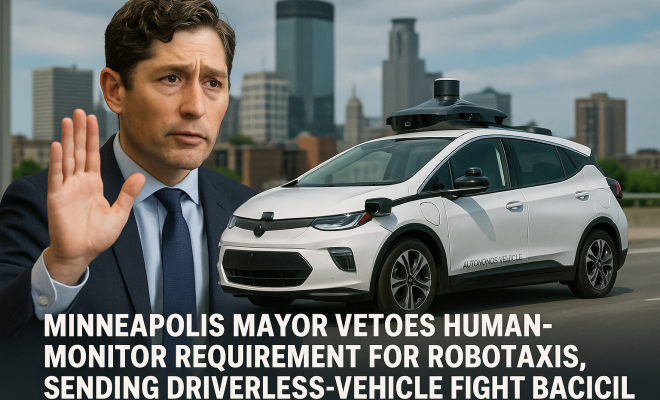
Minneapolis Mayor Vetoes Human-Monitor Requirement for Robotaxis, Sending Driverless-Vehicle Fight Back to Council
“`html
Robotaxi Rules: Why Minneapolis Just Sparked a Legal Firestorm
The future of transportation just hit a major roadblock in Minneapolis, and it’s not the kind you can navigate with advanced sensors. Mayor Jacob Frey recently took a firm stance, vetoing a city ordinance that would have demanded a human safety monitor occupy the driver’s seat of any commercial autonomous rideshare vehicle, like those operated by industry giants such as Waymo. This wasn’t just a minor administrative decision; it was a move that has reignited a fierce, often polarizing, debate between technological innovation, job security, and, perhaps most crucially, public safety. The implications of these evolving Minneapolis robotaxi regulations are far-reaching, touching on everything from urban planning to the very nature of work.
The Minneapolis City Council had initially pushed this measure through on October 3, 2026, with a tight 7-6 vote. Their rationale was clear: protect the public and safeguard the livelihoods of human rideshare drivers who might see their jobs disappear in the face of widespread automation. But Mayor Frey saw it differently. For him, a human monitor requirement essentially nullifies the core benefits of driverless technology – the promise of enhanced safety, the allure of reliability, and the sheer novelty of truly autonomous travel. This isn’t just a local spat; it’s a microcosm of a much larger, nationwide conversation about how we integrate groundbreaking AI into our daily lives, particularly when that AI is behind the wheel of a multi-ton vehicle. This builds on Elon Musk's robotaxi strategy.
The Mayor’s Rationale: Innovation vs. Inefficiency
Mayor Frey didn’t mince words when he explained his veto. He articulated a vision where driverless vehicles offer a distinct set of advantages, particularly in terms of perceived safety and reliability. Think about it: a robotaxi doesn’t get distracted, doesn’t get drowsy, and doesn’t engage in road rage. In theory, a well-programmed autonomous system should be more consistent and therefore, in many scenarios, safer than a human driver. By requiring a human to essentially babysit the AI, Frey argued, you’re stripping away a significant portion of that perceived benefit.
Furthermore, the Mayor pointed out that the council’s ordinance was, in his view, somewhat incomplete. It focused solely on the presence of a human monitor but failed to adequately address other critical aspects of integrating autonomous vehicles into a bustling urban environment. What about emergency response protocols when a robotaxi inevitably encounters an unforeseen situation? How would data privacy be handled with these vehicles constantly collecting information about their surroundings and occupants? These are not trivial questions, and Frey’s veto essentially called for a more comprehensive approach to Minneapolis robotaxi regulations, one that considers the full spectrum of challenges and opportunities that driverless technology presents.
The Council’s Concerns: Safety and Job Security
On the other side of the aisle, the City Council’s narrow approval of the human-monitor mandate wasn’t arbitrary. It stemmed from very real, very tangible concerns that resonate with a significant portion of the public. Public safety, naturally, was paramount. We’ve all seen the headlines – incidents in other major cities, most notably San Francisco, where robotaxis have stalled, obstructed emergency services, or been involved in collisions. These aren’t isolated anecdotes; they’re data points that fuel public skepticism and demand caution. When an autonomous vehicle blocks an ambulance, it’s not just an inconvenience; it can be a matter of life and death.
Beyond immediate safety, the council also grappled with the thorny issue of job displacement. The rise of rideshare platforms has already dramatically reshaped the taxi industry, creating new economic opportunities for many, but also introducing new vulnerabilities. The prospect of fully autonomous vehicles entering the market on a large scale sends shivers down the spines of countless human drivers who rely on ridesharing for their income. For the council members who voted for the mandate, protecting these jobs was a moral imperative, a way to slow down the inevitable march of automation and give the workforce time to adapt. This tension between technological progress and its societal impact is a recurring theme in the history of innovation, and Minneapolis is now front and center in that unfolding drama.
Lessons from San Francisco: A Cautionary Tale
You can’t talk about robotaxi regulations without talking about San Francisco. The city by the bay has become an accidental living laboratory for autonomous vehicle deployment, and its experiences offer a stark illustration of both the promise and the pitfalls. Companies like Waymo and Cruise have operated extensively there, and while they tout impressive safety records in terms of miles driven, the incidents that *do* occur often grab headlines and fuel public apprehension. We’ve seen driverless cars stop inexplicably in traffic, blocking lanes during rush hour. We’ve witnessed them interfere with fire trucks and ambulances trying to respond to emergencies. These aren’t just minor glitches; they highlight fundamental challenges in how these complex systems interact with the unpredictable chaos of a real-world urban environment.
One particularly high-profile incident involved a Cruise robotaxi that dragged a pedestrian for several feet after a separate collision with a human-driven vehicle, prompting the California DMV to revoke Cruise’s permit for driverless operations in San Francisco. This kind of event, though rare, has an outsized impact on public perception and policy debates. It underscores the critical need for robust regulatory frameworks, comprehensive emergency protocols, and clear lines of accountability. Minneapolis, in its debate over robotaxi regulations, is clearly learning from San Francisco’s trials and tribulations, trying to preempt similar issues before they become entrenched.
The Economic Angle: Jobs, Innovation, and the Gig Economy
The economic impact of autonomous vehicles is a double-edged sword. On one hand, advocates argue that robotaxis promise increased efficiency, reduced operational costs, and potentially lower fares for consumers. They could also contribute to reducing traffic congestion and emissions if optimized effectively. From an innovation standpoint, the development and deployment of AV technology represents a massive economic opportunity, driving investment, creating high-tech jobs, and positioning cities that embrace it as hubs of future technology. (See: self-driving cars regulations.)
However, the counter-argument, championed by the Minneapolis City Council, focuses on the direct threat to human jobs. The gig economy, largely built on the backs of human drivers, has provided flexible income for millions. Replacing these drivers with machines would undoubtedly lead to significant job displacement, creating economic hardship for many families. This isn’t a theoretical concern; it’s a very real socio-economic challenge that policymakers must confront. The debate over Minneapolis robotaxi regulations isn’t just about technology; it’s about the future of work and how society manages the transition to an increasingly automated economy. Finding a balance that fosters innovation without leaving a large segment of the workforce behind is an incredibly complex task.
The Role of Labor Unions and Advocacy Groups
It’s important to recognize that the push for human monitors isn’t happening in a vacuum. Labor unions, particularly those representing rideshare drivers and other transportation workers, are powerful voices in this debate. They see the introduction of fully driverless vehicles as an existential threat to their members’ livelihoods and are actively lobbying for regulations that protect human employment. Groups advocating for vulnerable populations or those with disabilities also often weigh in, raising concerns about accessibility and equitable service in a fully automated transportation landscape. Their collective pressure on city councils and state legislatures is a significant factor in shaping Minneapolis robotaxi regulations and similar policies across the country. For more context, see future-proof your job.
Liability and Legal Frameworks: A Lawyer’s Dream (or Nightmare)
This entire controversy over Minneapolis robotaxi regulations is generating significant buzz within the legal community, and for good reason. When an autonomous vehicle is involved in an accident, who is liable? Is it the software developer? The vehicle manufacturer? The fleet operator? The human “safety driver” if one is present? The city that approved its operation?
Current legal frameworks, largely built around human-driven vehicles, are ill-equipped to handle the complexities of autonomous incidents. This is precisely why the topic offers strong monetization potential within the high-CPC ‘legal services’ and ‘insurance’ niches. Specialized legal firms are already emerging to tackle autonomous vehicle accidents, and insurance companies are scrambling to develop new policies and risk assessment models. The questions surrounding liability are multifaceted, touching on product liability, negligence, and even emerging areas of AI ethics. Mayor Frey’s point about the ordinance failing to address emergency response and privacy also ties directly into potential legal challenges; without clear guidelines, every incident becomes a legal quagmire.
The Evolving Landscape of Autonomous Vehicle Insurance
Traditional auto insurance models are predicated on the idea of a human driver bearing primary responsibility. With autonomous vehicles, that paradigm shifts dramatically. Insurers are now looking at factors like the software’s safety record, the vehicle’s maintenance logs, and the operational parameters set by the fleet owner. Some are exploring product liability-style insurance, where the manufacturer bears more risk. The very concept of fault becomes more abstract, moving from human error to algorithmic decision-making or system failures. This means that as Minneapolis robotaxi regulations evolve, so too will the insurance products designed to cover them, leading to a fascinating, and potentially lucrative, new frontier for the insurance industry.
Privacy Concerns: Who’s Watching the Watchers?
Beyond safety and jobs, another critical, yet often overlooked, aspect of autonomous vehicles is privacy. Robotaxis are essentially mobile data collection platforms. They are equipped with an array of cameras, lidar, radar, and other sensors that constantly map their surroundings, identify pedestrians, detect other vehicles, and even, in some cases, record interactions within the vehicle cabin. This data is invaluable for training AI models and improving autonomous systems, but it also raises significant privacy concerns. Who owns this data? How is it stored? Who has access to it? Could it be used for surveillance or other purposes beyond improving the ride-sharing service?
Mayor Frey’s mention of privacy issues in his veto statement was a crucial one. Any comprehensive set of Minneapolis robotaxi regulations must include robust data governance policies. Without clear rules, the deployment of robotaxis could inadvertently create new avenues for privacy intrusion, potentially leading to public backlash and further complicating their widespread acceptance. Balancing the benefits of data collection for safety and efficiency with the fundamental right to privacy is a delicate act that requires careful consideration and transparent policies.
The Path Forward: Compromise or Standoff?
So, where does Minneapolis go from here? Mayor Frey’s veto sends the ordinance back to the City Council. They now face a choice: attempt to override the veto (which would require a supermajority vote), revise the ordinance to address the Mayor’s concerns, or let it die. Given the narrow 7-6 vote originally, overriding the veto seems like an uphill battle. This suggests that some form of compromise or a more thoroughly developed regulatory framework will likely be necessary.
A revised ordinance could, for example, implement a phased approach: perhaps allowing fully driverless operations in certain geofenced areas or during specific low-traffic hours, while maintaining a human monitor requirement in more complex or congested parts of the city. It could also shift focus from mandating a human in the seat to requiring robust remote monitoring capabilities, real-time data sharing with city emergency services, and clear protocols for disengagement and human intervention. Whatever the next step, the debate over Minneapolis robotaxi regulations is far from over, and its resolution will set an important precedent for other cities grappling with similar challenges. We covered Human involvement in crashes in more detail.
Public Perception and Social Media Engagement
The controversy surrounding Minneapolis robotaxi regulations isn’t confined to council chambers and mayoral offices; it’s a hot topic on social media. The polarizing nature of the debate – pitting technological progress against job security and public safety – makes it ripe for online discussion, heated arguments, and viral content. Incidents involving robotaxis in other cities quickly make their way to platforms like X (formerly Twitter), Reddit, and TikTok, shaping public opinion and amplifying calls for either stricter regulation or faster adoption.
This high level of social media engagement is a double-edged sword for both proponents and opponents of autonomous vehicles. It allows for rapid dissemination of information and public discourse, but it also means that misinformation can spread quickly, and emotionally charged narratives can overshadow nuanced policy discussions. Understanding and engaging with public perception, especially online, will be crucial for any city attempting to successfully integrate robotaxis into its transportation ecosystem. The court of public opinion, influenced heavily by social media, often holds more sway than legislative bodies when it comes to shaping the long-term viability of new technologies. (See: motor vehicle safety.)
The Broader National Context: A Patchwork of Regulations
What’s happening in Minneapolis isn’t unique. Across the United States, cities and states are grappling with how to regulate autonomous vehicles. There’s no single, unified national framework, leading to a patchwork of differing rules and approaches. Some states, like Arizona, have largely adopted a hands-off approach, allowing AV companies significant freedom to test and operate. Others, like California, have implemented more stringent testing and deployment requirements. This creates a complex environment for companies like Waymo and Cruise, who must navigate a myriad of local ordinances in addition to state and federal guidelines.
The Minneapolis robotaxi regulations, whatever their final form, will contribute to this evolving national landscape. They will inform discussions in other cities and potentially influence the development of best practices. This decentralized approach to AV regulation has its pros and cons: it allows for local experimentation and adaptation but can also hinder large-scale deployment and create regulatory headaches for companies operating across multiple jurisdictions. The tension in Minneapolis is a clear indicator that as AV technology matures, the demand for clearer, more consistent regulatory guidance will only grow. For more context, see AI upskilling courses.
The Role of AI Ethics in Robotaxi Deployment
Beyond the practical concerns of safety, jobs, and privacy, the debate around Minneapolis robotaxi regulations also touches on fundamental questions of AI ethics. When a driverless car faces an unavoidable accident, how is it programmed to make decisions? Should it prioritize the safety of its passengers, pedestrians, or other road users? These “trolley problem” scenarios, while often theoretical, highlight the profound ethical considerations embedded in autonomous system design. Companies developing robotaxis are investing heavily in ethical AI frameworks, but the public and policymakers still grapple with the idea of machines making life-or-death decisions without human oversight.
For Minneapolis, this means that any comprehensive regulatory framework needs to consider not just *how* robotaxis operate, but *why* they make certain decisions in critical moments. Transparency in these ethical programming choices, along with clear auditing mechanisms, will be vital for building public trust. Without it, even the most technically advanced robotaxi might struggle to gain widespread acceptance.
Comparisons to Other Disruptive Technologies
It’s worth putting the Minneapolis robotaxi debate into a broader historical context by comparing it to other disruptive technologies that faced similar regulatory and societal pushback. Think about the early days of personal computers, the internet, or even the automobile itself. Each innovation brought immense benefits but also sparked fears about job displacement, safety, and unforeseen societal changes. Horses were replaced by cars, typewriters by word processors, and traditional taxis by rideshares. In each instance, society adapted, often through a combination of market forces, new regulations, and the creation of entirely new industries and job roles.
The difference with robotaxis is the speed of development and the immediate, tangible impact on public safety and employment. However, understanding how past societies navigated these transitions can offer valuable insights for Minneapolis. It suggests that a complete ban on innovation is rarely the long-term solution, but that thoughtful, adaptive regulation is crucial for guiding technological progress in a way that benefits the most people.
Future Outlook: Smart Cities and Integrated Transportation
Looking ahead, the discussion around Minneapolis robotaxi regulations isn’t just about individual vehicles; it’s part of a larger vision for “smart cities” and integrated transportation systems. Robotaxis could be key components of a future where traffic lights communicate with vehicles, public transit is seamlessly connected with on-demand services, and urban planning prioritizes efficiency and sustainability. Imagine a city where private car ownership decreases, reducing parking needs and freeing up urban space for parks or housing. This utopian vision, however, depends entirely on effective integration and robust regulatory oversight.
For Minneapolis, this means that resolving the current debate could pave the way for a more technologically advanced and sustainable urban future. The city’s decisions today will influence its ability to attract smart city investments, reduce its carbon footprint, and create a more efficient transportation network for its residents in the decades to come. It’s a high-stakes game with long-term consequences.
Frequently Asked Questions about Minneapolis Robotaxi Regulations
Q: What exactly did Mayor Frey veto?
A: Mayor Frey vetoed a city ordinance that would have required all commercial autonomous rideshare vehicles (robotaxis) operating in Minneapolis to have a human safety monitor present in the driver’s seat. This was a direct response to the City Council’s attempt to mandate human oversight. For more context, see AI revolution and software development. (See: impact of autonomous vehicles.)
Q: Why did the City Council want a human monitor?
A: The City Council’s primary motivations were public safety concerns, citing incidents in other cities like San Francisco, and the desire to protect the jobs of human rideshare drivers facing displacement by automation.
Q: What are the Mayor’s main arguments against the human monitor requirement?
A: Mayor Frey argued that requiring a human monitor negates the core benefits of driverless technology, such as enhanced safety and reliability. He also felt the ordinance was incomplete, failing to address critical aspects like emergency response protocols and data privacy. There’s a fuller look at Demand for AI regulations in the US.
Q: What happens next after the veto?
A: The ordinance returns to the City Council. They can either attempt to override the veto (which requires a supermajority vote, unlikely given the original narrow vote), revise the ordinance to address the Mayor’s concerns, or let the ordinance die.
Q: How do Minneapolis robotaxi regulations compare to other cities?
A: The U.S. has a patchwork of regulations. Some states and cities, like Arizona, have a more hands-off approach, while others, like California, have stricter rules. Minneapolis is currently trying to carve out its own path, learning from the experiences of early adopters like San Francisco.
Q: What are the main economic impacts of robotaxis?
A: Robotaxis could lead to increased efficiency, lower fares, and new high-tech jobs. However, they also pose a significant threat of job displacement for human rideshare drivers, which is a major concern for labor unions and policymakers.
The Minneapolis saga underscores a fundamental truth about technological advancement: it’s rarely a smooth, linear path. Mayor Frey’s veto has not just sent an ordinance back to the council; it has thrown a spotlight on the intricate dance between innovation, public welfare, and economic impact. The city’s decision on how to ultimately shape its robotaxi regulations will be a fascinating case study for urban centers worldwide, demonstrating the complex considerations required to usher in the next era of transportation.
“`
Trending Now
Frequently Asked Questions
Why did Minneapolis Mayor veto the human-monitor requirement for robotaxis?
Minneapolis Mayor Jacob Frey vetoed the human-monitor requirement because he believes it undermines the benefits of driverless technology, such as enhanced safety, reliability, and the innovative potential of fully autonomous vehicles. He argued that the requirement would negate the advantages that come with automation.
What was the City Council's reasoning for the human-monitor rule?
The Minneapolis City Council pushed for the human-monitor requirement to protect public safety and the jobs of human rideshare drivers. They were concerned that widespread automation could jeopardize employment opportunities for drivers, prompting a tight 7-6 vote in favor of the measure.
What are the implications of the robotaxi regulations in Minneapolis?
The robotaxi regulations in Minneapolis spark a broader debate on technological innovation, job security, and public safety. The outcome of this decision could influence urban planning, the future of work, and how autonomous vehicles are integrated into daily life across the nation.
How does Mayor Frey view the future of driverless vehicles?
Mayor Frey views the future of driverless vehicles as one filled with potential benefits, including improved safety and reliability. He believes that embracing fully autonomous travel can lead to advancements in transportation that align with technological progress and urban development.
What is the current status of the robotaxi legislation in Minneapolis?
The current status of the robotaxi legislation is that Mayor Frey has vetoed the human-monitor requirement, sending the debate back to the City Council. This development has reignited discussions about the balance between innovation and public safety in the realm of autonomous vehicles.
What's your take on this? Share your thoughts in the comments below — we read every one.