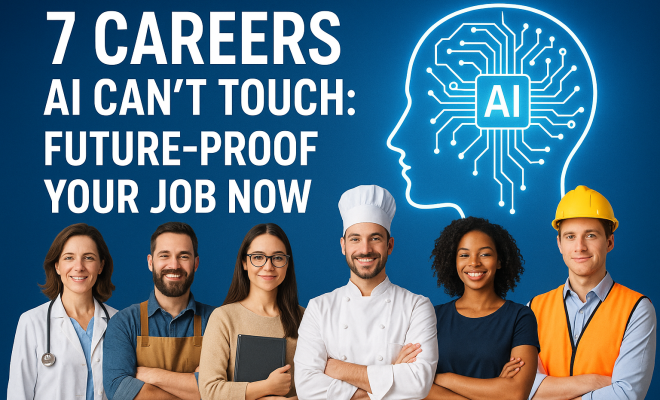
7 Careers AI Can’t Touch: Future-Proof Your Job Now
“`html
The drumbeat of AI replacing human jobs has grown louder and more insistent, hasn’t it? It’s enough to make anyone a little uneasy about their future career prospects. We’ve seen entire industries shift, and the rapid advancements in artificial intelligence are only accelerating that pace. But here’s the thing: while some jobs might indeed face automation, there’s a significant and growing demand for roles that lean into uniquely human capabilities – skills that AI simply can’t replicate. If you’re wondering how to navigate this evolving landscape and secure your professional future, you’re not alone. The quest for the best AI-proof careers in 2024 is more vital than ever.
It’s easy to get caught up in the hype and fear, but a closer look reveals a nuanced picture. What we’re witnessing isn’t just job displacement; it’s a transformation. Some roles, like the standalone ‘Prompt Engineer’ job title we heard so much about, might be fading as distinct positions. Yet, the underlying skills, like prompt engineering itself, are experiencing an explosive demand, becoming crucial competencies integrated into broader tech roles. Think about it: an AI Engineer, an AI Trainer, or an AI Product Manager all need to understand how to effectively communicate with and direct AI systems. This surprising shift underscores a deeper trend: the growing focus on what we’re calling ‘AI-proof’ careers. These are the jobs that emphasize uniquely human attributes – critical judgment, relational presence, ethical reasoning, and accountability. Let’s dig into seven such careers that are poised for resilience and growth, offering a compelling path to future-proof your job in 2024 and beyond.
1. Cybersecurity Architect: The Digital Fortress Builders
As our world becomes increasingly digitized, the threats lurking in the shadows of the internet grow more sophisticated. Data breaches, ransomware attacks, and nation-state sponsored hacking aren’t just headlines; they’re existential threats to businesses, governments, and individuals. This is precisely where the Cybersecurity Architect steps in. This isn’t just about patching vulnerabilities or running antivirus software; it’s about designing entire digital defense systems, understanding complex attack vectors, and anticipating future threats before they even materialize. AI can certainly assist in threat detection and anomaly identification, but the strategic, creative, and ethical decision-making involved in architecting a secure digital environment remains firmly in human hands.
A Cybersecurity Architect needs to possess a blend of deep technical knowledge and critical thinking. You’re not just implementing solutions; you’re developing comprehensive security frameworks, often across vast and intricate IT infrastructures. This involves understanding regulatory compliance (like GDPR or HIPAA), assessing risks, and crafting policies that balance security with usability. Think of it as building a high-tech, impenetrable fortress. AI can provide the blueprints for individual walls or alert you to a potential breach, but it’s the human architect who designs the overall structure, decides where to place the strongest defenses, and ultimately bears the accountability for its integrity. This role demands constant learning, adaptability, and an innate ability to think like an adversary – skills that are inherently human and therefore among the best AI-proof careers for the foreseeable future.
2. Chief AI Officer (CAIO): Guiding the AI Revolution
With AI becoming a central pillar of business strategy, organizations need someone at the helm to steer the ship. Enter the Chief AI Officer, a relatively new but rapidly essential executive role. This isn’t a technical role in the traditional sense, though a strong understanding of AI capabilities and limitations is crucial. Instead, the CAIO is responsible for setting the organization’s overarching AI strategy, ensuring ethical deployment, managing governance, and driving innovation. They bridge the gap between technical teams and executive leadership, making high-level decisions about how AI will be integrated into products, services, and internal operations.
Why is this role so AI-proof? Because it’s fundamentally about leadership, ethics, and strategic vision – all deeply human domains. A CAIO must navigate complex ethical dilemmas, such as algorithmic bias or data privacy, and ensure that AI initiatives align with corporate values and societal good. They’re responsible for the ‘why’ and ‘how’ of AI adoption, not just the ‘what.’ This involves communicating with diverse stakeholders, building consensus, and ultimately being accountable for the impact of AI on the business and its customers. AI can crunch data and offer predictions, but it cannot set a moral compass, articulate a compelling vision, or take ultimate responsibility for strategic outcomes. These are the hallmarks of human leadership, making the CAIO one of the most compelling of the best AI-proof careers in 2024.
3. AI Trainer & Data Ethicist: Shaping AI’s Morality
Remember how we talked about prompt engineering becoming a core skill rather than a standalone job? The AI Trainer role takes that a step further, combining technical understanding with a crucial human element: teaching and refining AI systems. AI models learn from data, and that data often carries human biases. An AI Trainer’s job is to curate, label, and refine datasets, and to provide feedback loops that help AI models improve their performance, accuracy, and fairness. This often involves intricate human judgment to distinguish nuances that a machine might miss, or to correct for unintended biases in training data.
Coupled with this, or often as a distinct but related role, is the Data Ethicist. This person is the moral compass for AI development. They scrutinize data sources, algorithms, and applications to identify potential biases, privacy violations, or unintended societal harms. They develop ethical guidelines, frameworks, and policies to ensure AI systems are deployed responsibly and equitably. While AI can analyze vast amounts of data to identify patterns, it cannot inherently understand or apply human concepts of fairness, justice, or empathy. These roles demand critical thinking, a strong moral compass, and a deep understanding of human values, making them incredibly resistant to automation. They are absolutely among the best AI-proof careers, requiring that unique human touch.
4. Renewable Energy Engineer: Powering Our Sustainable Future
The global push towards sustainability and renewable energy sources isn’t just an environmental initiative; it’s an economic and infrastructural revolution. Renewable Energy Engineers are at the forefront of designing, developing, and implementing systems that harness power from sources like solar, wind, hydro, and geothermal. This isn’t a purely automated process; it involves complex problem-solving, site-specific design considerations, materials science, and integration with existing power grids. Every project presents unique challenges, from geographical constraints to regulatory hurdles, demanding human ingenuity and adaptability. (See: AI and the future of jobs.)
These engineers are responsible for everything from optimizing turbine blade designs for specific wind patterns to developing efficient solar panel arrays and integrating battery storage solutions. They need to understand physics, engineering principles, and economic viability, often working on projects that require creative solutions to unprecedented problems. While AI can help optimize grid management or predict energy output, it cannot independently conceive, design, and oversee the construction of a new hydroelectric plant or a vast offshore wind farm. The strategic planning, creative design, and hands-on problem-solving in this sector make it a robust candidate for the best AI-proof careers, driven by societal need and human innovation.
5. Mental Health Professional (Therapist/Counselor): The Art of Human Connection
In an increasingly isolated and stressful world, the demand for mental health support continues to rise. Roles like therapists, counselors, and psychologists are fundamentally built on human connection, empathy, and nuanced understanding of the human psyche. While AI chatbots can offer rudimentary support or information, they simply cannot replicate the depth of a therapeutic relationship. A therapist doesn’t just process information; they build rapport, interpret non-verbal cues, understand complex emotional states, and provide tailored interventions based on a deep, empathetic understanding of an individual’s unique life experiences. For more context, see Japanese AI Startup and its impact on jobs.
Think about the complexities of grief, trauma, or relationship dynamics. These aren’t problems that can be solved with an algorithm. They require active listening, emotional intelligence, and the ability to sit with discomfort, offering genuine validation and guidance. The accountability for a patient’s well-being, the ethical considerations, and the sheer human effort involved in fostering healing are far beyond AI’s current or foreseeable capabilities. This makes mental health professions undeniably among the best AI-proof careers, as they are rooted in the very essence of human interaction and care.
6. Skilled Trades (Electricians, Plumbers, HVAC Technicians): The Hands-On Problem Solvers
While many white-collar jobs are facing the AI crunch, the skilled trades often fly under the radar as surprisingly AI-proof. Why? Because these professions involve complex, hands-on tasks in unpredictable environments. An electrician isn’t just following a diagram; they’re diagnosing a fault in an old wiring system, often in a cramped, dark space, requiring problem-solving skills, spatial reasoning, and manual dexterity. A plumber isn’t just fixing a leaky pipe; they’re navigating intricate pipe networks, often in emergency situations, requiring quick thinking and physical prowess.
These jobs demand a combination of technical knowledge, practical experience, and adaptability to unforeseen circumstances. Every house, every building, every repair job presents a unique set of challenges that can’t be fully anticipated by an AI. While AI might one day assist with diagnostics or provide virtual training, the actual physical work, the on-the-spot decision-making, and the accountability for a job well done remain firmly in human hands. The need for these essential services isn’t going anywhere, making them incredibly stable and among the best AI-proof careers for people who enjoy hands-on work and tangible results.
7. Creative Arts & Storytelling (Writers, Artists, Musicians): The Soul of Innovation
This might seem obvious, but it’s worth emphasizing: true human creativity, the kind that pushes boundaries, evokes deep emotion, and sparks new ideas, remains largely untouched by AI. While AI can generate text, create images, or compose music, it’s operating within the parameters of what it has been trained on. It can mimic styles, extrapolate from existing data, but it struggles with genuine originality, emotional depth, and the unique human experience that fuels groundbreaking art and storytelling.
A novelist weaves intricate narratives born from personal experience, observation, and a profound understanding of the human condition. A painter expresses emotions and ideas that transcend mere representation. A musician composes melodies that tap into universal feelings. These acts of creation are deeply personal and subjective. Furthermore, the human connection in appreciating art – the shared experience of a concert, the discussion of a thought-provoking novel, the emotional resonance of a painting – is something AI cannot replicate. For those with a passion for innovation, emotional expression, and unique perspectives, careers in the creative arts and storytelling represent some of the most enduring and best AI-proof careers out there.
The AI Skill Premium: Why Adaptability is Your Superpower
It’s clear that the job market is evolving, and frankly, it’s doing so at a breakneck pace. The conversation isn’t just about ‘AI-proof’ careers, but also about the ‘AI skill premium.’ What does that mean? It means that individuals who actively embrace AI skills – even if their core job isn’t directly AI development – are commanding a significant wage premium. We’re talking about a two-tier workforce emerging: those with AI competencies, and those without. This isn’t about becoming a prompt engineer (as a standalone title, that’s already shifting), but about integrating AI literacy into your existing skillset.
For instance, a marketing professional who understands how to leverage AI tools for market analysis or content generation is far more valuable than one who doesn’t. A project manager who can use AI to optimize schedules and resources is highly sought after. This isn’t just about tech roles; it’s about making yourself indispensable across various industries. Learning to effectively communicate with AI, understand its limitations, and integrate it into your workflow is becoming a non-negotiable part of career adaptation and upskilling. The market is rewarding those who are proactive in learning how to work *with* AI, not just against it.
Beyond Technical Skills: The Enduring Value of Human Attributes
When we talk about the best AI-proof careers, we’re really talking about a fundamental shift in what the job market values. While technical proficiency will always be important, the spotlight is increasingly shining on uniquely human attributes. Think about it: critical judgment, the ability to make nuanced decisions in ambiguous situations, is something AI struggles with. Relational presence – the ability to connect, empathize, and build trust with others – is foundational to many of the roles we’ve discussed, from therapists to Chief AI Officers.
And then there’s accountability. When something goes wrong, who takes responsibility? It’s the human. AI can’t bear the ethical weight of a decision, nor can it truly innovate in a way that stems from genuine human insight or emotional drive. These ‘soft skills’ are becoming the ‘hard skills’ of the future. Cultivating your emotional intelligence, your ability to think creatively, your ethical framework, and your capacity for complex, non-linear problem-solving will be your greatest assets in an AI-dominated world. (See: How AI is reshaping job markets.)
Strategies for Transitioning: Future-Proofing Your Own Path
So, you’ve identified some of these AI-proof careers that pique your interest. Now what? The good news is that transitioning into these roles isn’t always about starting from scratch. Many of the skills are transferable, and there’s a wealth of resources available for upskilling. Online education platforms offer courses in prompt engineering, AI ethics, and specialized skills relevant to these resilient careers. Career coaching can help you identify your strengths and map out a personalized transition plan.
Don’t be afraid to leverage your existing experience. If you’re a project manager, consider how your organizational skills could translate to managing renewable energy projects or cybersecurity implementations. If you’re passionate about human connection, explore certifications in counseling or therapy. The key is continuous learning and a proactive approach to skill development. Look for opportunities to integrate AI tools into your current role, even if it’s just to experiment and learn. This exposure will not only make you more efficient but also build your AI literacy, a critical component of career resilience. For more context, see AI Education in Colleges.
The Global Impact: Why AI-Proof Careers Matter Everywhere
It’s easy to think about these career shifts in a vacuum, focusing just on individual job seekers. But the reality is, the demand for these AI-proof roles has a profound global impact. Cybersecurity architects, for example, aren’t just protecting local businesses; they’re safeguarding international supply chains and critical infrastructure against global threats. A breach in one country can have ripple effects worldwide. Similarly, renewable energy engineers are vital in every nation’s journey towards energy independence and climate change mitigation. Their innovations in solar, wind, and geothermal power contribute to a cleaner planet for everyone, transcending borders.
Even mental health professionals play a crucial role on a global scale. As societies become more interconnected, so do our stresses and anxieties. The principles of therapy and counseling, while culturally nuanced, address universal human needs for connection and well-being. The rise of AI also means that questions of ethics and governance, often handled by CAIOs and data ethicists, are inherently global. Algorithmic bias in one country’s AI system can inadvertently impact populations in another, highlighting the necessity of human oversight with a broad, international perspective. These aren’t just jobs; they’re foundational pillars for a stable, ethical, and sustainable global future.
The Entrepreneurial Edge: Creating Your Own AI-Proof Path
While we’ve focused on established career paths, it’s worth noting the immense potential for entrepreneurship in the AI era. Many of the skills we’ve discussed – creativity, critical thinking, ethical reasoning, and understanding human needs – are precisely what make successful entrepreneurs. Instead of seeking an existing AI-proof job, you could create one. Think about developing niche services that leverage AI but require a distinct human touch for implementation or personalization. For example, an AI-powered content creation service still needs a human editor/strategist to ensure brand voice, emotional resonance, and strategic alignment. A business that helps other companies ethically integrate AI into their operations, offering bespoke training or policy development, is another prime example.
Consider the rise of personalized coaching that uses AI for data analysis (like fitness trackers or productivity apps) but relies on a human coach for motivation, empathy, and truly tailored guidance. The skilled trades, too, offer entrepreneurial avenues, with many electricians or plumbers running their own successful businesses. The key is to identify gaps where AI can augment efficiency or analysis, but where human judgment, connection, and accountability remain indispensable. This entrepreneurial spirit, combined with an understanding of AI’s capabilities and limitations, can unlock entirely new AI-proof opportunities.
Leveraging AI as a Co-Pilot, Not a Replacement
A fundamental shift in mindset is crucial for navigating the AI landscape: viewing AI not as a competitor, but as a powerful co-pilot. For instance, a graphic designer might use AI tools to generate initial concepts or explore different color palettes much faster than they could manually. But it’s the human designer who brings the artistic vision, the understanding of client brand identity, and the nuanced aesthetic judgment to refine those concepts into a compelling final product. Similarly, a writer might use AI to brainstorm ideas or proofread, but the emotional depth, unique voice, and storytelling prowess come from the human author.
In healthcare, AI can assist doctors in diagnosing diseases by analyzing medical images or patient data, potentially catching things a human eye might miss. However, the doctor still makes the final diagnosis, communicates with the patient with empathy, and creates a personalized treatment plan, taking into account the patient’s preferences and circumstances. This collaborative model, where AI handles repetitive or data-intensive tasks and humans focus on higher-order thinking, creativity, and interpersonal interactions, is the true pathway to AI-proof careers. It’s about augmenting human capability, not replacing it.
FAQ: Your AI-Proof Career Questions Answered
Q1: Will *any* job truly be 100% AI-proof?
While no job might be 100% immune to *any* AI influence, the careers discussed here are highly resistant to full automation. The goal isn’t absolute immunity, but rather choosing roles where human unique attributes (creativity, empathy, critical judgment, complex problem-solving in unpredictable environments, ethical reasoning, and accountability) are central and irreplaceable. AI will likely *assist* in these roles, making humans more efficient, but won’t fully take them over. For more context, see Does AI have a soul?. (See: Human factors and ergonomics research.)
Q2: How quickly are these AI-proof careers growing?
Growth rates vary, but many of these sectors are experiencing significant expansion. For instance, the cybersecurity market is projected for substantial growth, and the renewable energy sector is booming globally. Mental health demand continues to rise, and skilled trades face consistent demand due to an aging workforce and infrastructure needs. Roles like CAIO are new but exploding in importance as companies grapple with AI integration.
Q3: What if I’m not in a tech field? Can I still find an AI-proof career?
Absolutely! Look at skilled trades, mental health professionals, and creative arts. These are inherently non-tech fields that rely heavily on human skills. Even in more tech-adjacent roles, like AI Trainer or Data Ethicist, a background in humanities, psychology, or law can be a huge asset because understanding human behavior and ethical frameworks is key.
Q4: Should I learn to code to be AI-proof?
Not necessarily, but understanding *how AI works* at a conceptual level is incredibly valuable. For some roles, like Cybersecurity Architect or Renewable Energy Engineer, technical proficiency (which might include coding) is essential. For others, like a therapist, it’s more about understanding AI tools that might augment your practice, rather than coding them yourself. Focus on AI literacy – knowing what AI can do, what its limitations are, and how to effectively interact with it.
Q5: Is it too late to switch to an AI-proof career?
It’s never too late! Many of these careers value experience and transferable skills. Online courses, certifications, and vocational training offer accessible pathways. The key is to be proactive, identify your strengths, and commit to continuous learning. The job market is constantly evolving, and those who adapt will thrive.
Q6: What soft skills are most important for AI-proof careers?
Critical thinking, emotional intelligence, adaptability, creativity, complex problem-solving, ethical reasoning, and strong communication skills are paramount. These are the uniquely human attributes that AI struggles to replicate, making them your most valuable assets.
The Bottom Line: Embrace Change, Cultivate Humanity
The rise of AI isn’t a doomsday scenario for human employment; it’s an evolutionary leap. While some jobs will undoubtedly transform or disappear, new, exciting, and inherently human-centric roles are emerging. The best AI-proof careers in 2024 are those that lean into our unique capabilities: our creativity, our critical thinking, our emotional intelligence, and our capacity for genuine connection and accountability. By focusing on these human strengths and proactively acquiring relevant AI literacy, you can not only survive but thrive in this exciting new era. Don’t fear the future; shape it with your uniquely human touch.
“`
Trending Now
Frequently Asked Questions
What careers are safe from AI?
Several careers are considered safe from AI, particularly those that leverage uniquely human skills. Roles like Cybersecurity Architect, AI Trainer, and Mental Health Professional emphasize critical thinking, emotional intelligence, and ethical reasoning, making them resilient to automation.
How can I future-proof my career against AI?
To future-proof your career against AI, focus on developing skills that AI cannot replicate, such as creativity, complex problem-solving, and interpersonal communication. Consider pursuing roles in industries like healthcare, education, and cybersecurity that demand human judgment and ethical considerations.
What jobs are in high demand due to AI?
Jobs that are experiencing high demand due to AI include AI Engineers, Data Analysts, and Cybersecurity Specialists. These roles require a deep understanding of AI technologies and the ability to interpret and manage data effectively, ensuring they remain relevant in the evolving job market.
Will AI replace my job in the future?
While AI may automate certain tasks, it is unlikely to replace jobs entirely. Many roles will evolve to incorporate AI, emphasizing the need for human oversight, creativity, and ethical decision-making. Focus on enhancing your skills to stay competitive.
What skills are essential for AI-proof careers?
Essential skills for AI-proof careers include critical thinking, emotional intelligence, creativity, and ethical reasoning. These skills enable professionals to navigate complex situations and make decisions that require human insight, making them invaluable in an increasingly automated world.
What did we miss? Let us know in the comments and join the conversation.