JWST Stuns Scientists: Ancient Galaxy Lacks Rotation
Introduction
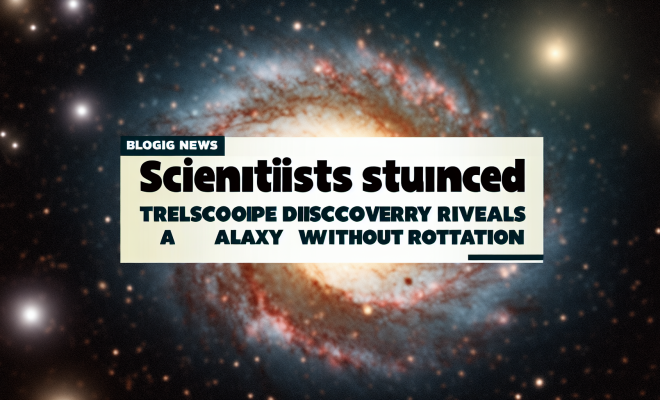
The James Webb Telescope discovery has taken the astronomical community by storm, delivering findings that challenge our longstanding understanding of galaxy formation and dynamics. Recently, astronomers using this cutting-edge instrument stumbled upon a galaxy located at an extreme distance and age, which revealed an astonishing trait: it has no measurable rotation. This unexpected finding is not just a mere curiosity; it has ignited significant debate within the scientific community and reshaped our understanding of the universe.
A Revolutionary Instrument at the Forefront of Astronomy
Launched in December 2021, the James Webb Space Telescope (JWST) has quickly become a vital asset in the field of astronomy. Equipped with advanced technology, its ability to peer deep into the cosmos allows astronomers to observe celestial bodies and phenomena that were previously hidden from view. Unlike its predecessor, the Hubble Space Telescope, JWST specializes in infrared observations, providing a clearer view of the early universe, star formation, and the intricate details of distant galaxies.
With each new finding, the James Webb Telescope unravels the complexities of cosmic evolution and deepens our understanding of the universe. Its discoveries not only astound scientists but also engage the public’s imagination, creating a renewed interest in space exploration.
The Discovery: A Galaxy Without Rotation
The recent discovery of a galaxy exhibiting no rotation has captured the attention of astronomers worldwide. This galaxy, situated at an extreme distance from Earth, defies conventional expectations that all galaxies should showcase some degree of rotational motion. In essence, rotational motion has long been considered a fundamental characteristic of galaxy formation, stemming from the conservation of angular momentum during their birth.
The galaxy’s peculiar status has raised numerous questions. What processes could lead to the formation of a galaxy that does not rotate? How does this anomaly fit within the current models of galaxy evolution? These inquiries are pivotal as they challenge existing theories and prompt researchers to rethink their understanding of galaxy dynamics.
Contradicting Conventional Wisdom
The discovery is particularly shocking because it contradicts well-established theories in astrophysics. The consensus has been that galaxies acquire their rotation through the collapse of gas and dust clouds under gravity, which leads to the spinning motion characteristic of most observed galaxies. The lack of rotation in this newly discovered galaxy suggests that either the processes guiding galaxy formation are more complex than previously thought or that additional mechanisms must be accounted for in our models.
This revelation has prompted a reevaluation of various aspects of cosmology, including theories of dark matter and dark energy, which play crucial roles in the formation and behavior of galaxies. Some researchers hypothesize that the absence of rotation may be linked to the galaxy’s formation in the early universe, potentially resulting from unique environmental conditions.
Implications for Galaxy Formation Theories
As astronomers scrutinize the implications of this James Webb Telescope discovery, several hypotheses have emerged regarding the galaxy’s unusual characteristics:
- Environmental Factors: The galaxy may have formed in an environment devoid of significant gravitational influences, preventing the accumulation of angular momentum.
- Gas Dynamics: The inflow and outflow of gas could have played a role in shaping the galaxy’s behavior, resulting in a lack of rotation.
- Interactions with Other Galaxies: If this galaxy had previous interactions with neighboring galaxies, it might have lost the rotational motion typically expected.
- New Physics: The anomaly could signal the need for new physical principles to explain galaxy dynamics, challenging our current understanding of gravitational forces.
The Role of the James Webb Telescope in Modern Astronomy
The James Webb Space Telescope is at the forefront of astronomical discovery, consistently providing data that prompts new lines of inquiry and challenges existing paradigms. Each observation serves as a stepping stone toward greater knowledge of the cosmos. The telescope’s high-resolution capabilities allow scientists to study the formation of stars, the composition of exoplanet atmospheres, and the behavior of distant galaxies like the one without rotation.
The JWST’s impact extends beyond scientific circles. The telescope has captured the public’s imagination, creating a wave of interest that resonates through social media and mainstream news outlets. As each new James Webb Telescope discovery is announced, it rekindles a sense of wonder about the universe, bridging the gap between complex scientific concepts and public understanding.
The Broader Cosmic Context
The galaxy’s lack of rotation is not just an isolated phenomenon; it also serves as a vital piece of the larger puzzle concerning cosmic evolution. Understanding how galaxies like this one fit into the grand tapestry of the universe can provide insights into the fundamental processes of galaxy formation, enabling scientists to develop more robust models and theories.
Additionally, this discovery underscores the need for continual exploration and observation. The universe is vast and complex, and as technology advances, so too does our capacity to uncover its secrets. The James Webb Telescope will undoubtedly act as a catalyst for further discoveries, revealing phenomena that challenge our understanding and inspire future generations of scientists and enthusiasts.
Impact on Future Research
The discovery of a galaxy without rotation will likely encourage a host of new research projects aimed at understanding the implications of this anomaly. Astronomers will be conducting comparative studies of similar distant galaxies, employing the JWST to identify whether this unique characteristic is an isolated case or part of a broader trend.
Furthermore, interdisciplinary research will become crucial in addressing the questions raised by this finding. Collaborations between astrophysicists, cosmologists, and theoretical physicists will be essential to formulate new models that incorporate this newfound complexity in galaxy dynamics.
Conclusion
The James Webb Telescope discovery of a galaxy devoid of rotation represents a pivotal moment in the field of astronomy, prompting significant rethinking of galaxy formation theories. This unexpected revelation not only challenges longstanding assumptions but also amplifies interest in cosmic exploration.
As the JWST continues its mission, astronomers eagerly anticipate further insights that will expand our understanding of the universe. With each new discovery, we inch closer to unraveling the mysteries of cosmic evolution, igniting curiosity and wonder in both the scientific community and the general public.
In an era defined by technological advancement and scientific discovery, the James Webb Telescope stands as a beacon of hope and inquiry. Its ability to unveil the universe’s secrets ensures that our journey into the cosmos continues, offering the promise of knowledge and the thrill of discovery for generations to come.