Honda’s Astonishing Breakthrough: EVs Get 500-Mile Range Sooner Than You Think
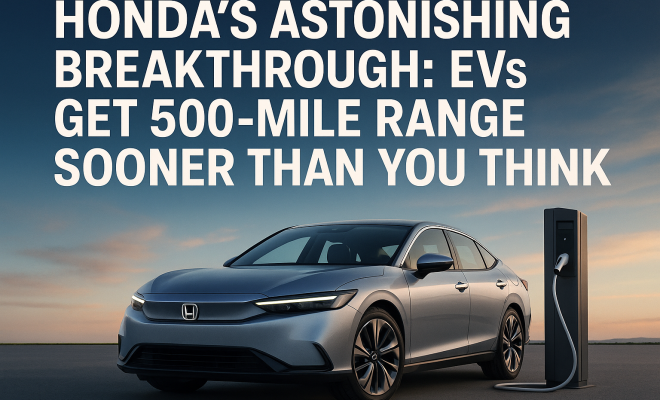
Imagine an electric vehicle that can travel over 500 miles on a single charge, refuel in minutes, and offer a level of safety currently unimaginable with today’s lithium-ion batteries. Sounds like science fiction, right? Well, Honda just pulled back the curtain on a development that suggests this future is far closer than many of us anticipated. The Japanese automaker has announced a monumental leap in solid-state battery (SSB) technology, not just in the lab, but on a bonafide production line. This isn’t just another press release about a promising prototype; this is about tangible manufacturing, putting Honda at the forefront of what could be the biggest revolution in electric vehicle history.
For years, solid-state battery technology has been the ‘holy grail’ for EVs, a whispered promise of a future free from range anxiety and lengthy charging stops. But the chasm between laboratory success and mass production has been vast, littered with technical hurdles and economic challenges. Now, Honda is bridging that chasm. By establishing a demonstration production line at its Sakura facility in Japan, Honda isn’t just talking the talk; they’re walking the walk, investing 43 billion yen (roughly $287 million) to turn theoretical potential into practical reality. This move is a game-changer, not just for Honda, but for the entire EV industry, signaling a decisive shift towards overcoming the current limitations of electric mobility.
1. The Holy Grail of EV Batteries: Why Solid-State Matters So Much
Let’s be honest, for all their environmental benefits and instant torque, current electric vehicles still face significant barriers to widespread adoption. Chief among these are range anxiety and charging times. A typical EV might offer 250-300 miles of range, which is fine for daily commutes but can feel restrictive on longer journeys. And then there’s the charging: even with fast chargers, you’re looking at 20-30 minutes for an 80% top-up, which feels like an eternity compared to a five-minute gas station stop.
This is precisely where solid-state battery technology enters the picture, poised to solve these fundamental problems. Unlike conventional lithium-ion batteries that use a liquid electrolyte, solid-state batteries employ a solid material for ion conduction. This seemingly simple change unlocks a cascade of benefits: higher energy density (meaning more range in the same or smaller package), faster charging capabilities, and significantly improved safety. Without a flammable liquid electrolyte, the risk of thermal runaway and fires is drastically reduced, making SSBs inherently safer. It’s no wonder the entire industry has been chasing this technology with such fervor.
The core difference between liquid and solid electrolytes is fundamental. In liquid electrolytes, ions move through a viscous medium, which can limit the rate of charge and discharge. Plus, these liquids are often flammable, posing a safety risk if the battery is damaged or overheats. Solid electrolytes, on the other hand, can be ceramic, polymer, or sulfide-based materials. These materials are non-flammable and structurally rigid, preventing dendrite formation – a common problem in lithium-ion batteries where lithium metal grows through the electrolyte, leading to short circuits and potential fires. This structural integrity is a huge win for both performance and safety, making solid-state battery technology a truly transformative leap.
2. Honda’s Bold Move: From Lab to Production Line
What makes Honda’s announcement so significant isn’t just the advancement of solid-state battery technology itself, but their commitment to its mass production. Many companies have showcased promising SSB prototypes, but Honda is the first major automaker to establish a dedicated demonstration production line. This isn’t just about crafting a few impressive cells in a research lab; it’s about validating the entire manufacturing process, from raw materials to finished battery packs, on a scale that can actually inform future mass production.
This strategic move at their Sakura facility isn’t just about showing off; it’s a critical step in de-risking the technology. Mass production of any new technology, especially one as complex as batteries, is fraught with challenges. Material sourcing, assembly precision, quality control, and cost efficiency all need to be meticulously worked out. By building this pilot line, Honda is essentially creating a real-world testing ground for their manufacturing techniques, ensuring that when the time comes for full-scale production, they’ve already ironed out the inevitable kinks. This proactive approach could give them a substantial head start over competitors.
The “demonstration production line” isn’t merely a larger lab; it’s a bridge between theoretical success and commercial viability. Think of it like a mini-factory designed to mimic the conditions of full-scale production. This allows Honda engineers to identify bottlenecks in the manufacturing process, refine automation, optimize material flow, and establish robust quality control protocols. They can test different suppliers for raw materials, assess the longevity of equipment under continuous operation, and gather crucial data on yield rates and defect detection. This hands-on experience is invaluable, translating directly into a smoother, faster, and more cost-effective ramp-up when true mass production begins. It’s about perfecting the ‘how’ as much as the ‘what’.
3. The $287 Million Bet: Investing in the Future of EVs
Make no mistake, Honda’s investment of 43 billion yen (approximately $287 million) into this solid-state battery technology production line is a serious commitment. This isn’t chump change for a research project; it’s a substantial capital expenditure aimed squarely at futureproofing their electric vehicle lineup. This level of investment signals profound confidence not only in the technology itself but in Honda’s ability to bring it to fruition.
What does this money fund? It goes into specialized equipment, highly skilled personnel, and the intricate infrastructure required to produce these advanced batteries. It’s an investment in research and development that goes beyond theoretical exploration, focusing on the practicalities of scalability and cost reduction. The goal isn’t just to make solid-state batteries; it’s to make them efficiently and affordably enough to integrate into consumer vehicles. This financial commitment underscores the high stakes involved in the race to dominate the next generation of EV technology. (See: Solid-state battery technology overview.)
To put that $287 million in perspective, consider the average cost of developing a new car model, which can easily run into the billions. This investment specifically for a battery production line, before widespread commercialization, highlights the strategic importance Honda places on proprietary solid-state battery technology. It signifies a long-term vision where battery technology isn’t just a component bought off the shelf, but a core competitive advantage. This capital will likely be allocated to cutting-edge cleanrooms, advanced robotics for precision assembly, and sophisticated testing equipment to ensure every battery cell meets stringent performance and safety standards. It’s a foundational investment designed to secure Honda’s position as a leader in the electric future. This builds on 600 miles in nine minutes.
4. Honda’s Secret Sauce: The Roll-Pressing Technique
One of the most intriguing aspects of Honda’s solid-state battery technology breakthrough lies in their innovative manufacturing technique, specifically their roll-pressing process. This isn’t just a minor tweak; it’s a potentially game-changing approach to how solid-state batteries are constructed, with direct implications for their performance and cost. For more context, see solid-state battery technology.
The core challenge with solid-state batteries has always been ensuring excellent contact between the solid electrolyte and the electrode materials. Gaps or imperfections can severely impede ion flow, reducing performance and durability. Honda’s roll-pressing technique aims to address this by applying pressure during the assembly process, creating a much denser and more uniform interface. This enhanced density isn’t just about better contact; it directly translates to improved energy efficiency and potentially higher energy density, meaning more power and longer range from a given battery size. It’s a clever engineering solution that could be key to making solid-state batteries commercially viable.
Let’s dive a bit deeper into why this roll-pressing technique is so crucial. In traditional battery manufacturing, slurries of active materials and binders are coated onto foils and then dried. While effective for liquid electrolytes, this method can leave microscopic voids and uneven surfaces when dealing with rigid solid electrolytes. These imperfections, even tiny ones, create resistance points for lithium ions, reducing the battery’s overall efficiency and leading to premature degradation. Honda’s roll-pressing, likely involving high-pressure rollers, physically compresses these layers together. This mechanical densification eliminates voids, maximizes the interfacial contact area, and ensures a consistent, low-resistance pathway for ion transfer. This isn’t just about making the battery work; it’s about making it work optimally, consistently, and for a very long time, which are all critical factors for consumer adoption and overall product reliability.
5. The 500+ Mile Promise: Redefining EV Range and Charging
Let’s talk about the real impact on you, the potential EV buyer. The promise of 500+ miles of range from solid-state battery technology isn’t just an incremental improvement; it’s a paradigm shift. For many, that kind of range completely eliminates range anxiety, making cross-country trips in an EV as feasible and stress-free as in a gasoline car. Think about it: a drive from Los Angeles to San Francisco or New York to Boston on a single charge becomes a reality for virtually any EV.
But it’s not just about distance. The rapid charging capabilities of SSBs are equally transformative. While specific charging times for Honda’s SSBs aren’t yet fully detailed, the inherent properties of solid electrolytes suggest much faster charging rates compared to liquid-based systems. Imagine pulling into a charging station and getting a significant top-up in the time it takes to grab a coffee – perhaps 10-15 minutes for hundreds of miles of range. This combination of extended range and ultra-fast charging could finally make EVs a truly viable and convenient option for everyone, not just early adopters.
To truly grasp the significance of 500+ miles, consider how it changes the psychological barrier to EV ownership. Most current EVs, while perfectly adequate for daily commutes, still require some planning for longer road trips. Finding charging stations, waiting for a charge, and the slight worry of not making it to the next stop can be a mental hurdle. A 500-mile range means most drivers would only need to charge a few times a week, if that, and often only at home overnight. This level of freedom mirrors the convenience of gasoline cars, but without the emissions. Combined with rapid charging, it transforms the EV experience from a conscious decision to adapt to a new technology into a seamless, superior way to travel. It’s about removing compromise from the equation entirely.
6. The Race Against Rivals: Outpacing Toyota and Others
The automotive industry is a fiercely competitive arena, and the race for solid-state battery technology dominance is particularly intense. Toyota, for instance, has been a vocal proponent of SSBs for years, announcing its own significant progress and aiming for mass production by the mid-2020s. Other players like Nissan, Volkswagen, and even dedicated battery startups are also heavily invested in the technology.
However, Honda’s establishment of a dedicated production line gives them a tangible lead in terms of manufacturing readiness. While Toyota has made impressive strides in R&D, moving from lab to scalable factory floor is a monumental challenge. Honda’s explicit focus on validating manufacturing processes and their innovative roll-pressing technique suggests they might be further along in solving the real-world production puzzle. This isn’t just about who develops the best battery, but who can make it at scale, reliably, and cost-effectively. Honda seems to be positioning itself to win that crucial part of the race. Safedrive's AI revolution offers useful background here.
The competition isn’t just between major automakers; it also involves specialized battery companies and tech giants. Companies like QuantumScape, Solid Power, and CATL are all pouring massive resources into developing their own solid-state battery technology. QuantumScape, backed by Volkswagen, has demonstrated impressive performance in lab tests, including rapid charging and high energy density. Solid Power, partnered with BMW and Ford, focuses on sulfide-based solid electrolytes. Each player is betting on a slightly different material science approach or manufacturing process. Honda’s move to establish a production line, rather than just announce lab results, signals a confidence in their specific approach to manufacturing. It shifts the focus from theoretical benchmarks to practical, repeatable production, which is where the real race is won or lost in the automotive industry.
7. Beyond the Car: Broader Implications of Solid-State Battery Technology
While the immediate focus of Honda’s solid-state battery technology breakthrough is on electric vehicles, the implications of this advancement stretch far beyond the automotive sector. The principles of higher energy density, faster charging, and enhanced safety are universally desirable for virtually any application that relies on batteries. Imagine the impact on consumer electronics: smartphones that last for days on a single charge and power up in minutes, or laptops that are lighter and run longer.
But the real long-term impact could be felt in areas like grid-scale energy storage and even aerospace. Storing renewable energy from solar and wind farms becomes far more efficient and compact with solid-state batteries, potentially accelerating the transition away from fossil fuels. Drones and electric aircraft could achieve greater range and payload capacity, opening up new possibilities for logistics and transportation. Honda’s focused effort on mass-producible solid-state battery technology isn’t just about better cars; it’s about enabling a more electrified and sustainable future across numerous industries. (See: Recent developments in solid-state batteries.)
Consider the potential for solid-state battery technology in medical devices. Pacemakers, insulin pumps, and other implanted devices could operate for significantly longer periods, reducing the need for invasive battery replacement surgeries. The enhanced safety of non-flammable solid electrolytes would also be a massive advantage in such sensitive applications. In the realm of smart homes and IoT devices, smaller, longer-lasting batteries would enable completely new form factors and functionalities, freeing devices from constant recharging or bulky power sources. Furthermore, for portable power tools and robotics, the increased power density and faster charging would translate to more uptime and greater productivity, making these devices more efficient and user-friendly across professional and consumer markets alike. The ripple effect of this technology is truly profound, touching almost every facet of our electrified world.
8. Overcoming the Hurdles: The Path to Mass Adoption
Despite Honda’s impressive progress, the path to widespread mass adoption of solid-state battery technology isn’t entirely clear of hurdles. One of the primary challenges remains cost. Currently, SSBs are significantly more expensive to produce than traditional lithium-ion batteries. The specialized materials, precise manufacturing techniques, and lower production volumes contribute to this higher price point. Honda’s investment in a demonstration line is a direct effort to drive down these costs through process optimization and economies of scale, but it will take time. For more context, see electric vehicle advancements.
Another challenge is durability and cycle life. While SSBs promise longevity, ensuring consistent performance over thousands of charge-discharge cycles in real-world conditions is crucial. Thermal management, though simplified by the absence of liquid electrolytes, still needs careful consideration, especially during rapid charging and discharging. The interplay between material science, engineering, and manufacturing will determine how quickly these batteries move from premium offerings to standard equipment in everyday EVs. Honda’s meticulous validation process aims to address these very concerns, laying the groundwork for a robust and reliable product.
Beyond cost and durability, there are also supply chain considerations. The specialized solid electrolyte materials often require different sourcing and processing than the components for liquid lithium-ion batteries. Establishing a stable and ethical supply chain for these new materials at a global scale is a significant undertaking. There’s also the challenge of integrating these new battery packs into existing vehicle architectures and manufacturing lines. While the battery itself is different, the way it connects to the vehicle’s power management system, cooling systems (even if simplified), and structural components still needs careful engineering. Overcoming these integration challenges efficiently will be key to meeting production targets and avoiding delays. Honda’s approach with a dedicated pilot line allows them to tackle these complex issues systematically, well before full-scale deployment.
9. The Future is Electric (and Solid): What This Means for You
So, what does Honda’s solid-state battery technology breakthrough truly mean for you, the consumer? It means the electric vehicle you eventually buy will likely be vastly superior to what’s available today. The anxieties around range and charging that currently deter many from making the switch will largely evaporate. You’ll be able to consider an EV for virtually any lifestyle or travel need, knowing it can keep up with your demands.
It also means a safer vehicle. While current EVs are already quite safe, eliminating the flammable liquid electrolyte further enhances peace of mind. This innovation isn’t just about performance; it’s about making electric mobility an undeniably better, more convenient, and more secure choice. Honda’s commitment to bringing this technology from the lab to a verifiable production line isn’t just a corporate win; it’s a significant step towards the mass electrification of transportation, making the future of driving cleaner, faster, and more accessible for everyone. It’s an exciting time to be watching the automotive world evolve.
10. Expert Perspectives on Solid-State Battery Technology
The excitement around solid-state battery technology isn’t limited to automakers and battery manufacturers; industry analysts and academic researchers are also keenly observing these developments. Many experts, like Professor Arumugam Manthiram from the University of Texas at Austin, a leading voice in battery research, often highlight the multi-faceted advantages of SSBs. He points out that while energy density is a major draw, the intrinsic safety of solid electrolytes is arguably an even greater breakthrough, potentially sidestepping the thermal runaway issues that have plagued some lithium-ion applications.
Dr. Shirley Meng, a professor at the University of Chicago and chief scientist for the Argonne Collaborative Center for Energy Storage Science (ACCESS), frequently emphasizes the manufacturing challenges. She notes that scaling up production for solid-state batteries requires entirely new engineering approaches and quality control standards, as the interfaces between solid materials are far more critical and less forgiving than in liquid-based systems. Honda’s roll-pressing technique, from this perspective, is a direct attempt to overcome a fundamental manufacturing hurdle that many research teams are still grappling with. The consensus among these experts is that while the promise is immense, the road to widespread commercialization is paved with intricate material science and sophisticated engineering challenges.
11. Comparison with Other Advanced Battery Technologies
While solid-state battery technology is certainly in the spotlight, it’s not the only advanced battery chemistry being explored. It’s worth briefly comparing it to some other contenders to understand why SSBs are considered the ‘holy grail’.
- Lithium-Sulfur (Li-S) Batteries: These batteries promise even higher theoretical energy densities than SSBs, primarily due to the light weight of sulfur. However, they face significant challenges with cycle life, as sulfur expands and contracts dramatically during charge/discharge, and the formation of polysulfides degrades performance.
- Lithium-Air (Li-Air) Batteries: Often touted as the ultimate battery, Li-Air batteries could theoretically store as much energy per unit weight as gasoline. The catch? They require oxygen from the ambient air, which introduces complex challenges related to air purification, cathode degradation, and very slow charging rates.
- Sodium-ion (Na-ion) Batteries: These are a more near-term alternative, particularly attractive because sodium is abundant and cheaper than lithium. While their energy density is typically lower than lithium-ion, they offer good safety and can perform well in cold temperatures. They’re unlikely to compete with SSBs on range but could be excellent for stationary storage or entry-level EVs.
Solid-state battery technology stands out because it aims to deliver significant improvements in energy density, charging speed, and safety, all within a relatively familiar lithium-ion framework, making the transition potentially smoother than completely novel chemistries. It tackles the most pressing limitations of current EVs head-on, without introducing entirely new sets of fundamental problems. For more context, see future of electric vehicles. (See: Scientific insights on solid-state batteries.)
Frequently Asked Questions about Solid-State Battery Technology
Q1: What exactly is a solid-state battery?
A solid-state battery is a type of battery that uses a solid electrolyte instead of the liquid or polymer gel electrolyte found in conventional lithium-ion batteries. This solid material facilitates the movement of ions between the anode and cathode, unlocking benefits like higher energy density, faster charging, and improved safety.
Q2: How is solid-state battery technology safer than traditional lithium-ion batteries?
The primary safety advantage comes from eliminating the flammable liquid electrolyte. In traditional lithium-ion batteries, this liquid can ignite if the battery is damaged, overcharged, or overheats, leading to thermal runaway and fires. Solid electrolytes are non-flammable and structurally stable, significantly reducing these risks.
Q3: When can I expect to see solid-state batteries in consumer EVs?
While Honda and other automakers like Toyota are making significant progress, mass production for consumer vehicles is still a few years away. Most estimates point to the mid-to-late 2020s for initial deployment in premium or limited-run vehicles, with wider adoption likely in the early 2030s as costs come down and production scales up. Honda’s pilot line is a major step towards this timeline.
Q4: Will solid-state batteries be compatible with existing EV charging infrastructure?
Yes, solid-state batteries are expected to be compatible with existing charging infrastructure. The improvements are in the battery chemistry itself, not necessarily the external charging protocols. In fact, their ability to handle higher power inputs means they could potentially utilize the fastest DC fast chargers even more effectively, reducing charging times.
Q5: What are the main challenges preventing widespread adoption of solid-state batteries?
The primary challenges include high manufacturing costs, ensuring consistent durability and cycle life over many years, and scaling up the production of specialized solid electrolyte materials. Honda’s investment in a demonstration line is a direct effort to tackle these cost and manufacturing hurdles.
Q6: Will solid-state batteries completely replace lithium-ion batteries?
It’s unlikely that solid-state batteries will completely replace all lithium-ion batteries in the short to medium term. Lithium-ion technology continues to evolve, and its cost-effectiveness for many applications is still superior. Solid-state batteries are more likely to first appear in premium segments or applications where their unique advantages (high energy density, ultra-fast charging, extreme safety) are most critical, with a gradual expansion into other markets. Related reading: range extended EVs.
Q7: What kind of solid electrolyte material is Honda using?
Honda has not publicly disclosed the exact composition of its solid electrolyte, but the industry generally focuses on sulfide-based, oxide-based, or polymer-based solid electrolytes. Each has its own advantages and challenges in terms of ionic conductivity, mechanical properties, and manufacturing feasibility. Honda’s emphasis on a “roll-pressing technique” suggests a material that can be effectively compressed and integrated into a layered structure.
Trending Now
Frequently Asked Questions
What is Honda's breakthrough in electric vehicle technology?
Honda has announced a significant advancement in solid-state battery (SSB) technology, allowing electric vehicles to achieve over 500 miles of range on a single charge. This development marks a major step towards overcoming current limitations in EV range and charging times.
How do solid-state batteries improve electric vehicles?
Solid-state batteries offer greater energy density, faster charging times, and enhanced safety compared to traditional lithium-ion batteries. This technology significantly reduces range anxiety and improves the overall driving experience for electric vehicle users.
What are the benefits of Honda's new solid-state batteries?
The benefits of Honda's solid-state batteries include a 500-mile range on a single charge, quick refueling times, and improved safety features. These advancements aim to address major concerns like range anxiety and lengthy charging stops.
When will Honda's solid-state batteries be available?
Honda has established a demonstration production line for solid-state batteries at its Sakura facility in Japan, indicating that these batteries may be available for mass production sooner than previously expected, although specific timelines have not been disclosed.
Why is solid-state battery technology considered the 'holy grail' for EVs?
Solid-state battery technology is regarded as the 'holy grail' for electric vehicles because it promises to eliminate key barriers such as limited range and long charging times, paving the way for widespread adoption and a more practical electric mobility future.
What's your take on this? Share your thoughts in the comments below — we read every one.