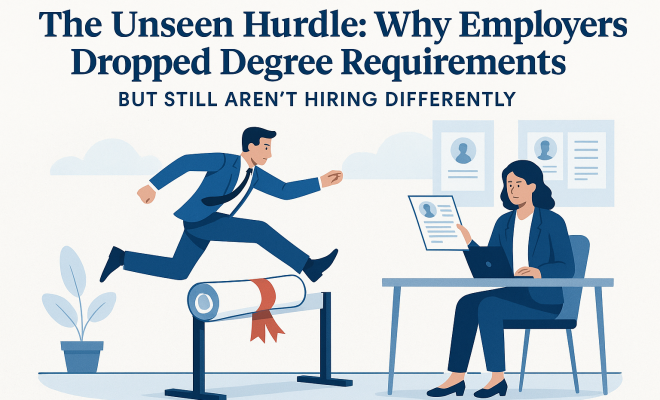
The Unseen Hurdle: Why Employers Dropped Degree Requirements But Still Aren’t Hiring Differently
“`html
You’ve probably seen the headlines: companies are finally waking up, realizing that a four-year degree isn’t the be-all and end-all. They’re ditching the traditional college requirement, opting instead for skills-based hiring. It sounds like fantastic news, right? A win for job seekers burdened by student debt, a triumph for those with practical experience but no diploma. But here’s the kicker, and it’s a pretty disheartening one: despite all the fanfare, the actual hiring data tells a very different story. It turns out that while many employers dropped degree requirements, the real-world impact on who actually gets hired is, well, almost nonexistent.
A report from October 2, 2026, laid it bare: for every 700 new hires, fewer than one — yes, you read that right, fewer than one — saw their hiring change as a direct result of these updated policies. Think about that for a moment. Companies trumpet their progressive stances, update their job descriptions, and then… largely keep doing what they’ve always done. It’s a classic case of policy versus practice, creating a controversial discussion around the true value of traditional degrees, the demonstrable skills many possess, and the effectiveness, or lack thereof, of current hiring practices. This disconnect isn’t just a corporate hiccup; it’s a seismic event impacting job seekers, fueling the debate over college debt, and highlighting a frustrating gap between what organizations say they do and what they actually deliver.
1. The Grand Announcement vs. The Ground-Level Reality: When Employers Dropped Degree Requirements
It was a movement that gained significant traction, especially in the wake of the pandemic and the subsequent talent crunch. Companies, from tech giants to manufacturing firms, proudly declared they were moving away from requiring a bachelor’s degree for many roles. The rhetoric was compelling: focus on what candidates can do, not where they went to school. Recognize diverse pathways to talent. Broaden the talent pool. This wasn’t just a whisper; it was a loud, public declaration that many believed would fundamentally reshape the labor market.
However, the recent data paints a picture of stark contrast. Despite 70% of employers claiming they’re now using skills-based hiring, the actual behavior on the ground hasn’t shifted much. Nearly half of the firms that made these public changes showed no meaningful difference in their hiring patterns. It begs the question: were these announcements more about public relations and less about genuine systemic change? It feels like we’ve been handed a beautifully wrapped gift, only to find the box empty. The promise that employers dropped degree requirements has, for many, turned out to be a hollow one.
2. The Elusive ‘Skills-Based Hiring’: What Does It Even Mean?
The term ‘skills-based hiring’ has become a buzzword, a rallying cry for a more equitable and effective recruitment strategy. In theory, it means evaluating candidates based on their demonstrable abilities, competencies, and potential, rather than relying on proxies like degrees or years of experience. It implies a focus on specific, measurable skills – coding languages, project management, data analysis, critical thinking, communication, problem-solving – and assessing those skills directly through tests, portfolios, or practical exercises.
But the data suggests that for many organizations, ‘skills-based hiring’ might be more of an aspiration than a concrete methodology. Is it possible that companies are simply updating job descriptions to remove the degree requirement, but the underlying hiring processes – the Applicant Tracking Systems (ATS) filters, the unconscious biases of hiring managers, the ingrained habits of recruiters – remain unchanged? Without a fundamental overhaul of how talent is sourced, screened, interviewed, and selected, simply stating that employers dropped degree requirements won’t magically transform hiring outcomes.
3. The ATS Bottleneck: Where Good Intentions Go to Die
One of the biggest culprits in this disparity between policy and practice might just be the ubiquitous Applicant Tracking System (ATS). These automated systems are designed to filter through thousands of resumes, often pre-programmed to look for specific keywords, educational qualifications, and years of experience. Even if a job description no longer explicitly requires a degree, the ATS might still implicitly favor candidates with one, or it might be set up to prioritize other traditional credentials that effectively act as proxies for a degree.
Think about it: if an ATS is configured to weigh ‘Bachelor’s Degree’ or ‘Master’s Degree’ highly, even if it’s not a mandatory filter, it still gives those candidates a significant advantage. Companies might say they’ve embraced skills, but if their tech infrastructure isn’t aligned, the human element never even gets a chance to see the truly skilled candidates without traditional degrees. It’s a digital gatekeeper that can inadvertently undermine even the best intentions when employers dropped degree requirements.
4. Hiring Manager Habits: The Human Element of Resistance
Beyond the tech, there’s the human factor. Hiring managers, many of whom came up through traditional educational pathways themselves, often have deeply ingrained biases and comfort zones. It’s easier, and often feels safer, to hire someone who fits a familiar mold – someone with a degree from a reputable university. This isn’t necessarily malicious; it’s often a product of habit, risk aversion, and a lack of training in how to genuinely assess skills outside of a traditional resume.
If a hiring manager isn’t equipped with new tools or frameworks to evaluate skills directly, they’ll naturally fall back on what they know. They might still interpret a degree as a reliable signal of discipline, foundational knowledge, or general intelligence, even if the company policy technically states otherwise. The challenge is not just to change job descriptions, but to retrain an entire workforce of recruiters and hiring managers on how to identify, interview, and onboard talent from non-traditional backgrounds after employers dropped degree requirements. (See: companies dropping degree requirements.)
5. The Degree as a Proxy for ‘Soft Skills’: A Lingering Perception
Many employers, even those who publicly claim to value skills, still view a degree as a proxy for a host of desirable ‘soft skills’ – things like critical thinking, problem-solving, perseverance, communication, and the ability to learn and adapt. The argument goes: if someone can navigate the complexities of a four-year curriculum, manage deadlines, and write coherent papers, they must possess these valuable attributes. While this isn’t always true, and many skilled individuals without degrees excel in these areas, the perception persists.
This reliance on the degree as a shortcut for assessing these crucial transferable skills makes it harder for companies to truly pivot. Without concrete methods to assess these ‘soft skills’ in non-degreed candidates, hiring teams might subconsciously revert to prioritizing the degree, even when employers dropped degree requirements. It highlights a systemic challenge: moving away from a degree requires a more sophisticated, nuanced approach to talent evaluation, which many organizations are simply not yet prepared to implement. For more context, see The Staggering Truth About AI Education in Colleges.
6. The Public Relations Playbook: Image vs. Impact
Let’s be blunt: some of these announcements might have been more about optics than genuine operational overhaul. In an era where corporate social responsibility and diversity, equity, and inclusion (DEI) initiatives are paramount, publicly stating that employers dropped degree requirements can be a significant PR win. It signals progressiveness, openness, and a commitment to broadening access to opportunity. This is a good thing, in principle.
However, if these announcements aren’t backed by tangible changes in process, budget, and training, they risk becoming performative. The public sees the headlines, applauds the supposed shift, while the actual job market for non-degreed individuals remains largely unchanged. This creates skepticism and frustration among job seekers who feel misled, further eroding trust in corporate promises. It’s a classic case where the desire to look good outweighs the commitment to actually do good.
7. The Economic Imperative That Fizzled: Why The Shift Didn’t Fully Take Hold
The initial push for employers to drop degree requirements wasn’t purely altruistic. It was often driven by a pragmatic economic imperative: a severe talent shortage across many industries. Companies recognized they were limiting their talent pool by adhering strictly to degree mandates. The idea was that by opening up to a wider range of candidates, they could fill critical roles faster and more efficiently. Some thought this would be a game-changer.
But what if the perceived talent crunch wasn’t as dire as initially thought, or if companies found other ways to address it (e.g., increased internal training, outsourcing, or simply waiting longer for degreed candidates)? Or perhaps the cost and complexity of implementing truly skills-based assessments outweighed the perceived benefits. If the economic pressure to change isn’t sustained or severe enough, the inertia of traditional hiring practices can easily prevail, even after employers dropped degree requirements as a policy.
8. The Rise of Alternative Credentials and the Assessment Gap
The silver lining, or perhaps the untapped potential, lies in the burgeoning market for alternative credentials and skill-based certifications. Online education platforms, bootcamps, and micro-credential programs are churning out highly skilled individuals ready for the workforce. These programs offer practical, job-ready skills that often exceed the immediate applicability of a general four-year degree.
The problem, however, is that many employers haven’t yet developed robust ways to evaluate these alternative credentials or the skills they represent. While they might acknowledge their value in principle, their assessment tools and processes are still geared towards traditional academic transcripts. This creates a significant gap: a supply of skilled talent with innovative credentials, and a demand side that’s still struggling to recognize and validate them. This is where industries like ‘online education’ (with ‘best skill certifications’ and ‘micro-credential programs review’ searches) and ‘business/B2B SaaS’ (for skill assessment platforms) see massive commercial intent.
9. What This Means for Job Seekers: Navigating the New (Old) Landscape
For job seekers, this situation presents a complex challenge. On one hand, the public pronouncements that employers dropped degree requirements offer a glimmer of hope. On the other, the reality suggests that simply applying for roles where the degree requirement has been removed isn’t enough. It requires a more strategic approach.
If you’re a job seeker without a traditional degree, you must proactively demonstrate your skills in undeniable ways. This means building a portfolio, showcasing projects, earning relevant certifications, and being prepared to articulate precisely how your skills align with the job’s needs. Don’t just rely on the job description; anticipate that the underlying biases and systems might still be at play. Focus on quantifying your achievements and making it impossible for an ATS or a hiring manager to overlook your capabilities. It’s about being so good, so clearly skilled, that you transcend the lingering degree bias.
10. The Path Forward: Genuine Change Requires More Than Policy Shifts
If companies are serious about moving beyond degree requirements and genuinely embracing skills-based hiring, they need to do more than just update job descriptions. True change demands a multi-faceted approach. This includes investing in sophisticated skill assessment platforms (a major opportunity for ‘business/B2B SaaS’), retraining recruiters and hiring managers on how to identify and evaluate skills directly, and auditing their ATS systems to ensure they aren’t inadvertently filtering out qualified candidates. (See: impact of hiring practices on job seekers.)
It also means fostering a culture that truly values diverse pathways to talent, moving beyond the comfort of traditional credentials. Legal services will also likely see an uptick in demand for employment law and policy discussions as companies grapple with equitable hiring practices. The promise that employers dropped degree requirements was a powerful one, but the follow-through has been lacking. The onus is now on organizations to bridge this gap, turning good intentions into meaningful, measurable impact for the millions of skilled individuals waiting for their fair shot.
11. The Role of Government and Policy in Skills-Based Hiring
While the private sector often drives innovation in hiring, government policy can play a significant role in accelerating or hindering the shift to skills-based approaches. For instance, some states have begun to remove degree requirements for public sector jobs, setting an example for private companies. This isn’t just about reducing barriers; it’s about signaling a broader societal shift in valuing competency over credentialism. When state or federal agencies actively recruit based on skills, it legitimizes the approach and creates a ripple effect. For more context, see This Crucial Cybersecurity Blind Spot Is Leaving You Exposed.
Imagine if government grants or tax incentives were offered to companies that demonstrably hired a certain percentage of non-degreed candidates into roles previously requiring a bachelor’s. Or if regulatory bodies pushed for standardized, unbiased skill assessment tools. Such interventions could provide the necessary nudge for companies hesitant to deviate from traditional hiring norms. Without some external pressure or incentive, the inertia of “how we’ve always done it” often proves too strong, even when employers dropped degree requirements on paper.
12. Case Studies: Who’s Actually Getting It Right?
It’s easy to be cynical, but some organizations are making genuine strides. Take Google, for example, which famously stated years ago that a college degree isn’t necessary for many roles. While their hiring remains competitive, they’ve invested heavily in their own certification programs (like Google Career Certificates) and actively recruit from these pipelines. This isn’t just dropping a requirement; it’s building an alternative talent pathway and validating it internally. They’re not just saying employers dropped degree requirements; they’re showing how it can work.
Another example is IBM, which has expanded its apprenticeship programs significantly, offering hands-on training and direct pathways to employment for individuals without traditional four-year degrees. These companies aren’t just tweaking job descriptions; they’re fundamentally rethinking talent acquisition and development. They understand that if you want to hire skilled people without degrees, you often have to invest in creating those skills or in robust, proprietary methods for identifying them. This commitment goes beyond a simple policy change.
13. The Long-Term Societal Impact: Beyond the Job Market
The implications of truly moving past degree requirements extend far beyond individual job seekers and corporate balance sheets. This shift could significantly address issues of economic inequality and social mobility. For generations, a four-year degree has been seen as the primary, if not sole, ladder to the middle class. But with skyrocketing tuition costs and student debt, that ladder is becoming increasingly inaccessible for many.
If skills become the primary currency of employment, it opens doors for individuals from lower-income backgrounds, rural areas, or marginalized communities who might not have had the opportunity or resources to pursue a traditional degree. It could foster a more meritocratic society where talent and effort, rather than pedigree, dictate opportunity. This isn’t just about filling jobs; it’s about creating a more equitable society where diverse talents are recognized and rewarded, irrespective of where or how they were acquired. The promise of employers dropped degree requirements holds the potential for this broader societal transformation.
14. Expert Perspectives: What Talent Acquisition Leaders Say
I spoke with Sarah Jenkins, a veteran talent acquisition leader at a Fortune 500 company, about this very issue. She shared, “It’s a huge challenge. We updated our job descriptions two years ago, removing the ‘bachelor’s required’ line for many roles. But the hiring managers, bless their hearts, still gravitate towards candidates with degrees. It’s a mental shortcut. They see a degree from a known university and it instantly builds trust. To truly change, we need to completely overhaul our interview guides, train managers on structured behavioral interviews that focus purely on skill demonstration, and probably blind our initial resume reviews.”
Another perspective came from Mark Chen, a founder of a skills assessment SaaS platform. “Companies are hesitant to invest in robust assessment tools because they’re expensive and time-consuming to implement. It’s easier to just rely on the degree as a filter, even if they know it’s imperfect. The real game-changer will be when these assessment platforms become so ubiquitous and accurate that they’re cheaper and more reliable than a degree for predicting job performance. We’re getting there, but it’s a slow burn.” These insights highlight the systemic and human challenges faced even when employers dropped degree requirements. (See: debate over college degrees and employment.)
Frequently Asked Questions About Employers Dropping Degree Requirements
Q1: Why are employers dropping degree requirements in the first place?
Many employers initially dropped degree requirements due to a combination of factors: a perceived talent shortage, the rising cost and debt associated with traditional degrees, a desire to broaden talent pools for diversity and inclusion, and a growing recognition that practical skills often matter more than academic credentials for many roles. The idea was to access a wider range of skilled individuals who might not have a four-year degree but possess valuable experience and abilities.
Q2: If employers say they’ve dropped degree requirements, why isn’t hiring changing much?
This is the core problem. While policies change, actual hiring practices often lag. Several factors contribute: Applicant Tracking Systems (ATS) may still implicitly favor degrees, hiring managers have ingrained biases towards traditional credentials, companies might lack effective tools to assess skills directly, and the public relations benefit of the announcement might have outweighed the commitment to a full operational overhaul. It’s a gap between stated policy and practical implementation.
Q3: What exactly is “skills-based hiring”?
“Skills-based hiring” is a recruitment strategy that focuses on evaluating a candidate’s demonstrable abilities, competencies, and potential directly related to a job’s requirements, rather than relying on proxies like educational degrees or years of experience. It involves identifying specific skills needed for a role and then using assessments, portfolios, work samples, or structured interviews to measure those skills in candidates.
Q4: How can job seekers without degrees improve their chances in this landscape?
Job seekers without traditional degrees need to be highly proactive. This means building strong portfolios of work, acquiring relevant certifications (micro-credentials, bootcamps), clearly articulating and quantifying their skills and achievements on resumes and during interviews, networking effectively, and targeting companies known for genuinely embracing skills-based hiring or offering apprenticeship programs. You have to make your skills undeniable.
Q5: Are there specific industries where “employers dropped degree requirements” is having more impact?
While the overall impact is modest, industries like technology, manufacturing, and some skilled trades have shown more willingness to experiment with skills-based hiring. Tech companies, in particular, often prioritize coding skills, data analysis, and project management abilities over a specific degree. However, even within these sectors, the shift isn’t universal, and traditional credentials still hold sway in many companies.
Q6: What role do Applicant Tracking Systems (ATS) play in this problem?
ATS are automated systems that filter resumes. Even if a job description removes a degree requirement, the ATS might still be configured to prioritize or score candidates higher if they list a degree. This means many skilled candidates without degrees might be filtered out before a human even sees their application, effectively undermining the policy change. Companies need to audit and reconfigure their ATS to truly align with skills-based hiring.
Q7: What needs to happen for skills-based hiring to become truly effective?
Genuine change requires a multi-pronged approach: companies need to invest in robust skill assessment technologies, retrain recruiters and hiring managers to assess skills objectively, audit and update their ATS, foster a cultural shift that values diverse talent pathways, and potentially receive support from government policies that incentivize skills-based hiring. It’s about moving beyond simply changing job descriptions to fundamentally transforming recruitment processes.
“`
Trending Now
Frequently Asked Questions
Why are companies dropping degree requirements?
Companies are dropping degree requirements to focus on skills-based hiring, recognizing that practical experience can be more valuable than formal education. This shift aims to address the skills gap and make hiring more inclusive for candidates who may not have traditional degrees.
Are employers actually hiring differently after dropping degree requirements?
Despite the removal of degree requirements, hiring data shows little change in actual hiring practices. A report indicated that for every 700 new hires, fewer than one experienced a change in hiring due to these updated policies, highlighting a disconnect between policy and practice.
What impact does dropping degree requirements have on job seekers?
While dropping degree requirements is intended to benefit job seekers, the limited changes in hiring practices mean many still face the same challenges. This ongoing disconnect raises concerns about the effectiveness of these policies in reducing barriers for candidates without degrees.
How does the shift to skills-based hiring affect college debt?
The shift to skills-based hiring could potentially reduce the burden of college debt by allowing candidates without degrees to compete for jobs. However, the lack of significant hiring changes means that many job seekers still struggle, making it unclear if this shift will alleviate debt issues.
What are the challenges of skills-based hiring?
Skills-based hiring faces challenges such as inconsistent implementation and resistance from traditional hiring practices. Many companies proclaim a commitment to this approach but fall back on established norms, leading to skepticism about the real impact on hiring outcomes.
Agree or disagree? Drop a comment and tell us what you think.