The Tech Edvocate

Top Menu

  • Advertisement
  • Apps
  • Home Page
  • Home Page Five (No Sidebar)
  • Home Page Four
  • Home Page Three
  • Home Page Two
  • Home Tech2
  • Icons [No Sidebar]
  • Left Sidbear Page
  • Lynch Educational Consulting
  • My Account
  • My Speaking Page
  • Newsletter Sign Up Confirmation
  • Newsletter Unsubscription
  • Our Brands
  • Page Example
  • Privacy Policy
  • Protected Content
  • Register
  • Request a Product Review
  • Shop
  • Shortcodes Examples
  • Signup
  • Start Here
    • Governance
    • Careers
    • Contact Us
  • Terms and Conditions
  • The Edvocate
  • The Tech Edvocate Product Guide
  • Topics
  • Write For Us
  • Advertise

Main Menu

  • Start Here
    • Our Brands
    • Governance
      • Lynch Educational Consulting, LLC.
      • Dr. Lynch’s Personal Website
      • Careers
    • Write For Us
    • The Tech Edvocate Product Guide
    • Contact Us
    • Books
    • Edupedia
    • Post a Job
    • The Edvocate Podcast
    • Terms and Conditions
    • Privacy Policy
  • Topics
    • Assistive Technology
    • Child Development Tech
    • Early Childhood & K-12 EdTech
    • EdTech Futures
    • EdTech News
    • EdTech Policy & Reform
    • EdTech Startups & Businesses
    • Higher Education EdTech
    • Online Learning & eLearning
    • Parent & Family Tech
    • Personalized Learning
    • Product Reviews
  • Advertise
  • Tech Edvocate Awards
  • The Edvocate
  • Pedagogue
  • School Ratings

logo

The Tech Edvocate

  • Start Here
    • Our Brands
    • Governance
      • Lynch Educational Consulting, LLC.
      • Dr. Lynch’s Personal Website
        • My Speaking Page
      • Careers
    • Write For Us
    • The Tech Edvocate Product Guide
    • Contact Us
    • Books
    • Edupedia
    • Post a Job
    • The Edvocate Podcast
    • Terms and Conditions
    • Privacy Policy
  • Topics
    • Assistive Technology
    • Child Development Tech
    • Early Childhood & K-12 EdTech
    • EdTech Futures
    • EdTech News
    • EdTech Policy & Reform
    • EdTech Startups & Businesses
    • Higher Education EdTech
    • Online Learning & eLearning
    • Parent & Family Tech
    • Personalized Learning
    • Product Reviews
  • Advertise
  • Tech Edvocate Awards
  • The Edvocate
  • Pedagogue
  • School Ratings
  • A Visitor’s Guide to Fresno (CA), United States

  • A Visitors Guide to New Orleans (LA), United States

  • A Visitors Guide to Sacramento (CA), United States

  • A Visitors Guide to Lyon, France

  • JisuLife Ultra2 Portable Fan: A Powerful Multi-Function Cooling Solution

  • A Visitors Guide to Viña del Mar, Chile

  • A Visitors Guide to Århus, Denmark

  • A Visitors Guide to Bakersfield (CA), United States

  • A Visitors Guide to Aurora (CO), United States

  • A Visitor’s Guide to Toledo (OH), United States

Digital & Mobile Technology
Home›Digital & Mobile Technology›How to Use diff to Compare Text Files in the Linux Terminal

How to Use diff to Compare Text Files in the Linux Terminal
By Matthew Lynch
June 13, 2023
0
Spread the love

When working with text files in Linux, it is often necessary to compare them to check for similarities or differences. This is where the “diff” command comes in handy. “Diff” is a powerful tool that allows you to compare two text files and see the differences between them. Here’s how to use “diff” to compare text files in the Linux terminal.

Step 1: Open the Terminal

The first step is to open your Linux terminal. Once it is open, you can start typing the “diff” command.

Step 2: Enter the “diff” Command

To use “diff”, type “diff” followed by the two file names you want to compare. For example, if you want to compare “file1.txt” and “file2.txt”, type:

$ diff file1.txt file2.txt

Step 3: View the Differences

After entering the command, you will see a list of the differences between the two files. The output will show you the line numbers where the differences occur, along with the text that has been added, removed, or changed.

If there are many differences, it can be helpful to redirect the output to a file. To do this, add “> diff_output.txt” to the end of the command. This will save the output to a file named “diff_output.txt”. For example:

$ diff file1.txt file2.txt > diff_output.txt

Step 4: Use Flags to Customize the Output

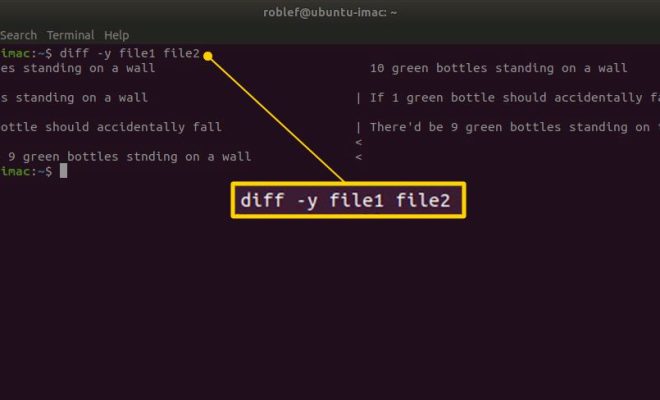
The “diff” command also has several flags that allow you to customize the output. For example, you can use the “-u” flag to show the differences in a unified format:

$ diff -u file1.txt file2.txt

You can also use the “-c” flag to show the differences in a context format:

$ diff -c file1.txt file2.txt

There are many other flags available, so be sure to read the “diff” command’s manual page for more information.

Step 5: Compare Directories

You can also use the “diff” command to compare directories. This is useful when you have several files that you want to compare. To compare two directories, use the “-r” flag followed by the directory names:

$ diff -r dir1/ dir2/

This will compare all the files in the “dir1” directory with the files in the “dir2” directory.

In conclusion, the “diff” command is a powerful tool that allows you to compare text files and directories in Linux. With a little practice, you’ll be able to use “diff” to quickly identify differences and similarities between files, ultimately making your workflow more efficient.

Previous Article

iTunes Authorized Explained: What It Is and ...

Next Article

Best Stretching Apps to Improve Your Flexibility

Matthew Lynch

Related articles More from author

  • Digital & Mobile Technology

    How to Enable or Disable Turbo Boost on Your Mac

    May 28, 2023
    By Matthew Lynch
  • Digital & Mobile Technology

    How to Set Up Parental Controls on a Router

    June 4, 2023
    By Matthew Lynch
  • Digital & Mobile Technology

    Free Healthy Cooking Apps for Beginners

    June 12, 2023
    By Matthew Lynch
  • Digital & Mobile Technology

    What Are Smart Bags?

    June 6, 2023
    By Matthew Lynch
  • Digital & Mobile Technology

    What lsass.exe Is & How It Affects Your Computer

    June 7, 2023
    By Matthew Lynch
  • Digital & Mobile Technology

    Websites to Help You Keep Up With Fashion Trends

    June 23, 2023
    By Matthew Lynch

Search

Login & Registration

  • Register
  • Log in
  • Entries feed
  • Comments feed
  • WordPress.org

Newsletter

Signup for The Tech Edvocate Newsletter and have the latest in EdTech news and opinion delivered to your email address!

About Us

Since technology is not going anywhere and does more good than harm, adapting is the best course of action. That is where The Tech Edvocate comes in. We plan to cover the PreK-12 and Higher Education EdTech sectors and provide our readers with the latest news and opinion on the subject. From time to time, I will invite other voices to weigh in on important issues in EdTech. We hope to provide a well-rounded, multi-faceted look at the past, present, the future of EdTech in the US and internationally.

We started this journey back in June 2016, and we plan to continue it for many more years to come. I hope that you will join us in this discussion of the past, present and future of EdTech and lend your own insight to the issues that are discussed.

Newsletter

Signup for The Tech Edvocate Newsletter and have the latest in EdTech news and opinion delivered to your email address!

Contact Us

The Tech Edvocate
910 Goddin Street
Richmond, VA 23231
(601) 630-5238
[email protected]

Copyright © 2025 Matthew Lynch. All rights reserved.