The Tech Edvocate

Top Menu

  • Advertisement
  • Apps
  • Home Page
  • Home Page Five (No Sidebar)
  • Home Page Four
  • Home Page Three
  • Home Page Two
  • Home Tech2
  • Icons [No Sidebar]
  • Left Sidbear Page
  • Lynch Educational Consulting
  • My Account
  • My Speaking Page
  • Newsletter Sign Up Confirmation
  • Newsletter Unsubscription
  • Our Brands
  • Page Example
  • Privacy Policy
  • Protected Content
  • Register
  • Request a Product Review
  • Shop
  • Shortcodes Examples
  • Signup
  • Start Here
    • Governance
    • Careers
    • Contact Us
  • Terms and Conditions
  • The Edvocate
  • The Tech Edvocate Product Guide
  • Topics
  • Write For Us
  • Advertise

Main Menu

  • Start Here
    • Our Brands
    • Governance
      • Lynch Educational Consulting, LLC.
      • Dr. Lynch’s Personal Website
      • Careers
    • Write For Us
    • The Tech Edvocate Product Guide
    • Contact Us
    • Books
    • Edupedia
    • Post a Job
    • The Edvocate Podcast
    • Terms and Conditions
    • Privacy Policy
  • Topics
    • Assistive Technology
    • Child Development Tech
    • Early Childhood & K-12 EdTech
    • EdTech Futures
    • EdTech News
    • EdTech Policy & Reform
    • EdTech Startups & Businesses
    • Higher Education EdTech
    • Online Learning & eLearning
    • Parent & Family Tech
    • Personalized Learning
    • Product Reviews
  • Advertise
  • Tech Edvocate Awards
  • The Edvocate
  • Pedagogue
  • School Ratings

logo

The Tech Edvocate

  • Start Here
    • Our Brands
    • Governance
      • Lynch Educational Consulting, LLC.
      • Dr. Lynch’s Personal Website
        • My Speaking Page
      • Careers
    • Write For Us
    • The Tech Edvocate Product Guide
    • Contact Us
    • Books
    • Edupedia
    • Post a Job
    • The Edvocate Podcast
    • Terms and Conditions
    • Privacy Policy
  • Topics
    • Assistive Technology
    • Child Development Tech
    • Early Childhood & K-12 EdTech
    • EdTech Futures
    • EdTech News
    • EdTech Policy & Reform
    • EdTech Startups & Businesses
    • Higher Education EdTech
    • Online Learning & eLearning
    • Parent & Family Tech
    • Personalized Learning
    • Product Reviews
  • Advertise
  • Tech Edvocate Awards
  • The Edvocate
  • Pedagogue
  • School Ratings
  • This One Flaw Just Blew Up the Guardian Smart Baby Monitor

  • The AI Race: Why Doomsday Warnings Can’t Stop the Train

  • XBOX: Activision takes over Halo, Obsidian joins Bethesda, and Ninja Theory is going

  • White House Arcade: 2nd Japan Protest, Nintendo Feud [2026]

  • One-Fifth of White-Collar Jobs Could Vanish by 2030, New Report Claims

  • Is a ‘Pacing’ AI Slowdown Really Possible? This Week’s AI News Roundup Reveals the Truth

  • California’s Bold Move: AB 1709 Social Media Restrictions Could Banish Teen Addiction

  • This One AI in Education Concern Is Completely Missing the Point

  • ShinyHunters Claims FBI Data Breach: Hacker Group Says It Stole Records of All Employees and Applicants

  • One Hacker, 100 Companies: The AI Cybersecurity Attack That Changed Everything

Online Learning & eLearning
Home›Online Learning & eLearning›How Does a Breadboard Work?

How Does a Breadboard Work?
By Matthew Lynch
June 23, 2023
0
Spread the love

A breadboard that is also known as a prototyping board or solderless breadboard is a fundamental tool that is used to make and test prototypes of electrical circuits. This tool is ideal for users who are looking to prototype or test electronic circuits fast without needing to go through the hassle of soldering components.

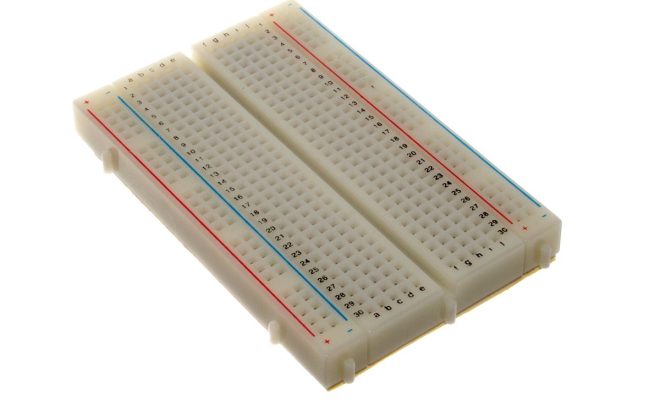
The simplest way to describe how a breadboard works is that it creates a temporary circuit by allowing you to insert and connect wires and various electrical components. They work by having a grid of small holes or pads made of metal that is arranged in a specific pattern. These small holes are designed to hold the leads of electrical components tightly into their spots. With the holes in these breadboards, it creates a socket where the components can easily be inserted. As a result, this creates a way to connect the leads of electronic components and experiment with the circuit without necessarily soldering all the components together.

Breadboards have two sets of holes or pads running down the center of the board, which are separated by a gap, often referred to as the “ditch”. The two halves of the board are electrically isolated, meaning that if you stick a wire into one half of the board, it will not connect with the other side unless you make an intentional connection.

The holes on the breadboard are connected to each other, hence the term “prototyping board”. The connections between each hole follow the pattern of the board. You will notice that each horizontal row of the breadboard is divided into five parts, and each of these parts is electrically connected. Along the bottom and top edges of the board are two horizontal rows that span the entire length of the board. These two lines are connected to positive and negative power rails respectively. By connecting these to an external power source, it can provide power to the components you are trying to prototype with.

In electrical circuits, it is essential to make connections that are solid and reliable. Breadboards make it very easy to do so without soldering, making it an ideal tool whether you are a novice or a seasoned electrical engineer. However, when you are working with high-frequency circuits or digital circuits, breadboards may not be the best solution since they may introduce noise or other signal problems.


Previous Article

How to Fix the Alt-Tab Keyboard Shortcut ...

Next Article

Ways to Fix DISM Error 2 in ...

Matthew Lynch

Related articles More from author

  • Online Learning & eLearning

    Layered Software And User Education Boost Cloud Security In K-12

    April 28, 2022
    By Matthew Lynch
  • Online Learning & eLearning

    Teaching Your Kids About eLearning

    January 16, 2024
    By Matthew Lynch
  • Elementary EducationOnline Learning & eLearning

    The Best Ways to Video Chat from Windows, Mac, iPhone, or Android

    April 1, 2023
    By Matthew Lynch
  • Online Learning & eLearning

    List the Different Types of Computer Software Packages

    March 28, 2023
    By Matthew Lynch
  • EdTech FuturesElementary EducationOnline Learning & eLearning

    SSD vs. HDD vs. USB Flash Drive: Everything You Need to Know

    March 30, 2023
    By Matthew Lynch
  • Online Learning & eLearning

    The Limitations Of eLearning And What You Can Do About Them

    January 27, 2020
    By Matthew Lynch

Search

Login & Registration

  • Log in
  • Entries feed
  • Comments feed
  • WordPress.org

Newsletter

Signup for The Tech Edvocate Newsletter and have the latest in EdTech news and opinion delivered to your email address!

About Us

Since technology is not going anywhere and does more good than harm, adapting is the best course of action. That is where The Tech Edvocate comes in. We plan to cover the PreK-12 and Higher Education EdTech sectors and provide our readers with the latest news and opinion on the subject. From time to time, I will invite other voices to weigh in on important issues in EdTech. We hope to provide a well-rounded, multi-faceted look at the past, present, the future of EdTech in the US and internationally.

We started this journey back in June 2016, and we plan to continue it for many more years to come. I hope that you will join us in this discussion of the past, present and future of EdTech and lend your own insight to the issues that are discussed.

Newsletter

Signup for The Tech Edvocate Newsletter and have the latest in EdTech news and opinion delivered to your email address!

Contact Us

The Tech Edvocate
910 Goddin Street
Richmond, VA 23231
(601) 630-5238
[email protected]

Copyright © 2026 Matthew Lynch. All rights reserved.