The Tech Edvocate

Top Menu

  • Advertisement
  • Apps
  • Home Page
  • Home Page Five (No Sidebar)
  • Home Page Four
  • Home Page Three
  • Home Page Two
  • Home Tech2
  • Icons [No Sidebar]
  • Left Sidbear Page
  • Lynch Educational Consulting
  • My Account
  • My Speaking Page
  • Newsletter Sign Up Confirmation
  • Newsletter Unsubscription
  • Our Brands
  • Page Example
  • Privacy Policy
  • Protected Content
  • Register
  • Request a Product Review
  • Shop
  • Shortcodes Examples
  • Signup
  • Start Here
    • Governance
    • Careers
    • Contact Us
  • Terms and Conditions
  • The Edvocate
  • The Tech Edvocate Product Guide
  • Topics
  • Write For Us
  • Advertise

Main Menu

  • Start Here
    • Our Brands
    • Governance
      • Lynch Educational Consulting, LLC.
      • Dr. Lynch’s Personal Website
      • Careers
    • Write For Us
    • The Tech Edvocate Product Guide
    • Contact Us
    • Books
    • Edupedia
    • Post a Job
    • The Edvocate Podcast
    • Terms and Conditions
    • Privacy Policy
  • Topics
    • Assistive Technology
    • Child Development Tech
    • Early Childhood & K-12 EdTech
    • EdTech Futures
    • EdTech News
    • EdTech Policy & Reform
    • EdTech Startups & Businesses
    • Higher Education EdTech
    • Online Learning & eLearning
    • Parent & Family Tech
    • Personalized Learning
    • Product Reviews
  • Advertise
  • Tech Edvocate Awards
  • The Edvocate
  • Pedagogue
  • School Ratings

logo

The Tech Edvocate

  • Start Here
    • Our Brands
    • Governance
      • Lynch Educational Consulting, LLC.
      • Dr. Lynch’s Personal Website
        • My Speaking Page
      • Careers
    • Write For Us
    • The Tech Edvocate Product Guide
    • Contact Us
    • Books
    • Edupedia
    • Post a Job
    • The Edvocate Podcast
    • Terms and Conditions
    • Privacy Policy
  • Topics
    • Assistive Technology
    • Child Development Tech
    • Early Childhood & K-12 EdTech
    • EdTech Futures
    • EdTech News
    • EdTech Policy & Reform
    • EdTech Startups & Businesses
    • Higher Education EdTech
    • Online Learning & eLearning
    • Parent & Family Tech
    • Personalized Learning
    • Product Reviews
  • Advertise
  • Tech Edvocate Awards
  • The Edvocate
  • Pedagogue
  • School Ratings
  • Ramp’s Staggering $60 Billion Valuation: 8 Reasons Why Investors Are Piling In

  • Uncovering the Cost: Why This AI Startup’s Collapse Is a Troubling Sign for Tech

  • The Silent Crisis: Why Your Next Console Will Cost a Fortune

  • Advisers urged to steer clear of ‘hyperscale’ AI models

  • The Quiet Crisis: Is AI in Education Creating an ‘Illusion of Learning’?

  • 84% of Ransomware Attacks Use AI: This Is How Your Own Systems Are Turning Against You

  • The Staggering Truth About Healthcare Cyberattacks: 76.6 Million Records Exposed in 2026

  • This Crucial Deadline For Rogue AI Is Much Closer Than You Think

  • This RNA Breakthrough Could Rewrite Alzheimer’s Treatment

  • This One Thing Is Silently Crushing US Consumer Inflation — And Your Wallet

Digital & Mobile Technology
Home›Digital & Mobile Technology›E-ATX vs. ATX vs. mATX vs. mini-ITX: All You Need to Know

E-ATX vs. ATX vs. mATX vs. mini-ITX: All You Need to Know
By Matthew Lynch
April 13, 2023
0
Spread the love

E-ATX (Extended ATX)
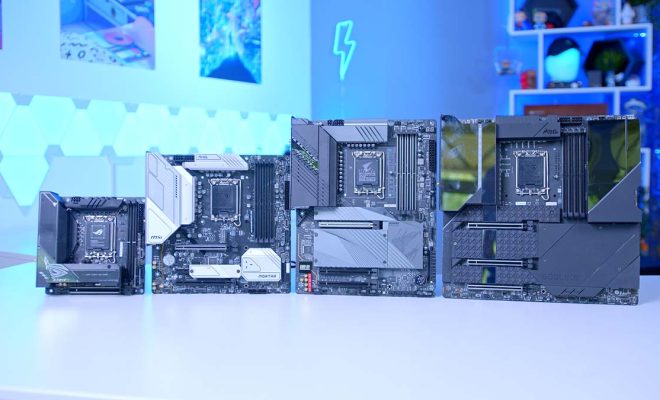
E-ATX motherboards are the largest and most feature-packed of all the motherboard sizes. They measure 12 x 13 inches and are designed for high-end workstations and gaming PCs. E-ATX motherboards typically have the most expansion slots, memory slots, and enhanced features such as dual CPUs and quad-channel memory support.
Pros:
– More expansion slots for graphics cards, sound cards, and other peripherals
– More memory slots for high-capacity builds
– Dual CPU support for extreme performance builds
– Quad-channel memory support for heavier workloads
Cons:
– Larger size can limit case compatibility
– Higher price point compared to smaller motherboard sizes
– Requires a larger power supply with higher wattage

ATX (Advanced Technology eXtended)
ATX motherboards are the standard size for most desktop computers. They measure 12 x 9.6 inches and are widely available and affordable. ATX motherboards are versatile and suitable for various builds, including gaming PCs and workstations.
Pros:
– Widely available and affordable
– Solid performance for most use cases
– Large enough to accommodate multiple graphics cards and expansion cards

Cons:
– Size and layout limitations may result in tighter component placement in some cases
– Fewer memory slots compared to E-ATX motherboards
– Limited support for specialized features compared to larger sizes

mATX (microATX)
mATX motherboards offer a smaller form factor than ATX motherboards but still provide enough features for most builds. They measure 9.6 x 9.6 inches and are suitable for budget builds or smaller case sizes.

Pros:
– Smaller size for cases with more limited space
– Solid performance for most applications
– Generally less expensive than larger size motherboards

Cons:
– Fewer expansion slots for graphics cards and other add-in cards
– Fewer memory slots than ATX motherboards
– Limited support for specialized features compared to larger sizes

mini-ITX
mini-ITX motherboards are the smallest form factor available for desktop computers. They measure 6.7 x 6.7 inches and are typically used in compact builds or home theater PCs. mini-ITX motherboards have only one PCIe slot limiting the number of expansion cards that can be installed.

Pros:
– Extremely small form factor for compact builds
– Low power consumption for energy-efficient builds
– Limited space usage ideal for media centers

Cons:
– Limited support for expansion cards
– Fewer memory slots compared to larger motherboard sizes
– Generally more expensive than larger size motherboards

Conclusion
Choosing the right motherboard size depends on the type of build you’re aiming to complete.


Previous Article

Easily Convert OST to PST Format with ...

Next Article

eMMC vs. SSD: Not All Solid-State Storage ...

Matthew Lynch

Related articles More from author

  • Digital & Mobile Technology

    How to Charge Your Android Phone Faster: 9 Tips and Tricks

    August 5, 2023
    By Matthew Lynch
  • Digital & Mobile Technology

    How to Fix It When Your PS5 Wi-Fi Is Slow

    June 12, 2023
    By Matthew Lynch
  • Digital & Mobile Technology

    What Is a Purple Team in Cybersecurity?

    June 15, 2023
    By Matthew Lynch
  • Digital & Mobile Technology

    How to Type an Exponent on a Keyboard

    June 1, 2023
    By Matthew Lynch
  • Digital & Mobile Technology

    Ways to Stop Websites Opening Automatically in Chrome

    June 13, 2023
    By Matthew Lynch
  • Digital & Mobile Technology

    The 6 Best Free Voice Changers for Chatting Online

    June 6, 2023
    By Matthew Lynch

Search

Login & Registration

  • Log in
  • Entries feed
  • Comments feed
  • WordPress.org

Newsletter

Signup for The Tech Edvocate Newsletter and have the latest in EdTech news and opinion delivered to your email address!

About Us

Since technology is not going anywhere and does more good than harm, adapting is the best course of action. That is where The Tech Edvocate comes in. We plan to cover the PreK-12 and Higher Education EdTech sectors and provide our readers with the latest news and opinion on the subject. From time to time, I will invite other voices to weigh in on important issues in EdTech. We hope to provide a well-rounded, multi-faceted look at the past, present, the future of EdTech in the US and internationally.

We started this journey back in June 2016, and we plan to continue it for many more years to come. I hope that you will join us in this discussion of the past, present and future of EdTech and lend your own insight to the issues that are discussed.

Newsletter

Signup for The Tech Edvocate Newsletter and have the latest in EdTech news and opinion delivered to your email address!

Contact Us

The Tech Edvocate
910 Goddin Street
Richmond, VA 23231
(601) 630-5238
[email protected]

Copyright © 2026 Matthew Lynch. All rights reserved.