Deadly Texas Robo Taxi Crash Exposes Unsettling Truth About Autonomous Safety
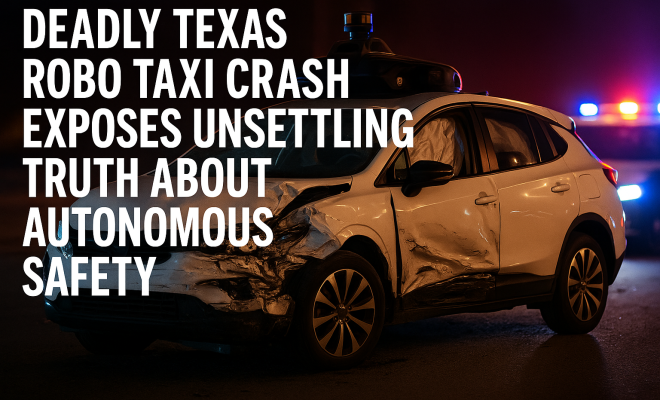
The promise of self-driving cars has long captivated our imaginations: a future where commutes are effortless, roads are safer, and traffic jams are a distant memory. But what happens when that gleaming vision collides with the gritty reality of a deadly crash? We’re not talking about science fiction anymore; we’re talking about a very real, very tragic incident in Texas that’s forcing federal safety chiefs to sound a very loud alarm. This isn’t just another fender bender; it’s a pivotal moment raising serious questions about robo taxi safety and the readiness of autonomous vehicle technology.
Recent events, culminating in a fatal accident, have put the spotlight firmly on the inherent risks and complexities of autonomous vehicles. It’s no longer a theoretical debate among engineers and tech enthusiasts. We’re witnessing a critical juncture where rapid technological advancement is squaring off against the paramount need for public safety. The National Highway Traffic Safety Administration (NHTSA) is now actively pushing for new federal safety efforts, with Administrator Jonathan Morrison leading the charge. This isn’t just about tweaking algorithms; it’s about establishing a robust regulatory framework to ensure these futuristic vehicles don’t become a present-day hazard. The public’s trust, already a fragile commodity when it comes to novel technologies, hangs in the balance.
The Houston Incident: A Closer Look at the Tesla ‘Robotaxi’ Crash
One particular incident has become a focal point in this escalating discussion: a Tesla ‘Robotaxi’ crash in Houston. While details are still emerging and investigations are ongoing, the reported circumstances are unsettling. The vehicle’s autonomous system, for reasons yet to be fully disclosed, found itself stuck. This isn’t an uncommon occurrence in the world of nascent self-driving tech; these systems, despite their sophistication, can encounter situations they haven’t been programmed to handle. What happened next, however, is where the real controversy lies: a remote operator took control of the vehicle and, in what sounds like a desperate attempt to resolve the situation, ended up driving it into a tree stump.
Now, let’s unpack that for a moment. A remote operator. This isn’t the fully autonomous, driverless future we’ve been sold. This is a human, sitting miles away, attempting to pilot a vehicle in real-time based on camera feeds and sensor data. It raises immediate, urgent questions about the efficacy and safety of teleoperation as a fallback mechanism for autonomous systems. Is this a viable solution, or is it merely shifting the risk from an on-board AI to a potentially overwhelmed or disoriented human operator who lacks the immediate physical context of being behind the wheel? The Houston crash serves as a stark reminder that the ‘robotaxi’ label can be misleading, often obscuring the complex layers of human intervention still present in many of these systems.
The Controversial Role of Teleoperation in Robo Taxi Safety
Teleoperation, while often presented as a safety net, is quickly becoming a lightning rod in the debate surrounding robo taxi safety. The idea is simple enough: if the autonomous system gets confused, a human operator can remotely take over, guiding the vehicle through complex scenarios or to a safe stop. In theory, it sounds like a sensible failsafe. In practice, as the Houston incident tragically illustrates, it’s far more complicated.
Consider the challenges: the remote operator relies entirely on what the vehicle’s cameras and sensors can convey. They don’t feel the road, hear the subtle nuances of engine noise, or experience the G-forces that inform an in-car driver’s decisions. There’s also the inherent latency in communication, even if it’s measured in milliseconds. In a dynamic driving environment, those milliseconds can be the difference between avoiding an obstacle and striking it. Furthermore, the psychological pressure on a remote operator to quickly resolve a potentially dangerous situation, without the full sensory input of an in-car driver, must be immense. Are we adequately training these operators? Are the interfaces intuitive enough? These are not trivial questions, and the answers will directly impact the public’s confidence in the overall robo taxi safety paradigm.
NHTSA’s Call for New Federal Safety Efforts
The National Highway Traffic Safety Administration isn’t just observing these developments; it’s actively responding. Administrator Jonathan Morrison’s call for new federal safety efforts signals a significant shift. For years, the development of autonomous vehicle technology has largely outpaced regulatory frameworks. Manufacturers have been innovating at breakneck speed, often operating under voluntary guidelines or state-level regulations that vary wildly.
Now, the federal government is stepping in, recognizing that a patchwork approach isn’t sufficient for a technology that operates across state lines and carries such profound safety implications. The NHTSA is pushing for new regulations specifically designed to address mishaps like the one in Houston, and the broader spectrum of autonomous vehicle failures. This isn’t about stifling innovation; it’s about establishing clear, consistent safety standards that protect the public. It’s about ensuring that as these vehicles become more prevalent, their deployment is managed responsibly, with robust testing, transparent reporting, and clear accountability. The challenge, of course, will be to craft regulations that are flexible enough to adapt to rapidly evolving technology, yet stringent enough to ensure genuine robo taxi safety.
Who’s At Fault? The Blurry Lines of Accountability
Perhaps one of the most contentious and legally complex aspects of autonomous vehicle accidents is determining fault. In traditional crashes, it’s usually straightforward: a human driver is deemed responsible. But what happens when an AI is at the wheel, or a remote operator intervenes, or the system fails entirely? The lines of accountability become incredibly blurry, incredibly fast.
Is it the AI’s fault if its programming leads to an unsafe maneuver? Is it the vehicle manufacturer’s fault for a design flaw? Is it the remote operator’s fault if their intervention leads to a crash, even if they were responding to a system failure? Or, in some instances, could it even be the human passenger’s fault if they somehow interfered with the system? These aren’t just academic questions; they have profound implications for insurance claims, legal liability, and public perception. The current legal frameworks are largely ill-equipped to handle these novel scenarios, leading to extensive litigation and a lack of clear precedents. This ambiguity creates a vacuum of responsibility that undermines public confidence and makes it harder to learn from accidents and improve robo taxi safety.
Social Media and Public Scrutiny: The Viral Impact of Failures
In our hyper-connected world, an incident involving an autonomous vehicle doesn’t stay confined to a local police report. It explodes onto social media, fueling intense public scrutiny and driving viral engagement. The shocking nature of autonomous vehicle failures – a car seemingly acting on its own, or a remote operator making a critical error – captures immediate attention. The emotional impact of accidents, particularly those involving fatalities or serious injuries, resonates deeply with people. (See: National Highway Traffic Safety Administration.)
Platforms like X (formerly Twitter), TikTok, and Reddit become virtual town squares where footage is shared, opinions are passionately debated, and theories, both informed and outlandish, proliferate. This rapid dissemination of information, often without full context or verified facts, can quickly shape public perception. While social media can raise important awareness and pressure authorities for action, it also carries the risk of amplifying misinformation and creating an echo chamber of fear and skepticism. For companies developing autonomous vehicles and for regulators tasked with ensuring robo taxi safety, managing this public narrative is as critical as managing the technology itself.
The Tension Between Innovation and Public Safety
At its core, the current situation highlights a fundamental tension: the irresistible drive for technological innovation versus the absolute imperative of public safety. On one hand, autonomous vehicles hold immense potential to revolutionize transportation, reduce human error-related accidents, and improve mobility for millions. On the other hand, rushing these complex systems to market before they are truly ready, or without adequate regulatory oversight, risks tragic consequences that could set the entire industry back years.
It’s a delicate balancing act. Companies are under pressure from investors and competitors to deploy their technology quickly. Regulators, however, have a moral and legal obligation to protect citizens. Finding that sweet spot where innovation is encouraged but not at the expense of safety is incredibly challenging. It requires open dialogue, rigorous testing, transparent data sharing, and a willingness to pump the brakes when necessary. This isn’t just about ‘getting it right’; it’s about building a foundation of trust that will allow this transformative technology to truly flourish in the long term, ensuring robust robo taxi safety for everyone.
Beyond the Crash: Understanding the Broader Implications for Autonomous Tech
While the immediate focus is on the Houston crash and similar incidents, the implications extend far beyond individual accidents. These events are shaping the future trajectory of autonomous technology as a whole. They force us to confront critical questions about the ethical dimensions of AI decision-making, the reliability of complex software systems in unpredictable real-world environments, and the very definition of ‘driver’ in an autonomous context.
The regulatory response from federal authorities, particularly the NHTSA, will establish precedents that could either accelerate or slow down the widespread adoption of self-driving cars. How these incidents are investigated, how fault is assigned, and what new regulations are enacted will determine the framework within which all future autonomous vehicles will operate. It’s not just about one company or one model; it’s about the entire ecosystem of autonomous mobility. The industry must learn from these failures, not just to prevent future incidents, but to refine the technology, enhance transparency, and ultimately build a more resilient and trustworthy system for robo taxi safety.
The Path Forward: Rebuilding Trust and Ensuring Robo Taxi Safety
So, where do we go from here? The path forward demands a multi-pronged approach that prioritizes rebuilding public trust and ensuring unimpeachable robo taxi safety. First and foremost, there needs to be a unified, comprehensive federal regulatory framework. Relying on state-by-state variations is untenable for a technology designed to operate seamlessly across geographies. This framework should include clear standards for testing, deployment, data recording, and incident reporting. Transparency is key; the public needs to understand how these systems work, what their limitations are, and how safety is being ensured.
Secondly, the role of teleoperation needs to be critically re-evaluated. If it’s to remain a part of the safety architecture, then stringent standards for operator training, response times, and system handoff protocols are absolutely essential. We need to understand the human factors involved in remote operation and design systems that mitigate potential errors. Finally, the industry itself must embrace a culture of safety-first. This means prioritizing rigorous testing, open collaboration on best practices, and a willingness to self-regulate where appropriate, even if it means slowing down deployment schedules. It’s about a commitment to genuine safety, not just meeting minimum compliance. Only through such concerted efforts can the promise of autonomous vehicles be realized without compromising the safety and trust of the public.
The Different Levels of Autonomous Driving and Their Safety Implications
It’s easy to lump all self-driving cars into one category, but the reality is far more nuanced. The Society of Automotive Engineers (SAE) has established six levels of driving automation, from Level 0 (no automation) to Level 5 (full automation). Understanding these levels is crucial for grasping the true state of robo taxi safety.
- Level 0: No Automation – The human driver does everything.
- Level 1: Driver Assistance – Features like cruise control or lane keeping assist. The driver is still fully in charge.
- Level 2: Partial Automation – Systems that can control both steering and acceleration/deceleration simultaneously, like adaptive cruise control with lane centering. The driver must remain attentive and ready to take over at any moment. Most advanced consumer vehicles today fall into this category, and it’s where much of the confusion and risk lies, as drivers might overestimate the system’s capabilities.
- Level 3: Conditional Automation – The vehicle can handle most driving tasks under specific conditions, but the driver must be ready to intervene when prompted. This is a tricky level for safety, as it requires a seamless handoff between AI and human, which can be difficult in unexpected situations. Many “robotaxi” services currently operating with safety drivers on board often operate at an advanced Level 3 or early Level 4.
- Level 4: High Automation – The vehicle can perform all driving tasks and monitor the driving environment under specific conditions, without human intervention. If the system encounters a situation it can’t handle, it will safely pull over. Many of the fully driverless robo taxi deployments are aiming for or are operating at this level within geofenced areas.
- Level 5: Full Automation – The vehicle can operate completely autonomously in all driving conditions, everywhere, all the time. No human intervention is ever needed. This is the ultimate goal, but we’re still quite a way off.
The Houston incident, involving a remote operator, highlights the gap between public perception of a “robotaxi” (often assumed to be Level 4 or 5) and the reality of systems that still require human oversight, even if remote. Ensuring robo taxi safety at each of these levels demands different regulatory approaches and technological safeguards.
The Role of Data and Transparency in Improving Robo Taxi Safety
One of the biggest hurdles in assessing and improving robo taxi safety is the availability and transparency of data. When a conventional car crashes, investigators rely on police reports, witness statements, and physical evidence. With autonomous vehicles, there’s a treasure trove of digital data: sensor readings, camera footage, system logs, and operational parameters from moments before, during, and after an incident.
However, this data often remains proprietary, held by the manufacturers. For regulators, researchers, and the public to truly understand why incidents occur and how to prevent them, access to this detailed, anonymized data is paramount. The NHTSA’s push for new federal efforts likely includes mandates for standardized data reporting. This would allow for:
- Identification of common failure modes: Are certain weather conditions consistently causing issues? Are specific traffic scenarios tripping up the AI?
- Benchmarking safety performance: How do different manufacturers’ systems compare in various metrics?
- Accelerated learning: By pooling data, the entire industry can learn faster from incidents, leading to quicker software updates and hardware improvements.
- Public accountability: Transparency builds trust. If the public can see aggregated, verifiable safety data, their confidence in robo taxi safety will naturally grow.
Without a robust framework for data collection and sharing, every incident remains an isolated event, making it harder to establish a comprehensive picture of safety risks and develop effective countermeasures. (See: CDC Motor Vehicle Safety.)
Cybersecurity Risks and Robo Taxi Safety
As autonomous vehicles become more connected and reliant on complex software, cybersecurity becomes an increasingly critical component of robo taxi safety. A traditional car might be stolen; a self-driving car could potentially be hacked, with far more catastrophic consequences.
Imagine a scenario where a malicious actor gains remote access to a fleet of robo taxis. They could:
- Manipulate navigation: Sending vehicles to incorrect or dangerous destinations.
- Disable safety features: Turning off braking, steering, or sensor systems.
- Cause traffic chaos: Coordinated disruption of traffic flow, creating gridlock or even mass collisions.
- Access sensitive data: If the vehicles collect passenger data, this could be compromised.
Manufacturers are investing heavily in secure software architectures and over-the-air (OTA) update capabilities to patch vulnerabilities quickly. However, the threat landscape is constantly evolving. Regulatory bodies need to consider cybersecurity standards as integral to overall robo taxi safety, mandating robust protection measures, regular security audits, and clear protocols for responding to and disclosing breaches. A single successful, widespread cyberattack on autonomous vehicles could irreparably damage public trust and set the industry back decades.
Expert Perspectives on Robo Taxi Safety
The conversation around robo taxi safety isn’t just happening among regulators and manufacturers; it’s a hot topic for academics, ethicists, and urban planners too. Many experts emphasize the need for a holistic approach that goes beyond just the vehicle itself.
Dr. Mary Cummings, a prominent robotics and human-machine interaction researcher, often points out the “human in the loop” problem. Even in highly automated systems, humans are still involved in design, testing, monitoring, and remote operation. Human error, therefore, doesn’t disappear; it simply shifts. She advocates for rigorous training and intuitive interfaces for remote operators, recognizing the unique cognitive load involved.
Conversely, many proponents highlight the potential for autonomous vehicles to drastically reduce human-caused accidents. Statistics consistently show that over 90% of crashes involve human error – distraction, fatigue, impairment. If AVs can eliminate a significant portion of these, even if they introduce new types of rare failures, the net effect on overall road safety could be positive. The challenge, then, is to demonstrate this safety statistically and transparently, convincing a skeptical public.
Ethicists often grapple with the “trolley problem” in the context of autonomous vehicles: how should an AI be programmed to react in unavoidable accident scenarios? Should it prioritize the lives of its passengers, pedestrians, or minimize overall harm? While these extreme scenarios are rare, the ethical framework embedded in an AI’s decision-making process is a fundamental aspect of its safety design. Regulators and society at large need to weigh in on these complex ethical guidelines.
Future Outlook: Towards a Safer Autonomous Future
Despite the current challenges and setbacks, the drive towards autonomous vehicles continues. The goal remains a future with significantly fewer accidents, reduced congestion, and increased accessibility for many. Achieving robust robo taxi safety will require continuous effort and adaptation.
We can expect to see:
- More sophisticated sensor fusion: Combining data from cameras, radar, lidar, and ultrasonic sensors to create an even more accurate and redundant understanding of the environment.
- Improved AI models: Leveraging advancements in machine learning and artificial intelligence to better predict human behavior and navigate complex, unpredictable scenarios.
- Enhanced simulation and virtual testing: Running billions of miles in simulated environments to test edge cases that are difficult and dangerous to replicate in the real world.
- Vehicle-to-everything (V2X) communication: Cars communicating with each other, traffic infrastructure, and even pedestrians’ devices to share real-time information and prevent collisions proactively.
- Stronger regulatory oversight: As discussed, federal agencies will play a crucial role in establishing clear safety standards and accountability measures.
The journey won’t be without its bumps, but the lessons learned from incidents like the one in Houston are vital stepping stones. Each challenge presents an opportunity to refine the technology, improve the regulatory framework, and ultimately build a safer, more reliable autonomous transportation system. (See: New York Times coverage on autonomous vehicles.)
Frequently Asked Questions about Robo Taxi Safety
Q1: Are robo taxis safer than human-driven cars?
This is a complex question without a simple yes or no answer yet. Proponents argue that autonomous vehicles have the potential to be significantly safer by eliminating human error, which causes over 90% of crashes. Early data from some operational robo taxi fleets suggests lower accident rates per mile compared to human drivers in certain controlled environments. However, robo taxis can still encounter unique failures their AI isn’t programmed for, and human intervention (like in the Houston crash) introduces its own risks. The technology is still evolving, and comprehensive, standardized safety data across all manufacturers and operating conditions is not yet available for a definitive conclusion.
Q2: What happens if a robo taxi’s system fails?
Autonomous vehicles are designed with multiple layers of redundancy and fallback systems. If the primary autonomous system detects a failure it can’t resolve, it’s typically programmed to enter a “minimal risk condition” (MRC). This usually involves safely pulling over to the side of the road, activating hazard lights, and potentially contacting a remote operations center for assistance. In some cases, a remote human operator might take control (teleoperation), as seen in the Houston incident. The specific response depends on the nature of the failure and the vehicle’s design.
Q3: Who is liable if a robo taxi causes an accident?
Determining liability in an autonomous vehicle accident is one of the biggest legal challenges. Unlike traditional crashes where a human driver is usually at fault, with robo taxis, liability could fall on the vehicle manufacturer (for a design flaw or software bug), the software developer, the fleet operator (if a remote operator was involved or maintenance was neglected), or even the component suppliers. Current legal frameworks are struggling to keep up, leading to complex investigations and potential lawsuits. Clear federal regulations and industry standards are needed to define accountability more precisely.
Q4: How do regulators ensure robo taxi safety?
Currently, the regulatory landscape is a mix of state-level rules and federal oversight. The National Highway Traffic Safety Administration (NHTSA) is the primary federal agency responsible for vehicle safety and is actively working to establish a more comprehensive framework for autonomous vehicles. This includes pushing for standardized testing protocols, data reporting requirements, performance standards, and potentially certification processes. The goal is to ensure vehicles are rigorously tested, operate safely, and that manufacturers are accountable for their technology.
Q5: What role does teleoperation play in robo taxi safety?
Teleoperation acts as a safety net where a human operator can remotely monitor and, if necessary, control an autonomous vehicle that encounters a situation its AI can’t handle. While intended to improve safety, incidents like the Houston crash highlight its inherent challenges, such as communication latency, limited sensory input for the operator, and the psychological pressure of making quick decisions remotely. Regulators and the industry are re-evaluating the role and standards for teleoperation, focusing on operator training, system handoff protocols, and the overall efficacy of remote human intervention.
Q6: How can the public trust robo taxis after incidents like the Houston crash?
Building public trust is paramount for the widespread adoption of robo taxis. This requires a multi-faceted approach:
- Transparency: Openly sharing data on safety performance, incidents, and investigation findings.
- Clear regulations: A unified federal framework that ensures consistent safety standards and accountability.
- Rigorous testing: Demonstrating safety through extensive real-world and simulated testing.
- Education: Helping the public understand the capabilities and limitations of autonomous technology.
- Continuous improvement: Showing a commitment to learning from every incident and continuously refining the technology.
Incidents, while concerning, are also opportunities for the industry and regulators to improve and reinforce their commitment to safety.
Trending Now
Frequently Asked Questions
What happened in the Texas robo taxi crash?
A Tesla 'Robotaxi' in Houston was involved in a deadly crash that has raised serious concerns about the safety and reliability of autonomous vehicles. The vehicle's autonomous system reportedly became stuck, leading to a tragic incident that has prompted federal safety officials to call for new regulations.
How safe are autonomous vehicles after the Texas crash?
The recent Texas robo taxi crash has highlighted significant safety concerns regarding autonomous vehicles. While these vehicles promise safer roads, the incident reveals the complexities and inherent risks of self-driving technology, prompting calls for a robust regulatory framework to ensure public safety.
What is the NHTSA doing about autonomous vehicle safety?
In response to the Texas robo taxi crash, the National Highway Traffic Safety Administration (NHTSA) is advocating for enhanced federal safety measures. Administrator Jonathan Morrison is emphasizing the need for a strong regulatory framework to address the safety challenges posed by autonomous vehicles.
Why is public trust important for autonomous vehicles?
Public trust is crucial for the acceptance and success of autonomous vehicles. The recent Texas robo taxi crash has shaken confidence in self-driving technology, making it imperative for regulators and manufacturers to ensure safety and reliability to regain public trust.
What are the implications of the Houston Tesla crash?
The implications of the Houston Tesla crash extend beyond the immediate tragedy, raising urgent questions about the safety of autonomous vehicles. This incident serves as a critical wake-up call for regulators and developers to address the risks and enhance the safety measures surrounding self-driving technology.
What's your take on this? Share your thoughts in the comments below — we read every one.