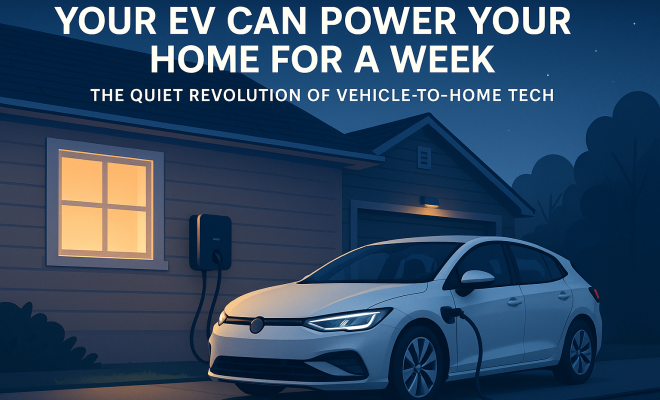
Your EV Can Power Your Home for a Week: The Quiet Revolution of Vehicle-to-Home Tech
“`html
Imagine this: the power goes out, the neighborhood goes dark, but your lights stay on, your fridge hums, and your Wi-Fi keeps streaming. Why? Because your electric vehicle, sitting quietly in your driveway, is now powering your entire home. This isn’t some far-off sci-fi fantasy; it’s the rapidly unfolding reality of Vehicle-to-Home (V2H) technology, and it’s set to fundamentally change how we think about energy independence and home backup.
For years, dedicated home battery systems like the Tesla Powerwall have been the go-to solution for energy storage, but they come with a hefty price tag. Now, your EV, which you already own and drive, is stepping up as a powerful, cost-effective alternative. We’re not talking about just an hour or two of power, either. Many modern EVs can keep an average home running for three to seven days on a single charge. This capability is becoming a game-changer, especially as grid stability becomes a growing concern and the desire for self-sufficiency rises. Let’s dive into the fascinating world of vehicle to home technology and explore the top ten reasons why it’s gaining such incredible momentum.
1. The Dawn of Energy Independence: Your Car, Your Power Plant
One of the most compelling aspects of vehicle to home technology is the unparalleled sense of energy independence it offers. Think about it: during a blackout, instead of being at the mercy of the grid, your electric vehicle transforms into a mobile power station, feeding electricity directly into your home. This isn’t just about convenience; it’s about control. You’re no longer solely reliant on external infrastructure, which can be vulnerable to severe weather events, infrastructure failures, or even cyberattacks.
This capability fundamentally shifts the paradigm of home energy. It moves us away from a purely consumer relationship with electricity to one where we are also producers and storers. The implications are enormous, particularly for those living in areas prone to grid instability. Having the ability to keep essential appliances running – your refrigerator, lights, medical devices, and communication systems – provides a peace of mind that traditional generators often can’t match, given their fuel requirements and noise levels. This builds on Drax Group's battery expansion.
2. Cost-Effectiveness That’s Hard to Beat: A Smart Investment
Let’s talk dollars and cents, because this is where V2H really shines. Installing a dedicated home battery system, like a Tesla Powerwall, typically runs you anywhere from $12,500 to $14,500, and that’s before installation costs. These are significant investments, often pushing them out of reach for many homeowners, despite the benefits.
Compare that to the costs associated with a vehicle to home setup. We’re looking at a range of roughly $1,500 to $8,000 for the necessary bidirectional charging equipment and installation. Considering you’ve already made the primary investment in the electric vehicle itself, this additional cost is dramatically lower for achieving robust home backup. This makes V2H an incredibly attractive proposition for anyone considering energy storage, leveraging an asset they already own and use daily.
3. Extended Home Backup Capabilities: Days, Not Hours
Forget the old-school generators that guzzle gasoline and often only last for a few hours. Modern V2H-capable EVs are designed to provide substantial backup power. Many models hitting the market today, or those already available, can power an average home for a remarkable three to seven days. That’s a full work week of energy independence, which can be crucial during prolonged grid outages.
This extended capability means you’re not just keeping the lights on; you’re maintaining a semblance of normalcy. You can run your HVAC system, cook meals, and keep your family comfortable for an extended period without scrambling for fuel or worrying about your food spoiling. The sheer capacity of these large EV batteries is what makes this possible, offering far more kilowatt-hours than most standalone home battery solutions at a fraction of the effective cost.
4. Leading the Charge: The Ford F-150 Lightning
When it comes to vehicle to home, the Ford F-150 Lightning has been a true pioneer, effectively bringing this technology to the mainstream. Ford’s ‘Intelligent Backup Power’ system, integrated with the F-150 Lightning, allows the truck to automatically power a home during an outage, provided it’s connected to Ford’s Charge Station Pro and a home integration system.
This isn’t just a gimmick; it’s a robust solution. Depending on the battery size (Standard Range or Extended Range), the F-150 Lightning can provide days of power. For many, this truck isn’t just a vehicle; it’s a dual-purpose investment that serves as both a workhorse and a critical piece of home infrastructure. Ford has really leaned into this capability, making it a key selling point and demonstrating the practical, real-world utility of V2H.
5. Kia EV9’s Bidirectional Prowess: A Stylish Solution
Not to be outdone, Kia has also entered the V2H arena with its impressive EV9. This three-row electric SUV, a stylish and family-friendly option, comes standard with bidirectional charging capabilities. This means it’s inherently designed to not only accept a charge but also to discharge power back into a home or even the grid (V2G – Vehicle-to-Grid). (See: Electric vehicles as home power sources.)
The EV9 leverages Kia’s E-GMP platform, which supports 800V architecture, enabling incredibly fast charging and robust power delivery. For families looking for a versatile vehicle that can handle daily commutes, road trips, and also act as a reliable home backup power source, the EV9 presents a compelling package. It demonstrates that V2H isn’t limited to trucks but is becoming a feature in a wider range of consumer EVs.
6. Tesla’s Powershare and the Cybertruck: The Future is Here
It’s no surprise that Tesla, a company synonymous with electric vehicles and energy storage, is also deeply invested in vehicle to home technology. Their system, known as ‘Powershare,’ is integrated with the highly anticipated Cybertruck. While the Cybertruck itself is a polarizing design, its V2H capabilities are undeniably forward-thinking. For more context, see collaboration tools for energy management. See also China's new energy solution.
Powershare will allow the Cybertruck to provide up to 11.5 kW of power to a home, making it a formidable backup option. Tesla’s approach typically involves seamless integration with their existing energy ecosystem, meaning a Cybertruck could potentially work in concert with a Tesla Powerwall or solar roof for a comprehensive home energy solution. This strategic move by Tesla will undoubtedly accelerate V2H adoption, given the brand’s immense influence and customer base.
7. Semi-Solid-State Battery Breakthroughs: Enhancing EV Appeal
Beyond the V2H functionality itself, advancements in battery technology are making EVs even more attractive, which in turn fuels V2H adoption. A significant breakthrough comes from companies like Dongfeng, which has confirmed mass production of semi-solid-state batteries for 2026. These batteries promise a range of over 1000 kilometers (more than 620 miles) on a single charge.
What does this mean for vehicle to home? Firstly, a longer range reduces range anxiety, making EVs a more viable primary vehicle for more people. Secondly, these batteries often boast improved safety characteristics compared to traditional lithium-ion batteries. And most importantly for V2H, a larger battery capacity for driving directly translates to more available power for your home backup. The more energy stored in your EV, the longer it can power your home during an outage, making the V2H proposition even stronger.
8. The Growing Need for Grid Resilience: A National Imperative
The increasing frequency and intensity of extreme weather events – from hurricanes and blizzards to heatwaves straining power grids – highlight a critical need for greater grid resilience. Power outages are becoming more common and often more prolonged, causing significant disruptions and economic losses. In this context, vehicle to home technology isn’t just a convenience; it’s becoming a crucial component of personal and community preparedness.
By decentralizing power backup and placing it in the hands of individual homeowners, V2H can contribute to a more robust and distributed energy system. It reduces the strain on the grid during peak demand times if vehicles are also used for V2G (Vehicle-to-Grid) services, and it provides immediate, localized power when the centralized grid fails. This societal benefit is a powerful driver for the continued development and adoption of V2H solutions.
9. Seamless Solar Integration Opportunities: A Synergistic Approach
For homeowners who already have solar panels or are considering installing them, vehicle to home technology creates a truly synergistic ecosystem. Imagine your solar panels charging your EV during the day, and then that same EV powering your home at night or during an outage. This combination maximizes the value of both investments.
The ability to store excess solar energy in your EV’s large battery, rather than sending it back to the grid for minimal credit, can significantly improve your home’s energy independence and reduce your electricity bills. It’s a closed-loop system where renewable energy is generated, stored, and consumed efficiently within your own property. This integration is a huge selling point for environmentally conscious consumers and those striving for true energy self-sufficiency.
10. The Future of Home Energy Management: Smart and Connected
Vehicle to home technology is just one piece of a much larger puzzle: the smart home energy ecosystem of the future. As V2H becomes more prevalent, we can expect increasingly sophisticated energy management systems that seamlessly integrate EVs, solar panels, dedicated home batteries, and smart appliances.
These systems will be able to intelligently manage energy flow, prioritizing charging based on electricity prices, discharging to power the home during peak hours to save money, and automatically switching to backup power during an outage. The vehicle will become an integral, intelligent component of the home, optimizing energy use and providing unparalleled flexibility. This evolution will not only save consumers money but also contribute to a more stable and sustainable energy grid for everyone.
11. Understanding the Technical Backbone: Bidirectional Charging
At the heart of vehicle to home technology lies a crucial innovation: bidirectional charging. Most standard EV chargers are unidirectional, meaning they only allow electricity to flow from the grid to your car’s battery. Bidirectional chargers, however, are designed to do both. They can charge your EV and also draw power back from the EV’s battery to send it into your home’s electrical panel.
This capability requires a specific type of charging station, often called a V2H inverter or a smart bidirectional charger. These devices convert the DC (direct current) electricity stored in your EV’s battery into AC (alternating current) electricity, which is what your home appliances use. The inverter also needs to safely isolate your home from the main grid during a power outage to prevent backfeeding electricity, which could endanger utility workers. This technical sophistication is why the installation of a V2H system is typically handled by certified electricians, ensuring safety and compliance with local electrical codes. (See: Vehicle-to-grid technology explained.)
12. Vehicle-to-Grid (V2G) and Vehicle-to-Everything (V2X): The Broader Vision
While V2H focuses on powering your home, it’s actually part of a larger family of technologies known as Vehicle-to-Everything (V2X). This umbrella term includes Vehicle-to-Grid (V2G) and Vehicle-to-Load (V2L) as well. V2G takes the concept a step further by allowing your EV to not only power your home but also sell excess energy back to the main electrical grid. Imagine getting paid by your utility company to help stabilize the grid during peak demand or when renewable energy sources like solar or wind aren’t producing as much.
V2L, on the other hand, is a simpler, more direct application, allowing you to plug appliances directly into your EV for power, like using your car to run power tools at a job site or charge your camping gear. Many new EVs, like the Hyundai Ioniq 5 and Kia EV6, offer V2L functionality straight out of the box with an adapter. V2X collectively represents a future where EVs are not just transportation, but dynamic, mobile energy assets that interact intelligently with our homes, communities, and the broader energy infrastructure. For more context, see cybersecurity and energy systems.
13. Regulatory Landscape and Incentives: Paving the Way
The widespread adoption of vehicle to home technology isn’t just about technical capabilities; it also depends heavily on supportive regulatory environments and financial incentives. Governments and utility companies are beginning to recognize the immense potential of V2H and V2G to enhance grid stability, integrate more renewable energy, and provide resilience against outages.
In some regions, pilot programs are testing V2G concepts, offering incentives to EV owners who participate. Tax credits, rebates, and other financial programs for installing bidirectional chargers or purchasing V2H-capable EVs are slowly emerging. For example, some states in the US offer clean energy incentives that might apply to V2H infrastructure. As these policies become more standardized and widespread, they will significantly reduce the upfront cost for consumers and accelerate the transition to a more distributed and resilient energy system. Keeping an eye on local and national incentives is a smart move if you’re considering V2H.
14. Future-Proofing Your Home: Preparing for a Dynamic Grid
Investing in vehicle to home technology isn’t just about solving today’s problems; it’s about preparing your home for the energy landscape of tomorrow. The grid is becoming increasingly dynamic, with a growing reliance on intermittent renewable energy sources. This means that periods of energy abundance (when the sun is shining brightly, or the wind is blowing strongly) will be followed by periods of scarcity.
V2H, especially when combined with V2G capabilities, positions your home to thrive in this environment. Your EV acts as a flexible battery, absorbing excess energy when it’s cheap and abundant, and discharging it when prices are high or the grid needs support. This ability to intelligently manage energy flow will be invaluable in a future where electricity prices fluctuate more frequently and grid stability becomes an even greater challenge. It’s a proactive step towards greater energy autonomy and financial savings. For more on this, see Future electric vehicle challenges.
15. Expert Perspectives: What Industry Leaders Are Saying
Industry experts are incredibly bullish on the future of vehicle to home and V2X technologies. Many see it as a natural evolution of both electric vehicles and smart home energy systems. For instance, utilities are increasingly interested in the aggregated storage capacity of millions of EVs, viewing them as a “virtual power plant” that can provide crucial support during peak demand or emergencies.
Automakers are not just adding V2H as a feature; they’re designing entire platforms, like Hyundai’s E-GMP, with bidirectional capabilities in mind from the ground up. Energy storage companies are also adapting, creating home energy management systems that seamlessly integrate with V2H. The consensus is that the technology is robust, the economic benefits are clear, and the societal advantages for grid resilience and renewable energy integration are too significant to ignore. We’re seeing a convergence of automotive, energy, and smart home industries around this transformative capability.
Frequently Asked Questions About Vehicle to Home (V2H)
Q1: What exactly is Vehicle to Home (V2H) technology?
V2H technology allows your electric vehicle (EV) to send electricity stored in its battery back into your home’s electrical system. This means your EV can act as a large, mobile battery bank, powering your house during a power outage or helping to offset your energy consumption during peak hours.
Q2: How does V2H differ from a traditional home generator?
V2H uses your EV’s electric battery, meaning it operates silently and produces zero emissions. Traditional generators typically run on gasoline, diesel, or natural gas, producing noise, fumes, and requiring fuel storage. V2H also offers smart energy management features and can integrate with solar, which most generators can’t. Plus, you already own the primary “fuel source” – your EV. There’s a fuller look at Trends in the automotive industry.
Q3: What equipment do I need for a V2H setup?
You’ll need a V2H-compatible electric vehicle, a bidirectional charging station (also known as a V2H inverter or smart charger), and a home energy management system or an automatic transfer switch to safely connect your EV to your home’s electrical panel and isolate it from the grid during an outage. Professional installation by a certified electrician is essential. For more context, see AI tools transforming energy solutions. (See: Impact of EVs on energy systems.)
Q4: Which electric vehicles currently support V2H?
The list of V2H-capable vehicles is growing rapidly. Notable examples include the Ford F-150 Lightning (with Ford’s Intelligent Backup Power system), the Kia EV9, and the Tesla Cybertruck (with Powershare). Some other vehicles offer V2L (Vehicle-to-Load) for direct appliance power, which is a step towards full V2H, but not the same thing.
Q5: How long can an EV power a home using V2H?
The duration depends on your EV’s battery capacity and your home’s energy consumption. Many modern V2H-capable EVs can power an average home for three to seven days on a single charge. Larger battery packs, like those found in electric trucks, typically offer longer backup times.
Q6: Will using my EV for V2H drain its battery too much for driving?
Most V2H systems allow you to set a minimum battery charge level, ensuring you always retain enough range for your daily commute or emergency travel. The system can be programmed to stop discharging once that threshold is reached.
Q7: Is V2H safe for my home and appliances?
Yes, when properly installed by a certified professional, V2H systems are designed with safety in mind. The bidirectional charger and home integration system include safety mechanisms, like automatic transfer switches, to prevent backfeeding electricity to the grid and protect your home’s electronics.
Q8: What’s the difference between V2H and V2G (Vehicle-to-Grid)?
V2H specifically refers to an EV powering a single home. V2G is a broader concept where an EV can send electricity back to the main utility grid, potentially earning the owner credits or payments. V2H is often a stepping stone to full V2G capabilities.
Q9: Can V2H help me save money on my electricity bill?
Absolutely. If your utility offers time-of-use (TOU) rates, you can charge your EV when electricity is cheapest (off-peak hours) and then use that stored energy to power your home during expensive peak hours, reducing your reliance on the grid when rates are high. If you have solar, you can store excess solar energy in your EV rather than sending it back for minimal credit.
Q10: Is V2H compatible with solar panels?
Yes, V2H and solar panels are highly synergistic. Your solar panels can charge your EV during the day with clean energy, and then your EV can power your home at night or during an outage, creating a truly independent and sustainable home energy ecosystem. Many V2H systems are designed for seamless integration with existing or new solar installations.
The rise of vehicle to home technology is more than just a clever trick; it’s a fundamental shift in how we approach energy. With cost-effective setups, extended backup capabilities, and a growing list of V2H-enabled EVs, the future of energy independence might just be parked in your driveway. As batteries get better and integration becomes more seamless, expect your car to do a whole lot more than just get you from point A to point B.
“`
Trending Now
Frequently Asked Questions
Can an electric vehicle power a home during an outage?
Yes, many modern electric vehicles (EVs) can power a home during outages through Vehicle-to-Home (V2H) technology. This allows your EV to act as a backup power source, providing electricity for several days, depending on the vehicle's charge and the home's energy needs.
What is Vehicle-to-Home technology?
Vehicle-to-Home (V2H) technology enables electric vehicles to supply energy directly to a home. This innovative system allows homeowners to utilize their EVs as mobile power stations, providing a reliable energy source during blackouts or when grid stability is compromised.
How long can an EV power a house?
Many electric vehicles can power an average home for three to seven days on a single charge, depending on the EV's battery capacity and the household's energy consumption. This capability makes EVs a cost-effective alternative to traditional home battery systems.
What are the benefits of using an EV for home power?
Using an EV for home power offers energy independence, cost savings, and security during outages. It transforms the EV into a mobile power plant, reducing reliance on the grid and providing homeowners with control over their energy resources.
Is V2H technology cost-effective compared to home batteries?
Yes, V2H technology is often more cost-effective than dedicated home battery systems like the Tesla Powerwall. Since many people already own EVs, leveraging them for home power reduces the need for additional costly battery installations.
Have you experienced this yourself? We'd love to hear your story in the comments.