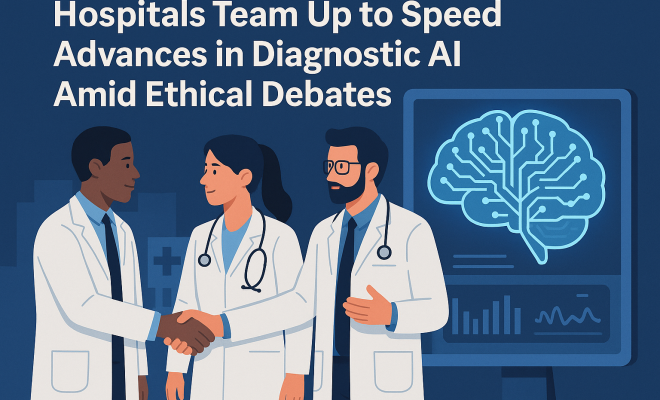
Hospitals Team Up to Speed Advances in Diagnostic AI Amid Ethical Debates
“`html
Imagine a future where a second opinion isn’t just a human physician, but an artificial intelligence sifting through millions of data points in a fraction of a second, spotting patterns the human eye might miss. That future isn’t some distant sci-fi fantasy; it’s here, and it’s being built right now in some of the most prestigious hospitals across the United States. A fascinating, if somewhat unnerving, development is underway: a dozen leading U.S. health systems, including powerhouses like Cedars-Sinai and Mount Sinai, have teamed up with an AI healthcare company called Aidoc. Their mission? To operationalize diagnostic imaging AI at a scale we haven’t seen before. They want to move beyond the small, contained pilot programs and really integrate AI into the fabric of daily medical practice. It’s an ambitious goal, aiming to revolutionize how quickly and accurately we detect diseases. But as with any technology that touches human lives so intimately, especially in life-and-death scenarios, this push for rapid advancement brings a whole host of questions, particularly around diagnostic AI ethics.
This isn’t just about making things a little faster; it’s about fundamentally reshaping the diagnostic process. Think about the implications for cancer detection, stroke identification, or identifying rare diseases that often stump even experienced clinicians. The potential upsides are enormous, promising a future with earlier interventions and better patient outcomes. Yet, the very power of this technology demands a careful, nuanced approach. We’re talking about algorithms that learn from vast datasets, and if those datasets carry inherent biases, the AI will perpetuate them, potentially exacerbating existing health inequities. How do we ensure these systems are fair, transparent, and ultimately, safe for every patient, regardless of their background or socioeconomic status? These are the thorny questions that are, rightly, at the forefront of this conversation.
The Collaborative Push: Beyond Pilot Programs
For years, we’ve heard about AI pilots in healthcare – isolated projects demonstrating what the technology *could* do. But the real challenge has always been scaling these innovations, integrating them seamlessly into complex hospital workflows, and proving their value in the messy reality of day-to-day patient care. That’s precisely what this new consortium, spearheaded by institutions like Cedars-Sinai and Mount Sinai, aims to tackle. They’re not just experimenting; they’re building a practical blueprint, a repeatable playbook for wider adoption. Their strategy involves rigorous testing, workflow integration, and crucially, publishing transparent outcomes. This commitment to sharing results is vital, as it allows other health systems to learn from their successes and failures, accelerating the overall pace of responsible AI deployment.
The collaboration with Aidoc is a significant step. Aidoc specializes in AI solutions for diagnostic imaging, which means their technology is designed to analyze X-rays, CT scans, MRIs, and other medical images, flagging critical findings for radiologists. By working with a dozen diverse health systems, Aidoc gains access to a massive and varied dataset, which is precisely what AI models need to become more robust and accurate. For the hospitals, it means leveraging cutting-edge technology without having to build it all from scratch, and benefiting from shared learning across the consortium. It’s a pragmatic approach to innovation, acknowledging that the challenges of implementing AI at scale are too great for any single institution to solve alone.
The Ethical Imperative: Navigating Diagnostic AI Ethics
As these technological advancements accelerate, the ethical debates surrounding AI in medicine become more pressing. It’s not enough to simply develop powerful AI; we have to ensure it’s deployed thoughtfully, equitably, and safely. Experts across the medical and technological fields are calling for thoughtful regulations. Why? Because without clear guidelines, we risk creating a system that could inadvertently harm patients, perpetuate biases, or erode the crucial human element of care. The core of diagnostic AI ethics revolves around several key pillars: patient safety, bias mitigation, and maintaining appropriate clinician oversight.
Patient safety, of course, is paramount. An AI misdiagnosis, even if rare, could have catastrophic consequences. This necessitates robust validation processes, continuous monitoring, and clear protocols for when and how clinicians override AI recommendations. Then there’s the insidious issue of bias. AI models learn from historical data, and if that data reflects existing disparities in healthcare access, treatment, or diagnostic accuracy across different demographic groups, the AI will internalize and amplify those biases. Imagine an AI that performs less accurately for certain racial groups or genders because the training data was predominantly drawn from another. This isn’t a hypothetical; it’s a very real danger. Finally, clinician oversight is non-negotiable. AI should be a tool that augments human expertise, not replaces it. Doctors need to understand how the AI arrives at its conclusions, retain the ultimate decision-making authority, and be able to intervene when necessary. The human-in-the-loop approach is critical for trust and accountability.
Bias and Fairness: A Deep Dive into Algorithmic Blind Spots
Let’s get specific about bias, because it’s arguably one of the most significant ethical hurdles for diagnostic AI. When AI models are trained on datasets that don’t accurately represent the diversity of the patient population, they inevitably develop blind spots. For instance, if a radiology AI is trained predominantly on images from Caucasian males, it might perform less accurately when analyzing images from women or individuals of different ethnic backgrounds. This isn’t malicious intent; it’s a consequence of data imbalance. The historical data used to train these models often reflects existing societal inequalities – who has access to healthcare, who gets certain diagnostic tests, and whose conditions are better documented. (See: NIH initiative on AI in healthcare.)
The implications of such bias are profound. An AI might miss a critical finding in a marginalized patient, leading to delayed diagnosis and poorer outcomes. Conversely, it might over-diagnose in another group, leading to unnecessary procedures and anxiety. Addressing this requires a multi-pronged approach: actively curating diverse and representative datasets, developing techniques to detect and mitigate bias during model training, and conducting rigorous external validation across varied patient populations. Furthermore, transparency about the limitations of an AI model – for which patient groups it performs best, and where its accuracy might drop – is an ethical imperative. Without these measures, AI could inadvertently deepen healthcare disparities, making the promise of equitable care an empty one.
The Role of Clinician Oversight and Accountability
One common misconception is that AI will replace doctors. That’s not the goal, nor is it a desirable outcome in diagnostic medicine. Instead, AI is envisioned as a powerful assistant, a co-pilot that helps clinicians be more efficient and accurate. This means maintaining robust clinician oversight is absolutely crucial. When an AI flags a potential abnormality on an imaging scan, the radiologist still needs to review it, interpret it in the context of the patient’s full medical history, and make the final diagnostic call. The AI provides a prompt, a second set of “eyes” that never gets tired, but the ultimate responsibility remains with the human expert. For more context, see AI Security Incident Reporting.
Accountability is another key component of diagnostic AI ethics. If an AI makes a recommendation that leads to a poor patient outcome, who is responsible? Is it the developer of the AI? The hospital that deployed it? The clinician who used it? These are complex legal and ethical questions that are still being debated. Clear frameworks for accountability need to be established, ensuring that there are mechanisms for redress and learning. Furthermore, clinicians need adequate training on how to interact with AI systems, understanding their capabilities, limitations, and how to critically evaluate their outputs. It’s about fostering a collaborative intelligence, where the strengths of both human and artificial intelligence are leveraged for the patient’s benefit.
Rapid Advancements: From Pathology to Predictive AI
The scope of AI in diagnosis extends far beyond imaging. Consider the fascinating work happening at Yale, where AI is being used in pathology. Pathologists traditionally examine tissue samples under a microscope to diagnose diseases like cancer. This is a highly skilled, labor-intensive process. AI can analyze these intricate slides, often identifying subtle anomalies or patterns that might be difficult for a human to spot, or doing so with greater consistency across different samples. This doesn’t just speed up diagnosis; it can potentially improve its accuracy and reproducibility, leading to more consistent treatment plans.
Beyond current diagnoses, AI is rapidly advancing into predictive and generative realms. Predictive AI can analyze a patient’s electronic health records, genetic data, and lifestyle factors to estimate their risk of developing certain diseases in the future. Imagine identifying individuals at high risk for diabetes or heart disease years in advance, allowing for proactive lifestyle interventions. Generative AI, on the other hand, can create synthetic data for training models, or even help generate personalized treatment plans or drug discovery insights. These advancements are transforming virtually every aspect of medical practice, from early detection to personalized medicine, but each new capability introduces its own set of ethical considerations that need careful thought and proactive policy development.
The Need for Policy and Regulation
Given the speed of AI development and its profound impact on healthcare, the existing regulatory frameworks are often playing catch-up. This isn’t just about creating new rules; it’s about crafting thoughtful, agile policies that can adapt to evolving technology while safeguarding public health. Governments and regulatory bodies, such as the FDA in the U.S., are grappling with how to effectively approve, monitor, and regulate AI-powered medical devices and software. Unlike traditional medical devices, AI models can continuously learn and evolve, posing unique challenges for static approval processes.
The policy discussions need to address several critical areas: data privacy and security (given the vast amounts of sensitive patient data AI relies on), transparency in AI algorithms (the ‘black box’ problem), accountability for errors, and ensuring equitable access. Without clear, comprehensive regulations, there’s a risk of a Wild West scenario where powerful AI is deployed without adequate safeguards. This isn’t to stifle innovation, but to ensure that innovation serves humanity responsibly. We need policies that encourage groundbreaking research while simultaneously protecting vulnerable patients and upholding the highest standards of medical ethics.
Ensuring Equitable Access for Vulnerable Patients
One of the great promises of AI in healthcare is its potential to democratize access to high-quality diagnostics, especially in underserved areas or developing countries where specialist expertise might be scarce. Imagine an AI system that can help rural clinics accurately diagnose complex conditions, reducing the need for patients to travel vast distances to see a specialist. However, this promise can only be realized if we explicitly design for equitable access, and this is a central tenet of responsible diagnostic AI ethics. (See: CDC facts on stroke identification.)
There’s a real danger that advanced AI tools could exacerbate existing health disparities if they are only available in well-funded urban centers, or if their cost makes them prohibitive for lower-income hospitals or patients. Policy makers and health systems must consider how to subsidize or make these technologies accessible to all, ensuring that the benefits of AI are not concentrated among the privileged. This means exploring innovative funding models, developing low-cost AI solutions, and actively working to overcome the digital divide that prevents many vulnerable populations from accessing even basic digital health services. The goal should be to uplift all, not just those who can afford the latest advancements.
Building Trust and Transparency
Ultimately, the widespread adoption of diagnostic AI hinges on trust. Patients need to trust that these systems are safe, accurate, and fair. Clinicians need to trust that the AI is a reliable tool that enhances their practice, rather than an opaque black box. Building this trust requires a commitment to transparency at every level. This means being open about how AI models are trained, what data they use, what their limitations are, and how their performance is continuously monitored. It also means clearly communicating to patients when AI is being used in their care, explaining its role, and reassuring them that a human clinician remains in charge. For more context, see AI Storm Tracker and its impact.
The ‘explainability’ of AI is a critical area of research. Can an AI not just give a diagnosis, but also explain *why* it arrived at that conclusion? This is much harder than it sounds, given the complex neural networks often involved, but it’s essential for clinician acceptance and for identifying potential errors or biases. Furthermore, independent auditing of AI systems by third parties can help build public confidence. Without a concerted effort to foster trust and transparency, even the most technologically advanced AI will struggle to gain widespread acceptance in the deeply human realm of healthcare.
The Future is Collaborative, Not Competitive
The consortium of twelve leading health systems partnering with Aidoc is a powerful testament to the idea that the future of diagnostic AI is collaborative. Instead of each hospital trying to reinvent the wheel, they’re pooling resources, sharing data (ethically and securely, of course), and learning from each other’s experiences. This collaborative model is precisely what’s needed to accelerate responsible innovation. The challenges of developing, validating, and integrating AI into complex medical environments are immense, requiring diverse expertise and significant investment.
This shared approach also helps to standardize best practices, paving the way for a more consistent and reliable application of AI across the healthcare landscape. By publishing their outcomes and creating a repeatable playbook, they’re not just advancing their own capabilities; they’re contributing to a collective body of knowledge that will benefit the entire medical community. It’s a recognition that for AI to truly transform healthcare for the better, it can’t be a siloed effort. It must be a shared journey, guided by a strong ethical compass, focused on improving care for all patients.
Measuring Impact and Continuous Improvement
Implementing AI in diagnostics isn’t a one-time deployment; it’s an ongoing process of refinement and evaluation. Hospitals and developers are grappling with how to effectively measure the real-world impact of these AI tools. Are they truly improving patient outcomes? Are they reducing diagnostic errors? Are they making clinicians more efficient? These aren’t always easy questions to answer, especially when considering the complex interplay of factors in patient care. Robust methodologies for data collection and analysis are essential, moving beyond simple accuracy metrics to encompass broader clinical utility and cost-effectiveness.
Continuous improvement is also paramount. Unlike traditional software, AI models can, and often should, be updated and retrained as more data becomes available or as medical knowledge evolves. However, this raises another set of ethical questions. How often should models be re-validated? What’s the process for deploying updates in a clinical setting without disrupting patient care or introducing new risks? A clear framework for version control, performance monitoring, and re-validation is critical. This dynamic nature of AI demands a proactive approach to governance and oversight, ensuring that models remain safe, effective, and ethically sound throughout their lifecycle. (See: ScienceDirect article on diagnostic AI ethics.)
The Patient’s Perspective: Informed Consent and Data Rights
As AI becomes more embedded in diagnostics, the patient’s role and rights become increasingly important. Patients have a fundamental right to understand how their data is being used, especially when it’s feeding sophisticated AI algorithms. This brings the concept of informed consent into a new light. It’s not enough to simply consent to treatment; patients should ideally understand if AI is involved in their diagnostic process and what that entails. This might include information about the AI’s known limitations, its purpose, and the human oversight involved.
Furthermore, questions around data ownership and access are emerging. While hospitals use anonymized or de-identified data for training AI, the sheer volume of data being processed raises concerns about re-identification risks. Patients need assurances that their sensitive health information is protected and used ethically. Clear policies on data governance, privacy, and security are not just legal requirements; they are ethical imperatives that build patient trust. Engaging patients in these discussions, perhaps through patient advisory councils, can help ensure that AI development aligns with their values and concerns, making them partners in this technological transformation rather than just recipients of it.
Expert Perspectives: A Multidisciplinary Approach
Tackling the complex ethical challenges of diagnostic AI isn’t something one discipline can do alone. It requires a truly multidisciplinary approach, bringing together ethicists, clinicians, AI researchers, legal scholars, policymakers, and even patient advocates. Each group brings a unique perspective that’s vital for a holistic understanding of the problem space. Ethicists can help frame the moral dilemmas, while clinicians offer practical insights into workflow and patient impact. AI researchers are crucial for understanding the technical capabilities and limitations, and legal experts can guide regulatory frameworks.
For example, the American Medical Association (AMA) has issued guidelines on augmented intelligence, emphasizing the need for physician oversight, transparency, and the mitigation of bias. Organizations like the World Health Organization (WHO) are also developing global guidance on AI in health, highlighting principles of human autonomy, safety, and equity. These diverse voices and perspectives ensure that the conversation around diagnostic AI ethics is robust, comprehensive, and ultimately leads to solutions that are both technologically advanced and deeply humane. This collaborative intellectual effort is foundational to navigating the uncharted waters of AI in healthcare responsibly.
The integration of AI into diagnostic medicine is one of the most exciting and challenging developments of our time. It holds the promise of unprecedented accuracy and speed, potentially saving countless lives and improving quality of life for millions. But this promise comes with a profound responsibility. The ongoing discussions around diagnostic AI ethics are not roadblocks to progress; they are essential guideposts, ensuring that as we push the boundaries of technology, we do so with humanity, fairness, and patient well-being at the absolute forefront. The hospitals and companies leading this charge have a monumental task ahead, one that demands not just technological prowess, but also deep ethical foresight and unwavering commitment to care.
“`
Trending Now
Frequently Asked Questions
What is the role of AI in diagnostic imaging?
AI in diagnostic imaging assists physicians by analyzing large volumes of data quickly, identifying patterns that may be missed by the human eye. This technology aims to enhance the accuracy and speed of disease detection, such as cancer or strokes, ultimately improving patient outcomes.
How are hospitals collaborating on diagnostic AI?
Leading U.S. health systems, including Cedars-Sinai and Mount Sinai, are collaborating with AI company Aidoc to integrate diagnostic imaging AI into everyday medical practice. This partnership seeks to move beyond pilot programs to operationalize AI on a larger scale, revolutionizing diagnostic processes.
What ethical concerns are associated with diagnostic AI?
The integration of diagnostic AI raises ethical concerns including bias in algorithms, transparency, and safety. If the training datasets contain biases, the AI could perpetuate these inequities, impacting patient care based on socioeconomic status or background.
What are the potential benefits of AI in healthcare?
AI has the potential to revolutionize healthcare by enabling earlier disease detection, improving diagnostic accuracy, and facilitating timely interventions. This could lead to better patient outcomes and a more efficient healthcare system overall.
How can we ensure fairness in AI-driven diagnostics?
Ensuring fairness in AI-driven diagnostics involves developing transparent algorithms, using diverse training datasets, and engaging in ongoing monitoring to identify and mitigate biases. It is crucial to prioritize patient safety and equity in healthcare applications.
Agree or disagree? Drop a comment and tell us what you think.