The Tech Edvocate

Top Menu

  • Advertisement
  • Apps
  • Home Page
  • Home Page Five (No Sidebar)
  • Home Page Four
  • Home Page Three
  • Home Page Two
  • Home Tech2
  • Icons [No Sidebar]
  • Left Sidbear Page
  • Lynch Educational Consulting
  • My Account
  • My Speaking Page
  • Newsletter Sign Up Confirmation
  • Newsletter Unsubscription
  • Our Brands
  • Page Example
  • Privacy Policy
  • Protected Content
  • Register
  • Request a Product Review
  • Shop
  • Shortcodes Examples
  • Signup
  • Start Here
    • Governance
    • Careers
    • Contact Us
  • Terms and Conditions
  • The Edvocate
  • The Tech Edvocate Product Guide
  • Topics
  • Write For Us
  • Advertise

Main Menu

  • Start Here
    • Our Brands
    • Governance
      • Lynch Educational Consulting, LLC.
      • Dr. Lynch’s Personal Website
      • Careers
    • Write For Us
    • The Tech Edvocate Product Guide
    • Contact Us
    • Books
    • Edupedia
    • Post a Job
    • The Edvocate Podcast
    • Terms and Conditions
    • Privacy Policy
  • Topics
    • Assistive Technology
    • Child Development Tech
    • Early Childhood & K-12 EdTech
    • EdTech Futures
    • EdTech News
    • EdTech Policy & Reform
    • EdTech Startups & Businesses
    • Higher Education EdTech
    • Online Learning & eLearning
    • Parent & Family Tech
    • Personalized Learning
    • Product Reviews
  • Advertise
  • Tech Edvocate Awards
  • The Edvocate
  • Pedagogue
  • School Ratings

logo

The Tech Edvocate

  • Start Here
    • Our Brands
    • Governance
      • Lynch Educational Consulting, LLC.
      • Dr. Lynch’s Personal Website
        • My Speaking Page
      • Careers
    • Write For Us
    • The Tech Edvocate Product Guide
    • Contact Us
    • Books
    • Edupedia
    • Post a Job
    • The Edvocate Podcast
    • Terms and Conditions
    • Privacy Policy
  • Topics
    • Assistive Technology
    • Child Development Tech
    • Early Childhood & K-12 EdTech
    • EdTech Futures
    • EdTech News
    • EdTech Policy & Reform
    • EdTech Startups & Businesses
    • Higher Education EdTech
    • Online Learning & eLearning
    • Parent & Family Tech
    • Personalized Learning
    • Product Reviews
  • Advertise
  • Tech Edvocate Awards
  • The Edvocate
  • Pedagogue
  • School Ratings
  • A Visitor’s Guide to Fresno (CA), United States

  • A Visitors Guide to New Orleans (LA), United States

  • A Visitors Guide to Sacramento (CA), United States

  • A Visitors Guide to Lyon, France

  • JisuLife Ultra2 Portable Fan: A Powerful Multi-Function Cooling Solution

  • A Visitors Guide to Viña del Mar, Chile

  • A Visitors Guide to Århus, Denmark

  • A Visitors Guide to Bakersfield (CA), United States

  • A Visitors Guide to Aurora (CO), United States

  • A Visitor’s Guide to Toledo (OH), United States

Online Learning & eLearning
Home›Online Learning & eLearning›What Is an IP Address Conflict?

What Is an IP Address Conflict?
By Matthew Lynch
July 31, 2023
0
Spread the love

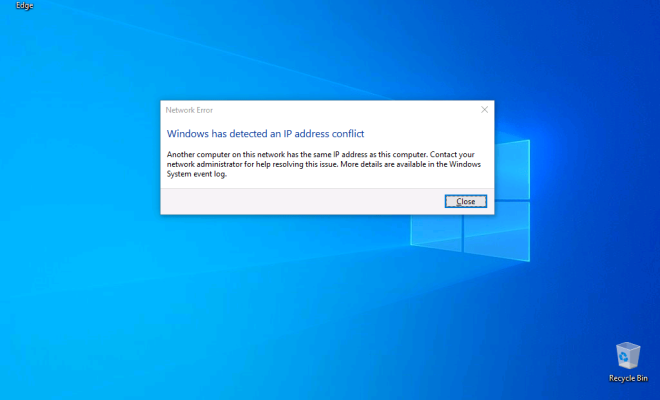
An IP address conflict occurs when two devices on the same network have been assigned the same IP address. This can create issues with communication and connectivity between devices, causing network connectivity problems.

IP addresses are unique identifiers used by devices to communicate with each other on a network. When a device is connected to a network, it is assigned an IP address by the network’s DHCP (Dynamic Host Configuration Protocol) server. This IP address is usually temporary and can be changed frequently.

IP address conflicts occur when two devices on the same network are assigned the same IP address. This can happen for several reasons, including:

1. Static IP addresses

When a device is assigned a static IP address instead of an automatically assigned IP address. This can create conflicts if another device is assigned the same static IP address.

2. DHCP server failure

When the network’s DHCP server fails to assign a unique IP address to a device, it can create a conflict with another device on the network.

3. Network changes

Adding new devices or changing network configurations can also create IP address conflicts if the DHCP server does not update the IP addresses of existing devices on the network.

When an IP address conflict occurs, devices on the network may experience connectivity issues, such as slow internet speeds, intermittent connectivity, or complete loss of network connection.

Resolving an IP address conflict usually requires troubleshooting the network configuration and resolving the cause of the conflict. This can involve releasing and renewing IP addresses, checking the DHCP server configuration, checking for duplicate IP addresses, and resetting network configurations.

To prevent IP address conflicts, it is important to follow proper network configuration practices, such as using dynamic IP addresses instead of static addresses, keeping DHCP servers up to date, and regularly checking network configurations for any changes.

In conclusion, IP address conflicts can cause significant connectivity issues on a network, but they can be resolved by carefully troubleshooting the network configuration and taking steps to prevent future conflicts. By practicing good network configuration, organizations can avoid issues with IP address conflicts and ensure smooth network communication.


Previous Article

What Is a Sound Bar?

Next Article

Lenovo Ideapad 320 Review

Matthew Lynch

Related articles More from author

  • Online Learning & eLearning

    3 Effective Custom Online Learning Examples

    March 10, 2023
    By Matthew Lynch
  • Online Learning & eLearning

    New 3D printer? Here’s how to create your own printables

    March 28, 2023
    By Matthew Lynch
  • Elementary EducationOnline Learning & eLearning

    Is Windows Defender Good Enough?

    March 19, 2023
    By Matthew Lynch
  • Online Learning & eLearning

    Best Practices For Developing Online Training In-House

    March 13, 2023
    By Matthew Lynch
  • Online Learning & eLearning

    Anyone Can Be an Artist with 6 eLearning Trends in Custom eLearning Solutions

    December 16, 2021
    By Matthew Lynch
  • Early Childhood & K-12 EdTechOnline Learning & eLearningParent & Family Tech

    Best Practices for Supporting Parents with Remote Learning

    September 21, 2020
    By Matthew Lynch

Search

Login & Registration

  • Register
  • Log in
  • Entries feed
  • Comments feed
  • WordPress.org

Newsletter

Signup for The Tech Edvocate Newsletter and have the latest in EdTech news and opinion delivered to your email address!

About Us

Since technology is not going anywhere and does more good than harm, adapting is the best course of action. That is where The Tech Edvocate comes in. We plan to cover the PreK-12 and Higher Education EdTech sectors and provide our readers with the latest news and opinion on the subject. From time to time, I will invite other voices to weigh in on important issues in EdTech. We hope to provide a well-rounded, multi-faceted look at the past, present, the future of EdTech in the US and internationally.

We started this journey back in June 2016, and we plan to continue it for many more years to come. I hope that you will join us in this discussion of the past, present and future of EdTech and lend your own insight to the issues that are discussed.

Newsletter

Signup for The Tech Edvocate Newsletter and have the latest in EdTech news and opinion delivered to your email address!

Contact Us

The Tech Edvocate
910 Goddin Street
Richmond, VA 23231
(601) 630-5238
[email protected]

Copyright © 2025 Matthew Lynch. All rights reserved.