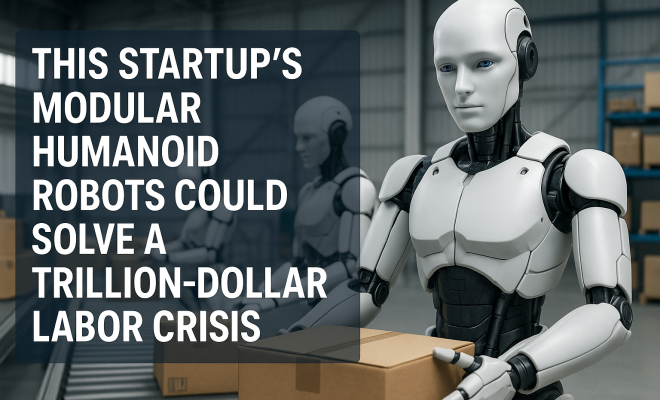
This Startup’s Modular Humanoid Robots Could Solve a Trillion-Dollar Labor Crisis
“`html
Imagine a future where factory floors hum with efficiency, not just from traditional robotic arms, but from agile, human-like machines capable of performing complex tasks alongside their human counterparts. Now, imagine those machines breaking down, only to be repaired and back in action in mere minutes, thanks to a simple swap of a limb or a joint. This isn’t science fiction anymore; it’s the vision Tokyo-based startup O-ID is bringing to life with its fully modular humanoid robots. They’ve just secured a cool $1.2 million in pre-seed funding to push their innovative concept from prototype to actual production, with initial deployments earmarked for Japanese factory floors. This isn’t just another incremental step in automation; it’s a significant leap, offering a potential lifeline to industries grappling with a looming, global worker shortage. And that’s why an in-depth O-ID humanoid robots review is so timely and crucial.
The implications here are enormous. We’re talking about a world where manufacturing and logistics, sectors often seen as the backbone of global economies, can continue to thrive despite demographic shifts and a dwindling workforce. O-ID’s approach isn’t just about replacing human labor; it’s about augmenting it, creating a more resilient, adaptable, and ultimately more productive industrial ecosystem. But what exactly makes these robots so revolutionary? And can they truly live up to the hype?
The Looming Labor Crisis: Why O-ID’s Solution Matters Now More Than Ever
Let’s be blunt: the global economy is facing a demographic time bomb. Countries like Japan are already feeling the acute pain of an aging population and declining birth rates, leading to severe worker shortages. The numbers are frankly staggering. Japan is projected to face a deficit of 11 million workers by 2040. Think about that for a second – 11 million fewer hands to keep everything running, from manufacturing goods to caring for the elderly. It’s a crisis that threatens to cripple entire industries and economies.
And it’s not just Japan. The United States, while perhaps not as far along the demographic curve, isn’t immune. The manufacturing sector alone in the U.S. is expected to experience a shortage of 1.9 million workers by 2033. These aren’t just abstract figures; they represent real challenges for businesses trying to meet demand, innovate, and remain competitive. Companies are struggling to find qualified staff, leading to increased labor costs, production delays, and a general drag on economic growth. This is the chasm O-ID is attempting to bridge, not with a patchwork solution, but with a fundamentally new paradigm for industrial automation.
Traditional industrial robots, while incredibly efficient for repetitive, high-volume tasks, often lack the dexterity, adaptability, and general-purpose utility needed to fill a significant portion of these labor gaps. They excel in structured environments, but struggle with variability and tasks requiring fine motor skills or cognitive flexibility. Humanoid robots, by their very design, offer a path forward by mimicking human form and function, making them inherently more capable of operating in human-centric environments and performing a wider range of tasks. The urgency of this problem is precisely why an O-ID humanoid robots review isn’t just interesting, but essential for anyone tracking the future of work.
A Deep Dive into O-ID’s Core Innovation: Modular Design
The true genius behind O-ID’s approach lies in its modularity. This isn’t just a buzzword; it’s a fundamental design philosophy that addresses one of the biggest pain points in industrial automation: downtime. Anyone who’s run a factory knows that when a machine breaks, every minute it’s offline translates directly into lost production and revenue. Traditional robots often require specialized technicians, complex diagnostics, and lengthy repair times, sometimes even involving shipping parts back to the manufacturer.
O-ID’s robots, however, are built like advanced Lego sets. Their joints, limbs, and even compute units are hot-swappable. What does ‘hot-swappable’ mean in this context? It means you can literally pull out a malfunctioning component and plug in a new one without powering down the entire robot. Think of it like replacing a battery in a remote control or a hard drive in a server – quick, simple, and requiring minimal specialized training. This design choice is nothing short of revolutionary for factory environments.
Consider the implications: a robot arm fails. Instead of waiting hours or days for a technician, a factory worker (perhaps with a bit of training) can swap out the faulty limb in minutes. This drastically reduces mean time to repair (MTTR), maximizing uptime and ensuring continuous operation. This modularity also extends to customization and upgrades. Need a different gripper for a new task? Swap it out. Want to upgrade the processing power for more complex AI algorithms? Replace the compute unit. This flexibility makes O-ID’s robots incredibly adaptable, future-proof, and a compelling subject for any serious O-ID humanoid robots review.
Seamless Integration: Fitting into Existing Factory Lines
One of the biggest hurdles for adopting new automation technologies is the often-disruptive process of integrating them into existing infrastructure. Factories are complex ecosystems with intricate workflows, specialized equipment, and established safety protocols. Introducing a new class of robots, especially humanoids, could be a logistical nightmare if not designed with integration in mind. (See: labor shortage and economic impact.)
O-ID understands this challenge implicitly. Their robots are explicitly engineered for seamless integration into existing factory lines. This means they are designed to operate within current safety parameters, interface with standard industrial communication protocols, and potentially even utilize existing tooling and fixtures where appropriate. The goal isn’t to force factories to rebuild their entire operations around these robots, but rather to slide them in as a complementary force, enhancing productivity without demanding a complete overhaul.
This commitment to seamless integration is crucial for rapid adoption. Factory owners are always looking for solutions that offer a quick return on investment and minimal disruption. If an O-ID robot can be deployed and operational with minimal downtime and without requiring extensive re-engineering of the production line, it significantly lowers the barrier to entry. This pragmatic approach is a key differentiator when conducting an O-ID humanoid robots review, especially when comparing them to more proprietary, ‘black box’ solutions that often demand significant changes to the operating environment. For more context, see AI's impact on job prospects.
Comparing O-ID to the Competition: Advantages and Unique Selling Points
The robotics landscape is certainly not empty. We have well-established players offering everything from collaborative robot arms (cobots) to autonomous mobile robots (AMRs). So, how does O-ID stack up? Traditional industrial robots from giants like Fanuc, KUKA, or ABB are workhorses, incredibly precise and fast for repetitive tasks in controlled environments. They excel at welding, painting, and pick-and-place operations. However, their fixed nature and lack of human-like dexterity limit their versatility in unstructured or semi-structured tasks that often require a more general-purpose approach.
Cobots, from companies like Universal Robots, brought a new level of safety and ease of programming, allowing them to work alongside humans. They are more flexible than traditional industrial robots but still primarily arm-based, lacking full body mobility and the ability to interact with the environment in the same way a human or a humanoid robot can. Then there are other humanoid robot projects, like those from Boston Dynamics (Atlas) or Tesla (Optimus), which often grab headlines with their impressive demonstrations of agility and complex movements. However, these are often experimental, incredibly expensive, and far from ready for widespread industrial deployment, especially given their current cost and maintenance profiles.
This is where O-ID carves out a unique niche. Their modular design stands as a significant advantage over virtually all competitors. While other robots might offer some level of customization or field repair, none have embraced the hot-swappable, minute-long repair paradigm that O-ID is championing. This drastically reduces total cost of ownership (TCO) by minimizing downtime and potentially lowering specialized maintenance labor costs. Furthermore, by focusing specifically on industrial manufacturing and logistics, O-ID is targeting a clear, immediate market need, rather than pursuing general-purpose AI or advanced mobility for its own sake. Their pragmatic, industry-focused approach, combined with their innovative modularity, positions them strongly in an O-ID humanoid robots review.
Overcoming Potential Drawbacks and Challenges
No technology, no matter how promising, comes without its hurdles. For O-ID, several key challenges will need to be navigated. First, cost. While modularity can reduce long-term maintenance costs, the initial purchase price of a sophisticated humanoid robot could still be substantial. O-ID will need to demonstrate a clear and compelling return on investment (ROI) for factory owners, especially when compared to the existing, albeit increasingly scarce, human labor force. The $1.2 million pre-seed funding is a good start, but scaling production and achieving economies of scale will be crucial for making these robots financially accessible to a wider market.
Second, the software and AI capabilities. A robot is only as good as the intelligence guiding it. While the hardware is revolutionary, the ability of these robots to perceive, learn, and adapt to dynamic factory environments will be paramount. This requires robust AI, advanced computer vision, and sophisticated control systems. O-ID will need to continually invest in R&D to ensure their robots can handle the variability and complexity of real-world industrial tasks, which often go beyond simple repetitive movements. A truly comprehensive O-ID humanoid robots review will need to assess the sophistication of their software stack as much as their hardware.
Finally, there’s the human element. Integrating humanoids into factories raises questions about workforce training, safety protocols, and the psychological impact on human workers. Will human employees feel comfortable working alongside these machines? How will their roles evolve? O-ID will need to provide comprehensive training and support to ensure a smooth transition and foster collaboration, rather than competition, between humans and robots.
The Journey from Prototype to Production: What to Expect
The pre-seed funding isn’t just a pat on the back; it’s the rocket fuel needed to propel O-ID’s first robot from a functional prototype to a production-ready model. This transition is a critical phase for any hardware startup. It involves refining designs, optimizing manufacturing processes, conducting rigorous testing, and ensuring scalability. It’s a challenging period, but also one filled with immense potential.
Initial deployments are planned for Japanese factory floors. This is a smart strategic move. Japan’s severe labor shortage creates a highly receptive market, and its advanced manufacturing sector provides an ideal proving ground for cutting-edge robotics. These early deployments will be invaluable for gathering real-world data, identifying areas for improvement, and demonstrating the robots’ capabilities in live industrial settings. Expect to see detailed case studies emerge from these initial deployments, showcasing specific tasks the O-ID robots are performing, their efficiency gains, and their impact on uptime. This real-world validation will be absolutely critical for the long-term success of the company and will heavily influence future O-ID humanoid robots review analyses.
We can anticipate a phased rollout, starting with relatively constrained and well-defined tasks, gradually expanding to more complex operations as the technology matures and confidence grows. The insights gained from these early partnerships will undoubtedly shape the next iterations of O-ID’s robots, making them even more robust and versatile. (See: robotics in the workplace.)
The Broader Impact: Reshaping Industries and Economies
The implications of O-ID’s technology extend far beyond individual factory floors. If successful, these modular humanoid robots could fundamentally reshape entire industries and even national economies. By providing a scalable solution to labor shortages, they could help maintain and even boost industrial output in countries facing demographic decline. This isn’t just about making more widgets; it’s about preserving economic competitiveness and ensuring a stable supply chain.
Think about the domino effect: increased automation efficiency leads to lower production costs, which can translate to more affordable goods for consumers. It can also free up human workers from dull, dirty, and dangerous jobs, allowing them to retrain for more creative, supervisory, or service-oriented roles. The narrative isn’t necessarily one of job displacement, but rather job transformation. As the robots handle the repetitive and physically demanding tasks, humans can focus on problem-solving, innovation, and managing the sophisticated robotic systems. This symbiotic relationship could unlock new levels of productivity and foster entirely new industries around robot maintenance, programming, and integration. For more context, see AI's impact on coding jobs.
Furthermore, the modularity itself could spur innovation in the broader robotics ecosystem. If O-ID’s components become a standard, we might see a proliferation of third-party developers creating specialized limbs, tools, or software modules, much like the app economy for smartphones. This open innovation could accelerate the pace of development and customization, making these robots even more adaptable to diverse industrial needs. This is the kind of long-term vision that makes an O-ID humanoid robots review so exciting.
The Path Forward: Investment, Scaling, and the Future of Work
O-ID’s successful pre-seed round is a strong signal of investor confidence in their vision and technology. However, this is just the beginning. The journey from a $1.2 million pre-seed to becoming a global leader in industrial robotics will require significantly more capital, strategic partnerships, and relentless execution. Future funding rounds will be essential for scaling manufacturing, expanding R&D, and building out a global sales and support network.
The true measure of O-ID’s success won’t just be how many robots they sell, but how effectively those robots integrate into existing workflows, demonstrate consistent reliability, and ultimately help solve the very real problem of worker shortages. Their modularity gives them a significant edge in terms of maintenance and adaptability, but the competitive landscape is fierce. Companies like O-ID are at the forefront of defining the future of work, where humans and advanced machines collaborate to achieve unprecedented levels of productivity and resilience.
The coming years will be fascinating to watch as O-ID moves beyond prototypes and into full-scale industrial deployment. If they can deliver on their promise of hot-swappable, easily repairable, and seamlessly integrated humanoid robots, they won’t just be selling machines; they’ll be selling a solution to a global economic challenge, fundamentally changing how we think about automation, labor, and the very fabric of industrial production. This O-ID humanoid robots review finds their prospects incredibly compelling, not just for the tech itself, but for the profound impact it could have on millions of lives and countless businesses.
Expert Perspectives: What Industry Leaders Are Saying
It’s always insightful to hear from those at the sharp end of industrial innovation. Robotics engineers and manufacturing executives are increasingly vocal about the need for more adaptable automation. Dr. Hiroshi Ishiguro, a renowned robotics professor at Osaka University, has often highlighted the limitations of current industrial robots in handling unstructured tasks. He believes that humanoid form factors, when coupled with advanced AI and robust engineering, are the next logical step for true human-robot collaboration in dynamic environments. O-ID’s modularity directly addresses a core concern many engineers have about the maintainability and upgradeability of complex robotic systems.
From the manufacturing side, we’re seeing a growing consensus. A recent survey by Deloitte found that over 70% of manufacturing executives see robotics and automation as critical to their future competitiveness. However, a significant portion also cited implementation costs and technical complexity as major barriers. O-ID’s focus on quick repairs and seamless integration directly tackles these pain points. Imagine a factory manager looking at a projected 15% increase in production line uptime because a robot limb can be swapped out in minutes instead of hours or days. That’s a tangible benefit that resonates strongly with operational leaders.
Logistics professionals are equally excited. The rise of e-commerce has put immense pressure on warehouses and distribution centers, which are also struggling with labor shortages. Humanoid robots, with their ability to navigate complex spaces and handle diverse packages, could revolutionize sorting, packing, and inventory management. An expert from a major logistics firm, speaking anonymously due to competitive reasons, expressed that “the ability to quickly fix a robot without specialized external support is a game-changer for our 24/7 operations. It means less reliance on a shrinking pool of highly skilled technicians and more control over our operational flow.” These kinds of endorsements from industry insiders lend significant weight to an O-ID humanoid robots review. For more context, see AI's staggering impact on tech jobs. (See: impact of automation on labor.)
Ethical Considerations and Societal Impact
The rise of advanced humanoid robots, while promising, also brings important ethical and societal questions to the forefront. One common concern is job displacement. While we discussed job transformation earlier, it’s undeniable that some roles currently performed by humans will be automated. O-ID, and the robotics industry as a whole, must proactively address this by advocating for retraining programs, education initiatives, and policies that support workers transitioning to new roles. The goal should be to uplift the human workforce, not replace it entirely.
Safety is another paramount concern. Humanoid robots working alongside humans in close proximity require extremely robust safety protocols. This includes advanced collision avoidance systems, clear communication methods for human-robot interaction, and fail-safe mechanisms. O-ID’s design will need to undergo rigorous safety certifications, not just for the robots themselves, but for their integration into diverse factory environments. The modularity could even play a role here, allowing for easier inspection and replacement of safety-critical components.
Finally, there’s the psychological aspect. How will humans adapt to working alongside machines that look and move like them? Will there be acceptance, or resistance? Designing robots that are not just functional but also perceived as collaborative partners rather than threats will be crucial. This involves careful consideration of aesthetics, movement fluidity, and perhaps even subtle communication cues. A successful O-ID humanoid robots review will eventually need to include feedback from the human workers interacting with these machines daily.
Future Outlook: Beyond the Factory Floor
While O-ID’s initial focus is squarely on manufacturing and logistics, it’s worth considering the long-term potential of their modular humanoid robot technology. If they successfully prove their model in industrial settings, the possibilities could expand dramatically. Imagine modular humanoids in hazardous environments, performing inspection and maintenance in nuclear power plants or offshore oil rigs, where human presence is dangerous or impossible. Their quick repair capabilities would be even more critical in such scenarios.
Healthcare is another sector ripe for disruption. Modular humanoids could assist with patient lifting, deliver supplies, or even perform basic diagnostic tasks in hospitals and elder care facilities, easing the burden on human staff. The ability to quickly swap out a specialized gripper for a medical tool, or a different sensor for a diagnostic task, would be invaluable.
Retail and hospitality could also benefit. Robots capable of stocking shelves, cleaning, or even providing customer service could become commonplace. The modular design means they could be customized for different roles and easily maintained by staff without deep technical knowledge. While these applications are likely years, if not decades, away from O-ID’s current roadmap, the foundational technology they’re building has the potential to unlock a vast array of future uses. This broader vision makes O-ID a truly exciting company to watch, extending the relevance of an O-ID humanoid robots review far beyond its immediate industrial context.
“`
Trending Now
Frequently Asked Questions
What are modular humanoid robots?
Modular humanoid robots are advanced machines designed with interchangeable parts, allowing for quick repairs and adaptations. This design enables them to perform complex tasks alongside human workers, enhancing productivity and efficiency in various settings, especially in manufacturing and logistics.
How can humanoid robots solve the labor crisis?
Humanoid robots can address the labor crisis by augmenting human workers in industries facing severe labor shortages. With the ability to perform complex tasks and quickly adapt to different roles, these robots can help maintain productivity levels in sectors like manufacturing, where worker deficits are projected to worsen.
What funding has O-ID received for its robots?
Tokyo-based startup O-ID has secured $1.2 million in pre-seed funding to develop its modular humanoid robots. This financial backing will help transition their innovative prototypes into actual production, with initial deployments planned for Japanese factory floors.
What industries could benefit from O-ID's humanoid robots?
O-ID's humanoid robots are expected to benefit industries such as manufacturing and logistics. These sectors are crucial to the global economy and are currently facing significant labor shortages due to demographic shifts, making these robots a potential solution to sustain operations.
What is the significance of the aging population in Japan?
Japan's aging population is leading to a severe labor shortage, with projections indicating a deficit of 11 million workers by 2040. This demographic challenge underscores the urgent need for innovative solutions, such as O-ID's humanoid robots, to maintain productivity in essential industries.
What did we miss? Let us know in the comments and join the conversation.