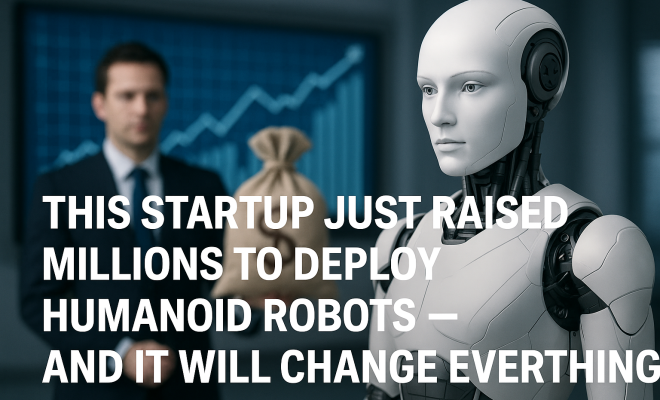
This Startup Just Raised Millions to Deploy Humanoid Robots — And It Will Change Everything
Imagine a factory floor where a robot arm suddenly malfunctions. In the past, this might mean hours, even days, of downtime, waiting for a specialized technician to diagnose the issue, order parts, and perform a complex repair. Every minute of that downtime translates directly into lost production, missed deadlines, and a significant hit to the bottom line. But what if that scenario could be resolved in a matter of minutes, right there on the factory floor, by simply swapping out a faulty component with a new one?
That’s not some futuristic fantasy; it’s the very real, immediate future that Tokyo-based startup O-ID is bringing to life. They’ve just secured a crucial $1.2 million in pre-seed funding, not just to build more humanoid robots, but to build them differently. Their vision centers on fully modular humanoid robots designed from the ground up for industrial manufacturing and logistics. This isn’t about replacing human workers wholesale; it’s about addressing a looming, critical shortage of labor that threatens to cripple industries worldwide. And the impact of their approach could be nothing short of revolutionary.
The Looming Labor Crisis and Why Industries Need Humanoid Robots
The global economy is facing a demographic time bomb, particularly in developed nations. Birth rates are declining, populations are aging, and the pool of available workers is shrinking rapidly. This isn’t just a distant concern; it’s already a pressing reality that’s creating immense pressure on industries vital to our daily lives, from manufacturing to healthcare, logistics, and beyond.
Consider Japan, for instance, a nation at the forefront of this demographic shift. Projections are stark: by 2040, Japan is expected to face a staggering deficit of 11 million workers. Eleven million! That’s not just a minor inconvenience; it’s an existential threat to economic stability and quality of life. Factories could grind to a halt, supply chains could unravel, and essential services could become unsustainable. Similarly, in the United States, the manufacturing sector alone is bracing for a shortfall of 1.9 million workers by 2033. These aren’t abstract numbers; they represent real people, real jobs, and real economic output that simply won’t be there.
Traditional automation, while helpful, often falls short in environments designed for human dexterity and adaptability. Industrial robot arms, for example, are fantastic for repetitive tasks in fixed positions, but they lack the full range of motion, human-like perception, and general-purpose utility needed to truly integrate into a diverse, dynamic factory setting. This is where advanced humanoid robots come into their own. They’re not just machines; they’re designed to mimic human form and function, allowing them to operate in spaces and with tools originally designed for people. They can navigate complex environments, handle a variety of objects, and even learn new tasks – capabilities that are becoming indispensable as the human workforce dwindles.
O-ID’s Vision: Modularity as the Key to Industrial Adoption
The true genius behind O-ID’s approach isn’t just that they’re building humanoid robots; it’s how they’re building them. The concept of ‘modularity’ is central to their strategy, and it’s a game-changer for industrial applications. Think of it like a high-performance gaming PC where you can easily swap out the graphics card, RAM, or even the power supply without replacing the entire system. O-ID is applying this same principle to complex robotic systems.
Their robots feature hot-swappable joints, limbs, and even compute units. What does this mean in practice? It means that if a robot’s shoulder joint starts to wear out, or if a limb suffers damage, a factory technician (who doesn’t need to be a robotics PhD) can simply unclip the faulty part and replace it with a new one. This isn’t a factory-return scenario; it’s an on-site repair that can be completed in minutes, not hours or days. This drastically reduces downtime, a metric that can make or break a manufacturing operation. For industries struggling with efficiency and labor shortages, this kind of rapid maintenance is not just desirable; it’s absolutely essential.
Furthermore, modularity opens up possibilities for customization and upgradeability. As technology advances, or as factory needs change, components can be easily upgraded or reconfigured without having to scrap an entire robot. This future-proofs the investment in these complex machines, making them far more attractive to businesses hesitant about the rapid obsolescence often associated with high-tech equipment. (See: Aging and health fact sheet.)
Seamless Integration into Existing Factory Lines
One of the biggest hurdles to adopting advanced robotics in manufacturing isn’t just the cost of the robots themselves, but the immense cost and disruption of retooling an entire factory. Many industrial robots require dedicated cells, safety cages, and significant changes to floor plans and workflows. This kind of overhaul can be prohibitively expensive and time-consuming, especially for small to medium-sized enterprises (SMEs) or facilities that can’t afford extended shutdowns.
O-ID’s humanoid robots are specifically designed to overcome this challenge. Their form factor and capabilities allow them to seamlessly integrate into existing factory lines, often working alongside human employees or taking over tasks in environments originally designed for human operators. This means businesses can introduce automation incrementally, targeting specific bottlenecks or labor-intensive areas without having to redesign their entire production process. Imagine a robot that can walk up to an assembly station, pick up tools, perform a delicate task, and then move to the next station, all within the existing human-centric layout of the factory. For more context, see AI's impact on job prospects.
This ‘drop-in’ capability dramatically lowers the barrier to entry for robotics adoption. Companies don’t need to build new factories or make multi-million dollar investments in infrastructure changes just to experiment with automation. They can start small, demonstrate the value, and scale up as their needs and confidence grow. This pragmatic approach is crucial for accelerating the deployment of humanoid robots in real-world industrial settings.
From Prototype to Production: The Funding’s Immediate Impact
The $1.2 million pre-seed funding O-ID has secured isn’t just a vote of confidence; it’s the fuel that will propel them from the lab to the factory floor. This capital is earmarked for a critical phase: moving their first humanoid robot from the prototype stage into full production. This transition is notoriously difficult for hardware startups, requiring significant investment in manufacturing processes, supply chain development, quality control, and testing.
Getting a single, functional prototype to work in a controlled environment is one thing; building hundreds or thousands of robust, reliable machines that can withstand the rigors of an industrial setting is an entirely different beast. The funding will allow O-ID to refine their designs, optimize for manufacturability, and establish the supply chains necessary to produce these complex machines at scale. This includes securing components, setting up assembly lines, and implementing rigorous testing protocols to ensure each robot meets industrial standards for reliability and safety.
The ultimate goal of this phase is to prepare for initial deployments on Japanese factory floors. This isn’t just about selling robots; it’s about proving their concept in real-world industrial environments, gathering crucial feedback, and demonstrating measurable returns on investment for their early adopters. These initial deployments will be vital learning opportunities, helping O-ID iterate on their designs and software to create even more capable and efficient humanoid robots.
Beyond the Hype: The Practical Applications of Humanoid Robots
When most people think of humanoid robots, they often picture science fiction scenarios: robots fighting battles, engaging in philosophical debates, or serving drinks on a futuristic cruise ship. While those applications might be decades away, the practical, immediate applications for humanoid robots in industrial settings are far more grounded and, frankly, more impactful in the short term.
Consider tasks that are currently difficult to automate with traditional fixed-arm robots. These often involve:
- Complex Assembly: Many products still require human dexterity for intricate assembly steps, especially those involving small, delicate parts or variable orientations. Humanoid robots, with their articulated hands and arms, can mimic these actions.
- Material Handling in Unstructured Environments: Moving items in warehouses or factories where goods are not perfectly stacked or positioned can be challenging for traditional robots. Humanoid robots can navigate these spaces, pick up various objects, and place them accurately.
- Inspection and Quality Control: Tasks requiring visual inspection, especially in areas difficult for humans to access or for long durations where human fatigue sets in, are prime candidates. Humanoid robots can be equipped with advanced vision systems to perform consistent, tireless inspections.
- Operating Human-Designed Machinery: Many existing machines in factories are operated by human hands, pressing buttons, pulling levers, or turning knobs. Retrofitting these machines for traditional automation can be costly. A humanoid robot can simply walk up and operate them as a human would.
- Logistics and Packaging: From picking and packing items of various shapes and sizes to loading and unloading trucks, humanoid robots can provide much-needed assistance in a sector constantly battling labor shortages and ergonomic challenges for human workers.
These are not glamorous tasks, but they are the backbone of our economy. By automating these roles, O-ID’s humanoid robots can free up human workers for more complex, creative, and supervisory roles, ultimately enhancing productivity and making industrial jobs safer and more appealing. (See: Labor force participation trends.)
The Economic and Societal Implications
The rise of humanoid robots, particularly those designed for industrial deployment, carries significant economic and societal implications. On the economic front, it’s clear that these machines offer a powerful solution to the aforementioned labor shortages. By augmenting the workforce, they can help maintain production levels, prevent supply chain disruptions, and potentially even bring manufacturing back to regions that have struggled with high labor costs or insufficient local talent.
For businesses, the return on investment (ROI) can be substantial. Reduced labor costs, increased efficiency, minimized downtime due to modular design, and enhanced safety (by moving robots into hazardous environments) all contribute to a healthier bottom line. Furthermore, the ability to operate 24/7 without fatigue means production can continue around the clock, maximizing asset utilization. For more context, see AI's impact on coding jobs.
Societally, the conversation around automation often sparks fears of job displacement. However, it’s crucial to view this not as a zero-sum game, but as an evolution of work. As humanoid robots take on repetitive, dangerous, or physically demanding tasks, human workers can be upskilled into roles focused on robot supervision, maintenance, programming, and higher-level problem-solving. This shift has the potential to create new types of jobs and elevate the quality of existing ones, moving humans away from ‘drudge work’ and towards more engaging, cerebral contributions.
Moreover, the ability to sustain critical industries like manufacturing and logistics, even in the face of demographic decline, has profound implications for national security, economic resilience, and maintaining a high standard of living. Without these technological interventions, societies could face significant economic contraction and a decline in the availability of goods and services.
The Competitive Landscape in Humanoid Robotics
While O-ID’s modular approach is certainly innovative, they are not alone in the burgeoning field of humanoid robots. Several other prominent players are making significant strides, each with their own unique strategies and target markets. Understanding this competitive landscape helps contextualize O-ID’s position.
- Boston Dynamics: Perhaps the most recognizable name, Boston Dynamics is famous for its agile, dynamic robots like Atlas and Spot. While Atlas is a research platform showcasing incredible human-like mobility, their focus has largely been on quadrupedal robots (Spot) for inspection and surveillance in challenging terrains, rather than direct industrial assembly with human-like dexterity. Their recent acquisition by Hyundai underscores the automotive industry’s interest in advanced robotics.
- Agility Robotics: Known for their bipedal robot Digit, Agility Robotics is targeting logistics and warehouse automation. Digit is designed to move boxes, load and unload trailers, and navigate human-centric environments. Their approach emphasizes robust locomotion and manipulation for specific, high-volume tasks.
- Tesla Optimus: Elon Musk’s entry into humanoid robots, Optimus, aims for mass production at a low cost, eventually targeting a wide range of applications from manufacturing to domestic use. While still in early development, Tesla’s manufacturing prowess and AI capabilities could make them a formidable player.
- Figure AI: Another well-funded startup, Figure AI is developing a general-purpose humanoid robot designed for a wide array of tasks. They’ve recently secured significant investment from major tech players like Microsoft and Amazon, signaling strong market interest in versatile humanoid platforms.
What differentiates O-ID in this competitive space is their laser focus on ‘industrial modularity’ and ‘hot-swappability.’ While others focus on general-purpose capabilities or specific agile movements, O-ID is directly addressing the core pain points of industrial adoption: maintenance, downtime, and integration complexity. Their modular design could give them a distinct advantage in terms of operational cost and flexibility for factory operators, making their humanoid robots a truly practical choice for businesses looking to automate without overhauling their entire infrastructure.
The Road Ahead: Challenges and Opportunities for O-ID
O-ID’s journey from prototype to widespread industrial deployment is fraught with both exciting opportunities and significant challenges. On the opportunity side, the sheer scale of the global labor shortage creates an immense market for their modular humanoid robots. Every factory, warehouse, and logistics hub struggling to find workers represents a potential customer. The ability to integrate seamlessly and offer rapid, on-site repairs provides a compelling value proposition that resonates deeply with industrial clients who prioritize uptime and efficiency above all else.
However, the challenges are equally substantial. First, there’s the perennial issue of cost. While modularity can reduce long-term operational expenses, the initial investment in sophisticated humanoid robots remains significant. O-ID will need to demonstrate a clear and compelling ROI to convince businesses, especially smaller ones, to make the leap. Second, reliability and safety are paramount in industrial settings. Any robot deployed on a factory floor must be incredibly robust, perform consistently, and operate safely alongside or in proximity to human workers. Achieving this level of engineering excellence requires rigorous testing and certification. For more context, see AI rewriting your future. (See: Understanding the labor shortage.)
Third, software and AI development will be critical. The hardware is only as good as the intelligence that controls it. O-ID’s humanoid robots will need sophisticated software to understand commands, perceive their environment, adapt to variations in tasks, and learn over time. This requires continuous investment in AI research and development. Finally, public perception and acceptance will play a role. While industries are desperate for solutions, the idea of robots in the workplace can still evoke apprehension. O-ID will need to clearly communicate the benefits, emphasizing job augmentation over displacement, and demonstrate how their robots improve working conditions and overall productivity.
Despite these hurdles, O-ID’s focused, pragmatic approach to modularity positions them well. By addressing real-world industrial pain points with a practical, scalable solution, they are poised to make a tangible impact on the future of manufacturing and logistics.
The Future of Work: A Human-Robot Collaboration
The narrative around automation often defaults to a ‘robots vs. humans’ paradigm, but the reality that O-ID and other innovative robotics companies are building is far more nuanced. It’s a future of collaboration, where humanoid robots don’t replace humans, but rather augment their capabilities and fill critical gaps in the workforce. Think of it as a highly skilled, tireless assistant, capable of performing the repetitive, dangerous, or physically demanding tasks that humans find tedious or hazardous.
This collaboration model offers a compelling vision for the future of work. Human workers can focus on higher-value activities: creative problem-solving, strategic planning, quality assurance, complex decision-making, and direct customer interaction. Meanwhile, humanoid robots can handle the grunt work, ensuring consistent output, improving safety, and enabling businesses to operate more efficiently and productively.
For individuals, this could mean a shift towards more fulfilling and intellectually stimulating careers, free from the monotony or physical strain of certain industrial jobs. For industries, it means resilience against demographic shifts and economic fluctuations, ensuring that essential goods and services continue to be produced and delivered. O-ID’s investment in modular humanoid robots is a significant step towards realizing this collaborative future, demonstrating that advanced robotics can be a practical, immediate solution to some of the most pressing economic challenges facing the world today.
Trending Now
Frequently Asked Questions
What is the purpose of humanoid robots in manufacturing?
Humanoid robots are designed to address labor shortages in manufacturing and logistics. By being fully modular, they can quickly replace faulty components on the factory floor, minimizing downtime and maintaining productivity. This innovation aims to support industries facing critical labor shortages without entirely replacing human workers.
How much funding did the startup O-ID raise?
The Tokyo-based startup O-ID recently secured $1.2 million in pre-seed funding. This funding will be used to develop humanoid robots specifically tailored for industrial manufacturing and logistics, emphasizing modular design to enhance efficiency and reduce operational downtime.
What demographic challenges are influencing the need for robots?
Developed nations are facing demographic challenges like declining birth rates and aging populations, leading to a shrinking workforce. For instance, Japan is projected to have a deficit of 11 million workers by 2040, creating immense pressure on industries to adopt solutions like humanoid robots to sustain economic stability.
How do modular humanoid robots improve factory operations?
Modular humanoid robots improve factory operations by allowing for quick and easy repairs of malfunctioning components. This capability drastically reduces downtime, enabling factories to maintain production efficiency and meet deadlines, thereby protecting the bottom line.
What industries will benefit from humanoid robots?
Industries such as manufacturing, logistics, and healthcare will benefit significantly from humanoid robots. These robots can help alleviate labor shortages, ensure operational continuity, and enhance productivity, making them vital in sectors critical to daily life and economic stability.
Agree or disagree? Drop a comment and tell us what you think.