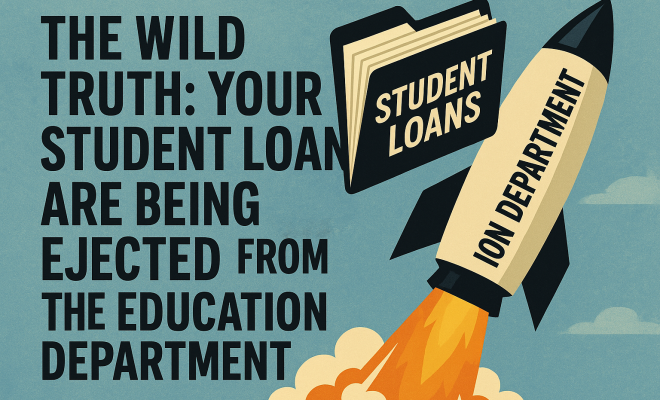
The Wild Truth: Your Student Loans Are Being Ejected from the Education Department
“`html
If you’re one of the millions of Americans juggling student loan debt, you’ve likely felt the ground shifting beneath your feet. For years, the federal student loan landscape has been a complex maze of acronyms and regulations, but a monumental shake-up is now underway. The ‘One Big Beautiful Bill Act,’ passed in July 2025, isn’t just tweaking the system; it’s fundamentally reshaping it. This legislation introduces a new Repayment Assistance Plan for student loans (RAP) while simultaneously phasing out many of the income-driven repayment options that borrowers have come to rely on. And if that weren’t enough, whispers of a ‘secret plan’ to move federal student loans entirely out of the Education Department have sent shockwaves through the borrower community.
This isn’t just bureaucratic shuffling; it’s a critical moment for your financial future. The changes, particularly the transition to the new Repayment Assistance Plan for student loans, demand your immediate attention. We’re talking about a complete overhaul that could dictate how much you pay, for how long, and what protections you have if you hit a rough patch. Let’s dig into what’s happening, why it matters, and how you can prepare for these dramatic shifts.
1. The ‘One Big Beautiful Bill Act’: A New Era for Student Loans
The passage of the ‘One Big Beautiful Bill Act’ in July 2025 marked a definitive turning point for federal student loans. For decades, the system, while imperfect, offered a variety of pathways for borrowers, particularly those struggling to make ends meet. Income-driven repayment (IDR) plans, for example, provided a safety net, adjusting monthly payments based on a borrower’s income and family size. They weren’t perfect, but they offered flexibility and, for many, a path to eventual forgiveness.
This new legislation, however, signals a move towards a more streamlined, and arguably, less flexible approach. The core tenet seems to be simplification, but for millions of borrowers, that simplification comes at a significant cost. The Act introduces stricter loan limits for graduate and professional programs, which will impact future students, but its most immediate and impactful change for current borrowers is the restructuring of repayment options. It’s out with the old, and in with the new, whether you like it or not.
2. Introducing the Repayment Assistance Plan (RAP) for Student Loans
At the heart of the new system is the Repayment Assistance Plan for student loans, or RAP. This is positioned as the primary alternative to the traditional Standard Repayment Plan. While details are still emerging and subject to interpretation, the RAP is designed to offer some level of payment flexibility for borrowers who can’t afford the standard 10-year repayment schedule. However, it’s crucial to understand that RAP is not a direct replacement for the previous suite of IDR plans.
Early indications suggest the RAP will likely have different eligibility criteria, payment calculation methodologies, and potentially less generous forgiveness terms than its predecessors. Borrowers currently enrolled in plans like REPAYE, PAYE, IBR, or ICR will need to carefully assess how the RAP compares to their current arrangement. The transition won’t be automatic or seamless, and understanding the nuances of the Repayment Assistance Plan for student loans will be paramount for maintaining financial stability.
3. The Phasing Out of Existing Income-Driven Repayment Plans
Perhaps the most alarming aspect of the ‘One Big Beautiful Bill Act’ for many current borrowers is the explicit plan to phase out existing income-driven repayment plans. By 2028, these long-standing safety nets are slated to disappear. This isn’t just about new borrowers; it means millions of current borrowers, many of whom have built their financial lives around these plans, will be forced into new structures. Imagine relying on a payment calculated at 10% of your discretionary income, only to find that option vanishing within a few years. It’s a terrifying prospect for many.
This forced transition raises serious concerns about affordability, particularly for those with high debt loads and modest incomes. The loss of existing IDR options means borrowers will have fewer choices and potentially higher monthly payments, increasing the risk of delinquency and default. It’s a move that many advocacy groups are calling short-sighted, arguing it will push more people into financial distress rather than alleviating it.
4. The Controversial ‘Secret Plan’: Loans Leaving the Education Department
Adding another layer of complexity and controversy to this already turbulent situation are reports, surfacing on October 21, 2026, of a potential ‘secret plan’ to transfer federal student loans entirely out of the Education Department. While details remain murky, it’s been confirmed that operational control of defaulted loans has already shifted to the Treasury Department. This isn’t just an administrative tweak; it carries significant implications for how defaulted loans are handled.
When loans are managed by the Treasury, the enforcement mechanisms available can be far more aggressive. We’re talking about an increased likelihood of administrative wage garnishment, where a portion of your paycheck is seized without a court order, and federal benefits offsets, where things like Social Security payments or tax refunds can be withheld. This potential shift away from the Education Department, which traditionally has a mission focused on borrower support, to the Treasury, which is primarily a revenue collection agency, is a deeply troubling development for many.
5. The Stakes for Defaulted Borrowers: Increased Enforcement
The operational shift of defaulted loans to the Treasury Department is not a minor detail; it’s a major red flag for anyone struggling with student loan debt. The Education Department, for all its flaws, has historically exercised some discretion and offered various pathways for borrowers to rehabilitate their loans or enter into affordable payment plans. While wage garnishment and offsets were always possibilities, the focus often remained on re-engaging borrowers and finding solutions.
The Treasury Department, however, operates with a different mandate. Its primary function is to collect revenue owed to the federal government. This means that for defaulted student loans, we can expect a more aggressive and less forgiving approach to collections. The prospect of increased administrative wage garnishment and federal benefits offsets is a chilling reality for vulnerable borrowers, potentially pushing them further into economic hardship. It underscores the urgency of understanding the Repayment Assistance Plan for student loans and avoiding default at all costs. (See: U.S. Department of Education.)
6. Navigating the Transition: What Borrowers Need to Do Now
With such significant changes on the horizon, proactive engagement is no longer optional; it’s essential. If you currently have federal student loans, especially if you’re on an income-driven repayment plan, you need to start preparing for this transition immediately. Don’t wait until 2028 to figure out your options. Begin by thoroughly reviewing your current loan statements and understanding your existing repayment terms.
Next, keep a close eye on official communications from your loan servicer and the Department of Education. Information regarding the Repayment Assistance Plan for student loans and the phase-out of IDR plans will be critical. It’s also wise to start modeling potential payment scenarios under the new RAP as details become available. Consider seeking advice from a qualified student loan counselor or financial advisor who specializes in this complex area. The more informed you are, the better equipped you’ll be to make the best decisions for your financial future. For more context, see Why Your Student Loan Debt Relief Is Stuck in Legal Limbo.
7. The Emotional and Financial Toll on Millions of Borrowers
It’s easy to get lost in the technical details of legislation and departmental shifts, but we must remember the human element. This situation is generating massive social media sharing precisely because it’s deeply personal and emotionally charged. Millions of borrowers, many of whom made good-faith efforts to pursue education and are now facing economic uncertainty, feel blindsided and betrayed. They’re grappling with the prospect of being forced out of affordable repayment plans, facing potentially higher payments, and dealing with rising default rates.
The anxiety and stress associated with student loan debt are already immense. These changes only amplify those feelings, creating a sense of instability and despair for many. For families struggling to make ends meet, an increase in monthly student loan payments could mean the difference between keeping the lights on or falling further behind. This isn’t just about numbers on a spreadsheet; it’s about people’s lives, their ability to buy homes, start families, and build secure futures.
8. Implications for Future Borrowers: Stricter Limits and Fewer Options
While current borrowers are dealing with the immediate fallout, prospective students, particularly those eyeing graduate and professional programs, also need to pay close attention. The ‘One Big Beautiful Bill Act’ introduces new, stricter loan limits for these programs. This means future students may not be able to borrow as much as their predecessors, potentially impacting their educational choices and career paths.
Combined with a narrower set of repayment options, primarily the Standard Repayment Plan and the new Repayment Assistance Plan for student loans, the landscape for future borrowing looks significantly different. It signals a shift towards greater financial responsibility upfront, with fewer safety nets available post-graduation. This could lead to a re-evaluation of the value proposition of certain degrees and encourage students to explore more affordable educational pathways or alternative funding sources.
9. The Broader Economic Impact and Monetization Opportunities
The ripple effects of these student loan changes extend far beyond individual borrowers. Higher default rates and increased financial strain on millions of Americans will undoubtedly have a broader impact on the economy. Reduced consumer spending, delayed homeownership, and decreased entrepreneurial activity are all potential consequences of a population burdened by escalating debt. This is not just a personal finance crisis; it’s a macroeconomic challenge.
For those in the personal finance, loans, and legal services niches, however, these changes also present significant, albeit ethically complex, monetization opportunities. The demand for information on ‘student loan refinance rates,’ ‘debt relief options,’ and ‘student loan lawyer’ services will likely skyrocket. Borrowers will be desperately seeking solutions, advice, and legal representation to navigate this complex and often hostile new environment. Understanding the nuances of the Repayment Assistance Plan for student loans and offering clear, actionable guidance will be invaluable for these service providers.
10. Understanding the Mechanics of the Repayment Assistance Plan (RAP): What We Know So Far
Given that the Repayment Assistance Plan for student loans is becoming the cornerstone of federal student loan repayment, it’s worth diving deeper into its potential structure, based on early discussions and legislative drafts. While final rules are still pending, several key aspects are beginning to solidify.
Firstly, eligibility for RAP is expected to be more stringent than previous IDR plans. It might require demonstrating a higher level of financial hardship, possibly through a more rigorous income verification process or a higher income-to-debt ratio threshold. This means not everyone who qualified for an IDR plan in the past will automatically be eligible for RAP.
Secondly, the payment calculation itself is likely to differ. Previous IDR plans calculated payments based on a percentage of “discretionary income,” which was often defined as income above 150% of the poverty line. We could see RAP use a different percentage (perhaps higher than the 10-15% common in older IDRs) or redefine “discretionary income” with a lower poverty line exclusion, effectively increasing the amount of income subject to payment calculation. This could result in higher monthly payments for many borrowers, even if they qualify.
Thirdly, the forgiveness timeline and criteria are a major point of concern. While older IDR plans offered forgiveness after 20 or 25 years of payments (and sometimes even 10 years for public service workers), the RAP might extend this period or introduce new conditions for forgiveness. There’s also speculation that the amount forgiven might be subject to federal income tax, a provision that was often waived for IDR forgiveness in the past. These changes could significantly alter the long-term financial benefit of the plan.
Finally, the process for enrollment and annual recertification could become more complex. Borrowers might face a heavier administrative burden to prove their eligibility each year, increasing the risk of falling out of the plan due to missed paperwork or misunderstandings. It’s clear that the RAP is not a simple rebranding of existing options; it’s a new beast entirely, and borrowers need to be prepared for its unique characteristics. (See: Centers for Disease Control and Prevention.)
11. The Shift in Philosophy: From Borrower Support to Fiscal Responsibility?
The entire ‘One Big Beautiful Bill Act’ and the subsequent changes, including the creation of the Repayment Assistance Plan for student loans and the potential move of loans to the Treasury, reflect a significant philosophical pivot in how the federal government views student loans. Historically, there’s been a dual mandate: to facilitate access to higher education through loans and to provide support for borrowers who face financial challenges after graduation.
This new legislation appears to prioritize fiscal responsibility and streamlined collection over borrower assistance. The phasing out of IDR plans, which were designed to prevent default and offer a path to financial stability, strongly suggests this shift. By limiting options and potentially increasing payments, the government seems to be placing a greater onus on individual borrowers to manage their debt, even in the face of economic hardship.
This isn’t to say fiscal responsibility isn’t important, but the question is at what cost? Critics argue that this approach could lead to a less educated workforce, higher default rates, and a struggling middle class, ultimately harming the economy in the long run. It’s a fundamental re-evaluation of the social contract around higher education and who bears the primary risk of student debt. For more context, see the $25 Billion Meta Privacy Ruling That Could Reshape Tech Accountability.
12. Impact on Specific Borrower Groups: A Closer Look
While these changes affect everyone with federal student loans, certain groups are likely to feel the pinch more acutely. Let’s break down a few:
- Low-Income Borrowers: Those who previously relied on IDR plans to keep payments near $0 or very low will face the biggest challenge. If the RAP has higher minimum payment thresholds or stricter eligibility, these borrowers could be pushed into default or forced to make impossible choices between loan payments and basic necessities.
- Graduate and Professional Students: With stricter loan limits, future students in fields like medicine, law, or advanced sciences might find it harder to finance their education, potentially deterring talented individuals from pursuing these critical professions. Current graduate borrowers, who often have very high loan balances, will also be vulnerable if RAP’s forgiveness terms are less generous than their current IDR plans.
- Public Service Workers: While the Public Service Loan Forgiveness (PSLF) program is technically separate, the changes to underlying repayment plans could still impact these borrowers. If the RAP doesn’t count as a “qualifying payment plan” for PSLF, or if its terms make it harder to reach the 120 payments, it could undermine the very incentive PSLF was designed to create.
- Defaulted Borrowers: As mentioned, the shift to the Treasury Department means a more aggressive collection approach. This group faces the most immediate threat of wage garnishment and federal benefits offsets, making it harder to escape the cycle of debt.
Understanding how these broad changes apply to your specific situation is crucial. It’s not a one-size-fits-all scenario, and the nuances matter.
13. Expert Perspectives and Advocacy Group Responses
The ‘One Big Beautiful Bill Act’ and the introduction of the Repayment Assistance Plan for student loans have sparked widespread debate among financial experts, economists, and student loan advocacy groups. Many consumer protection organizations have voiced strong opposition, arguing that the legislation prioritizes government revenue over borrower well-being.
For example, the Student Borrower Protection Center (SBPC) has called the potential shift to the Treasury Department a “betrayal of trust,” warning of a “debt collection dragnet” that will ensnare vulnerable Americans. Financial aid experts like Mark Kantrowitz have highlighted how the new loan limits for graduate students could exacerbate educational inequality, making advanced degrees less accessible to those without significant personal wealth.
Economists are also weighing in, with some predicting a slowdown in consumer spending and an increase in personal bankruptcies if borrowers are forced into unaffordable payment plans. The argument is that while the government might see a short-term increase in collections, the long-term economic damage from a financially stressed populace will outweigh any gains.
These expert opinions underscore the gravity of the situation and suggest that the full ramifications of these changes may not be immediately apparent but will unfold over the coming years, potentially with significant negative consequences for millions of individuals and the broader economy.
Frequently Asked Questions (FAQ) about the Repayment Assistance Plan for Student Loans
Q1: What is the Repayment Assistance Plan (RAP) for student loans?
A1: The Repayment Assistance Plan (RAP) is a new federal student loan repayment option introduced by the ‘One Big Beautiful Bill Act’ in July 2025. It’s designed to offer some payment flexibility for borrowers who cannot afford the standard 10-year repayment plan, replacing most existing income-driven repayment (IDR) plans by 2028.
Q2: How is RAP different from the old Income-Driven Repayment (IDR) plans like REPAYE or PAYE?
A2: RAP is expected to have stricter eligibility criteria, potentially different payment calculation methodologies (e.g., a higher percentage of discretionary income or a different definition of “discretionary income”), and likely less generous forgiveness terms. The old IDR plans are being phased out, meaning RAP is not a direct, equivalent replacement.
Q3: When will the existing IDR plans be phased out?
A3: Existing income-driven repayment plans are slated to be completely phased out by 2028. This means current borrowers on these plans will need to transition to the RAP or another available repayment option before then. (See: New York Times coverage on student loans.)
Q4: What should I do if I’m currently on an Income-Driven Repayment plan?
A4: You should immediately review your current loan statements, understand your repayment terms, and stay vigilant for official communications from your loan servicer and the Department of Education regarding the transition. Start researching the details of the Repayment Assistance Plan for student loans as they become available and consider consulting a student loan counselor to strategize your options.
Q5: What is the ‘secret plan’ about loans leaving the Education Department?
A5: Reports indicate a potential plan to transfer federal student loans entirely out of the Education Department, with operational control of defaulted loans already shifting to the Treasury Department. This move is controversial because the Treasury Department typically employs more aggressive collection tactics than the Education Department.
Q6: How will the shift of defaulted loans to the Treasury Department affect borrowers?
A6: For defaulted borrowers, this shift means a higher likelihood of aggressive enforcement actions, such as administrative wage garnishment (where a portion of your paycheck is seized without a court order) and federal benefits offsets (where federal payments like Social Security or tax refunds are withheld). The Treasury’s primary focus is revenue collection, not borrower rehabilitation.
Q7: Will the Repayment Assistance Plan for student loans offer loan forgiveness?
A7: While details are still being finalized, early indications suggest RAP may offer loan forgiveness after a certain number of years, similar to old IDR plans. However, the timeline might be extended, the conditions could be stricter, and there’s speculation that the forgiven amount might be subject to federal income tax, which was often not the case with older IDR forgiveness.
Q8: Are there new loan limits for future borrowers?
A8: Yes, the ‘One Big Beautiful Bill Act’ introduces stricter loan limits, particularly for graduate and professional programs. This means future students may not be able to borrow as much as previous generations, potentially impacting their educational choices.
Q9: Where can I get reliable information about these changes?
A9: Keep an eye on official websites for the Department of Education and your specific loan servicer. Reputable non-profit student loan counseling organizations and financial advisors specializing in student debt can also provide valuable, unbiased guidance. Be wary of predatory companies promising easy fixes.
Q10: What are the broader economic impacts of these changes?
A10: Experts predict that increased financial strain on borrowers, higher default rates, and reduced consumer spending could have negative macroeconomic consequences. This could delay milestones like homeownership and starting families for millions, impacting overall economic growth.
The student loan landscape is undergoing a seismic shift. The ‘One Big Beautiful Bill Act’ and the introduction of the Repayment Assistance Plan for student loans, coupled with the alarming prospect of loans leaving the Education Department, paint a challenging picture for millions. Staying informed, acting proactively, and seeking expert advice are no longer luxuries but necessities. Your financial future depends on understanding these changes and adapting your strategy now.
“`
Trending Now
Frequently Asked Questions
What is the 'One Big Beautiful Bill Act' for student loans?
The 'One Big Beautiful Bill Act,' passed in July 2025, fundamentally reshapes the federal student loan landscape by introducing a new Repayment Assistance Plan (RAP) and phasing out many income-driven repayment options. This act aims to simplify loan repayment processes but raises concerns about reduced flexibility for borrowers.
How will the new Repayment Assistance Plan affect my student loans?
The new Repayment Assistance Plan (RAP) will change how much you pay and for how long. It replaces existing income-driven repayment options, which could impact your monthly payments and financial protections if you encounter difficulties. It's crucial to understand these changes to prepare for their effects on your finances.
Are federal student loans moving out of the Education Department?
Yes, there are discussions about a 'secret plan' to transfer federal student loans out of the Education Department. This potential shift has created significant concern among borrowers, as it may fundamentally change how student loans are managed and affect borrower protections.
What should I do to prepare for changes to my student loans?
To prepare for changes to your student loans, stay informed about the new Repayment Assistance Plan and how it will affect your payments. Consider reviewing your financial situation and exploring available resources for guidance on managing your debt under the new system.
Will income-driven repayment plans still be available after the new act?
No, the 'One Big Beautiful Bill Act' phases out many income-driven repayment options that borrowers have relied on. This shift may reduce the flexibility previously available to borrowers, making it essential to understand the new repayment landscape and how it affects your financial obligations.
Agree or disagree? Drop a comment and tell us what you think.