Milky Way’s Edge Revealed: Star Formation Boundary Mapped
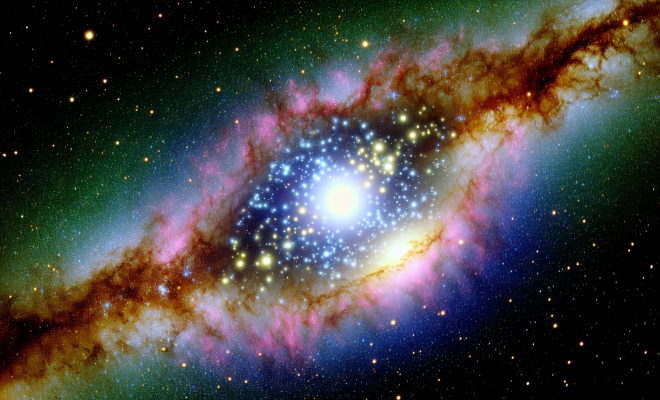
The Milky Way galaxy, a vast spiral of stars, gas, and dust, has long captivated astronomers and stargazers alike. Recent research has brought forth a significant revelation regarding the galaxy’s dimensions and the dynamics of star formation. A team of astronomers has successfully mapped the true boundary of the Milky Way’s star-forming region, uncovering a U-shaped pattern that suggests a sharp decline in star formation activity around 35,000 to 40,000 light-years from the galactic center. This groundbreaking discovery not only reshapes our understanding of the Milky Way’s structure but also provides clarity on the processes that govern star formation within our galaxy.
The Quest for the Milky Way’s Boundaries
For decades, scientists have been engaged in a quest to define the limits of the Milky Way. The galaxy’s sheer size and the complex interactions of its components have posed significant challenges. Traditional methods of mapping stellar populations have often been hindered by the Milky Way’s dense central bulge and the obscuring effects of interstellar dust, which can mask the visibility of distant stars.
In light of these challenges, astronomers have turned to innovative techniques to gain insights into the galaxy’s structure. One such method involves stellar age mapping, which allows scientists to determine the ages of stars and trace the history of star formation across different regions of the galaxy.
Stellar Age Mapping: A Revolutionary Technique
Stellar age mapping is a sophisticated technique that utilizes the properties of stars to infer their ages. By analyzing the luminosity, temperature, and chemical composition of stars, astronomers can estimate how long these celestial bodies have existed. This provides valuable insight into the conditions under which they formed.
In the context of the Milky Way, the age distribution of stars serves as a proxy for star formation activity. Younger stars indicate recent star formation, while older stars suggest areas where star formation has ceased. By compiling data from various surveys, astronomers can create a comprehensive map of stellar ages across the galaxy.
The Discovery of the U-Shaped Boundary
The recent findings reveal a striking U-shaped boundary that delineates the region of active star formation in the Milky Way. This pattern indicates that the formation of new stars sharply declines beyond the 35,000 to 40,000 light-year mark from the galactic center. Within this range, astronomers have observed a rich tapestry of star-forming regions, including nebulae and clusters, where new stars are born from dense clouds of gas and dust.
However, once past this critical threshold, the characteristics of stars begin to change dramatically. The research indicates that beyond this boundary, the stars are predominantly migrants—those that have drifted outward from the central regions rather than formed in situ. This shift in stellar demographics suggests that the processes governing star formation are not uniform throughout the galaxy.
Implications for Galactic Structure
This discovery has profound implications for our understanding of the Milky Way’s structure and evolution. The identification of a clear boundary for star formation suggests that the galaxy’s stellar nursery has a defined end, challenging previous notions that star formation could occur indefinitely throughout its expanse.
The findings also prompt new questions regarding the mechanisms that limit star formation in the outer regions of the galaxy. Factors such as the density of gas, the availability of materials, and the influence of gravitational forces may all play a role in determining where and how stars form.
The Role of Galactic Dynamics
Understanding the dynamics of the Milky Way is crucial for interpreting the new boundary findings. The galaxy is not a static entity; it is a dynamic system influenced by gravitational interactions, rotation, and the movement of gas and stars.
The Milky Way’s spiral arms, for instance, are regions of enhanced star formation, where gas is compressed, leading to the birth of new stars. However, as one moves away from the galactic center and into the halo, these conditions become less favorable. The gravitational pull of the central bulge and the overall structure of the galaxy create a complex interplay that affects where stars can form.
Exploring the Galactic Halo
The discovery of the U-shaped boundary raises important questions about the galactic halo, the region surrounding the Milky Way that contains older stars and globular clusters. The halo is thought to be populated by stars that formed early in the galaxy’s history and have since drifted outward.
As researchers delve deeper into the characteristics of stars in the halo, they seek to understand how these ancient stars relate to the younger populations found closer to the galactic center. This exploration may reveal insights into the formation and evolution of the Milky Way as a whole.
Future Research Directions
The findings surrounding the Milky Way’s star-forming boundary open up exciting avenues for future research. Astronomers are now tasked with further investigating the factors that contribute to the cessation of star formation beyond the identified boundary. Potential areas of inquiry include:
- Gas Density and Composition: Analyzing the distribution and properties of gas in the outer regions of the galaxy to determine its role in star formation.
- Gravitational Interactions: Studying how the gravitational influence of the Milky Way’s central bulge and neighboring galaxies affects star formation rates.
- Stellar Migration Patterns: Investigating the pathways that stars take as they migrate from the inner regions to the outskirts of the galaxy.
As astronomers utilize advanced telescopes and observational techniques, they will be able to refine their understanding of the Milky Way’s structure and the dynamics of star formation.
Broader Implications for Galactic Astronomy
The implications of this research extend beyond the Milky Way itself. Understanding the processes that govern star formation and the structural boundaries of galaxies is a critical area of study in galactic astronomy. The findings may provide insights applicable to other galaxies, allowing astronomers to draw comparisons and enhance our understanding of the universe as a whole.
By examining the similarities and differences in star formation patterns across various galaxies, scientists can begin to piece together the evolutionary history of the cosmos. This holistic approach to galactic studies promises to deepen our comprehension of both the Milky Way and its neighboring galaxies.
The Impact of Technological Advancements
The successful mapping of the Milky Way’s star-forming boundary has been made possible by advancements in observational technology. State-of-the-art telescopes and instruments are now capable of collecting vast amounts of data, allowing astronomers to conduct detailed analyses of stellar populations.
Projects such as the Gaia mission have revolutionized our understanding of the Milky Way by providing precise measurements of the positions, distances, and motions of millions of stars. This wealth of data has enabled researchers to construct more accurate models of the galaxy’s structure and dynamics.
As technology continues to evolve, astronomers will be equipped with even more powerful tools to unravel the mysteries of the cosmos. The ongoing development of next-generation observatories will likely yield new insights into star formation, galactic boundaries, and the overall architecture of galaxies.
Conclusion: A New Chapter in Galactic Research
The discovery of the Milky Way’s star-forming boundary marks a significant milestone in our understanding of the galaxy’s structure and evolution. As astronomers continue to explore the implications of this finding, they are poised to reshape our knowledge of how galaxies function and evolve over time.
With the Milky Way serving as a key reference point, researchers can leverage these insights to study other galaxies and their star formation patterns. The journey to uncover the secrets of the universe is far from over, and the revelations awaiting us promise to be as exciting as the discoveries we have already made.
As we look to the future, the collaboration between astronomers, physicists, and technologists will be essential in addressing the unanswered questions that linger about the Milky Way and its place in the cosmos. With each new discovery, we come closer to understanding not only our galaxy but also the fundamental processes that govern the universe itself.