Asteroids on Course: NASA Confirms Safe Pass for Two Heavy Asteroids in April 2026
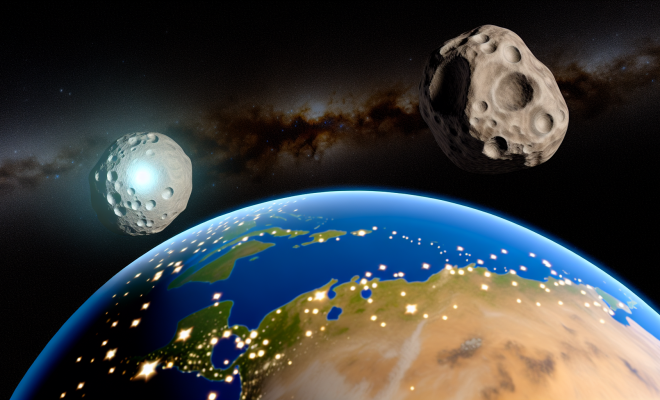
On April 29, 2026, Earth will experience a close encounter with two sizable asteroids, known as 2026 HL3 and 2026 HP3. Both of these celestial bodies, each comparable in size to an airplane, will pass by our planet at considerable distances of 1.6 million miles and 3.68 million miles, respectively. Despite their proximity, NASA and other scientists have emphasized that these asteroids pose no threat to Earth, assuring the public that there is no cause for alarm.
The Asteroids in Question
Asteroids are remnants from the early solar system, composed primarily of rock and metal. They vary widely in size and composition, with some being merely a few meters across while others span hundreds of kilometers. The two asteroids set to make their closest approach to Earth in April 2026 are classified as Near-Earth Objects (NEOs), which are asteroids or comets whose orbits bring them into proximity with Earth.
- Asteroid 2026 HL3: This asteroid is set to pass Earth at a distance of 1.6 million miles. Its size is comparable to that of a commercial airliner, making it a notable object of study for astronomers.
- Asteroid 2026 HP3: Slightly larger, this asteroid will pass at a distance of 3.68 million miles. While the distance may seem vast, it is relatively close in astronomical terms.
NASA’s Monitoring Efforts
NASA has been at the forefront of monitoring asteroids and other NEOs through its various space missions and observatories. The agency employs advanced tracking systems and telescopes to observe the trajectories of these objects, ensuring that any potential threats to Earth can be identified early.
The Near-Earth Object Observations Program is particularly significant in this regard. Launched in 1998, the program aims to detect, track, and characterize NEOs, providing critical data to scientists worldwide. Through this program, NASA has cataloged thousands of asteroids and comets, assessing their orbits and potential hazards.
Why No Cause for Alarm?
The fact that 2026 HL3 and 2026 HP3 will not pose any risk to Earth has been confirmed by scientists and astronomers worldwide. These assessments rely on precise calculations of the asteroids’ orbits, which have been conducted using data gathered from telescopes and observation missions.
According to experts, the distances at which these asteroids will pass are substantially far from Earth, well outside the realm of concern. The average distance from Earth to the Moon is approximately 238,855 miles, highlighting just how far these asteroids will be. Moreover, the gravitational influences of the Earth and other celestial bodies are continuously monitored, ensuring that any slight changes in trajectory can be detected well in advance.
Scientific Opportunities
While the close approach of these asteroids may not pose a danger, it does present significant opportunities for scientific research. Astronomers and planetary scientists view such events as unique chances to study the composition, structure, and behavior of these objects.
Research conducted on asteroids like 2026 HL3 and 2026 HP3 can provide insights into the early solar system’s conditions:
- Composition Analysis: Understanding the materials that make up these asteroids can shed light on the building blocks of the planets.
- Impact Risk Assessment: Studying their orbits helps refine models predicting future asteroid paths, including potential threats to Earth.
- Space Exploration Preparation: Knowledge gained from monitoring and analyzing asteroids can inform future missions aimed at asteroid mining or exploration.
Public Engagement and Awareness
Navigating public concern regarding near-Earth asteroids is a vital aspect of NASA’s communication strategy. Engaging the public through education and outreach efforts is essential to demystifying these cosmic events.
NASA has established a range of initiatives to inform the public about asteroids, including:
- Public Observations: Live streams and public telescope viewings allow people to watch these celestial events unfold.
- Social Media Campaigns: Using platforms like Twitter and Instagram to share real-time updates and educational content.
- Workshops and Lectures: Collaborations with educational institutions to host events that explain the science behind asteroids and their tracking.
The Future of Asteroid Monitoring
As technology continues to advance, so too does our capability to monitor and understand asteroids. Several space missions are currently in development or underway, aimed at furthering our knowledge of these intriguing celestial bodies.
- NASA’s DART Mission: Launched in late 2021, this mission aims to test the ability to redirect an asteroid’s trajectory by crashing a spacecraft into it.
- European Space Agency’s Hera Mission: Set to follow DART, Hera will study the asteroid’s surface and gather data on its composition and structure.
- OSIRIS-REx Mission: This mission collected samples from the asteroid Bennu and is set to return them to Earth for analysis in 2023, providing invaluable data on asteroid material.
Conclusion
The upcoming close flyby of asteroids 2026 HL3 and 2026 HP3 on April 29, 2026, serves as a reminder of the dynamic and sometimes unpredictable nature of our solar system. While these asteroids will pass safely at a distance of millions of miles, they present a unique opportunity for scientific inquiry and public engagement.
NASA’s commitment to monitoring these celestial bodies ensures that we remain informed about their movements and any potential threats they may pose in the future. As we look ahead, the ongoing study of asteroids will continue to enhance our understanding of the universe and our place within it.