The Tech Edvocate

Top Menu

  • Advertisement
  • Apps
  • Home Page
  • Home Page Five (No Sidebar)
  • Home Page Four
  • Home Page Three
  • Home Page Two
  • Home Tech2
  • Icons [No Sidebar]
  • Left Sidbear Page
  • Lynch Educational Consulting
  • My Account
  • My Speaking Page
  • Newsletter Sign Up Confirmation
  • Newsletter Unsubscription
  • Our Brands
  • Page Example
  • Privacy Policy
  • Protected Content
  • Register
  • Request a Product Review
  • Shop
  • Shortcodes Examples
  • Signup
  • Start Here
    • Governance
    • Careers
    • Contact Us
  • Terms and Conditions
  • The Edvocate
  • The Tech Edvocate Product Guide
  • Topics
  • Write For Us
  • Advertise

Main Menu

  • Start Here
    • Our Brands
    • Governance
      • Lynch Educational Consulting, LLC.
      • Dr. Lynch’s Personal Website
      • Careers
    • Write For Us
    • The Tech Edvocate Product Guide
    • Contact Us
    • Books
    • Edupedia
    • Post a Job
    • The Edvocate Podcast
    • Terms and Conditions
    • Privacy Policy
  • Topics
    • Assistive Technology
    • Child Development Tech
    • Early Childhood & K-12 EdTech
    • EdTech Futures
    • EdTech News
    • EdTech Policy & Reform
    • EdTech Startups & Businesses
    • Higher Education EdTech
    • Online Learning & eLearning
    • Parent & Family Tech
    • Personalized Learning
    • Product Reviews
  • Advertise
  • Tech Edvocate Awards
  • The Edvocate
  • Pedagogue
  • School Ratings

logo

The Tech Edvocate

  • Start Here
    • Our Brands
    • Governance
      • Lynch Educational Consulting, LLC.
      • Dr. Lynch’s Personal Website
        • My Speaking Page
      • Careers
    • Write For Us
    • The Tech Edvocate Product Guide
    • Contact Us
    • Books
    • Edupedia
    • Post a Job
    • The Edvocate Podcast
    • Terms and Conditions
    • Privacy Policy
  • Topics
    • Assistive Technology
    • Child Development Tech
    • Early Childhood & K-12 EdTech
    • EdTech Futures
    • EdTech News
    • EdTech Policy & Reform
    • EdTech Startups & Businesses
    • Higher Education EdTech
    • Online Learning & eLearning
    • Parent & Family Tech
    • Personalized Learning
    • Product Reviews
  • Advertise
  • Tech Edvocate Awards
  • The Edvocate
  • Pedagogue
  • School Ratings
  • Trader Joe’s March 2026 Arrivals: Affordable Gems and Customer Favorites

  • Mark Sprague Takes the Helm as Director of St. Pete-Clearwater International Airport

  • Consumer Attitudes Toward Editing Claim Images: A Growing Concern for Insurers

  • ProstaVive: A Comprehensive Review of the Prostate Health Supplement in 2026

  • Discover Trader Joe’s Top Picks for 2026: Customer Choice Awards Highlights

  • U.S. Stock Market Faces Uncertainty Amid Rising Oil Prices and Geopolitical Tensions

  • Asian Markets Show Mixed Results Amid Rising Oil Prices and U.S. Futures Decline

  • Stability in Fuel Prices Amidst Global Crude Market Turmoil: An Analysis

  • Crude Oil Prices Surge Amid Tensions in the Strait of Hormuz

  • Indian Stock Market Opens Flat Amid Geopolitical Tensions and Oil Price Fluctuations

Digital & Mobile Technology
Home›Digital & Mobile Technology›Raspberry Pi Pico vs. ESP32: Which Microcontroller Is Right for You?

Raspberry Pi Pico vs. ESP32: Which Microcontroller Is Right for You?
By Matthew Lynch
June 26, 2023
0
Spread the love

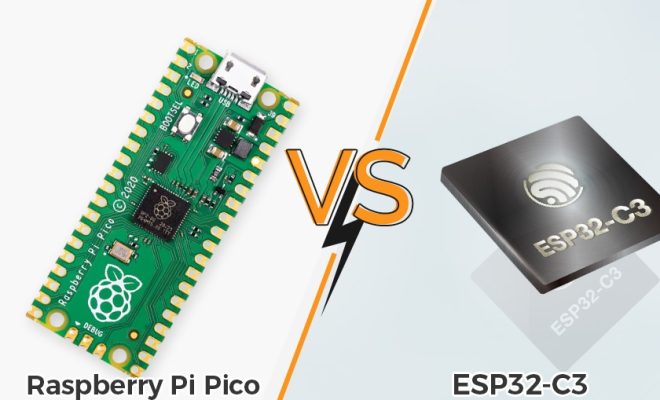
With the rise in popularity of the Internet of Things (IoT), microcontrollers have become an essential tool for developers and hobbyists alike. Two of the most popular options in the market right now are the Raspberry Pi Pico and the ESP32. In this article, we’ll take a closer look at both and help you decide which microcontroller is right for you.

Raspberry Pi Pico

The Raspberry Pi Pico is a tiny microcontroller board released by Raspberry Pi in January 2021. It is based on the RP2040 microcontroller chip, which was designed by Raspberry Pi and is built using a 40nm process. The Pico provides 2MB of flash memory, 256KB of RAM, and 26 GPIO pins. It has dual-core processors running at up to 133MHz and supports both MicroPython and C/C++ programming languages.

One of the significant advantages of the Pico is the Open-Source hardware design philosophy that Raspberry Pi has adopted. It means that anyone can design, manufacture, and sell their Pico boards. Additionally, Pico is also very power-efficient, making it ideal for low-power IoT applications.

ESP32

The ESP32 is a low-cost microcontroller board based on the ESP32 module developed by Espressif Systems. It is quite popular due to its AI capabilities, integrated Wi-Fi, and Bluetooth connectivity. The chip comes with 4MB of flash memory and 520KB of RAM, which is enough for most projects. It also has a 240MHz dual-core processor and supports a wide range of programming languages, including MicroPython, C/C++, and JavaScript.

One of the advantages of the ESP32 is its advanced connectivity features. It supports Wi-Fi, Bluetooth, and BLE, making it an excellent choice for IoT projects that require extensive connectivity. The board is also compatible with a broad range of sensors and modules, which makes integration and development much more manageable.

Comparison: Raspberry Pi Pico vs. ESP32

Both microcontrollers have their benefits and drawbacks. Here’s how they compare:

Power consumption: Raspberry Pi Pico shines in this aspect. It consumes far less power than the ESP32, making it suitable for battery-powered projects.

Connectivity: While the Raspberry Pi Pico has no built-in Wi-Fi and Bluetooth, the ESP32 board has these features built-in. The board also has a faster processor that handles complex connectivity tasks better.

Programming languages: Both devices support multiple programming languages. However, the Raspberry Pi Pico has better MicroPython support, while the ESP32 has an edge in other programming languages.

Price: The Raspberry Pi Pico is cheaper than the ESP32, though the latter board has many more features.

Which one to choose?

Both microcontrollers are excellent choices, but your selection depends on the kind of projects you want to work on. If you’re interested in low-power projects that don’t require connectivity, then the Raspberry Pi Pico is a perfect fit. On the other hand, if you need advanced connectivity features, the ESP32 offers a far more comprehensive range of capabilities. The price difference between the two boards is negligible, so your choice may ultimately rest on the features you require.

In conclusion, the Raspberry Pi Pico and ESP32 are both powerful microcontrollers that are well-suited for various types of IoT projects. When deciding which one to use, consider the power consumption, connectivity options, available programming languages, and your budget. Whatever your decision, both microcontrollers will provide an engaging learning experience and serve your project needs well.

Previous Article

How to Host a Secure Website on ...

Next Article

5 Hydroponic Systems With Raspberry Pi and ...

Matthew Lynch

Related articles More from author

  • Digital & Mobile Technology

    Ways to Take Long Exposure Photos With an iPhone

    June 12, 2023
    By Matthew Lynch
  • Digital & Mobile Technology

    Best Sites to Prank Your Friends With Fake Email Messages

    June 22, 2023
    By Matthew Lynch
  • Digital & Mobile Technology

    Top 50 Most Popular Outlook Tips, Tricks and Tutorials

    June 10, 2023
    By Matthew Lynch
  • Digital & Mobile Technology

    A Complete Guide to Using the Zoom Feature on an iPhone or iPad

    June 12, 2023
    By Matthew Lynch
  • Digital & Mobile Technology

    How to Speed Test Your Internet From the Linux Command Line

    July 31, 2023
    By Matthew Lynch
  • Digital & Mobile Technology

    What Does Telework Mean?

    June 23, 2023
    By Matthew Lynch

Search

Login & Registration

  • Register
  • Log in
  • Entries feed
  • Comments feed
  • WordPress.org

Newsletter

Signup for The Tech Edvocate Newsletter and have the latest in EdTech news and opinion delivered to your email address!

About Us

Since technology is not going anywhere and does more good than harm, adapting is the best course of action. That is where The Tech Edvocate comes in. We plan to cover the PreK-12 and Higher Education EdTech sectors and provide our readers with the latest news and opinion on the subject. From time to time, I will invite other voices to weigh in on important issues in EdTech. We hope to provide a well-rounded, multi-faceted look at the past, present, the future of EdTech in the US and internationally.

We started this journey back in June 2016, and we plan to continue it for many more years to come. I hope that you will join us in this discussion of the past, present and future of EdTech and lend your own insight to the issues that are discussed.

Newsletter

Signup for The Tech Edvocate Newsletter and have the latest in EdTech news and opinion delivered to your email address!

Contact Us

The Tech Edvocate
910 Goddin Street
Richmond, VA 23231
(601) 630-5238
[email protected]

Copyright © 2025 Matthew Lynch. All rights reserved.