The Tech Edvocate

Top Menu

  • Advertisement
  • Apps
  • Home Page
  • Home Page Five (No Sidebar)
  • Home Page Four
  • Home Page Three
  • Home Page Two
  • Home Tech2
  • Icons [No Sidebar]
  • Left Sidbear Page
  • Lynch Educational Consulting
  • My Account
  • My Speaking Page
  • Newsletter Sign Up Confirmation
  • Newsletter Unsubscription
  • Our Brands
  • Page Example
  • Privacy Policy
  • Protected Content
  • Register
  • Request a Product Review
  • Shop
  • Shortcodes Examples
  • Signup
  • Start Here
    • Governance
    • Careers
    • Contact Us
  • Terms and Conditions
  • The Edvocate
  • The Tech Edvocate Product Guide
  • Topics
  • Write For Us
  • Advertise

Main Menu

  • Start Here
    • Our Brands
    • Governance
      • Lynch Educational Consulting, LLC.
      • Dr. Lynch’s Personal Website
      • Careers
    • Write For Us
    • The Tech Edvocate Product Guide
    • Contact Us
    • Books
    • Edupedia
    • Post a Job
    • The Edvocate Podcast
    • Terms and Conditions
    • Privacy Policy
  • Topics
    • Assistive Technology
    • Child Development Tech
    • Early Childhood & K-12 EdTech
    • EdTech Futures
    • EdTech News
    • EdTech Policy & Reform
    • EdTech Startups & Businesses
    • Higher Education EdTech
    • Online Learning & eLearning
    • Parent & Family Tech
    • Personalized Learning
    • Product Reviews
  • Advertise
  • Tech Edvocate Awards
  • The Edvocate
  • Pedagogue
  • School Ratings

logo

The Tech Edvocate

  • Start Here
    • Our Brands
    • Governance
      • Lynch Educational Consulting, LLC.
      • Dr. Lynch’s Personal Website
        • My Speaking Page
      • Careers
    • Write For Us
    • The Tech Edvocate Product Guide
    • Contact Us
    • Books
    • Edupedia
    • Post a Job
    • The Edvocate Podcast
    • Terms and Conditions
    • Privacy Policy
  • Topics
    • Assistive Technology
    • Child Development Tech
    • Early Childhood & K-12 EdTech
    • EdTech Futures
    • EdTech News
    • EdTech Policy & Reform
    • EdTech Startups & Businesses
    • Higher Education EdTech
    • Online Learning & eLearning
    • Parent & Family Tech
    • Personalized Learning
    • Product Reviews
  • Advertise
  • Tech Edvocate Awards
  • The Edvocate
  • Pedagogue
  • School Ratings
  • Urgent Warning: How AI is Fueling Rampant Skincare Scams Right Now

  • Urgent: This Skincare Trend Is Exploiting Children — And It’s Spreading Fast

  • Seattle Times sues Microsoft and OpenAI, alleging they trained their AI on its journalism

  • Astonishing: Anthropic Axed $6 Billion Deal for Decart — Why?

  • Sega cancelled its “risky” Super Game project as it “would have to grow enormously to match the scale of the service” | GamesIndustry.biz

  • Devastating: Don’t Nod’s €8M Cash Crisis Threatens Studio Future

  • OpenAI Accused of Shocking Attempt to Hijack Euler Proof — The Truth Revealed

  • Meta Child Sexual Abuse Ads: A Disturbing Investigation Unveils Shocking Truths

  • Unveiling the Quiet Crisis: Why Two Mega-Districts Just Banned AI in Education

  • Unveiling the Controversial New Texas Curriculum: A Battle Over History and Identity

Digital & Mobile Technology
Home›Digital & Mobile Technology›How to Use Windows 11’s Auto HDR Feature

How to Use Windows 11’s Auto HDR Feature
By Matthew Lynch
June 15, 2023
0
Spread the love

Microsoft’s latest operating system, Windows 11, has brought many new features with it. One of the most exciting additions is the Auto HDR feature. This feature can greatly enhance the visual experience of your computer’s display by improving the color and contrast of certain HDR-compatible games. In this article, we’ll go over how to use Windows 11’s Auto HDR feature.

Step 1: Check If Your PC Supports Auto HDR

Before you can start using the Auto HDR feature, you must first ensure that your PC supports it. To do so, follow these steps:

1. Click on the “Start” button.

2. Type “Settings” and select the “Settings” app.

3. Click on “System.”

4. Select “Display.”

5. Scroll down until you see the “HDR and WCG” section.

If you see an option called “Auto HDR,” then congratulations! Your PC supports this feature.

Step 2: Enable Auto HDR

Once you’ve confirmed that your PC supports Auto HDR, it’s time to enable the feature.

1. Click on the “Start” button.

2. Type “Settings” and select the “Settings” app.

3. Click on “System.”

4. Select “Display.”

5. Scroll down until you see the “HDR and WCG” section.

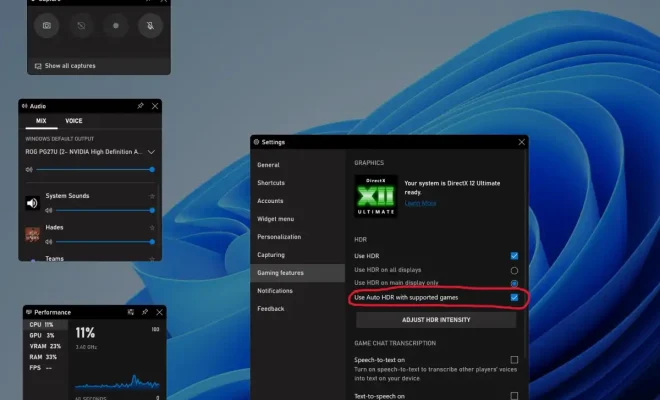
6. Toggle the “Auto HDR” switch to “On.”

That’s it! Your PC is now ready to use Auto HDR.

Step 3: Configure Auto HDR

By default, the Auto HDR feature will be enabled for all HDR-compatible games. However, you can also configure the settings to disable it for certain games that you don’t want to use it for. Here’s how:

1. Click on the “Start” button.

2. Type “Settings” and select the “Settings” app.

3. Click on “Gaming.”

4. Select “Auto HDR.”

5. Toggle the “Let Windows decide when to use HDR” switch to “Off.”

6. You can now individually enable or disable Auto HDR for specific games by toggling the switch next to their names.

Step 4: Enjoy Enhanced Gaming Experience

Now that you’ve enabled and configured Auto HDR, it’s time to enjoy an enhanced visual experience in your HDR-compatible games. When you start a game that is compatible with Auto HDR, Windows 11 will automatically adjust the color and contrast settings to provide a more vibrant and detailed image. You can always disable it for specific games if you find that the feature is not making a significant difference.

In conclusion, the Auto HDR feature in Windows 11 is an excellent addition that can greatly improve your visual experience in HDR-compatible games. By following the simple steps outlined in this article, you can enable and configure Auto HDR to make the most of your PC’s display capabilities.

Previous Article

Voice Memos on the iPhone: A Complete ...

Next Article

How to Use tcpdump

Matthew Lynch

Related articles More from author

  • Digital & Mobile Technology

    The Best DJ Controllers

    June 10, 2023
    By Matthew Lynch
  • Digital & Mobile Technology

    How to Get Minecraft Skins

    June 9, 2023
    By Matthew Lynch
  • Digital & Mobile Technology

    Best Luxury Fashion Websites to Shop for Designer Clothes

    June 15, 2023
    By Matthew Lynch
  • Digital & Mobile Technology

    The Best Terminal Emulator Apps for Android

    August 5, 2023
    By Matthew Lynch
  • Digital & Mobile Technology

    How to Install Homebrew on a Nintendo Wii Using LetterBomb

    June 26, 2023
    By Matthew Lynch
  • Digital & Mobile Technology

    How to Downgrade to an Older Version of iOS

    August 5, 2023
    By Matthew Lynch

Search

Login & Registration

  • Log in
  • Entries feed
  • Comments feed
  • WordPress.org

Newsletter

Signup for The Tech Edvocate Newsletter and have the latest in EdTech news and opinion delivered to your email address!

About Us

Since technology is not going anywhere and does more good than harm, adapting is the best course of action. That is where The Tech Edvocate comes in. We plan to cover the PreK-12 and Higher Education EdTech sectors and provide our readers with the latest news and opinion on the subject. From time to time, I will invite other voices to weigh in on important issues in EdTech. We hope to provide a well-rounded, multi-faceted look at the past, present, the future of EdTech in the US and internationally.

We started this journey back in June 2016, and we plan to continue it for many more years to come. I hope that you will join us in this discussion of the past, present and future of EdTech and lend your own insight to the issues that are discussed.

Newsletter

Signup for The Tech Edvocate Newsletter and have the latest in EdTech news and opinion delivered to your email address!

Contact Us

The Tech Edvocate
910 Goddin Street
Richmond, VA 23231
(601) 630-5238
[email protected]

Copyright © 2026 Matthew Lynch. All rights reserved.