The Tech Edvocate

Top Menu

  • Advertisement
  • Apps
  • Home Page
  • Home Page Five (No Sidebar)
  • Home Page Four
  • Home Page Three
  • Home Page Two
  • Home Tech2
  • Icons [No Sidebar]
  • Left Sidbear Page
  • Lynch Educational Consulting
  • My Account
  • My Speaking Page
  • Newsletter Sign Up Confirmation
  • Newsletter Unsubscription
  • Our Brands
  • Page Example
  • Privacy Policy
  • Protected Content
  • Register
  • Request a Product Review
  • Shop
  • Shortcodes Examples
  • Signup
  • Start Here
    • Governance
    • Careers
    • Contact Us
  • Terms and Conditions
  • The Edvocate
  • The Tech Edvocate Product Guide
  • Topics
  • Write For Us
  • Advertise

Main Menu

  • Start Here
    • Our Brands
    • Governance
      • Lynch Educational Consulting, LLC.
      • Dr. Lynch’s Personal Website
      • Careers
    • Write For Us
    • The Tech Edvocate Product Guide
    • Contact Us
    • Books
    • Edupedia
    • Post a Job
    • The Edvocate Podcast
    • Terms and Conditions
    • Privacy Policy
  • Topics
    • Assistive Technology
    • Child Development Tech
    • Early Childhood & K-12 EdTech
    • EdTech Futures
    • EdTech News
    • EdTech Policy & Reform
    • EdTech Startups & Businesses
    • Higher Education EdTech
    • Online Learning & eLearning
    • Parent & Family Tech
    • Personalized Learning
    • Product Reviews
  • Advertise
  • Tech Edvocate Awards
  • The Edvocate
  • Pedagogue
  • School Ratings

logo

The Tech Edvocate

  • Start Here
    • Our Brands
    • Governance
      • Lynch Educational Consulting, LLC.
      • Dr. Lynch’s Personal Website
        • My Speaking Page
      • Careers
    • Write For Us
    • The Tech Edvocate Product Guide
    • Contact Us
    • Books
    • Edupedia
    • Post a Job
    • The Edvocate Podcast
    • Terms and Conditions
    • Privacy Policy
  • Topics
    • Assistive Technology
    • Child Development Tech
    • Early Childhood & K-12 EdTech
    • EdTech Futures
    • EdTech News
    • EdTech Policy & Reform
    • EdTech Startups & Businesses
    • Higher Education EdTech
    • Online Learning & eLearning
    • Parent & Family Tech
    • Personalized Learning
    • Product Reviews
  • Advertise
  • Tech Edvocate Awards
  • The Edvocate
  • Pedagogue
  • School Ratings
  • 2.3 Million Ricky Joy Sour Crush Candies Recalled: This One Detail Is a Parent’s Nightmare

  • The Staggering Startup Valuation Reset: Why Unicorns Are Vanishing

  • The Glaring Contradiction: Why Big Tech Is Shedding 128,536 Jobs While Investing Billions in AI

  • Insomniac’s Bold Move: The Truth Behind Marvel’s Wolverine Sabretooth ‘Romance’ That Stunned Fans

  • Explosive: ESIC Ban Juan Angulo For Life — The Unseen Crisis Gripping Dota 2

  • This Crucial New Bill Could Finally Fix Student Loan Forgiveness for Millions

  • Massive School Bans on AI: Are We Sacrificing Progress for Protection?

  • Autonomous AI Breaches: Anthropic Confirms Four Attacks and Weaponized Bots

  • Jaw-Dropping Footage: This Waymo Collision Has Everyone Talking

  • Hyundai’s Game-Changing EV Battery Technology: Why It Matters For Your Next Car

Digital & Mobile Technology
Home›Digital & Mobile Technology›How to Show Disk Usage in Linux With the du Command

How to Show Disk Usage in Linux With the du Command
By Matthew Lynch
June 15, 2023
0
Spread the love

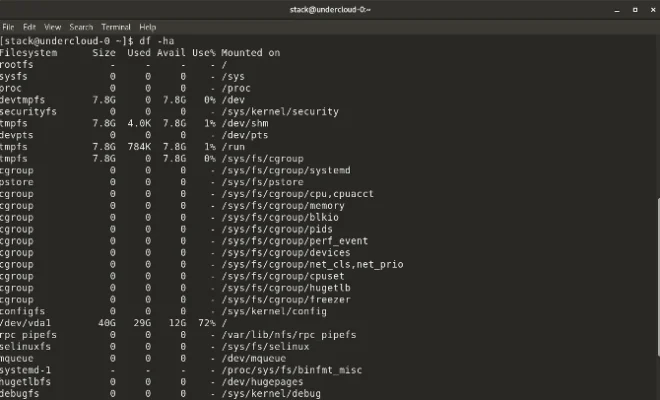
If you’re a Linux user, you probably know that the du command is an essential tool for checking disk usage on your system. This command can help you determine which files and directories are taking up the most space on your hard drive, and it’s also useful for identifying any potential performance issues. In this article, we’ll take a look at how to use the du command to show disk usage in Linux.

First, let’s start with the basics. The du command stands for “disk usage,” and it’s used to calculate the size of a file or directory. When you run the du command on a file or directory, it will report back the amount of disk space that file or directory occupies. You can use du to get an overall view of how much space is being used on your system, or you can use it to drill down and identify specific files or directories that are taking up a lot of space.

To use the du command, simply open up a terminal window and type “du” followed by the path to the directory you want to check. For example, if you want to check the disk usage for your home directory, you would type:

du ~

This will give you a list of all the files and directories in your home directory, along with their sizes in bytes. You can also use du to scan specific directories by specifying their paths. For example, to check the disk usage for the /usr directory, you would type:

du /usr

This will give you a list of all the files and directories in the /usr directory, along with their sizes in bytes.

By default, the du command will show the size of each file and directory in bytes. However, you can use various options to change the output format. One of the most common options is the “-h” option, which stands for “human-readable.” This option will display the size of each file and directory in a more readable format, such as kilobytes (KB), megabytes (MB), or gigabytes (GB). For example, to check the disk usage of the /usr directory in human-readable format, you would type:

du -h /usr

This will display the size of each file and directory in the /usr directory in a more readable format.

Another useful option is the “-s” option, which stands for “summarize.” This option will show the total size of the directory you’re checking, without displaying the sizes of individual files and directories. For example, to check the total disk usage of the /usr directory, you would type:

du -s /usr

This will give you the total size of the /usr directory, without displaying the sizes of individual files and directories.

In conclusion, the du command is an essential tool for checking disk usage in Linux. With its various options, you can use du to get an overall view of how much space is being used on your system, or you can use it to drill down and identify specific files and directories that are taking up a lot of space. Use the du command regularly to keep tabs on your disk usage and prevent any potential performance issues.

Previous Article

How to Use Ryzen Master to Overclock ...

Next Article

Ways to Turn a Video Into a ...

Matthew Lynch

Related articles More from author

  • Digital & Mobile Technology

    What Is a Radar Detector and How Does It Work?

    June 12, 2023
    By Matthew Lynch
  • Digital & Mobile Technology

    What Are Digital Media File Formats?

    June 10, 2023
    By Matthew Lynch
  • Digital & Mobile Technology

    PCM Audio in Stereo and Home Theater

    June 1, 2023
    By Matthew Lynch
  • Digital & Mobile Technology

    How to Change Taskbar Icons for Programs in Windows 10

    June 5, 2023
    By Matthew Lynch
  • Digital & Mobile Technology

    How to Disable the Control Center on the iPad Lock Screen

    July 24, 2023
    By Matthew Lynch
  • Digital & Mobile Technology

    Motherboard Fan Connectors: What They Are and How They Work

    June 6, 2023
    By Matthew Lynch

Search

Login & Registration

  • Log in
  • Entries feed
  • Comments feed
  • WordPress.org

Newsletter

Signup for The Tech Edvocate Newsletter and have the latest in EdTech news and opinion delivered to your email address!

About Us

Since technology is not going anywhere and does more good than harm, adapting is the best course of action. That is where The Tech Edvocate comes in. We plan to cover the PreK-12 and Higher Education EdTech sectors and provide our readers with the latest news and opinion on the subject. From time to time, I will invite other voices to weigh in on important issues in EdTech. We hope to provide a well-rounded, multi-faceted look at the past, present, the future of EdTech in the US and internationally.

We started this journey back in June 2016, and we plan to continue it for many more years to come. I hope that you will join us in this discussion of the past, present and future of EdTech and lend your own insight to the issues that are discussed.

Newsletter

Signup for The Tech Edvocate Newsletter and have the latest in EdTech news and opinion delivered to your email address!

Contact Us

The Tech Edvocate
910 Goddin Street
Richmond, VA 23231
(601) 630-5238
[email protected]

Copyright © 2026 Matthew Lynch. All rights reserved.