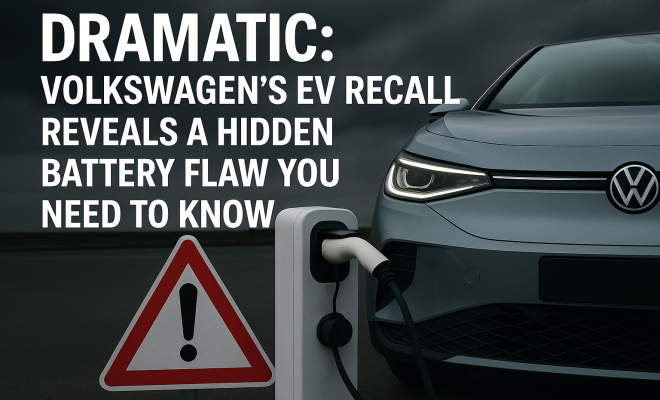
Dramatic: Volkswagen’s EV Recall Reveals a Hidden Battery Flaw You Need to Know
When you buy a brand-new electric vehicle, especially from a marque as established as Volkswagen, you expect a certain level of reliability and, above all, safety. You envision silent, emissions-free driving, cutting-edge technology, and the peace of mind that comes with a well-engineered machine. So, imagine the jolt when news breaks that your shiny new EV, a beacon of modern automotive progress, might harbor a critical flaw within its very heart – the high-voltage battery – potentially leading to thermal runaway and even fire. This isn’t a hypothetical; it’s the stark reality facing thousands of Volkswagen EV owners right now, as the German giant initiates a significant global recall. The implications are far-reaching, touching not just the immediate safety of drivers but also the delicate ecosystem of consumer trust in the burgeoning electric vehicle market.
This isn’t just another minor service bulletin. We’re talking about a fundamental issue in the high-voltage battery system, the most expensive and critical component in any EV. Volkswagen’s internal quality checks have unearthed a disturbing truth: individual battery cells in certain models aren’t meeting the rigorous standards required. This deficiency can lead to what engineers call ‘thermal stress,’ and in the most extreme scenarios, it could culminate in a battery fire. The Volkswagen EV recall affects several thousand vehicles, spanning popular models like the ID.3, ID.4, ID.7, and the much-anticipated ID. Buzz, along with the Cupra Born, all produced between 2023 and 2026. If you own one of these, you’ve likely felt a mix of concern and frustration, and you’re not alone. The automaker’s advice to limit charging to 80% capacity, while a sensible interim measure, underscores the severity of the problem and the immediate need for a permanent solution.
The Heart of the Problem: Unpacking the Battery Cell Defect
At the core of this Volkswagen EV recall is a deeply concerning manufacturing or quality control issue with individual battery cells. Think of an EV battery pack not as a single giant unit, but as a sophisticated collection of thousands of individual cells, meticulously arranged and managed. Each cell must perform flawlessly, maintaining specific voltage, temperature, and degradation characteristics. If even a handful of these cells are subpar, they can become weak links, creating imbalances within the pack.
Volkswagen’s internal audits, thankfully, caught this before widespread incidents occurred. The discovery was that certain cells simply don’t adhere to the company’s stringent quality benchmarks. What does that mean in practical terms? It could be anything from microscopic impurities introduced during manufacturing, inconsistent electrode coatings, or even subtle variations in electrolyte composition. Any of these can compromise a cell’s long-term stability and performance. Over time, or under specific charging and discharging cycles, these compromised cells can experience internal resistance, leading to localized heating. This ‘thermal stress’ is the precursor to more serious problems, potentially initiating a chain reaction within the battery pack known as thermal runaway – a self-propagating increase in temperature that can be incredibly difficult to stop and often results in fire.
The fact that this issue was identified internally speaks to the complexity of modern battery manufacturing and the constant vigilance required. However, it also highlights a significant challenge for automakers as they push the boundaries of EV technology. Ensuring consistent quality across millions of individual battery cells sourced from various suppliers, or manufactured in-house, is a monumental task. When such a fundamental component falters, the ripple effect is immense, triggering not just logistical headaches but also a serious blow to brand reputation and consumer confidence.
Which Models Are Affected by the Volkswagen EV Recall?
For current and prospective EV owners, one of the most pressing questions is, naturally, which vehicles are implicated in this critical Volkswagen EV recall. The scope isn’t limited to a single model; it encompasses a significant portion of Volkswagen’s modern electric lineup, alongside a related brand’s offering. Specifically, the recall targets several thousand electric vehicles globally, all manufactured between 2023 and 2026. This broad production window suggests that the issue might have been present for some time or that the problematic batch of cells was used across multiple production runs.
The affected models include key players in Volkswagen’s ambitious ID. family: the compact ID.3 hatchback, the popular ID.4 SUV, the newer ID.7 sedan, and the highly anticipated retro-futuristic ID. Buzz van. Each of these represents a significant investment for Volkswagen and a commitment to different segments of the EV market. Beyond the VW badge, the recall also extends to the Cupra Born, a sportier electric hatchback that shares its underlying platform and many components, including battery systems, with the Volkswagen ID.3. This cross-brand implication underscores the modular nature of modern automotive platforms and how a single component issue can quickly cascade across multiple vehicle lines.
If you’re an owner of any of these models, particularly those produced within the specified timeframe, it’s absolutely crucial to remain vigilant. Volkswagen is in the process of notifying owners, with letters expected by late November 2026. However, given the safety implications, proactively checking your vehicle’s VIN with a Volkswagen dealership or through their official recall checker is a prudent step. Don’t wait for a letter if you have any doubts. This isn’t just about a potential inconvenience; it’s about mitigating a genuine safety risk associated with your vehicle’s most vital system. (See: Electric Vehicle Safety Standards.)
The 80% Charge Limit: A Temporary, But Inconvenient, Solution
One of the most immediate and tangible pieces of advice Volkswagen is giving to affected owners is to limit their vehicle’s charging to 80% capacity. This isn’t just a suggestion; it’s a critical interim safety measure designed to reduce the risk associated with the faulty battery cells until a permanent fix can be implemented. But why 80%? And what does it really mean for daily driving?
Battery experts know that the most stressful periods for a lithium-ion battery are at the extreme ends of its charge cycle – when it’s very low or, more critically for this situation, when it’s charged to 100%. Pushing a battery to full capacity places more strain on individual cells, increasing internal resistance and generating more heat, especially if those cells are already compromised. By capping the charge at 80%, Volkswagen aims to create a buffer, reducing the likelihood of thermal stress reaching dangerous levels in the defective cells. It’s a calculated risk management strategy, essentially telling the battery, ‘Don’t work too hard, just in case.’ This temporary measure will likely be implemented via a software update that automatically restricts charging, or owners will be advised to manually stop charging at the 80% mark, depending on the vehicle’s existing software capabilities.
While understandable from a safety perspective, this 80% limit is undeniably inconvenient for owners. It directly impacts the effective range of their vehicles, effectively reducing it by 20%. For someone who bought an EV specifically for its long-range capabilities or for daily commutes that push the limits of a full charge, this is a significant operational downgrade. It means more frequent charging stops, potentially longer travel times, and a constant awareness of remaining battery percentage. This isn’t just about range anxiety; it’s about a tangible reduction in the utility and value proposition of their expensive electric vehicle. It’s a stop-gap measure that buys time, but it doesn’t solve the underlying problem, and it certainly doesn’t alleviate the frustration of affected owners.
The Broader Impact on Consumer Confidence in EVs
Recalls, unfortunately, are a part of the automotive industry. Even combustion engine vehicles have their share of issues, from airbag inflators to brake system flaws. However, an EV recall, particularly one involving the battery and fire risk, often carries a disproportionately heavier weight in the public consciousness. Why? Because the electric vehicle market is still relatively nascent, and many consumers are either on the fence about making the switch or are early adopters keenly watching how the technology evolves. This Volkswagen EV recall arrives at a delicate time.
The public perception of EVs is heavily influenced by safety, reliability, and range. Battery fires, while statistically less common than ICE vehicle fires, tend to generate intense media scrutiny and can quickly go viral, fueling existing anxieties about electric car safety. When a major manufacturer like Volkswagen, which has invested billions into its electrification strategy, faces a battery-related recall, it inevitably erodes a degree of public trust. Potential buyers, already grappling with higher upfront costs and charging infrastructure concerns, might now add ‘battery fire risk’ to their list of hesitations. This isn’t fair to the vast majority of safe EVs on the road, but perception often trumps reality, especially in the early stages of technological adoption.
Moreover, this recall could inadvertently empower critics of EV technology, providing them with ‘proof’ that EVs are inherently unsafe or unreliable. This narrative, however inaccurate it may be when looking at the broader picture, can slow down the transition to electric mobility. Automakers and regulators have worked tirelessly to build confidence, and incidents like this, even when handled transparently, represent a setback. It underscores the immense responsibility manufacturers bear not only to their customers but to the future of sustainable transportation itself. Rebuilding and maintaining that trust will require not just a swift fix for the affected vehicles, but ongoing, transparent communication and an unwavering commitment to quality in every aspect of EV production.
Financial Headaches for Affected Owners
Beyond the immediate safety concerns and the inconvenience of reduced range, this Volkswagen EV recall poses significant financial implications for affected owners. Buying a new car is a substantial investment, and an EV often comes with a premium price tag. When that investment is compromised by a fundamental defect, the financial ripple effects can be substantial and varied.
First and foremost, there’s the immediate loss of utility due to the 80% charge limit. This isn’t just a minor annoyance; it’s a tangible reduction in the vehicle’s promised capabilities. If you bought an ID.4 with a 300-mile range and are now effectively limited to 240 miles, that’s a 20% cut in performance you paid for. This can impact everything from daily commutes to planned road trips, potentially forcing owners to spend more on public transport, rental cars, or simply enduring more frequent charging stops.
Then there’s the question of resale value. A vehicle with an active recall, especially one concerning the battery and fire risk, is almost certainly going to see a depreciation in its market value. Even after a permanent fix is implemented, the stigma of a major battery recall can linger, making it harder to sell or trade in the vehicle at a fair price. Buyers in the used EV market will be wary, and rightly so, which translates directly into lower offers for owners. This isn’t just a hypothetical; it’s a real-world consequence that can cost owners thousands of dollars. (See: Battery Safety and Health Risks.)
Furthermore, owners might face increased auto insurance premiums, especially if specialized EV coverage providers begin to factor in the recall history. While standard insurance often covers fire, the underlying risk factor could be considered. And what about the time and effort involved in getting the fix? Taking time off work, arranging alternative transportation, and dealing with dealership logistics all represent indirect costs. For some, the frustration might even lead to considering legal avenues, adding further financial strain through consultations with product liability lawyers. This recall isn’t just about a technical fix; it’s about the financial burden and emotional toll it places on the very customers who put their faith in Volkswagen’s electric vision.
The Race for a Permanent Solution: What’s Next?
The 80% charge limit is a temporary bandage, not a cure. The true resolution for this Volkswagen EV recall lies in developing and implementing a permanent fix for the defective battery cells. This is where Volkswagen’s engineering prowess will be put to the ultimate test. The nature of the fix will depend heavily on the exact root cause of the cell quality issue.
If the problem is confined to a specific batch of cells from a particular supplier, the solution might involve replacing entire battery modules or even full battery packs in affected vehicles. This would be a massive undertaking, logistically complex and incredibly expensive, given the size and cost of EV battery packs. If the issue is more widespread across different suppliers or represents a design flaw that manifests under certain conditions, a software-based solution might be possible to better manage the compromised cells, though this would likely require extensive testing and validation to ensure long-term safety and performance.
Volkswagen has indicated that notification letters are expected by late November 2026, which gives a hint at the timeline. This is a considerable period, suggesting that a complex engineering solution is being developed, tested, and prepared for mass deployment. It also implies that the process of securing new, verified battery components (if replacement is needed) and training technicians will take time. During this waiting period, owners are left with the 80% charge limit and the anxiety of driving a vehicle with a known, albeit mitigated, safety risk.
The company’s focus will be on ensuring the fix is comprehensive, durable, and doesn’t introduce new problems. They will undoubtedly be under intense scrutiny from regulatory bodies globally, such as the National Highway Traffic Safety Administration (NHTSA) in the US and similar organizations in Europe. The permanent solution needs to restore not just the safety of the vehicles, but also the full range and performance that owners paid for, thereby rebuilding trust in the Volkswagen brand and its commitment to electric mobility.
Monetization Opportunities: A Silver Lining for Some?
While this Volkswagen EV recall is undoubtedly a challenging situation for the automaker and its customers, it also creates an interesting, albeit somewhat opportunistic, landscape for various industries. In the complex aftermath of a major recall, certain sectors often find unexpected opportunities for growth and engagement.
One of the most immediate beneficiaries could be auto insurance providers, particularly those specializing in electric vehicle coverage. The heightened awareness of EV battery risks, even if statistically low, might prompt more EV owners to seek out comprehensive policies that explicitly address battery-related incidents, fire, and potential depreciation due to recalls. Providers offering specialized EV coverage with clear terms on battery defects and recall-related losses could see increased demand. This isn’t just about covering damage; it’s about providing peace of mind in a slightly more uncertain environment. This builds on solid state battery news.
Legal firms are another sector likely to see increased activity. Product liability law and class-action lawsuits are common responses to widespread automotive defects. Affected owners, particularly those who feel significantly impacted by the reduced vehicle utility, diminished resale value, or prolonged waiting times for a fix, may explore legal avenues. Firms specializing in consumer protection and automotive litigation will undoubtedly be poised to offer consultations and potentially initiate collective actions, seeking compensation for damages beyond what the manufacturer might unilaterally offer. (See: IEEE Publications on Battery Technology.)
Finally, personal finance platforms and automotive consumer advice channels will have a prime opportunity to engage their audiences. Owners will be looking for guidance on managing the financial implications: how to assess potential depreciation, whether to sell or hold onto the vehicle, how to negotiate trade-in values, and what their rights are as consumers. Platforms offering well-researched advice on EV resale value, repair costs, and navigating manufacturer recalls will become valuable resources for a worried customer base. This unfortunate situation, while difficult, does highlight how interconnected the automotive ecosystem is, creating ripple effects that benefit some while challenging others.
The Long Road to Rebuilding Trust
The Volkswagen EV recall isn’t just a logistical challenge; it’s a significant test of the company’s commitment to quality and its ability to maintain consumer trust in a rapidly evolving market. In the wake of previous controversies, particularly ‘Dieselgate,’ Volkswagen has worked hard to rebrand itself as a leader in sustainable mobility. This latest battery issue, while different in nature, puts that renewed image under considerable pressure. Rebuilding trust will be a long and arduous process, requiring more than just a technical fix.
Transparency is paramount. Volkswagen needs to communicate openly and frequently with affected owners, providing clear timelines, detailed explanations of the fix, and genuine empathy for the disruption this causes. Vague statements or delayed information will only fuel frustration and suspicion. Offering tangible compensation for the inconvenience, such as extended warranties, charging credits, or even goodwill payments, could go a long way in appeasing disgruntled customers.
Beyond the immediate recall, Volkswagen must demonstrate an unwavering commitment to quality control throughout its entire EV production chain, from cell sourcing to final assembly. This might involve re-evaluating supplier relationships, enhancing internal testing protocols, and investing even more heavily in advanced battery management systems that can detect and mitigate cell anomalies before they become critical. The future of electric vehicles, for Volkswagen and the industry as a whole, hinges on delivering not just innovative technology, but also flawless reliability and unquestionable safety.
Ultimately, this Volkswagen EV recall serves as a powerful reminder that the journey to mass EV adoption is not without its bumps and detours. While the technology promises a cleaner future, the complexities of engineering and manufacturing these sophisticated machines mean that challenges will inevitably arise. How automakers respond to these challenges – with speed, transparency, and a genuine commitment to their customers – will define not just their individual success, but the pace and trajectory of the entire electric revolution. For now, thousands of Volkswagen EV owners are holding their breath, hoping for a swift and definitive resolution that restores their faith in their vehicles and the brand.
Frequently Asked Questions
What is the Volkswagen EV recall about?
The Volkswagen EV recall involves a significant defect in the high-voltage battery system of several models, including the ID.3, ID.4, ID.7, and ID. Buzz, produced between 2023 and 2026. The issue can lead to thermal stress and potentially result in battery fires, prompting the company to recall thousands of vehicles worldwide.
Which Volkswagen models are affected by the recall?
The recall affects multiple Volkswagen models, specifically the ID.3, ID.4, ID.7, and ID. Buzz, along with the Cupra Born, all manufactured between 2023 and 2026. Owners of these vehicles are advised to take precautions due to a critical battery flaw.
What should Volkswagen EV owners do about the recall?
Volkswagen EV owners should limit their vehicle charging to 80% capacity as a temporary measure while awaiting further instructions from the company. It’s crucial to stay updated on the recall and follow any guidance provided by Volkswagen regarding repairs or replacements.
What causes the battery defect in Volkswagen EVs?
The battery defect in Volkswagen EVs is attributed to individual battery cells that fail to meet rigorous quality standards. This deficiency can lead to thermal stress, increasing the risk of a battery fire, thus prompting the significant recall of affected vehicles.
How does the battery flaw affect consumer trust in electric vehicles?
The battery flaw revealed in Volkswagen's EV recall significantly impacts consumer trust in electric vehicles. Safety concerns regarding high-voltage batteries may lead potential buyers to hesitate, affecting the overall perception and growth of the electric vehicle market.
What's your take on this? Share your thoughts in the comments below — we read every one.