The AI Overhaul: 93% of Google Searches Now Zero-Click?
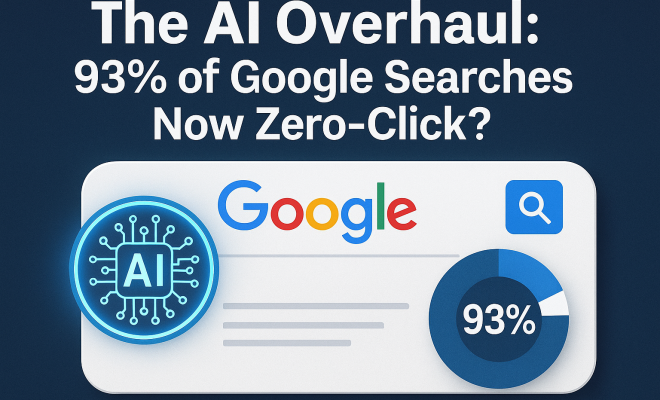
For years, the internet has largely operated on a simple premise: you search, you click. That click, whether it led to a news article, a product page, or a service provider, was the lifeblood of countless businesses and publishers. It was how content creators monetized their work, how brands connected with customers, and how information flowed across the digital landscape. But what happens when that fundamental interaction – the click – starts to evaporate? We’re not talking about a slow decline; we’re talking about a dramatic, almost overnight transformation driven by Google’s aggressive push into AI. Recent data suggests a truly stunning shift: up to 93% of Google searches might now be zero-click, meaning users find their answers directly on the search results page without ever visiting an external website. This phenomenon, fueled by Google AI zero-click searches, is rewriting the rules of online visibility and posing an existential question for anyone who relies on organic traffic.
It’s a seismic shift, particularly for those in the digital marketing and content creation trenches. Imagine building your entire business model around driving traffic, only to have the very engine of that traffic redesigned to keep users on its own platform. That’s the reality many are grappling with right now. While the exact percentage of zero-click searches can fluctuate based on methodology and query type, the trend is undeniable and accelerating. Google’s AI Overviews, powered by large language models, are becoming incredibly sophisticated, capable of synthesizing information from multiple sources and presenting it in a concise, authoritative answer directly at the top of the search results. This changes everything, forcing a radical re-evaluation of SEO strategies, content creation, and even the fundamental value proposition of a website.
The Rise of AI Overviews: Your Content, Their Platform
Google’s AI Overviews, often appearing as a prominent, generated answer box at the top of the search results page, are the primary driver behind the surge in Google AI zero-click searches. These overviews aren’t just snippets; they’re comprehensive summaries, sometimes several paragraphs long, designed to answer a user’s query directly. Think about it: if you ask ‘What’s the capital of France?’ you don’t need to click through to Wikipedia anymore. Google tells you directly. This isn’t new for simple factual queries, but the sophistication has grown exponentially. Now, complex questions about ‘how-to’ guides, product comparisons, or even technical explanations are being distilled into AI-generated answers.
What makes this particularly impactful is the breadth of topics these AI Overviews cover. For instance, the source material points out that technical and B2B queries can see up to 70% exposure to AI Overviews. This means that if you’re a SaaS company trying to explain a complex feature, or a B2B firm offering insights into industry trends, a significant portion of potential searchers might be getting their information directly from Google’s AI, bypassing your meticulously crafted blog post or whitepaper. This isn’t just about losing a click; it’s about losing the opportunity to introduce your brand, demonstrate your expertise, and guide users further down your sales funnel. The AI is effectively acting as a highly efficient, content-synthesizing gatekeeper.
The Cannibalization of Informational SEO
For years, a cornerstone of SEO strategy, particularly for content marketers and publishers, has been creating high-quality, long-form informational content. Blog posts, articles, guides – these were designed to answer user questions, build authority, and attract organic traffic. The idea was simple: provide value, rank high, and earn clicks. This traditional informational SEO is now facing direct cannibalization from Google AI zero-click searches.
When Google’s AI can provide a succinct, accurate answer for ‘how to fix a leaky faucet’ or ‘what are the benefits of cloud computing,’ the incentive for a user to click through to an external site diminishes significantly. Why spend time browsing a website, navigating ads, and scrolling through paragraphs when the answer is presented clearly and instantly? This poses a serious challenge for businesses that have invested heavily in content marketing purely for informational purposes. The value proposition of an informational blog post, in many cases, has been drastically reduced. Publishers, in particular, are feeling the squeeze, as their ad revenue models are directly tied to page views and clicks. If users aren’t clicking, ad impressions plummet, and revenue dries up. It’s a stark reality that requires a fundamental rethink of content strategy.
Identifying Resilient Query Types: Where Clicks Still Matter
While the overall trend points towards a surge in Google AI zero-click searches, it’s not a uniform landscape. Certain types of queries are proving more resilient and continue to generate clicks. Understanding these categories is crucial for businesses looking to adapt their SEO and content strategies. The source highlights several key areas where traditional clicks still hold strong:
- Transactional Queries: When someone is ready to buy, they need to visit a website. Searches like ‘buy running shoes online’ or ‘best CRM software pricing’ inherently require a click to a retail site, a product page, or a vendor’s pricing page. Google’s AI can summarize product features, but it can’t complete a purchase or sign you up for a free trial.
- Brand Searches: If a user explicitly searches for ‘Nike official website’ or ‘HubSpot login,’ they have a clear intent to interact with a specific brand’s property. The AI might provide a quick summary of the brand, but the user’s goal is to engage directly with the brand’s online presence.
- Comparisons and Reviews: While AI can summarize pros and cons, users often want to delve deeper into detailed reviews, side-by-side comparisons, or user testimonials before making a decision. They want to hear from real people, see specific feature breakdowns, and understand nuances that an AI summary might miss. Content like ‘iPhone 15 vs. Samsung Galaxy S24 review’ often leads to clicks on dedicated tech review sites.
- Demos and Case Studies: For complex products or services, especially in B2B, users often seek detailed demonstrations or real-world examples of how a solution works. A search for ‘Salesforce demo’ or ‘case study on successful digital transformation’ typically requires a click to a vendor’s site to access that specific content.
These categories represent the battlegrounds where traditional SEO can still win. The intent behind these queries is typically much stronger, signaling a user who is further along in their decision-making process and needs more than a quick AI summary.
The Monetization Angle: A Looming Crisis for Publishers and Marketers
The implications of Google AI zero-click searches extend far beyond mere traffic numbers; they strike at the heart of online monetization. For publishers, ad revenue is directly tied to page views. Fewer clicks mean fewer ad impressions, leading to a significant drop in income. Many news organizations and content sites, already struggling in a challenging media landscape, face an existential threat as their primary revenue stream diminishes. (See: impact of AI on search engines.)
For businesses, especially those in B2B SaaS or e-commerce, the problem is multifaceted. While transactional queries might be more resilient, the initial ‘discovery’ phase, often driven by informational searches, is where many potential customers first encounter a brand. If Google’s AI delivers the answer without a click, that crucial first touchpoint is lost. This makes it harder to build brand awareness, capture leads through content upgrades, or nurture prospects with retargeting campaigns. The entire customer journey is being reshaped, forcing marketers to find new ways to engage users who might never land on their website. The traditional funnels are breaking down, demanding innovative approaches to capture attention and drive conversions.
Adapting Content Strategy for the AI Era
Given the rise of Google AI zero-click searches, a passive approach to content strategy is no longer viable. Businesses and publishers must proactively adapt. This means shifting focus from purely informational content to content that serves the resilient query types and provides value that AI cannot easily replicate.
Firstly, double down on content that caters to transactional intent. Optimize product pages, service descriptions, and pricing pages for relevant keywords. Ensure clear calls to action and a frictionless conversion path. Secondly, invest heavily in brand building. If users are searching for your brand specifically, you’ve already won a significant battle against AI Overviews. This means strong branding, excellent customer service, and unique value propositions that make people want to seek you out.
Thirdly, create genuinely authoritative and in-depth comparison and review content. While AI can summarize, a human-written, detailed review with personal insights, hands-on testing, and nuanced analysis still holds significant sway. Think about content that offers a truly unique perspective, data, or user experience that an AI couldn’t simply scrape and regurgitate. Finally, produce compelling case studies and demos that showcase real-world results and practical applications. These types of content often require a deeper dive that necessitates a website visit, providing an opportunity to capture leads.
Beyond the Click: The Value of Implicit Engagement
It’s tempting to view the decline in clicks solely as a negative, but it’s also important to consider the concept of ‘implicit engagement.’ Even if a user doesn’t click on your site, if Google’s AI Overviews are drawing information from your content to answer a query, there’s still a form of attribution, however indirect. Your content is being recognized as a valuable source of information, which can contribute to brand authority and expertise over the long term.
The challenge, of course, is how to convert this implicit engagement into tangible business results. One strategy is to ensure your brand name is prominently featured and associated with the information being presented in the AI Overview. While Google might not link directly, if your brand is consistently cited as the source, it builds recognition and trust. Another approach is to think about the ‘next step’ a user might take after reading an AI summary. If the AI answers a specific question, what’s the logical follow-up? Can you create content that anticipates that next question and provides a compelling reason to click through to your site for a deeper dive or a solution?
The Future of SEO: From Keywords to Intent and Authority
The rise of Google AI zero-click searches fundamentally shifts the focus of SEO. While keywords will always play a role, the emphasis moves much more towards understanding user intent and establishing unparalleled authority. Ranking for a keyword is no longer enough; you need to rank for intent, anticipating what a user truly needs and providing the most comprehensive, trustworthy answer – whether that answer is consumed on Google’s platform or yours.
This means SEO professionals need to evolve their skill sets. It’s less about stuffing keywords and more about semantic understanding, entity relationships, and truly exceptional content creation. Google’s AI is designed to understand context and nuance, so your content needs to do the same. Building domain authority, becoming a recognized expert in your niche, and creating content that Google’s AI consistently deems as the best source of truth will be paramount. This might involve a greater focus on E-E-A-T (Experience, Expertise, Authoritativeness, Trustworthiness) signals, as Google increasingly relies on these to determine content quality and reliability. Ultimately, the goal isn’t just to rank, but to be the definitive answer, wherever that answer is consumed.
Strategic Investments: What to Prioritize Now
In this rapidly changing landscape, businesses need to make strategic investments to survive and thrive. First and foremost, invest in genuinely differentiated content. If your content is merely a rehash of what’s already out there, it’s easily digestible by AI and less likely to drive clicks. Focus on original research, unique data, proprietary insights, and truly engaging storytelling that offers a human touch AI can’t replicate.
Secondly, diversify your traffic sources. Relying solely on Google organic search is becoming increasingly risky. Explore other channels like social media marketing, email marketing, paid advertising, partnerships, and direct outreach. Building a loyal audience that comes directly to your site or signs up for your newsletter bypasses Google’s gatekeepers entirely. Thirdly, enhance your website’s user experience (UX) and conversion rate optimization (CRO). If you do get a click, make sure that user experience is exceptional and that your site effectively guides them towards your desired action, whether it’s a purchase, a signup, or a contact form submission. The value of each click is increasing, so you need to maximize its potential.
The Long Game: Building Direct Relationships
Perhaps the most crucial long-term strategy in the face of Google AI zero-click searches is to focus on building direct relationships with your audience. In an era where intermediaries like Google are increasingly controlling access to information, owning your audience becomes incredibly powerful. This means prioritizing email list building, fostering community engagement, and creating compelling reasons for people to return to your site directly, rather than through a search engine. (See: Google's AI and search behavior changes.)
Think about creating gated content that requires an email signup, exclusive newsletters, loyalty programs, or interactive tools that provide unique value. These strategies bypass the search engine entirely and create a direct line of communication with your most engaged users. The goal is to transform one-off searchers into loyal followers and customers, ensuring that even if Google continues to evolve its search experience, your business has a sustainable foundation built on direct audience connection. It’s a shift from renting space on Google’s platform to owning your own digital real estate and inviting people directly to your home.
The Ethical Quandary of Content Sourcing
Beyond the immediate business implications, there’s a significant ethical debate emerging around how Google’s AI Overviews source their information. When Google’s AI synthesizes content from various websites to generate an answer, it essentially extracts value without necessarily sending traffic or direct compensation to the original creators. This raises questions about intellectual property rights and fair use. Publishers, particularly those investing heavily in investigative journalism or expert analysis, are finding their unique content being leveraged by Google’s AI without a reciprocal benefit.
This isn’t just a minor complaint; it’s a fundamental challenge to the economic model of content creation. If the incentive to produce high-quality, original content diminishes because it’s simply absorbed and repurposed by AI without a click, who will fund that creation? Some argue Google should directly compensate publishers for the content used in AI Overviews, similar to licensing agreements. Others suggest clearer attribution and more prominent links within the AI answers are needed. The resolution of this ethical quandary will likely shape the future relationship between search engines and content creators, and it’s a conversation that’s only just beginning.
The Impact on Niche Industries and Local Businesses
While large publishers and e-commerce giants feel the squeeze, niche industries and local businesses face unique challenges and opportunities with Google AI zero-click searches. For a local plumber, a zero-click search for “emergency plumber near me” might mean the AI provides contact details and a map directly, bypassing their website entirely. This could be good if the AI accurately presents their services and contact info, but detrimental if it’s incomplete or directs users elsewhere.
Niche content creators, specializing in very specific topics, might find their highly specialized information is precisely what AI Overviews are looking for to provide comprehensive answers. The challenge then becomes how to leverage that implicit recognition into tangible leads or sales. For these smaller players, optimizing for local SEO (Google My Business, local citations) and ensuring their unique selling propositions are crystal clear and easily digestible by AI becomes even more critical. They need to stand out not just to human searchers, but to Google’s algorithms that are scanning for the best, most relevant information.
The Role of Voice Search and Conversational AI
The trend of Google AI zero-click searches is closely intertwined with the rise of voice search and conversational AI assistants. When you ask your smart speaker, “Hey Google, how do I make sourdough bread?”, it doesn’t open a browser and navigate to a recipe site. It provides a direct, synthesized answer. These interactions are inherently zero-click. As more users interact with search through voice and conversational interfaces, the demand for concise, direct answers will only grow.
This means content needs to be structured and written in a way that’s easily digestible by these systems. Think about creating content that directly answers common questions, uses natural language, and is formatted for quick extraction. Schema markup, which helps search engines understand the context and relationships of content, will become even more vital for signaling to AI what information is most important and how it should be presented in a direct answer. Preparing content for conversational AI isn’t just about SEO; it’s about future-proofing your information for how people will increasingly consume it.
Frequently Asked Questions About Google AI Zero-Click Searches
What exactly is a “zero-click search”?
A zero-click search is when a user types a query into Google (or uses voice search) and finds the complete answer directly on the search results page, often within an AI Overview, featured snippet, or knowledge panel, without needing to click through to an external website.
How common are zero-click searches now?
While figures vary based on the methodology and query type, some reports suggest that up to 93% of Google searches could now be zero-click. The trend is definitely increasing with the prevalence of AI Overviews. (See: research on zero-click search trends.)
Are zero-click searches bad for all businesses?
Not necessarily. For informational queries, it can reduce traffic to websites. However, for some businesses, especially local ones, if the AI Overview directly provides their contact information or a clear call to action, it can still lead to conversions. For transactional or brand-specific searches, clicks are generally still essential.
How can publishers and content creators adapt to this change?
They should focus on creating content that is highly authoritative, offers unique insights, and caters to queries where clicks are still crucial (transactional, comparisons, brand searches). Diversifying traffic sources beyond Google and building direct audience relationships (email lists, communities) are also key strategies.
Will Google’s AI Overviews completely eliminate the need for websites?
No, not entirely. While AI Overviews handle many informational queries, websites remain essential for complex transactions, detailed product exploration, in-depth research, brand engagement, and building direct customer relationships. The role of websites is shifting, not disappearing.
What is E-E-A-T and why is it important for AI Overviews?
E-E-A-T stands for Experience, Expertise, Authoritativeness, and Trustworthiness. Google uses these signals to assess the quality and reliability of content. For AI Overviews, Google’s AI wants to provide the most trustworthy answers, so content that demonstrates strong E-E-A-T is more likely to be sourced and featured by the AI. There’s a fuller look at teaching digital marketing.
Should I stop creating informational content?
Not necessarily, but you should re-evaluate its purpose. Instead of solely aiming for clicks, consider how informational content contributes to your brand authority, helps Google’s AI understand your expertise, and supports a broader customer journey that eventually leads to a click on a transactional page or a direct engagement.
The landscape of online search is undeniably shifting, and the rise of Google AI zero-click searches is a potent force reshaping how we find and consume information. While the challenges are real, they also present an opportunity for innovation and a return to fundamental principles: creating genuine value, building strong brands, and fostering direct relationships. Businesses and content creators who recognize this transformation and adapt proactively will be the ones who not only survive but thrive in this brave new AI-driven world.
Trending Now
Frequently Asked Questions
What are zero-click searches?
Zero-click searches occur when users find the information they need directly on the search results page without clicking on any links. Recent data indicates that up to 93% of Google searches may now fall into this category, primarily driven by Google's AI capabilities.
How is AI changing Google search results?
AI is transforming Google search results by providing users with direct answers through AI Overviews. These concise, synthesized responses are generated from multiple sources and displayed prominently, reducing the need for users to visit external websites.
What impact do zero-click searches have on businesses?
Zero-click searches significantly impact businesses that rely on web traffic for revenue. With users finding answers directly in search results, traditional traffic-driving strategies may become less effective, forcing businesses to reevaluate their online presence and SEO strategies.
Why are zero-click searches increasing?
The increase in zero-click searches is largely due to Google's aggressive integration of AI technologies. These advancements allow for more sophisticated information synthesis, enabling users to receive quick, authoritative answers directly within search results.
What should content creators do about zero-click searches?
Content creators should adapt their strategies by focusing on providing high-quality, concise information that aligns with user intent. Exploring new formats and platforms to engage audiences, as well as optimizing for voice search and featured snippets, can help mitigate the impact of zero-click searches.
Have you experienced this yourself? We'd love to hear your story in the comments.