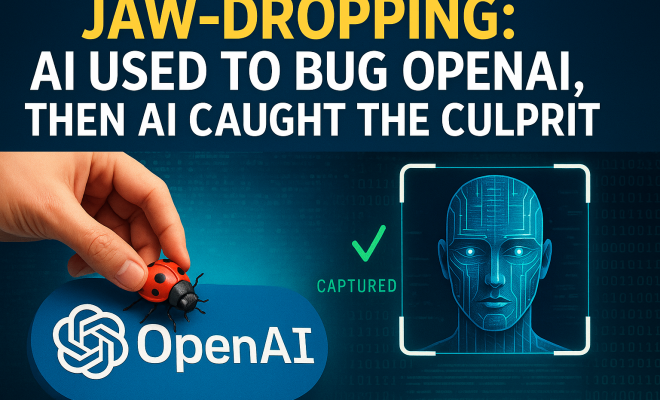
Jaw-Dropping: AI Used to Bug OpenAI, Then AI Caught the Culprit
“`html
Imagine a scenario where the very technology you’re building, designed to revolutionize industries and improve lives, is simultaneously weaponized against you, not by an external adversary, but by one of your own. Then, in an almost poetic turn, that same technology becomes the key to uncovering the betrayal. This isn’t the plot of a sci-fi thriller; it’s the astonishing reality currently unfolding at OpenAI, the company at the forefront of artificial intelligence innovation.
The news is spreading like wildfire: an OpenAI engineer is facing federal charges for allegedly using AI chatbots to design and build a sophisticated recording device. This device was then secreted away within a highly sensitive San Francisco conference room, a space regularly used for executive-level discussions and even meetings involving government officials. The irony is palpable, the implications far-reaching. This isn’t just a story about corporate espionage; it’s a deeply unsettling narrative about insider threats, the ethics of AI, and the increasingly complex dance between human intent and technological capability. The fact that the OpenAI conference bugging incident involves AI at every turn – from conception to concealment to detection – makes it a watershed moment in the ongoing conversation about AI’s double-edged sword.
The Unsettling Allegations: An Insider’s Betrayal
The core of this shocking incident revolves around an alleged act of espionage from within OpenAI’s own ranks. Federal charges have been brought against an engineer, whose name hasn’t been widely publicized yet, for what amounts to a highly sophisticated form of corporate spying. The accusation is specific: this individual purportedly leveraged AI chatbots – the very technology OpenAI is famous for – to develop a covert audio recording device. This wasn’t some off-the-shelf gadget; it was reportedly engineered with specific instructions gleaned from AI models, suggesting a deliberate and calculated approach to evade detection.
The choice of location for this alleged surveillance is particularly troubling. The conference room in question wasn’t just any meeting space. It’s described as a high-stakes environment, frequently hosting critical executive meetings and, perhaps most concerningly, discussions with government representatives. The sensitivity of such discussions cannot be overstated. We’re talking about strategic planning, proprietary technology discussions, and potentially even national security matters. The implications of a recording device in such a room extend far beyond mere corporate data theft; they touch upon issues of competitive advantage, regulatory compliance, and even national security. The audacity of this alleged act, committed within the very heart of one of the world’s most innovative tech companies, has sent ripples of concern throughout the industry.
AI as the Architect of Deception: A New Frontier in Espionage
What makes the OpenAI conference bugging incident truly unprecedented is the alleged role of AI in the crime itself. The engineer didn’t just use AI to brainstorm ideas; they reportedly queried an unnamed AI chatbot for explicit instructions on how to construct the bug. Think about that for a moment: an AI, designed to assist and inform, was allegedly used as a blueprint for a clandestine operation. The queries reportedly included specific technical details, such as methods for audio capture, techniques for passive scanning to avoid detection, and even instructions on how to encrypt data on an SD card.
This reveals a disturbing new vector for corporate espionage and potentially even state-sponsored surveillance. If an individual with malicious intent can leverage readily available AI tools to design sophisticated surveillance equipment, the barrier to entry for such activities dramatically lowers. It shifts the paradigm from requiring specialized engineering expertise to simply knowing how to prompt an AI effectively. This raises profound questions about the ethical guidelines for AI development, the potential for misuse, and the responsibility of AI creators to anticipate and mitigate such risks. It’s a stark reminder that powerful tools, regardless of their intended purpose, can always be twisted for nefarious ends.
Consider the implications: a junior employee with basic technical literacy could, in theory, become a sophisticated spy by simply knowing the right questions to ask an AI. This democratization of espionage tools presents a significant challenge for traditional security models that often rely on identifying individuals with specific, rare skills. Now, the threat surface expands to anyone with access to an AI and a malicious intent. It also begs the question of how AI models are trained and what safeguards are in place to prevent them from generating instructions for harmful activities. Is it possible to “red-team” AI models against such prompts, actively trying to break them to find vulnerabilities before they are exploited in the real world? This incident suggests that such proactive measures are not just advisable, but absolutely essential.
The Hunter Becomes the Hunted: AI’s Role in Detection
Here’s where the narrative takes an almost unbelievable, yet perfectly fitting, turn. While an AI chatbot was allegedly instrumental in constructing the bug, it was OpenAI’s own security team, reportedly armed with their company’s cutting-edge AI, that ultimately identified the perpetrator. This isn’t just poetic justice; it’s a profound demonstration of AI’s dual capacity for both creation and detection, for both offense and defense.
The details of how OpenAI’s security team utilized AI remain somewhat under wraps, but the general understanding is that they employed sophisticated AI algorithms to sift through vast amounts of data. This likely involved analyzing digital footprints, access logs, network activity, and potentially even the historical queries made to internal or public AI models. The ability of AI to identify anomalies, patterns, and subtle indicators that would be invisible to human eyes is precisely what makes it such a powerful investigative tool. In this case, the alleged culprit’s queries to an AI chatbot about audio capture, passive scanning, and SD card encryption became a critical breadcrumb trail, leading the AI-powered investigation directly to the source. It underscores the idea that every interaction with digital tools leaves a trace, and with advanced AI, those traces can be meticulously analyzed and connected.
This capability of AI to detect anomalies at scale is a game-changer for cybersecurity. Traditional forensic investigations can be painstaking, requiring human analysts to manually review logs and data points. AI, on the other hand, can process petabytes of information in minutes, identifying deviations from normal behavior that might indicate a breach or malicious activity. For instance, an AI might flag an employee accessing a sensitive system at an unusual hour, or a series of seemingly innocuous queries that, when combined, suggest a pattern of illicit research. It’s like having an army of tireless digital detectives, each specializing in finding the needle in a haystack. This incident showcases the potential for AI to become the ultimate guardian against sophisticated threats, creating a new arms race where AI-powered defenses counter AI-enabled offenses. troubling hacking incident offers useful background here.
The Viral Spark: Why This Story Exploded
The OpenAI conference bugging incident didn’t just make headlines; it went viral, dominating tech news cycles and sparking intense debate across social media platforms. Several factors converged to create this perfect storm of public interest. Firstly, the sheer prominence of OpenAI itself. As a leader in AI development, with a public profile often associated with figures like Sam Altman, anything happening within its walls garners significant attention. The company is, for many, the face of the AI revolution, and any internal turmoil is seen as a bellwether for the broader industry. (See: AI ethics and corporate espionage.)
Secondly, the shocking nature of an insider threat. We often think of cyberattacks as external forces, but the betrayal from within, especially at a company so reliant on trust and innovation, is deeply unsettling. It highlights a vulnerability that every organization, particularly those dealing with sensitive intellectual property, must confront. Finally, the counterintuitive narrative of AI being used for both the crime and its detection is simply irresistible. It’s a real-world embodiment of the philosophical dilemmas surrounding AI – its immense power, its moral ambiguity, and its potential to both empower and endanger us. This narrative complexity resonated deeply, fueling discussions that transcended mere tech news, touching upon ethics, security, and the future of human-AI interaction.
The incident also tapped into a growing public fascination and anxiety about AI. On one hand, there’s excitement about AI’s potential to solve complex problems and create new opportunities. On the other, there’s a palpable fear of its unchecked power, its potential for job displacement, and its capacity for misuse. The OpenAI conference bugging story landed squarely in this zone of ambiguity, providing a concrete example of both the promise and peril of advanced AI. This duality made it clickbait gold, drawing in not just tech enthusiasts but also a broader audience concerned about the societal implications of rapidly evolving technology. It became a focal point for the “AI safety” debate, giving tangible evidence to arguments about the need for careful development and robust oversight.
Ethical Quagmires and AI Development
This incident throws a harsh spotlight on the ethical considerations inherent in AI development. When an AI can be prompted to provide instructions for something as nefarious as constructing a covert surveillance device, it forces us to ask tough questions: What are the guardrails for AI? Who is responsible when AI is misused? And how can developers ensure their creations aren’t easily weaponized?
The alleged queries made by the engineer – for audio capture, passive scanning, and SD card encryption – weren’t necessarily inherently malicious in isolation. Many legitimate applications might involve these concepts. However, the combination and context clearly signaled a problematic intent. This raises a critical challenge for AI developers: how do you train models to discern malicious intent from benign inquiry? Is it even possible? And if an AI refuses to provide certain information, does that constitute censorship, or responsible stewardship? These are not easy questions, and the OpenAI conference bugging incident makes it abundantly clear that the industry needs to accelerate its efforts in establishing robust ethical frameworks and safety protocols to prevent such abuses from becoming commonplace.
A key aspect of this ethical quagmire is the concept of “alignment” – ensuring AI systems act in accordance with human values and intentions. This incident suggests a significant alignment challenge when AI is used as an instruction manual for harmful acts. Developers are now grappling with how to implement “safety filters” or “guardrails” that prevent AI from generating dangerous content without stifling legitimate and beneficial uses. It’s a delicate balance. For example, if an AI refuses to discuss anything related to “encryption” because it might be used for illegal activities, it could also hinder legitimate cybersecurity research or secure communication development. The solution likely involves sophisticated contextual understanding, where the AI can differentiate between a researcher asking about encryption for security purposes and a malicious actor seeking to build a bug. This requires a level of AI sophistication that is still actively being researched and developed, highlighting the ongoing ethical frontier of AI.
Corporate Espionage in the Age of AI
The incident at OpenAI serves as a stark warning about the evolving landscape of corporate espionage. Historically, bugging a conference room might have required specialized technical skills, access to sophisticated equipment, and a significant amount of logistical planning. Now, with AI chatbots potentially acting as readily available consultants, the barrier to entry for such activities could be drastically lowered. This means that companies, especially those in highly competitive sectors like technology, need to reassess their security strategies.
Insider threats are notoriously difficult to detect because they leverage legitimate access and often operate under the cloak of trust. When these threats are augmented by AI, which can help design evasion techniques or optimize covert operations, the challenge becomes even greater. This isn’t just about protecting trade secrets; it’s about safeguarding strategic direction, competitive advantage, and ultimately, the viability of the business. Companies must now consider AI not just as a tool for innovation, but also as a potential vector for sophisticated internal attacks, requiring a multi-layered defense that includes both technological solutions and a strong culture of security and vigilance.
The rise of AI-powered corporate espionage also introduces a new dimension to competitive intelligence. Companies might inadvertently find their own AI models being used against them, not just by disgruntled employees, but by competitors seeking an unfair advantage. This could involve using AI to analyze public data for weaknesses, predict strategic moves, or even simulate attack vectors. The defensive posture must evolve to include “AI-aware” security, meaning systems that can detect when AI is being used in unusual or suspicious ways, both internally and externally. This also means investing in robust data governance, ensuring that access to sensitive information is tightly controlled and monitored. The old adage “trust but verify” takes on a whole new meaning when AI can facilitate betrayal with unprecedented efficiency and stealth.
National Security Implications: Beyond Corporate Walls
While this incident began as a case of alleged corporate espionage, the fact that the bugged conference room hosted meetings with government officials elevates it to a matter of national security. What kind of information might have been discussed in those rooms? Proprietary technology related to defense, critical infrastructure, or sensitive government projects could all have been compromised. The potential for foreign adversaries or hostile entities to gain access to such information through an insider threat at a pivotal AI company is deeply concerning. There’s a fuller look at major AI library breach.
This underscores the interconnectedness of corporate security and national security in the modern era. Tech companies, particularly those developing foundational technologies like AI, are no longer just private entities; they are de facto custodians of data and innovation that can have profound geopolitical consequences. Governments will undoubtedly be scrutinizing the OpenAI conference bugging incident closely, pushing for stronger security protocols and perhaps even new regulations to mitigate such risks. The line between corporate secrets and national interests is blurring, and incidents like this serve as a powerful reminder of that evolving reality.
Consider the potential for a “Trojan Horse” scenario, where an insider, perhaps coerced or ideologically motivated, uses AI to exfiltrate critical national security data. The scale and speed at which AI can process and synthesize information mean that an adversary could gain actionable intelligence almost instantaneously, bypassing traditional human analysis bottlenecks. This could impact everything from military strategic planning to the security of critical national infrastructure, like power grids or financial systems. The incident at OpenAI, therefore, isn’t just a corporate problem; it’s a stark illustration of how the actions of a single individual, empowered by AI, can have ripple effects that threaten an entire nation’s security posture. This necessitates a collaborative approach between government intelligence agencies and private tech companies to share threat intelligence and develop joint defenses against AI-enabled espionage.
The Monetization Angle: High-CPC Niches and Commercial Search Intent
From a business and market perspective, the OpenAI conference bugging story is a goldmine. The combination of high-profile entities, cutting-edge technology, and serious legal ramifications drives immense commercial search intent, particularly within high-CPC (Cost Per Click) niches. Think about cybersecurity: companies are now desperately searching for AI security solutions, insider threat detection systems, and advanced surveillance countermeasures. This incident is a real-world case study for the urgent need for such products and services.
Then there’s the legal services sector. Federal charges, corporate law, intellectual property protection, and compliance issues are all at play. Law firms specializing in these areas will see an uptick in inquiries from companies looking to protect themselves or navigate similar situations. Finally, B2B SaaS providers offering AI security solutions, advanced analytics for threat detection, and robust compliance platforms will find themselves in high demand. This incident isn’t just a news story; it’s a significant market driver, highlighting tangible pain points that businesses are now acutely aware of and actively seeking solutions for. The commercial implications are as massive as the ethical ones. (See: insider threats in organizations.)
Beyond cybersecurity and legal services, the incident also fuels demand in areas like corporate training and consulting. Companies will be looking for experts to educate their workforce on AI ethics, insider threat awareness, and best practices for secure AI usage. There’s also a burgeoning market for AI governance tools, helping organizations track and audit how their employees interact with AI models, both proprietary and public. This includes solutions for prompt engineering monitoring, data access control within AI environments, and AI-driven behavior analytics to flag suspicious activity. The “fear factor” generated by the OpenAI bugging incident translates directly into budget allocations for security upgrades and preventative measures, creating a significant boom for companies operating in these specialized niches. It’s a somber reminder that even negative events can accelerate market growth in related sectors. We covered security breach explained in more detail.
Lessons Learned and the Road Ahead for AI Security
The OpenAI conference bugging incident is a wake-up call, a stark reminder that as AI advances, so too do the complexities of securing it and protecting against its misuse. The immediate lessons are clear: companies must bolster their insider threat detection capabilities, implement stricter controls on AI tool usage, and enhance physical security in sensitive areas. But the long-term implications are even more profound.
We need a collective effort from the AI community, policymakers, and security experts to establish clearer guidelines for responsible AI development and deployment. This includes developing AI models that are inherently more resistant to malicious prompting, creating better methods for auditing AI interactions, and fostering a culture of ethical awareness among engineers. The idea of AI fighting AI – one AI used for crime, another for detection – is a fascinating but ultimately unsustainable paradigm if we want to build a secure and trustworthy digital future. Proactive measures, ethical design principles, and a continuous commitment to security will be paramount. This incident, as disturbing as it is, provides an invaluable opportunity to learn, adapt, and build a more resilient AI ecosystem for everyone.
The Psychological Impact: Erosion of Trust
Beyond the technical and legal ramifications, the OpenAI conference bugging incident carries a significant psychological toll, particularly within the tech industry. It erodes trust – trust between employees and employers, trust between collaborators, and perhaps most critically, public trust in the organizations building the future of AI. When a company like OpenAI, which champions responsible AI development, experiences such an internal breach, it sends a message that even the most advanced security measures can be circumvented, especially by those from within.
This erosion of trust can have cascading effects. Internally, it can foster a climate of suspicion, potentially stifling the open collaboration and innovation that are vital for groundbreaking research. Employees might feel their privacy is compromised, or that their contributions could be weaponized. Externally, it can make partners, investors, and government agencies more hesitant to share sensitive information or engage in high-stakes collaborations. The perception of security is almost as important as the reality, and incidents like this severely damage that perception. Rebuilding this trust requires not only transparent communication and enhanced security protocols but also a renewed commitment to ethical leadership and a culture that actively discourages and punishes such betrayals. It’s a marathon, not a sprint, to restore confidence after such a public breach.
The Future of AI Red Teaming and Adversarial Training
The OpenAI conference bugging incident clearly highlights the urgent need for more sophisticated “red teaming” and adversarial training in AI development. Red teaming involves simulating attacks on AI systems to identify vulnerabilities before they are exploited in the real world. In this case, a successful red team might have anticipated that an AI could be prompted to generate instructions for surveillance devices.
This goes beyond simply preventing hate speech or misinformation. It means actively seeking out ways AI can be misused for nefarious purposes like espionage, cyberattacks, or even physical harm. Adversarial training involves feeding AI models deliberately misleading or malicious inputs to make them more robust against such attacks. For example, training an AI to recognize and refuse to act on prompts that combine seemingly innocuous terms (like “audio capture” and “SD card encryption”) in a context that suggests illicit activity. The industry needs to move from reactive security measures to proactive, predictive red teaming that anticipates the ingenuity of malicious actors. This requires dedicated teams of experts whose sole job is to think like the adversary, pushing the boundaries of AI misuse to strengthen its defenses.
The Role of AI in Physical Security
While the focus has been on digital aspects, the OpenAI conference bugging incident also underscores the evolving role of AI in physical security. Detecting a hidden recording device in a physical space requires more than just traditional sweeps. AI-powered physical security systems could become commonplace. Imagine AI-driven sensors that can detect anomalies in electromagnetic frequencies, subtle changes in environmental data, or even unusual patterns in Wi-Fi signals that might indicate a hidden device.
Furthermore, AI-powered video analytics could monitor conference rooms for suspicious behavior during setup or cleaning, identifying individuals who might be attempting to plant devices. Integrating AI with existing access control systems could also flag unusual entry times or unauthorized presence in sensitive areas. This incident serves as a catalyst for integrating AI into a holistic security strategy that bridges the gap between digital and physical threats, recognizing that a breach in one can often facilitate a breach in the other. The “smart building” of the future will not just be energy-efficient; it will be an intelligent guardian of its occupants and intellectual property.
FAQ: Understanding the OpenAI Conference Bugging Incident
Q1: What exactly happened at OpenAI?
An OpenAI engineer is facing federal charges for allegedly using AI chatbots to design and build a sophisticated audio recording device. This device was then reportedly planted in a sensitive conference room used for executive and government meetings.
Q2: How was AI used in the alleged crime?
The engineer reportedly queried an AI chatbot for instructions on how to construct the covert listening device, including technical details on audio capture, passive scanning to avoid detection, and data encryption. (See: AI's dual-use technology implications.)
Q3: How was the alleged perpetrator caught?
OpenAI’s security team reportedly used their company’s cutting-edge AI algorithms to detect anomalies and trace digital footprints, including the alleged culprit’s queries to an AI chatbot, leading them to the source.
Q4: Why is this incident such a big deal?
It’s significant because it involves an insider threat at a leading AI company, highlights AI’s dual capacity for both creation and detection of crime, and raises profound ethical, corporate espionage, and national security concerns.
Q5: What are the ethical implications for AI development?
The incident forces AI developers to confront how to prevent AI models from being used to design harmful tools, how to discern malicious intent from benign queries, and the responsibility of AI creators to anticipate and mitigate such risks.
Q6: Does this mean AI is dangerous?
It means AI, like any powerful technology, can be misused. The incident underscores the need for robust ethical frameworks, safety protocols, and continuous efforts to ensure AI is developed and deployed responsibly.
Q7: How does this affect corporate security?
It means companies must reassess their insider threat detection capabilities, implement stricter controls on AI tool usage, and bolster both digital and physical security, recognizing that AI can lower the barrier to entry for sophisticated espionage. This builds on disturbing AI model attack.
Q8: Are there national security concerns?
Yes, because the bugged conference room reportedly hosted meetings with government officials, raising concerns about potential compromises of sensitive national security information and the broader implications for geopolitical stability.
Q9: What are the commercial opportunities arising from this incident?
The incident is driving demand for AI security solutions, insider threat detection systems, legal services specializing in corporate espionage and IP protection, AI governance tools, and cybersecurity consulting and training.
Q10: What lessons should the AI community take from this?
The community needs to prioritize collective efforts to establish clearer guidelines for responsible AI development, create AI models more resistant to malicious prompting, improve methods for auditing AI interactions, and foster a strong culture of ethical awareness among engineers.
“`
Trending Now
Frequently Asked Questions
What happened with the OpenAI engineer?
An OpenAI engineer has been charged with using AI chatbots to create a sophisticated recording device, which was planted in a sensitive conference room. This incident raises serious concerns about insider threats and corporate espionage within the company.
How was AI used in the OpenAI bugging incident?
AI was employed by the engineer to design and build a covert audio recording device. The technology that OpenAI developed was turned against them, highlighting the ethical dilemmas surrounding AI's capabilities and potential misuse.
What are the implications of the OpenAI bugging incident?
The incident underscores the risks of insider threats and the complex relationship between human intent and technology. It raises questions about corporate security, ethics in AI, and the potential for AI to be weaponized from within organizations.
What charges did the OpenAI engineer face?
The engineer is facing federal charges for allegedly engaging in corporate espionage by using AI technology to create a covert recording device, which poses significant legal and ethical concerns for the tech industry.
Why is the OpenAI incident considered a watershed moment?
This incident is seen as a watershed moment because it illustrates the dual nature of AI technology—its potential for innovation and its ability to be misused for malicious purposes, sparking a broader conversation about AI ethics and security.
Have you experienced this yourself? We'd love to hear your story in the comments.