Decoding Saturn’s Spin: Unraveling the Gas Giant’s Rotational Mystery
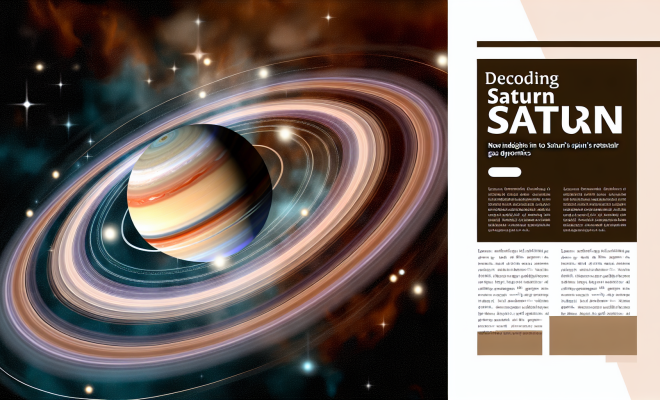
Astronomers have made significant strides in unraveling the complexities of Saturn’s rotation, a phenomenon that has puzzled scientists for years. Recent research has shed light on the reasons behind the planet’s seemingly variable spin rate, offering new insights into the rotational dynamics of gas giants and enhancing our understanding of planetary behavior within our solar system.
The Spin Enigma
Saturn, the sixth planet from the Sun, is renowned for its stunning rings and vibrant atmosphere. However, it has also been an object of intrigue due to its complex rotational behavior. Unlike terrestrial planets, Saturn’s rotation is not uniform; instead, it appears to change over time, leading to questions about the underlying mechanisms driving this variability.
Understanding Saturn’s Rotation
Historically, astronomers have observed that Saturn’s rotation rate seems to fluctuate. While the planet’s equatorial region spins at an average rate of approximately 10.7 hours, measurements taken at different latitudes have indicated discrepancies in this timing. These variations raised critical questions: What causes Saturn’s rotation to change? Is it related to atmospheric dynamics, internal structures, or something entirely different?
Recent Research Findings
In a breakthrough study, a team of astronomers utilized data from NASA’s Cassini spacecraft, which orbited Saturn from 2004 to 2017. By analyzing the gravitational field data collected during the mission, researchers were able to discern patterns in Saturn’s rotation.
The findings suggest that the variations in Saturn’s spin are primarily influenced by its atmospheric dynamics. As winds whip through the planet’s gaseous envelope, they interact with the planet’s rotation, causing the spin rate to appear to change. This interaction is particularly pronounced at different latitudes, where the speed of winds varies, leading to the observed discrepancies in rotation.
Gas Giant Dynamics
This research not only clarifies Saturn’s spin but also contributes to a broader understanding of gas giant physics. Gas giants like Saturn and Jupiter exhibit unique behaviors that are not fully understood, particularly regarding their internal structures and atmospheric conditions.
One key takeaway from this study is the importance of atmospheric circulation in shaping a planet’s rotational dynamics. The winds on Saturn, which can reach speeds of up to 1,100 miles per hour, play a crucial role in this process. By understanding how these atmospheric patterns interact with the planet’s rotation, scientists can gain insights into the fundamental processes that govern gas giants.
Implications for Planetary Science
The implications of this research extend beyond Saturn. Understanding the rotational dynamics of gas giants is essential for comparative planetology, a field that seeks to draw connections between different celestial bodies within our solar system and beyond. By studying Saturn’s peculiar spin, researchers can better understand the dynamics of other gas giants, such as Jupiter, Uranus, and Neptune.
Moreover, the findings could provide crucial information for future missions targeted at exploring these planets. As space agencies prepare for more in-depth studies of gas giants, knowledge of their rotation and atmospheric dynamics will be vital for mission planning and interpretation of data.
Conclusion
In summary, the mystery of Saturn’s changing rotation has taken a significant step towards resolution, thanks to cutting-edge research utilizing data from the Cassini mission. The discovery that atmospheric dynamics drive the planet’s rotational variations enhances our understanding of gas giants and their behaviors, not only within our solar system but in the broader context of planetary science. As astronomers continue to explore the mysteries of our celestial neighbors, findings like these serve as a reminder of the intricate and dynamic nature of the universe we inhabit.
As we look to the future, the ongoing study of Saturn and other gas giants will undoubtedly yield more insights, enriching our knowledge of planetary formation, evolution, and the fundamental physics that govern our solar system.