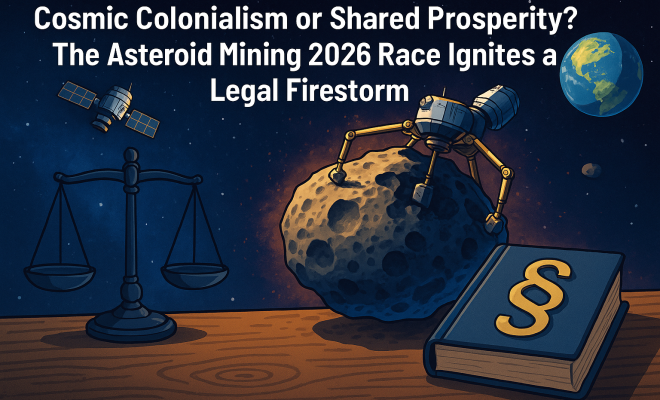
Cosmic Colonialism or Shared Prosperity? The Asteroid Mining 2026 Race Ignites a Legal Firestorm
“`html
Imagine a future where the resources that power our technology, from your smartphone to your electric car, aren’t dug from the Earth but plucked from the vastness of space. It sounds like science fiction, right? Well, that future is closer than you think, and it’s bringing with it a whole new set of geopolitical and ethical dilemmas. We’re talking about asteroid mining, and specifically, the groundbreaking missions slated for asteroid mining 2026.
Private companies are gearing up to launch deep-space ventures with the explicit goal of harvesting incredibly valuable materials like platinum-group metals and other rare resources. These aren’t just speculative endeavors; they’re concrete plans with real launch dates. The potential wealth involved is staggering – we’re talking trillions of dollars, enough to fundamentally reshape global economies and power dynamics. But this impending ‘space gold rush’ isn’t just about technological prowess or astronomical profits; it’s sparked a fierce international debate over who owns what in the cosmos, turning the final frontier into a new battleground for legal and ethical arguments.
1. The Deep-Space Prospectors: Who’s Leading the Charge?
When we talk about asteroid mining 2026, one name that frequently comes up is AstroForge. This private company isn’t just dreaming about space resources; they’re actively building the technology and planning the missions to go get them. Their ambition is to launch deep-space asteroid mining missions in late 2026, targeting specific asteroids known for their rich composition of platinum-group metals (PGMs).
Think about the implications here: these aren’t state-sponsored programs driven by national prestige, at least not directly. These are commercial ventures, driven by the oldest motivator in the book: profit. AstroForge, and others like them, are betting big on the idea that the cost of reaching and extracting these resources will be dwarfed by their market value back on Earth. It’s a bold play, requiring immense technological innovation, significant capital investment, and a healthy dose of entrepreneurial courage. The success or failure of these early missions will undoubtedly set the tone for the entire industry, either validating the dream or pushing it back decades.
Other players are also making moves, albeit sometimes with different initial objectives. Companies like TransAstra, for example, are focusing on technologies for asteroid capture and in-space resource utilization (ISRU) to create propellant depots. While not directly mining for PGMs initially, their foundational work is critical for the long-term viability of the asteroid mining industry. Planetary Resources, a pioneering company in the field, was acquired by ConsenSys in 2018, shifting its focus, but its early efforts undeniably paved the way for current ventures. The landscape is dynamic, with various startups and established aerospace firms exploring different niches, from asteroid identification and characterization to extraction and processing technologies. The collaborative ecosystem developing around these individual efforts is a testament to the growing belief that asteroid mining is no longer just a distant dream.
2. The Trillion-Dollar Question: What Are They After?
So, what exactly makes an asteroid worth the colossal effort and expense of a deep-space mining mission? The answer lies in the incredible concentration of certain elements. Asteroids, particularly M-type (metallic) asteroids, are thought to be remnants of protoplanets that never fully formed, or the cores of larger bodies stripped of their outer layers. This means they can be incredibly rich in metals that are scarce and highly valuable on Earth.
Specifically, companies like AstroForge are eyeing platinum-group metals (PGMs) such as platinum, palladium, rhodium, ruthenium, iridium, and osmium. These metals are critical for a vast array of high-tech industries, from catalytic converters in cars to electronics, medical devices, and even jewelry. Their scarcity on Earth drives their high price. Beyond PGMs, some asteroids may also contain significant quantities of rare earth elements, nickel, iron, and cobalt – all vital for the burgeoning electric vehicle and renewable energy sectors. The sheer volume of these materials potentially locked within a single asteroid could be worth trillions of dollars, a sum that could fundamentally alter global supply chains and economic power structures.
To put this into perspective, consider the asteroid 16 Psyche. While not a target for asteroid mining 2026 due to its size and distance, it’s often cited as an example of the immense potential. Scientists estimate 16 Psyche contains enough iron, nickel, and precious metals to be worth an estimated $10,000 quadrillion – yes, that’s a 1 with 16 zeros. Even a much smaller, near-Earth asteroid (NEA) could hold hundreds of billions of dollars worth of PGMs. For instance, a 500-meter-wide M-type asteroid could contain more platinum than has ever been mined in human history. The implications for industries reliant on these metals are profound. Imagine a world where platinum is no longer a luxury commodity but an abundant resource, potentially driving down costs for everything from medical implants to fuel cells. This abundance could accelerate technological innovation in ways we can only begin to imagine.
3. The ‘Space Gold Rush’: Why Now?
Why is asteroid mining 2026 suddenly on the horizon? It’s a confluence of several factors. First, technological advancements in rocketry and spacecraft design have made deep-space travel more accessible and affordable than ever before. We’ve seen a rapid acceleration in reusable rocket technology, miniaturization of payloads, and sophisticated autonomous systems that can operate far from Earth.
Second, the increasing demand for critical minerals on Earth, coupled with geopolitical instability affecting traditional supply chains, has made extraterrestrial resources look increasingly attractive. Dependence on a few key nations for essential materials is a significant economic and strategic vulnerability. Third, and perhaps most crucially for private enterprise, there’s a growing legal framework, however contentious, that attempts to legitimize the extraction and ownership of these resources. Without some semblance of legal backing, investors would be far more hesitant to pour money into such speculative ventures. The combination of these elements has created a perfect storm for the ‘space gold rush’ to begin.
Beyond these foundational elements, a shift in investment philosophy is also playing a role. The ‘New Space’ economy, characterized by private sector innovation and investment, has dramatically lowered the barriers to entry for space ventures. Venture capitalists are increasingly willing to fund audacious projects with long-term payoffs, recognizing the potential for exponential returns. Furthermore, the development of in-situ resource utilization (ISRU) technologies is a game-changer. Imagine not having to bring all your fuel, water, or construction materials from Earth. If you can extract water from lunar ice or process asteroid regolith into building materials, the cost of sustained space operations drops dramatically, making asteroid mining much more economically viable. This ability to ‘live off the land’ in space is transforming the economics of deep-space missions, making asteroid mining 2026 a realistic target. (See: Asteroid mining overview on Wikipedia.)
4. A Legal Minefield: The Outer Space Treaty of 1967
The core of the international debate swirling around asteroid mining 2026 centers on the 1967 Outer Space Treaty. This foundational document, officially the ‘Treaty on Principles Governing the Activities of States in the Exploration and Use of Outer Space, including the Moon and Other Celestial Bodies,’ was a landmark agreement during the Cold War. It aimed to prevent the militarization of space and promote its peaceful use for the benefit of all humanity.
Article II of the treaty states, ‘Outer space, including the Moon and other celestial bodies, is not subject to national appropriation by claim of sovereignty, by means of use or occupation, or by any other means.’ This is where the controversy truly ignites. Critics of private asteroid mining, particularly nations like China and Russia, argue that allowing companies to extract and own resources from asteroids essentially constitutes a form of ‘appropriation’ – claiming parts of space through economic use, if not direct sovereignty. They demand a global framework that ensures any wealth derived from space benefits all nations, not just a select few wealthy corporations or countries. For more context, see the future with self-driving cars.
While the Outer Space Treaty is a cornerstone, its language is intentionally broad, reflecting the limited understanding of space activities at the time of its drafting. It doesn’t explicitly address resource extraction by private entities, leading to the current legal grey area. Some interpretations argue that ‘appropriation’ refers specifically to sovereign claims over territory, not the extraction of movable resources. They draw parallels to international waters, where fishing or mineral extraction is permitted without claiming sovereignty over the ocean itself. However, opponents contend that even without a direct claim of sovereignty, continuous extraction from a specific asteroid effectively establishes a de facto claim, undermining the spirit of common heritage. This interpretational divide is a major hurdle for establishing a universally accepted legal framework for asteroid mining 2026 and beyond.
5. Conflicting National Interests: The UN’s Paralysis
The United Nations Committee on the Peaceful Uses of Outer Space (COPUOS) is the primary forum for discussing these issues, but it currently finds itself largely paralyzed. The committee, which has historically played a crucial role in shaping international space law, is now caught between deeply conflicting national interests regarding space resource ownership. On one side, you have countries that view space as a new frontier for economic expansion and private enterprise.
On the other, you have nations that emphasize the ‘common heritage of mankind’ principle, arguing that space resources should be managed collectively for universal benefit. This ideological chasm makes it incredibly difficult to reach consensus on new international regulations. Without clear, globally recognized rules, the fear is that a chaotic, unregulated scramble for resources could ensue, potentially leading to conflicts and further exacerbating global inequalities. The inaction of COPUOS means that the legal landscape for asteroid mining 2026 and beyond remains murky, leaving pioneers in a legal grey area.
The root of COPUOS’s paralysis isn’t just an ideological split; it’s also a power struggle. Nations with advanced space capabilities, particularly those with strong private space sectors, are eager to protect their head start. They see comprehensive international regulations as potentially stifling innovation and economic growth. Conversely, nations with less developed space programs fear being left behind and advocate for a more equitable distribution of future space wealth. This dynamic makes it incredibly difficult to find common ground. Attempts to create a new, binding international treaty on space resources, like the Moon Agreement, have largely failed to gain widespread ratification, underscoring the deep divisions. Consequently, individual nations and private companies are pushing forward, creating facts on the ground that future international agreements will have to contend with.
6. The Pioneers of Private Ownership: US, Luxembourg, and UAE
Despite the international impasse, some nations have taken proactive steps to establish a legal basis for private space resource extraction. The United States led the way with the SPACE Act of 2015 (Spurring Private Aerospace Competitiveness and Entrepreneurship Act), which explicitly grants U.S. citizens and entities the right to ‘possess, own, transport, use, and sell’ asteroid resources they obtain. This was a bold and, for some, controversial move, essentially declaring that while no one can own the asteroid itself, you can own what you take from it.
Following suit, Luxembourg and the United Arab Emirates have also passed similar national laws. Luxembourg, in particular, has positioned itself as a hub for space mining companies, offering a supportive legal and financial environment. These countries argue that their laws do not violate the Outer Space Treaty because they aren’t claiming sovereignty over celestial bodies, but merely establishing property rights for extracted resources. However, this interpretation is precisely what China and Russia vehemently dispute, setting the stage for a potential international legal showdown as asteroid mining 2026 draws nearer.
These national laws, while providing some legal certainty for companies operating under their respective flags, create a patchwork of regulations rather than a unified global framework. This means that a company from a country without such a law might face legal challenges if it were to extract resources, even if it partnered with a U.S. or Luxembourg-based entity. This fragmented legal environment could lead to ‘flag shopping,’ where companies register in jurisdictions with more favorable space resource laws, much like how shipping companies choose flags of convenience. The lack of universal recognition for these national laws poses a significant risk for the long-term stability and legitimacy of the asteroid mining industry. Without a broader international consensus, the legal status of extracted resources could remain ambiguous, potentially leading to disputes over ownership and trade.
7. Cosmic Colonialism vs. Shared Prosperity: The Ethical Divide
The debate isn’t just about legal interpretations; it’s deeply rooted in ethics and philosophy. Critics of the current trajectory warn against ‘cosmic colonialism’ – a scenario where powerful nations and wealthy corporations essentially claim vast swathes of space resources for themselves, much like historical colonial powers exploited resources on Earth. This perspective argues that such an approach would deepen global inequalities, create new forms of exploitation, and potentially lead to environmental degradation of extraterrestrial bodies.
On the other side, proponents argue that private enterprise is the most efficient engine for innovation and progress. They believe that allowing companies to profit from asteroid mining will drive technological development, create new industries, and ultimately benefit humanity through the availability of new resources and technologies. The challenge is finding a way to reconcile these two visions: how do we harness the entrepreneurial drive while ensuring that the immense wealth generated from space benefits a broader spectrum of humanity, rather than concentrating power in the hands of a few?
This ethical dilemma extends to the potential environmental impact, even in space. While asteroids aren’t teeming with life as we know it, they are unique geological formations, some potentially containing clues to the early solar system. Unregulated mining could inadvertently destroy these scientific treasures or create vast amounts of space debris, a growing concern for orbital safety. There’s also the question of ‘resource curse’ in space. If one nation or corporation gains control over an asteroid with immense value, how might that impact international relations and economic stability back on Earth? The sudden influx of trillions of dollars worth of PGMs, for instance, could crash commodity markets, devastating Earth-based mining industries and the communities that depend on them. These are not merely theoretical concerns but tangible risks that need careful consideration as asteroid mining 2026 approaches.
8. Monetization Potential and High-CPC Niches: Beyond the Stars
The impending reality of asteroid mining 2026 isn’t just a fascinating scientific and legal story; it’s also a significant economic opportunity, attracting attention from high-CPC (Cost Per Click) niches. The immense financial stakes and the complex legal and technological challenges involved mean there’s considerable monetization potential for various sectors. (See: NASA's asteroid missions and research.)
- Space Investment Funds: As the industry matures, we’ll see more specialized investment funds emerge, targeting companies involved in asteroid mining, space infrastructure, and related technologies. This appeals to investors looking for high-growth, speculative opportunities in the ‘new space’ economy.
- International Space Law Services: The legal ambiguities surrounding space resource ownership create a booming market for legal professionals specializing in international space law. Companies, governments, and even international organizations will need expert counsel to navigate the complex regulatory landscape, draft agreements, and potentially litigate disputes.
- Resource Extraction Technology: The development of specialized robotics, autonomous mining equipment, in-situ resource utilization (ISRU) systems, and advanced propulsion technologies for asteroid missions represents a massive business opportunity. Companies innovating in these areas will be crucial enablers of the industry.
- Insurance and Risk Management: Space missions are inherently risky. As commercial ventures, asteroid mining operations will require sophisticated insurance and risk management services to cover everything from launch failures to operational mishaps in deep space.
- Logistics and Supply Chain Management: Getting resources from an asteroid back to Earth, or even to orbital processing facilities, will require entirely new logistical and supply chain solutions. This opens doors for companies specializing in space transportation, refining, and distribution.
The commercial implications are vast, attracting not just scientists and engineers, but also economists, lawyers, and investors keen to get a piece of the cosmic pie. The debate over ownership is critical because it will ultimately determine who benefits from this new frontier and how those benefits are distributed. The path ahead is fraught with challenges, but the promise of virtually limitless resources continues to drive humanity’s gaze towards the asteroids, making asteroid mining 2026 a pivotal moment in our expansion into the solar system.
9. Technological Hurdles and Innovations: Making it Happen
While the legal and ethical debates rage, engineers and scientists are busy tackling the monumental technological challenges of asteroid mining. It’s not just about getting there; it’s about what you do once you arrive. For more context, see this crucial AI debate.
- Asteroid Rendezvous and Capture: Precisely matching orbits with a fast-moving asteroid, sometimes millions of miles away, is incredibly difficult. For larger asteroids, the challenge shifts to capturing or securely attaching to the body. Techniques like robotic harpoons, gripping mechanisms, or even surrounding the asteroid with a containment bag are being explored.
- Low-Gravity Operations: Asteroids have negligible gravity. This means traditional drilling or excavation methods won’t work – a drill bit could push the spacecraft away from the asteroid. New methods involve anchoring systems, focused energy beams (like lasers or microwaves to vaporize material), or robotic arms designed for delicate manipulation in microgravity.
- In-Situ Resource Utilization (ISRU): This is arguably the most critical technological innovation. Instead of bringing everything from Earth, ISRU aims to use resources found on the asteroid itself. For example, if a carbonaceous asteroid contains water ice, that water can be extracted, purified, and then split into hydrogen and oxygen to create rocket propellant. This dramatically reduces the cost and complexity of future missions.
- Autonomous Robotics and AI: Due to the immense communication delays over vast distances, human operators can’t directly control mining operations in real-time. Missions will rely heavily on advanced AI and autonomous robotics capable of making decisions, adapting to unforeseen circumstances, and performing complex tasks without constant human intervention.
- Refining and Processing in Space: Bringing raw ore back to Earth is inefficient. The goal is to process and refine the valuable materials in space, sending back only the purified metals or even manufacturing components in orbit. This requires developing compact, low-power refining technologies that can operate in the vacuum of space.
Companies like AstroForge are developing novel refining processes designed to work in space, focusing on volatile extraction and separation of PGMs. The success of asteroid mining 2026 hinges on proving these technologies at scale, demonstrating that space-based extraction and processing are not only possible but economically viable.
10. The Long-Term Vision: Beyond Earth-Bound Resources
While the immediate focus of asteroid mining 2026 is on bringing valuable resources back to Earth, the long-term vision extends far beyond that. The real game-changer isn’t just about enriching Earth with new metals, but about enabling a sustainable, off-world economy.
- Space Infrastructure Development: Asteroid resources could be used to build habitats, fuel depots, and manufacturing facilities in Earth orbit, on the Moon, or even on Mars. Imagine space stations constructed from asteroid metals, fueled by asteroid water. This would drastically reduce the cost of deep-space exploration and colonization.
- Propellant Depots: Water extracted from asteroids is a crucial resource. It can be split into hydrogen and oxygen, which are powerful rocket propellants. Establishing propellant depots in space would allow missions to refuel on their way to distant destinations, making travel to Mars and beyond much more feasible and affordable.
- Manufacturing in Space: With abundant raw materials and energy (solar power), we could eventually see manufacturing facilities in space. This would allow for the creation of large structures that are impractical to launch from Earth, or specialized components that benefit from microgravity environments.
- Planetary Defense: The technologies developed for asteroid mining, such as asteroid rendezvous, capture, and manipulation, could also be invaluable for planetary defense. If a dangerous asteroid is ever found on a collision course with Earth, these capabilities could be adapted to deflect it.
The vision is not just about mining an asteroid, but about transforming humanity into a multi-planetary species. The initial steps of asteroid mining 2026 are laying the groundwork for a future where humanity’s reach and resources are no longer confined to a single planet.
11. Expert Perspectives and Industry Outlook
Leading figures in the aerospace industry and space policy circles offer varied but generally optimistic outlooks on asteroid mining. Dr. Phil Metzger, a planetary scientist at the University of Central Florida, often emphasizes the potential for space resources to create an “economic boom” that could lift billions out of poverty by making resources abundant. He argues that the vastness of space resources fundamentally changes the scarcity paradigm that drives many conflicts on Earth.
On the other hand, legal scholars like Joanne Gabrynowicz, former editor-in-chief of the Journal of Space Law, frequently highlight the critical need for comprehensive international agreements. She points out that national laws, while necessary for domestic industry, don’t solve the international legitimacy problem and could lead to future disputes if not harmonized. The consensus among many experts is that while asteroid mining 2026 represents a crucial step, it’s just the beginning of a long journey that will require continuous technological innovation, significant capital investment, and, most importantly, collaborative international diplomacy to avoid a free-for-all.
Industry projections are cautiously optimistic. While early missions will be expensive and risky, the potential rewards are so high that investment continues to flow. Analysts at various space consulting firms suggest that the space resource utilization market could reach hundreds of billions of dollars annually by the mid-21st century, assuming initial missions prove successful and a more stable legal framework emerges. The success of missions like those planned for asteroid mining 2026 will be critical in validating these projections and attracting further investment, moving the industry from speculative potential to tangible reality.
Frequently Asked Questions about Asteroid Mining 2026
Q1: What exactly is asteroid mining?
Asteroid mining involves extracting valuable raw materials like metals (e.g., platinum, nickel, iron) and volatile compounds (e.g., water ice) from asteroids and other near-Earth objects. These materials can then be used on Earth or for in-space construction and propulsion.
Q2: Why is 2026 a significant year for asteroid mining?
2026 is significant because several private companies, notably AstroForge, have announced plans to launch their first deep-space asteroid mining missions in late 2026. These missions aim to demonstrate the feasibility of extracting valuable platinum-group metals from targeted asteroids, potentially marking the beginning of a commercial space resource industry. For more context, see Tesla's Cybercab faces make-or-break deadline. (See: Scientific research on asteroid resources.)
Q3: What kind of resources are companies hoping to find on asteroids?
The primary targets are platinum-group metals (PGMs) like platinum, palladium, and rhodium, which are extremely valuable and scarce on Earth. Other potential resources include nickel, iron, cobalt, and rare earth elements, as well as water ice, which can be converted into rocket fuel and life support resources for in-space use.
Q4: Who owns the resources extracted from asteroids?
This is a major point of international contention. The 1967 Outer Space Treaty states that no nation can ‘appropriate’ celestial bodies. However, countries like the US, Luxembourg, and UAE have passed national laws granting their citizens and companies the right to ‘possess, own, transport, use, and sell’ resources they obtain from space. Other nations, like China and Russia, dispute this interpretation, arguing for a common heritage principle where benefits should be shared globally. There is currently no universally accepted international framework.
Q5: Is asteroid mining technologically feasible by 2026?
The technology is rapidly advancing. Reusable rockets, miniaturized spacecraft, autonomous robotics, and in-situ resource utilization (ISRU) concepts are making deep-space missions more achievable and affordable. While significant challenges remain, companies believe they have developed the necessary capabilities to attempt initial extraction missions by 2026, focusing on smaller, more accessible asteroids.
Q6: What are the main ethical concerns surrounding asteroid mining?
Ethical concerns include ‘cosmic colonialism’ – the fear that powerful nations and corporations will monopolize space resources, exacerbating global inequalities. There are also worries about the potential for environmental impact on celestial bodies, even if they are not biologically active, and the risk of creating space debris. The fair distribution of potential wealth is a central ethical question.
Q7: How will asteroid mining impact Earth’s economy?
If successful, asteroid mining could significantly increase the supply of rare and valuable metals, potentially lowering their market prices. This could benefit industries reliant on these materials, like electronics and automotive. However, it could also disrupt Earth-based mining industries and economies dependent on those resources. The long-term impact could involve creating entirely new space-based industries and supply chains.
Q8: What are the biggest risks for asteroid mining missions?
The risks are substantial: technical failures during launch or in deep space, unexpected challenges in asteroid rendezvous or resource extraction in microgravity, and the immense financial investment required for uncertain returns. The absence of a clear, stable international legal framework also poses a significant geopolitical and commercial risk.
Q9: Could asteroid mining help save Earth’s environment?
Potentially, yes. By sourcing critical minerals from space, we could reduce the environmental impact of terrestrial mining, which often involves deforestation, water pollution, and habitat destruction. It also offers a way to meet the growing demand for resources (especially for green technologies) without further depleting Earth’s finite reserves.
Q10: What’s the difference between asteroid mining and lunar mining?
Both involve space resource extraction, but they target different bodies and resources. Lunar mining primarily focuses on water ice (for fuel and life support) and helium-3 (a potential future fusion fuel) from the Moon. Asteroid mining typically targets metallic asteroids for platinum-group metals and other rare elements, though some carbonaceous asteroids also contain water ice. The Moon is much closer and easier to reach, but asteroids may offer a wider variety and higher concentration of certain valuable metals.
“`
Trending Now
Frequently Asked Questions
What is asteroid mining and why is it important?
Asteroid mining involves extracting valuable resources from asteroids, such as platinum-group metals. It is important because it has the potential to reshape global economies and provide materials that are increasingly scarce on Earth, thus driving technological advancements.
Who are the major players in asteroid mining?
AstroForge is a key player in the asteroid mining race, actively developing technology and planning missions to target asteroids rich in valuable resources. Other private companies are also entering the field, competing for a share of the potential wealth.
What are the legal issues surrounding asteroid mining?
Asteroid mining raises significant legal and ethical dilemmas regarding resource ownership in space. As private companies venture into this field, debates about who has the right to claim and exploit these resources are intensifying among nations and stakeholders.
How much wealth could asteroid mining generate?
The potential wealth from asteroid mining is staggering, with estimates reaching trillions of dollars. This could fundamentally alter global economies and power dynamics, leading to a new 'space gold rush' that attracts investment and innovation.
When is the first asteroid mining mission planned?
The first deep-space asteroid mining missions are planned for late 2026, with companies like AstroForge leading the charge to harvest valuable materials from targeted asteroids known for their rich composition.
Agree or disagree? Drop a comment and tell us what you think.