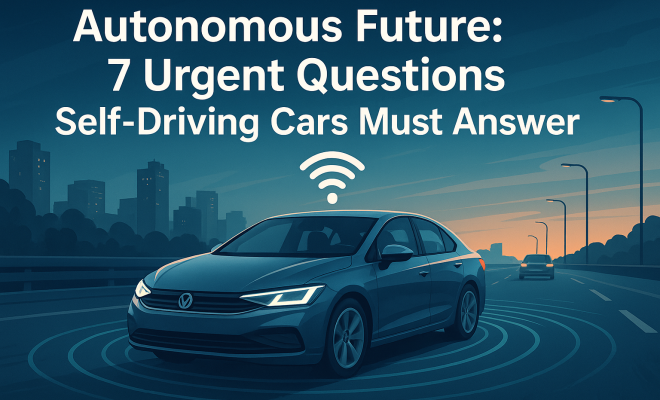
Autonomous Future: 7 Urgent Questions Self-Driving Cars Must Answer
“`html
The road ahead for self-driving cars is undoubtedly paved with incredible promise, but it’s also riddled with complex ethical dilemmas, regulatory potholes, and a fair bit of public trepidation. We’re standing at the precipice of a transportation revolution, and while the allure of fully autonomous vehicles is strong, recent events have thrown a spotlight on the very real challenges that need addressing. Forget the sci-fi fantasies for a moment; let’s talk about the gritty reality of putting AI behind the wheel.
From the sleek, driverless designs of vehicles like Tesla’s Cybercab to the increasingly common sight of Waymo robotaxis navigating city streets, the technology is advancing at a breathtaking pace. Yet, this rapid evolution often outstrips our ability to regulate it, understand its full implications, or even determine who’s truly at fault when things go wrong. It’s a fascinating, sometimes frightening, dance between innovation and accountability, and it’s one that touches on everything from personal safety to the very fabric of our legal system. The debate isn’t just academic; it’s playing out on our roads every single day.
The Cybercab Controversy: A Glimpse into the Driverless Future
When Tesla unveiled its Cybercab in October 2024, it wasn’t just another product launch; it was a statement. This vehicle, designed with no traditional controls whatsoever – no steering wheel, no pedals – was a bold, almost defiant, assertion of a fully autonomous future. It relies entirely on a sensor setup remarkably similar to what powers Tesla’s existing Full Self-Driving (FSD) technology. Now, for some, this was an exhilarating peek into tomorrow, a vision of effortless, AI-driven mobility. For others, it triggered a wave of concern, even alarm.
The core of the controversy lies in that lack of human override. If a system relies solely on its sensors and algorithms, what happens when it encounters a truly unprecedented situation? What if the sensors get confused by extreme weather, or an unexpected obstacle? The inherent trust required to step into a vehicle with no manual controls is immense, and it’s a trust that the public is still wrestling with. It forces us to confront fundamental questions about the reliability of AI and the ultimate responsibility when that AI makes a mistake. Tesla’s move, while ambitious, certainly amplified the ongoing debate about how much control we’re truly willing to cede to machines.
Waymo’s Robotaxis and the Uncomfortable Truth of Accidents
While Tesla pushes the boundaries of design, companies like Waymo have been operating autonomous vehicles on public roads for years, collecting invaluable data – and unfortunately, accumulating a significant number of incidents. Between 2021 and 2024, Waymo robotaxis were involved in hundreds of crashes. Let that sink in for a moment. Hundreds. Now, it’s crucial to put this into perspective: many of these incidents are minor fender-benders, often involving human-driven vehicles rear-ending the robotaxi or performing unsafe maneuvers around them. Autonomous vehicles, by design, tend to drive more cautiously and defensively.
However, the sheer volume of incidents, regardless of their severity, underscores the ongoing challenges. Each crash, no matter how minor, raises difficult questions about liability. Who is at fault when an autonomous vehicle is involved in a collision? Is it the software developer, the vehicle manufacturer, the fleet operator, or even the human driver of the other vehicle who might have misunderstood the robotaxi’s behavior? These aren’t simple questions, and our current legal frameworks weren’t built with AI drivers in mind. The experience of Waymo, a pioneer in this space, serves as a stark reminder that the path to widespread adoption of self-driving cars is rarely smooth.
The FMCSA Exemption: Accelerating Autonomous Trucking Amidst Opposition
Perhaps one of the most contentious developments in recent memory occurred in October 2026, when the Federal Motor Carrier Safety Administration (FMCSA) granted a controversial exemption. This ruling allows autonomous trucking companies, such as Aurora, to operate driverless trucks on public roads. Think about the implications: massive, multi-ton vehicles traversing highways without a human behind the wheel. The potential for efficiency gains in logistics is enormous, promising reduced labor costs, longer operating hours, and potentially safer long-haul journeys by eliminating human fatigue.
Yet, this exemption was met with significant opposition, and for good reason. Previous safety concerns, often voiced by traditional trucking unions and safety advocates, have highlighted the unique risks associated with autonomous heavy vehicles. The sheer kinetic energy of an 80,000-pound truck means any accident, even a low-speed one, can have devastating consequences. The technology is undeniably advanced, but is it truly robust enough to handle every conceivable scenario on the open road – from sudden tire blowouts to aggressive human drivers, or even adverse weather conditions that might confuse sensors? This FMCSA decision, while a boon for the industry, has undoubtedly intensified public anxiety and amplified calls for more stringent oversight of self-driving cars, especially in the commercial sector.
The Viral Nature of Fear: Why Accidents Captivate Us
It’s no secret that stories about self-driving car accidents go viral. Why? Because they tap into primal human fears. There’s a fundamental discomfort when control is ceded to a machine, especially when that machine is operating something as potentially dangerous as an automobile. When an autonomous vehicle is involved in a crash, even a minor one, it often generates headlines and social media discussions far beyond what a similar human-involved accident would. This isn’t just about sensationalism; it’s about the unknown, about the perceived loss of control, and about the inherent ethical questions surrounding AI responsibility. (See: Automated Vehicles Overview.)
The public’s imagination is easily captured by the idea of a rogue robot or a malfunctioning algorithm. These fears are often amplified by the ‘trolley problem’ scenarios that academics love to debate: if an autonomous car must choose between two bad outcomes, which one does it choose? While real-world accidents are rarely so clear-cut, the underlying anxiety about AI making life-or-death decisions is very real. This emotional response means that every incident, every regulatory debate, and every new technological leap in self-driving cars becomes a focal point for intense public scrutiny, making it a hotbed for viral content and widespread discussion.
Defining Liability: A Legal Minefield for Self-Driving Cars
One of the most complex and pressing issues surrounding self-driving cars is the question of liability in an accident. Our current legal system is built around the concept of a human driver’s negligence. But what happens when there’s no human driver? When a Waymo robotaxi or an Aurora truck is involved in a collision, who is legally responsible? Is it the company that developed the software? The manufacturer of the sensors? The company that owns and operates the fleet? Or perhaps the entity that performed the last software update? For more context, see AI startup's collapse.
These aren’t hypothetical questions; they are real-world dilemmas that judges, juries, and insurance companies are already grappling with. Traditional product liability laws might apply, but autonomous vehicles are not simple products; they are complex, constantly evolving systems. The lack of clear precedent creates a legal minefield, making it difficult for victims to seek compensation and for companies to assess risk. Until clearer legal frameworks are established, the specter of liability will continue to hang over the widespread adoption of self-driving cars, making it a critical area for legislative action and judicial interpretation.
The Race Between Tech and Regulation: A Fundamental Imbalance
The rapid pace of technological advancement in self-driving cars is consistently outpacing the speed at which regulations can be developed and implemented. This isn’t a new phenomenon in the tech world, but it’s particularly acute when the technology directly impacts public safety on such a massive scale. Engineers and developers are constantly pushing the boundaries, refining algorithms, and introducing new capabilities, often on monthly or even weekly cycles.
Government bodies, by their very nature, move much slower. The legislative process is deliberate, requires extensive public comment, scientific review, and often, political consensus. This fundamental imbalance means that by the time a regulation is drafted and passed, the technology it’s meant to govern may have already evolved significantly, rendering the rules partially obsolete. This creates a regulatory vacuum, where companies are operating with guidelines that may not fully address the latest capabilities or risks of their systems. Bridging this gap – finding a way for regulation to be both agile and comprehensive – is perhaps the greatest challenge facing the self-driving car industry and the public alike.
Ethical AI: Beyond Code, Into Morality
The discussion around self-driving cars quickly transcends mere technical specifications and dives headfirst into complex ethical territory. When an autonomous vehicle makes a decision that leads to harm, the responsibility isn’t just legal; it’s deeply moral. How do we program a machine to make ethical choices, especially in unavoidable accident scenarios? Who decides what those ethics are, and whose values are prioritized?
Consider the ‘least harm’ principle. Sounds straightforward, right? But what does ‘least harm’ truly mean in practice? Is it minimizing casualties, even if it means sacrificing the vehicle’s occupants? Is it protecting pedestrians above all else? Or is it about minimizing property damage? These are not questions that can be answered purely with code. They require philosophical debate, societal consensus, and a clear understanding of the implications of embedding specific moral frameworks into AI. As self-driving cars become more sophisticated, the ethical considerations will only grow more pronounced, demanding robust public dialogue and careful philosophical consideration.
The Monetization Matrix: Investing in the Autonomous Future
Despite the challenges, the economic incentives for self-driving cars are immense, making it a highly attractive sector for investment and innovation. The monetization opportunities are incredibly strong, particularly in high-CPC (Cost Per Click) niches. Think about the burgeoning legal services market: every accident, every question of liability, generates a need for specialized lawyers focused on autonomous vehicle claims. This is a new frontier for legal practice, promising significant growth.
Then there’s the insurance industry. Traditional auto insurance models simply don’t fit the autonomous paradigm. We’re seeing the emergence of specialized autonomous vehicle insurance policies, designed to cover everything from software malfunctions to fleet-level risks. Furthermore, investment analysis in the self-driving technology sector itself is booming. Venture capitalists and institutional investors are pouring billions into companies developing everything from LIDAR sensors to advanced AI algorithms. The promise of transforming logistics, ride-sharing, and personal mobility ensures that, despite the hurdles, the financial engine driving self-driving cars forward remains incredibly powerful.
The Human Element: Trust, Acceptance, and Education
Beyond the technical and legal hurdles, one of the biggest factors influencing the widespread adoption of self-driving cars is the human element. Public trust isn’t something that can be programmed; it has to be earned. The viral nature of self-driving car accidents, even minor ones, highlights a deep-seated apprehension. For many, the idea of relinquishing control to a machine, especially in a critical activity like driving, feels counter-intuitive and even frightening. (See: CDC on Automated Vehicles.)
Overcoming this requires more than just flawless technology. It demands transparency from companies about how their systems work, what their limitations are, and how they handle incidents. It also means effective public education campaigns to demystify the technology and explain its benefits. People need to understand the statistical safety improvements that autonomous vehicles *could* offer compared to human drivers, who are prone to distraction, fatigue, and impairment. Until a significant portion of the population feels comfortable and confident sharing the road with, or riding in, self-driving cars, their potential will remain untapped. This involves a shift in mindset, a generational change in how we perceive transportation, and a clear demonstration of consistent reliability.
Infrastructure Adaptation: The Unsung Hero of Autonomous Driving
While we often focus on the vehicles themselves, the success of self-driving cars is inextricably linked to the infrastructure they operate within. Our current roads, signage, and communication systems were designed for human drivers. For autonomous vehicles to reach their full potential, significant infrastructure upgrades are necessary. This includes clearer lane markings that are easily detectable by sensors, smart traffic lights that communicate directly with vehicles, and potentially even dedicated autonomous vehicle lanes in high-traffic areas. For more context, see hyperscale AI models.
Consider the implications of V2I (Vehicle-to-Infrastructure) communication. Imagine traffic lights sending real-time data about their status to approaching self-driving cars, optimizing flow and reducing sudden stops. Or roads embedded with sensors that detect hazards like black ice or sudden debris and relay that information to nearby autonomous fleets. These kinds of smart infrastructure investments would not only enhance the safety and efficiency of self-driving cars but also improve the overall transportation ecosystem for everyone. The challenge here is the immense cost and coordination required across various levels of government and private entities.
Cybersecurity: A New Frontier of Vulnerability
As self-driving cars become more connected and reliant on complex software, a new and critical concern emerges: cybersecurity. A traditional car can be stolen, but an autonomous vehicle presents a different level of vulnerability. Imagine a scenario where a hacker gains control of a self-driving car’s systems – not just to steal it, but to manipulate its navigation, sensors, or braking. The potential for malicious intent, from individual pranksters to state-sponsored attacks, is chilling.
Companies developing self-driving technology are investing heavily in robust cybersecurity measures, but the threat landscape is constantly evolving. Regular software updates, encryption protocols, and intrusion detection systems are essential. The industry must develop standardized security practices and rigorous testing methodologies to ensure these vehicles are not just safe from physical accidents but also secure from digital threats. A major cybersecurity breach affecting a fleet of self-driving cars could severely erode public trust and set back the entire industry significantly.
Global Perspectives: Varied Approaches to Self-Driving Cars
The development and regulation of self-driving cars aren’t happening in a vacuum; different countries and regions are taking distinct approaches, leading to a patchwork of rules and testing environments. For example, while the US has a more fragmented state-by-state regulatory landscape, countries like Germany and Japan often adopt more centralized, national frameworks, sometimes with stricter certification processes. China, a major player in AI, is aggressively pursuing autonomous vehicle technology, often with government backing and extensive urban testing zones.
This global variation has implications for international standards and market penetration. A vehicle approved for autonomous operation in one country might face significant hurdles in another. Harmonizing these regulations, or at least creating interoperable standards, will be crucial for companies looking to scale their self-driving car offerings globally. Understanding these diverse legal and cultural approaches helps us appreciate the complexity of building a truly worldwide autonomous transportation system.
FAQ: Navigating the Future of Self-Driving Cars
Q1: Are self-driving cars safer than human-driven cars?
A1: This is the ultimate goal, but it’s not a simple “yes” or “no” right now. Early data from companies like Waymo and Cruise suggests that their autonomous vehicles have a lower crash rate per mile compared to human drivers, especially for serious collisions. However, autonomous vehicles can still struggle with unpredictable situations, adverse weather, or unusual road conditions that human drivers might navigate intuitively. The technology is constantly improving, and the long-term aim is indeed to significantly reduce the 1.3 million annual global traffic fatalities caused by human error.
Q2: What are the different levels of self-driving automation?
A2: The Society of Automotive Engineers (SAE) defines six levels of driving automation, from Level 0 (no automation) to Level 5 (full automation). Most cars on the road today are Level 1 (e.g., adaptive cruise control) or Level 2 (e.g., Tesla’s Autopilot, requiring constant human supervision). Level 3 allows for “eyes off” in specific conditions but requires the human to be ready to take over. Level 4 vehicles can handle most driving situations independently within defined operational design domains, and Level 5 is fully autonomous in all conditions, requiring no human intervention at all. The Cybercab, for example, aims for Level 5, whereas Waymo robotaxis operate at Level 4. For more context, see AI in ransomware attacks. (See: New York Times on Self-Driving Regulation.)
Q3: What happens if a self-driving car’s sensors fail?
A3: Redundancy is key here. Modern self-driving cars use multiple sensor types – cameras, radar, lidar, ultrasonic – all working together. If one sensor type malfunctions, others can often compensate. Additionally, vehicles are designed with fail-safe mechanisms. If critical sensors or systems fail, the car might safely pull over to the side of the road, activate hazard lights, or alert a remote operator who can take control or guide it to a safe stop. The goal is to prevent a complete loss of control in case of individual component failure.
Q4: Will self-driving cars eliminate traffic jams?
A4: They have the potential to significantly reduce them, but not necessarily eliminate them entirely. Self-driving cars communicate with each other and with infrastructure, allowing for optimized traffic flow, smoother acceleration and braking, and tighter platooning (driving closer together). This can dramatically increase road capacity and reduce “phantom” traffic jams caused by human driving inefficiencies. However, if the sheer volume of cars on the road remains constant or increases, some level of congestion might still occur, especially in dense urban areas. The biggest impact will likely be on the *nature* of traffic, making it more predictable and less stop-and-go.
Q5: How will self-driving cars impact jobs, especially in transportation?
A5: This is a significant concern. While self-driving cars promise new jobs in software development, maintenance, and fleet management, they are likely to displace jobs for professional drivers in trucking, ride-sharing, and delivery services. The transition will require careful planning, retraining programs, and social safety nets to support affected workers. The overall economic impact is complex, with potential gains in productivity and efficiency balancing against job displacement in specific sectors.
Q6: Are self-driving cars expensive?
A6: Currently, vehicles with advanced self-driving capabilities or those operating as robotaxis are quite expensive, due to the sophisticated sensor arrays, powerful computing hardware, and extensive software development required. However, as the technology matures and scales, costs are expected to decrease. The business model for many self-driving car companies isn’t necessarily individual ownership, but rather ride-sharing or logistics fleets, where the high upfront cost is amortized over many users and miles, potentially making autonomous transportation more affordable than traditional car ownership in the long run.
The Road Ahead: Navigating the Self-Driving Revolution
The journey toward a fully autonomous future for self-driving cars is less a straight highway and more a winding, complex road with unexpected turns and occasional detours. We’ve seen the dazzling potential with vehicles like the Cybercab, the everyday realities and challenges presented by Waymo’s operations, and the contentious regulatory push from bodies like the FMCSA. Each development, whether a breakthrough or a setback, contributes to a rapidly evolving landscape that demands our attention and careful consideration.
The public’s fear, the legal quagmires of liability, the ethical dilemmas woven into AI, the persistent gap between technological innovation and regulatory oversight, the crucial human element of trust, the need for intelligent infrastructure, and the ever-present threat of cyber vulnerabilities are not minor obstacles; they are fundamental questions that must be answered with clarity and foresight. While the allure of efficiency, safety improvements, and convenience is undeniable, we must ensure that our pursuit of an autonomous future doesn’t outpace our commitment to safety, accountability, and ethical responsibility. The conversation around self-driving cars isn’t just about technology anymore; it’s about shaping the very future of how we move, interact, and live in the world.
“`
Trending Now
Frequently Asked Questions
What are the main challenges facing self-driving cars?
Self-driving cars face several challenges, including ethical dilemmas regarding decision-making in emergencies, regulatory hurdles that lag behind technological advancements, and public concerns about safety and accountability. These issues complicate the implementation of fully autonomous vehicles on our roads.
How do self-driving cars handle unexpected situations?
Self-driving cars rely on advanced sensors and algorithms to navigate. However, a significant concern is their ability to respond to unprecedented situations without human intervention. This raises questions about the reliability and adaptability of AI in real-world scenarios.
What is the significance of Tesla's Cybercab?
Tesla's Cybercab represents a bold step toward a fully autonomous future, featuring no traditional controls like steering wheels or pedals. Its launch signifies a shift in the transportation landscape, but it also sparks debate about the implications of relying entirely on AI for driving.
What ethical dilemmas do self-driving cars present?
Self-driving cars pose ethical dilemmas, particularly in emergency situations where a decision must be made that could harm individuals. The challenge lies in programming AI to make choices that align with societal values and legal standards, raising questions about morality and accountability.
How are self-driving cars regulated?
The regulation of self-driving cars is complex and varies by region. Many governments are still developing frameworks to address the rapid advancement of autonomous technology, focusing on safety, liability, and the integration of these vehicles into existing traffic systems.
What's your take on this? Share your thoughts in the comments below — we read every one.