Astronomers Uncover the Earliest Known Quasar: A Historic Deep-Space Discovery
“`html
Astronomy is filled with mysteries, and every so often, a discovery comes along that challenges our understanding of the universe. Recently, astronomers at MIT and other institutions achieved a significant milestone by identifying the earliest known quasar, a flickering beacon of light that dates back to just 850 million years after the Big Bang. This groundbreaking finding not only reshapes our expectations about the formation of supermassive black holes but also unveils complex cosmic behaviors much earlier than many scientists anticipated.
What is a Quasar?
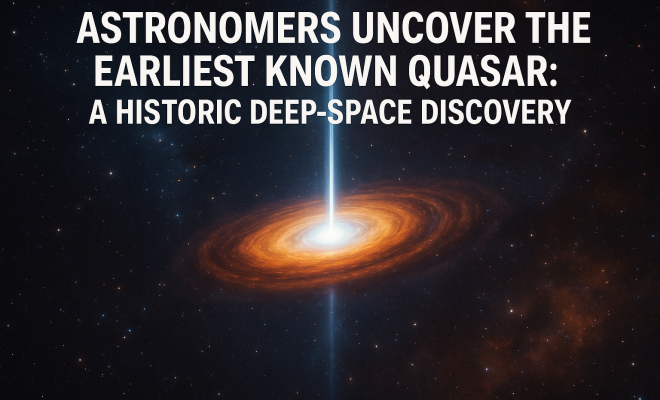
Quasars, short for “quasi-stellar objects,” are among the brightest and most energetic objects in the universe. They are powered by supermassive black holes sitting at the centers of galaxies. As matter spirals into these black holes, it heats up and emits intense radiation, making quasars detectable even from vast distances.
The brilliance of quasars lies in their ability to outshine entire galaxies, making them essential tools for astronomers trying to probe the early universe. Their light allows scientists to study not only the black holes themselves but also the conditions of the cosmos when they first began to evolve.
The Discovery Process
The discovery of this flickering quasar was made possible through the meticulous reprocessing of data from NASA’s NEOWISE mission. Over a span of 14 years, NEOWISE conducted surveys of the night sky, gathering a wealth of information about various celestial bodies. It’s fascinating to think that data collected over a decade could lead to such a monumental finding.
By combing through this extensive dataset, researchers identified signals that pointed to the presence of a quasar flickering to life in the early universe. The analysis revealed that this quasar was not only among the earliest known but also exhibited a unique flickering behavior, a phenomenon previously undocumented at such an early stage in cosmic history.
Light from the Past: Tracing the Quasar’s Origins
This quasar’s light traveled for approximately 13.1 billion years before reaching us, which means we are observing it as it was just 850 million years after the Big Bang. Imagine that for a moment: the light we see today is a snapshot of the universe when it was still in its infancy. This timeline is crucial for astronomers, as it provides a window into the conditions that prevailed shortly after the formation of the first stars and galaxies.
The implications of this discovery are profound. It suggests that supermassive black holes were forming and becoming active much earlier in the universe’s history than previously thought. This challenges existing theories about cosmic evolution and the timeline of galaxy formation.
What Makes This Quasar Unique?
The identified quasar, dubbed by researchers, is notable not just for its age but for its flickering nature. This flickering indicates that the accretion of material onto the black hole is not constant; instead, it varies over time, creating fluctuations in brightness. Such a behavior adds a layer of complexity to our understanding of black hole activity in the early universe.
This variability could be linked to several factors, such as changes in the inflow of gas or dust into the black hole, which can influence how much material is available for accretion at any given moment. Observing such dynamics in a quasar from this early period offers a rare glimpse into the interactions that governed the evolution of the universe’s first galaxies.
Implications for Cosmic Evolution
The discovery of the earliest known quasar rewrites existing expectations about how supermassive black holes and their associated quasars formed. Prior to this finding, many astronomers believed that such massive black holes could only emerge after a significant amount of time had passed in the universe’s life cycle.
With evidence showing that this quasar flickered into existence just 850 million years after the Big Bang, it’s clear that the foundations of these enormous structures were laid down much earlier than previously understood. This revelation could have far-reaching implications for theories of cosmic evolution, particularly regarding the formation of galaxies and the large-scale structures we observe today. (See: MIT's research on quasars.)
Reevaluating Cosmic Timeframes
Given that this quasar challenges the long-held timelines of black hole formation, scientists may need to reevaluate various models of cosmic history. The early universe was a chaotic and rapidly evolving environment, and the presence of such an active quasar hints at a dynamic interplay of forces that may have led to the rapid formation of galaxies.
Furthermore, this finding prompts questions about the conditions that allowed for such massive black holes to exist so soon after the Big Bang. Was there a more abundant supply of gas and material in the early universe? Were there less complex physical processes at play that permitted these black holes to form more rapidly? These are some of the questions that will likely guide future research.
The Role of NASA’s NEOWISE Mission
The NEOWISE mission has been instrumental in expanding our understanding of the cosmos. Launched in 2009, NEOWISE initially aimed to survey near-Earth objects, but its capabilities quickly extended to a broader array of celestial phenomena. The mission continues to provide researchers with valuable data that aids in the discovery of distant galaxies, comets, and other astronomical entities.
The technical prowess of NEOWISE lies in its ability to detect infrared light, which is critical for observing objects that are too faint or too distant for optical telescopes. This capability made it possible to identify the flickering quasar that has now captured the attention of the scientific community.
Future Research Directions
The discovery of the earliest known quasar opens the door for further investigations into the universe’s infancy. Astronomers are likely to use advanced telescopes, such as the James Webb Space Telescope, to study this quasar and others like it in greater detail. These observations could help to unravel the complexities surrounding the formation of supermassive black holes and the lifecycle of early galaxies.
Moreover, researchers may focus on understanding the environmental conditions present at the time of this quasar’s formation. Was there a higher density of dark matter? What role did cosmic inflation play? Such inquiries will help to refine our models of the universe and deepen our grasp of cosmic history.
Broader Implications for Astrophysics
The implications of discovering the earliest known quasar extend beyond simply understanding early black holes. This finding challenges existing paradigms in astrophysics and sparks a reexamination of how we perceive galaxy formation and the evolution of cosmic structures. It emphasizes the need to keep revising our theories based on new evidence from the universe.
For educators and science communicators, this discovery serves as an opportunity to engage the public in discussions about the complexities of our universe. By sharing the story of this quasar, we can inspire a new generation of astronomers and physicists to explore the cosmos and seek answers to the lingering questions that surround us.
FAQ About the Earliest Known Quasar
What is a quasar and why are they important?
A quasar is an extremely bright and energetic object powered by a supermassive black hole at the center of a galaxy. They are significant because they can be used to study the early universe, providing insights into the formation of galaxies and black holes.
How was the earliest known quasar discovered?
The earliest known quasar was discovered through a reprocessing of data from NASA’s NEOWISE mission, which involved analyzing infrared signals collected over 14 years. Scientists identified a quasar that existed just 850 million years after the Big Bang.
Why is the flickering nature of this quasar significant?
The flickering indicates variations in the accretion of material onto the black hole, suggesting that the process of black hole growth was more dynamic in the early universe than previously believed. This challenges existing theories about how supermassive black holes accumulate mass.
What does this discovery mean for our understanding of the universe’s evolution?
This discovery suggests that supermassive black holes were forming and becoming active much earlier in the universe’s history than theorized. It prompts a reevaluation of the timelines for galaxy formation and the conditions in the early universe. (See: Wikipedia entry on quasars.)
How does this finding impact future astronomical research?
This finding paves the way for future research, particularly using advanced telescopes like the James Webb Space Telescope, to further study quasars and the conditions around their formation. It invites deeper inquiries into cosmic evolution and the dynamics of early galaxies.
Comparing Quasars and Other Cosmic Objects
To understand the significance of quasars like the earliest known quasar, it’s helpful to compare them to other cosmic phenomena. While quasars are the brightest objects, radio galaxies and active galactic nuclei (AGN) also play important roles in astrophysical research. Each of these categories has distinct characteristics and offers unique insights.
Quasars vs. Radio Galaxies
Both quasars and radio galaxies host supermassive black holes, but they differ in their emissions. Quasars emit primarily optical and ultraviolet light, while radio galaxies primarily emit radio waves. This difference is crucial because it informs astronomers about the environments in which these black holes reside. For example, quasars are typically found in more distant galaxies, whereas radio galaxies are often seen in nearby, massive galaxies.
Quasars vs. Active Galactic Nuclei (AGN)
AGN is a broader category that includes quasars but also encompasses other types of active galaxies. The distinction often lies in their luminosity. Quasars are the most luminous AGN, allowing researchers to use them as beacons to probe the distant universe. By studying AGN, scientists gain insights into the growth of black holes and the evolution of galaxies over time.
The Role of Advanced Technology in Discovering Quasars
Technology plays a pivotal role in the discovery and study of quasars. Innovations in telescope design, data processing, and observational techniques have significantly enhanced our ability to detect these distant objects. The James Webb Space Telescope, for instance, is designed to capture infrared light with unprecedented clarity, making it a powerful tool for further exploring quasars.
Other technologies, such as machine learning algorithms, are also being employed to sift through massive datasets more efficiently. By automating parts of the data analysis process, researchers can identify quasars and other celestial objects with greater accuracy, opening up new avenues for exploration in the field of cosmology.
International Collaboration in Astronomy
The discovery of the earliest known quasar is a testament to the collaborative nature of modern astronomy. Scientist teams from institutions around the world, including those at MIT and NASA, worked together to analyze data and interpret findings. This spirit of collaboration is essential in a field where the complexity of cosmic phenomena often requires a diverse range of expertise and resources.
Furthermore, international observatories pool their resources and knowledge to tackle major questions in astrophysics. The combined efforts of researchers across borders accelerate the pace of discovery and enhance our understanding of the universe.
The Future of Quasar Research
As we look to the future, the study of quasars will continue to be a focal point in the quest to understand the universe’s evolution. With upcoming missions and advancements in technology, researchers anticipate uncovering more about the early universe and the formation of structures within it.
New telescopes and instruments will push the boundaries of our observational capabilities, allowing astronomers to map out the distribution of quasars and study their environments. This research will undoubtedly lead to new insights, potentially refining our theories about dark matter, cosmic inflation, and the very fabric of the universe. (See: NASA's NEOWISE mission.)
Comparative Analysis of Quasars Over Time
As we continue to explore the universe, it’s essential to understand how quasars fit into the broader cosmic narrative over time. Quasars are not static; they evolve, and their properties depend on their environment and the era in which they exist. By comparing quasars from different epochs, researchers can track changes in their behavior, luminosity, and impact on galaxy formation.
For instance, studies have shown that quasars from the early universe, like the earliest known quasar, exhibit different luminosity profiles compared to those formed billions of years later. This suggests that the mechanisms driving their growth and activity may have changed as the universe aged and evolved.
Additionally, the rate of quasar activity appears to have peaked at certain points in cosmic history, influenced by factors such as the availability of gas and the dynamics of surrounding environments. Understanding these trends can shed light on how galaxies interact with their central black holes and how this relationship has changed over cosmic time.
The Significance of Dark Matter in Quasar Formation
Dark matter plays a crucial role in the formation and activity of quasars. Although it cannot be observed directly, its gravitational effects influence the structure of galaxies and clusters, shaping the potential wells where gas collects to form stars and fuel black holes. The presence of dark matter may have contributed to the rapid formation of supermassive black holes in the early universe.
Recent simulations suggest that regions with higher concentrations of dark matter could have provided the necessary conditions for black holes to accrete mass at an accelerated rate. This insight adds another layer of complexity to our understanding of quasar formation, indicating that the dark matter distribution in the early universe might have played a significant role in the growth of supermassive black holes.
Emerging Questions in Quasar Research
Each new discovery raises additional questions, and the latest findings regarding the earliest known quasar are no exception. Researchers are eager to understand the precise mechanisms behind its formation and activity. For example:
- What specific conditions allowed this quasar to form so early in cosmic history?
- How did it acquire enough material to become a supermassive black hole?
- Are there more quasars like this one waiting to be discovered, and if so, what can they reveal about the early universe?
These questions are at the forefront of ongoing research, prompting scientists to refine their theoretical models and design new observational campaigns. The quest to answer them will involve cutting-edge technology and international collaboration across the globe.
Conclusion
The identification of the earliest known quasar marks a significant shift in our understanding of the universe’s early days. By challenging existing theories and urging us to reconsider cosmic timelines, this discovery reveals the dynamic nature of the cosmos and the intricate behaviors that emerged in its formative years. As we continue to uncover the mysteries of the universe, findings like these remind us of the beauty and complexity of the cosmos, urging us to look up and wonder.
“`
Trending Now
- the complete explanation
- Unlocking the Power of Apple Health Google Health Integration: A Comprehensive Guide
- our breakdown of what you need to know about mazdutide and orforglipron for obesity and diabetes
- Why Clothing Discovery Trends Are Driving Unprecedented Shopping Demand Right Now
Frequently Asked Questions
What is the significance of the earliest known quasar?
The discovery of the earliest known quasar, dating back to just 850 million years after the Big Bang, reshapes our understanding of supermassive black hole formation and reveals complex cosmic behaviors earlier than previously thought.
How are quasars formed?
Quasars are formed by supermassive black holes at the centers of galaxies. As matter spirals into these black holes, it heats up and emits intense radiation, making quasars some of the brightest objects in the universe.
What does a flickering quasar indicate?
A flickering quasar indicates a unique behavior where the light output varies, which is significant as it was previously undocumented at such an early stage in cosmic history, offering insights into the early universe's conditions.
How did astronomers discover the earliest quasar?
Astronomers discovered the earliest quasar by reprocessing data from NASA’s NEOWISE mission, which surveyed the night sky over 14 years. This extensive dataset provided signals indicating the quasar's presence, leading to this groundbreaking finding.
What role do quasars play in astronomy?
Quasars play a crucial role in astronomy as they are essential tools for studying the early universe, helping scientists understand the formation of black holes and the conditions of the cosmos during its formative years.
What did we miss? Let us know in the comments and join the conversation.