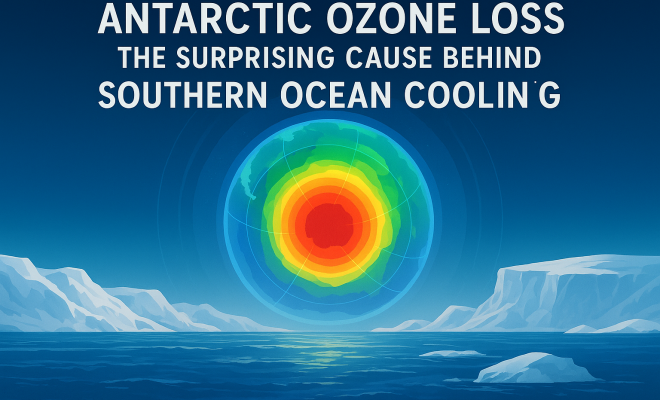
Antarctic Ozone Loss Causes Surprising Southern Ocean Cooling (2026)
“`html
The latest research has taken the scientific community by storm with its groundbreaking revelations about Antarctic ozone loss. A study published on July 3, 2026, unveils a surprising paradox: while the world grapples with the effects of global warming, the depletion of ozone in the Antarctic atmosphere is leading to unexpected cooling in the Southern Ocean. This discovery not only challenges existing climate change narratives but also highlights the complexities of how atmospheric changes interact with our planet’s oceanic systems.
1. The Study That Changed the Narrative
Researchers employed a sophisticated climate model to analyze the impact of Antarctic ozone loss on the Southern Ocean. The results revealed that as the ozone layer depletes, it indirectly contributes to a cooling trend in this vital ecosystem. This finding raises questions about the traditional understanding of climate change, where warming is often viewed as a universal trend. Instead, localized cooling phenomena could emerge as significant counterweights to global temperature rises.
Published in a prominent climate science journal, this study has already sparked widespread discussion among scientists, sparking debates about the implications of these findings. The model used in the study incorporated various atmospheric variables, allowing researchers to draw conclusions that highlight the interconnectedness of climate systems.
2. The Role of Ozone Depletion
Ozone, a molecule concentrated in the stratosphere, plays a crucial role in protecting the Earth from harmful ultraviolet radiation. However, human activities, especially the release of chlorofluorocarbons (CFCs), have led to significant degradation of the ozone layer, particularly over Antarctica. This depletion has been extensively studied for its immediate health effects and its role in climate dynamics.
The new research indicates that the repercussions of Antarctic ozone loss extend beyond what was previously understood. The loss of ozone leads to changes in atmospheric circulation patterns, which in turn affect ocean currents and temperatures. As warm air is displaced and cooler air moves in, the Southern Ocean experiences localized cooling, revealing a complex interplay between atmospheric conditions and oceanic temperatures.
3. A Counterintuitive Findings
This study presents a counterintuitive finding that challenges the prevailing narrative surrounding climate change. Instead of a straightforward warming trend, the research suggests that certain regions may experience cooling effects as a result of ozone depletion. This phenomenon creates a paradox: global warming may not be as uniform as previously assumed, leading to a more nuanced understanding of climate dynamics.
Many climate models have historically focused on greenhouse gas emissions as the primary driver of warming. This new perspective forces scientists to reconsider how atmospheric changes, especially those related to ozone loss, can alter ocean temperatures. It begs the question: how many other localized phenomena remain undiscovered in our quest to understand climate change?
4. The Southern Ocean: A Key Player in Climate Regulation
The Southern Ocean is more than just a body of water; it plays a pivotal role in regulating global climate. Acting as a significant carbon sink, it absorbs a large portion of the carbon dioxide emitted into the atmosphere. However, changes in this ocean system can have far-reaching consequences for both marine life and global weather patterns.
The cooling observed in the Southern Ocean may have implications for the ocean’s ability to absorb carbon. As temperatures drop, the dynamics of water circulation change, potentially affecting the efficiency with which the ocean sequesters carbon. This could further complicate the relationship between atmospheric CO2 levels and global temperatures, challenging the assumptions underpinning many climate models.
5. Public Interest and Social Media Buzz
The revelations from this study have not only captivated scientists but have also sparked massive interest among the general public. Social media platforms have seen a surge in discussions about Antarctic ozone loss, with many users sharing articles and personal perspectives. The paradox of cooling in the face of global warming has resonated widely, prompting many to question established climate theories. (See: Ozone Layer Fact Sheet.)
In the age of information, the ability to share and discuss scientific findings rapidly has transformed how the public engages with climate science. This phenomenon underscores the importance of communicating scientific research effectively, ensuring that the nuances of findings like those from this study are accurately conveyed to a broader audience.
6. Implications for Future Climate Research
This groundbreaking study opens the door for further research into the complex relationships between ozone depletion, atmospheric changes, and ocean temperatures. Scientists are now challenged to explore the extent of localized cooling effects and how they interact with global warming trends. This could lead to new insights that reshape current climate models.
Understanding the implications of Antarctic ozone loss could have vital ramifications for climate policy and conservation efforts. If localized cooling can offset some effects of global warming, policymakers must consider how these dynamics can inform strategies for mitigation and adaptation.
7. How Ozone Loss Could Shape Climate Policy
Given these revelations, climate policy may require a reevaluation. Current frameworks often prioritize reduction of greenhouse gas emissions, but they may need to take into account the effects of ozone layer depletion on climate patterns. This nuanced understanding can lead to more effective policies aimed at both reducing emissions and protecting the ozone layer.
As discussions about climate action continue, addressing Antarctic ozone loss alongside greenhouse gas emissions could provide a dual approach to mitigating climate change. Promoting awareness and action around the ozone layer will be essential not only for its direct benefits but also for its unexpected impact on ocean temperatures and global climate.
8. A Deeper Look at Ozone Layer Recovery Efforts
The Montreal Protocol, established in 1987, has been instrumental in reducing the use of ozone-depleting substances globally. This landmark agreement led to the phasing out of CFCs and other harmful chemicals. Scientists are now seeing encouraging signs that the ozone layer is slowly recovering, with estimates suggesting that it could return to its pre-1980 levels by the middle of the 21st century.
However, the recovery of the ozone layer is a complex process. While the reduction of CFCs is a significant step, other factors such as climate change can influence the rate of recovery. For instance, the warming of the stratosphere due to greenhouse gas emissions could slow down the natural replenishment of ozone. This underlines the interconnectedness of atmospheric phenomena and the need for a holistic approach to environmental policy. Antarctic Circumpolar Current insights offers useful background here.
9. The Economic Implications of Ozone Loss
Economic impacts arising from Antarctic ozone loss and its associated cooling trends are becoming a topic of interest among economists and climate analysts. The cooling of the Southern Ocean could have direct consequences on fishing industries, particularly in regions reliant on species that thrive in specific temperature ranges. For instance, changes in ocean temperatures can affect the distribution of fish stocks, leading to shifts in fishing patterns and economic instability for communities dependent on these resources.
Additionally, the cooling could impact tourism in areas like Antarctica, where ecosystems are highly sensitive to temperature changes. As wildlife patterns shift, so too could the attractions for visitors, potentially affecting local economies that rely on eco-tourism. It’s essential for policymakers to consider these economic factors when devising strategies to mitigate the effects of ozone depletion and its associated cooling trends.
10. Frequently Asked Questions (FAQ)
What causes Antarctic ozone loss?
Antarctic ozone loss is primarily caused by human-made chemicals, particularly chlorofluorocarbons (CFCs). These substances break down ozone molecules in the stratosphere, leading to a thinning of the ozone layer, especially during the Antarctic spring. (See: NASA Ozone Overview.)
How does ozone depletion affect global warming?
While ozone depletion itself doesn’t directly cause global warming, it contributes to changes in atmospheric circulation and ocean temperatures. The latest research indicates that this can lead to localized cooling effects even as the planet warms overall.
What are the health effects of increased UV radiation due to ozone loss?
Increased UV radiation can lead to higher rates of skin cancer, cataracts, and other health issues for humans. It can also have significant impacts on ecosystems, affecting plant life and marine organisms.
Is there hope for the recovery of the ozone layer?
Yes, there is hope. The Montreal Protocol has been successful in reducing the levels of ozone-depleting substances in the atmosphere. Current projections suggest that the ozone layer is on track to recover to its pre-1980 levels by mid-century, assuming that current policies remain in place.
How can individuals help in the fight against ozone depletion?
Individuals can help by being mindful of the products they use. Choosing items that do not contain CFCs or other ozone-depleting substances, supporting policies that aim to protect the ozone layer, and advocating for environmental sustainability can all contribute to the recovery of the ozone layer.
11. Global Collaboration and Future Directions
Addressing the challenges posed by Antarctic ozone loss requires global collaboration. The international community must work together not only to enforce existing agreements like the Montreal Protocol but also to adapt to new findings regarding the complex interactions between ozone depletion, climate change, and ocean health.
Future research should focus on refining climate models to better integrate the effects of ozone loss into predictions of climate change. This means enhancing our understanding of how stratospheric changes influence weather patterns and marine ecosystems. As we uncover more about these relationships, it becomes increasingly important to share knowledge across borders to create effective and equitable climate policies.
12. The Importance of Education and Public Engagement
Educating the public on the intricacies of ozone depletion and its implications is vital. Schools, community programs, and media outlets play important roles in disseminating information about the significance of the ozone layer. Engaging narratives about the complexities of climate science can inspire a new generation to advocate for environmental sustainability and policies that protect our planet.
Public awareness campaigns can help dispel myths concerning climate science while promoting understanding of the interplay between ozone loss and climate dynamics. As individuals become more informed, they can participate more meaningfully in discussions and decisions surrounding environmental protection.
13. Innovative Technologies in Monitoring Ozone Levels
With advances in technology, monitoring the ozone layer has become more precise and widespread. Satellites equipped with sophisticated sensors now provide real-time data on ozone concentration, enabling scientists to track fluctuations and analyze trends. Instruments like NASA’s Aura satellite and the European Space Agency’s Sentinel satellites are key to this effort, delivering vital information that helps researchers understand the dynamics of ozone depletion. (See: CDC Ozone and Health.)
Additionally, ground-based observatories play a crucial role in validating satellite data, offering a comprehensive view of ozone concentrations. These technologies not only enhance our understanding of ozone dynamics but also offer critical insights into how policy changes and recovery efforts impact ozone levels over time.
14. Future Challenges and Considerations
While the recovery of the ozone layer is promising, several challenges remain. Climate change poses a significant threat to ozone recovery, as changes in temperature and weather patterns can influence the stratosphere’s ability to replenish ozone. For instance, the Arctic ozone layer has been experiencing fluctuations due to warming temperatures, highlighting the interconnected nature of these environmental issues.
Moreover, the potential emergence of new ozone-depleting substances, such as those used in alternative technologies and newer industrial applications, remains a critical concern. Continuous monitoring and regulatory vigilance are necessary to ensure that hard-won progress is not undermined by emerging threats.
15. The Role of Policy and Legislation
Effective policy frameworks are crucial for addressing both ozone depletion and climate change. The success of the Montreal Protocol demonstrates the importance of international cooperation in tackling global environmental issues. Policymakers must remain vigilant and proactive, adapting regulations to address new challenges as they arise. This includes creating incentives for industries to adopt sustainable practices and technologies that protect the ozone layer.
Furthermore, incorporating ozone protection into broader climate strategies can lead to more cohesive and effective environmental policies. By recognizing the links between ozone loss and climate change, governments can develop comprehensive strategies that address both issues simultaneously, yielding benefits for public health, biodiversity, and the global climate.
16. Wrapping Up: The Path Forward
The revelations regarding Antarctic ozone loss and its impact on the Southern Ocean underscore the need for continued vigilance and action. As we continue to unravel the complexities of our planet’s climate systems, it’s imperative that we embrace a multifaceted approach to environmental stewardship. It’s about understanding that these issues are interconnected—addressing ozone loss, greenhouse gas emissions, and ocean health simultaneously to forge a sustainable future for all.
In moving forward, collaboration, education, and informed policy-making will be our most powerful tools. By fostering a deeper understanding of the nuances of ozone depletion and its effects, we can hope to inspire a collective commitment to safeguarding our planet’s atmosphere and oceans for generations to come.
“`
Trending Now
Frequently Asked Questions
What is causing the cooling in the Southern Ocean?
Recent research indicates that Antarctic ozone loss is leading to unexpected cooling in the Southern Ocean. The depletion of the ozone layer, primarily due to human activities like CFC emissions, is contributing to this localized cooling trend, challenging traditional views of global warming.
How does ozone depletion affect climate change?
Ozone depletion affects climate change by altering atmospheric dynamics. The recent study shows that while global warming is prevalent, the loss of ozone in Antarctica can lead to localized cooling effects, complicating the understanding of climate interactions.
What are the implications of Antarctic ozone loss?
Antarctic ozone loss has significant implications, including unexpected cooling of the Southern Ocean and challenges to existing climate change narratives. This highlights the complexity of climate systems and the need for a nuanced understanding of atmospheric changes.
What role does ozone play in protecting the Earth?
Ozone, concentrated in the stratosphere, protects the Earth from harmful ultraviolet radiation. Its depletion due to human activities has immediate health effects and contributes to broader climate dynamics, as highlighted by recent studies on Antarctic ozone loss.
How was the study on Antarctic ozone loss conducted?
The study utilized a sophisticated climate model to analyze the impact of Antarctic ozone loss on the Southern Ocean. It incorporated various atmospheric variables to reveal the interconnectedness of climate systems and the unexpected cooling effects resulting from ozone depletion.
Have you experienced this yourself? We'd love to hear your story in the comments.