The Tech Edvocate

Top Menu

  • Advertisement
  • Apps
  • Home Page
  • Home Page Five (No Sidebar)
  • Home Page Four
  • Home Page Three
  • Home Page Two
  • Home Tech2
  • Icons [No Sidebar]
  • Left Sidbear Page
  • Lynch Educational Consulting
  • My Account
  • My Speaking Page
  • Newsletter Sign Up Confirmation
  • Newsletter Unsubscription
  • Our Brands
  • Page Example
  • Privacy Policy
  • Protected Content
  • Register
  • Request a Product Review
  • Shop
  • Shortcodes Examples
  • Signup
  • Start Here
    • Governance
    • Careers
    • Contact Us
  • Terms and Conditions
  • The Edvocate
  • The Tech Edvocate Product Guide
  • Topics
  • Write For Us
  • Advertise

Main Menu

  • Start Here
    • Our Brands
    • Governance
      • Lynch Educational Consulting, LLC.
      • Dr. Lynch’s Personal Website
      • Careers
    • Write For Us
    • The Tech Edvocate Product Guide
    • Contact Us
    • Books
    • Edupedia
    • Post a Job
    • The Edvocate Podcast
    • Terms and Conditions
    • Privacy Policy
  • Topics
    • Assistive Technology
    • Child Development Tech
    • Early Childhood & K-12 EdTech
    • EdTech Futures
    • EdTech News
    • EdTech Policy & Reform
    • EdTech Startups & Businesses
    • Higher Education EdTech
    • Online Learning & eLearning
    • Parent & Family Tech
    • Personalized Learning
    • Product Reviews
  • Advertise
  • Tech Edvocate Awards
  • The Edvocate
  • Pedagogue
  • School Ratings

logo

The Tech Edvocate

  • Start Here
    • Our Brands
    • Governance
      • Lynch Educational Consulting, LLC.
      • Dr. Lynch’s Personal Website
        • My Speaking Page
      • Careers
    • Write For Us
    • The Tech Edvocate Product Guide
    • Contact Us
    • Books
    • Edupedia
    • Post a Job
    • The Edvocate Podcast
    • Terms and Conditions
    • Privacy Policy
  • Topics
    • Assistive Technology
    • Child Development Tech
    • Early Childhood & K-12 EdTech
    • EdTech Futures
    • EdTech News
    • EdTech Policy & Reform
    • EdTech Startups & Businesses
    • Higher Education EdTech
    • Online Learning & eLearning
    • Parent & Family Tech
    • Personalized Learning
    • Product Reviews
  • Advertise
  • Tech Edvocate Awards
  • The Edvocate
  • Pedagogue
  • School Ratings
  • The Hidden Cost of EVs: Why Your Battery Could Cost More Than Your Car in 2026

  • Jensen Huang’s Shock Exit: This Unbelievable Scandal Just Rocked Nvidia and the AI World

  • Big Walk developer House House Confirms ‘Sparing’ Use of Gen AI – Press Start

  • Baffling: How a Cyber Breach at South Korea’s Top Security Watchdog Exposed Millions

  • Wenn Ordnung den Bildschirm beruhigt: Warum klare Abläufe Casino-Unterhaltung einladender machen

  • Reddit AI Reviews: The Quiet Reshaping of Online Opinion

  • The Chilling Truth: Iran Cyberattacks Europe’s Food and Blood Supplies

  • Anthropic’s $3.4 Billion Bet on Gas: The Unseen Cost of AI’s Future

  • Tribit FlyBuds C3 Earbuds: Premium Features at a Budget-Friendly Price

  • Is AuraCam Pro’s Emotional AI a Privacy Nightmare or Security Breakthrough?

Digital & Mobile Technology
Home›Digital & Mobile Technology›What is Laminated Object Manufacturing (LOM)?

What is Laminated Object Manufacturing (LOM)?
By Matthew Lynch
May 23, 2023
0
Spread the love

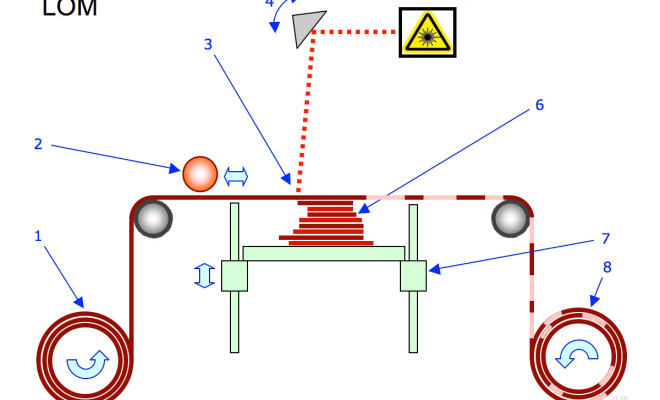
Laminated Object Manufacturing (LOM) is a type of 3D printing technology that involves the creation of three-dimensional objects through the layering and bonding of paper or plastic sheets. LOM was first developed in the 1990s by Michael Feygin, who aimed to create a more affordable and accessible method of 3D printing.

The LOM process typically starts with a Computer-Aided Design (CAD) model that is uploaded to a computer software program. The program then uses a cutting tool to cut the desired shape out of a stack of paper or plastic sheets. The layers are then bonded together using heat, pressure, or an adhesive, depending on the material used. Finally, excess material is removed and the finished product is ready for use.

The materials used in LOM include paper, plastic, or composite materials, which make it a cost-effective manufacturing option for large objects. Most commonly, the paper sheets are made from copy paper or engineering paper, while plastics such as polycarbonate, ABS, or nylon can also be used.

One of the advantages of LOM is that it can produce objects with a smooth surface finish and a high level of accuracy. Objects produced through LOM have a solid, dense structure and high dimensional stability, making them suitable for a wide range of applications. Additionally, LOM can create objects with large dimensions, such as architectural models or full-size prototypes for product design.

LOM is particularly useful in architectural and engineering applications, where large-scale, three-dimensional objects are required to be produced accurately and cost-effectively. This includes the creation of building facades, detailed models of cityscapes, and 3D printed parts for vehicles and machines.

As with any manufacturing process, there are some disadvantages to LOM. The material used in LOM can be expensive, particularly if high-grade papers or plastics are used. Additionally, the layering process can take longer compared to other 3D printing methods, as each layer needs to be cut and bonded together, which can result in slower production times.

Despite these limitations, Laminated Object Manufacturing remains a cost-effective and accessible 3D printing technology that is capable of producing detailed and accurate objects with a smooth surface finish. As it continues to evolve and improve, LOM could become an essential manufacturing method for various industries.


Previous Article

What is Lean Production?

Next Article

What is ITIL (Information Technology Infrastructure Library)?

Matthew Lynch

Related articles More from author

  • Digital & Mobile Technology

    How to Convert Apple Pages Into Word Documents

    September 7, 2023
    By Matthew Lynch
  • Digital & Mobile Technology

    What is Network Optimization?

    May 24, 2023
    By Matthew Lynch
  • Digital & Mobile Technology

    How to Troubleshoot Suddenlink

    May 29, 2023
    By Matthew Lynch
  • Digital & Mobile Technology

    How to Open Device Manager

    May 31, 2023
    By Matthew Lynch
  • Digital & Mobile Technology

    Guide to the Different Types of Game Boys

    June 10, 2023
    By Matthew Lynch
  • Digital & Mobile Technology

    Best Record Player

    April 11, 2023
    By Matthew Lynch

Search

Login & Registration

  • Log in
  • Entries feed
  • Comments feed
  • WordPress.org

Newsletter

Signup for The Tech Edvocate Newsletter and have the latest in EdTech news and opinion delivered to your email address!

About Us

Since technology is not going anywhere and does more good than harm, adapting is the best course of action. That is where The Tech Edvocate comes in. We plan to cover the PreK-12 and Higher Education EdTech sectors and provide our readers with the latest news and opinion on the subject. From time to time, I will invite other voices to weigh in on important issues in EdTech. We hope to provide a well-rounded, multi-faceted look at the past, present, the future of EdTech in the US and internationally.

We started this journey back in June 2016, and we plan to continue it for many more years to come. I hope that you will join us in this discussion of the past, present and future of EdTech and lend your own insight to the issues that are discussed.

Newsletter

Signup for The Tech Edvocate Newsletter and have the latest in EdTech news and opinion delivered to your email address!

Contact Us

The Tech Edvocate
910 Goddin Street
Richmond, VA 23231
(601) 630-5238
[email protected]

Copyright © 2026 Matthew Lynch. All rights reserved.