Online vs face-to-face learning: why can’t we have both?
This article was written by Christopher Scanlon, La Trobe University
Ever since the invention of the printed word, academics have been arguing about the proper place of technology in teaching.
On one side are those who I’ll call the traditionalists who insist on the primacy of face-to-face and barely tolerate online delivery. For the traditionalists, students need, as one colleague put it, to be exposed to the “rhetorical performance of the lecture”. For them, students learn a great deal from simply watching academics nut through problems.
While they may decry passive lectures, their own teaching, they insist, is a highly interactive affair. They adopt a Socratic approach in which they engage students in a rich dialogue. While technologies such as the web have a place in teaching, it is a secondary one, limited for broadcasting announcements and pasting up subject learning guides.
On the other side, are the technologists. The technologists would happily do away with lectures — or give face-to-face teaching the flick entirely. New technologies provide tools for reaching into students’ lives. Students can learn when and where they want. And now that students are getting online delivery at high school, it’s time that universities caught up.
While early versions of online teaching were often cheap and nasty, its present day champions argue that things have gotten a lot better. Learning analytics, for example, provide new ways to track students’ progress and comprehension throughout a subject, permitting more targeted, customised lectures.
As an Associate Dean, I’ve heard passionate defenders of both sides — and I have some sympathy for both.

The modern day classroom? Flickr/George Redgrave, CC BY
Those who defend the face-to-face are absolutely correct: in many instances there is no substitute for meeting in person. Anyone who has taken part in video conferencing or a Skype call knows this to be true.
According to some estimates, non-verbal cues account for up to 60% of communication. No amount of bandwidth can make up for this potential loss of information. No doubt this is part of the diabolical attrition rates for Massive Open Online Courses.
But, at the same time, traditionalists often uncritically equate attendance with attentiveness.
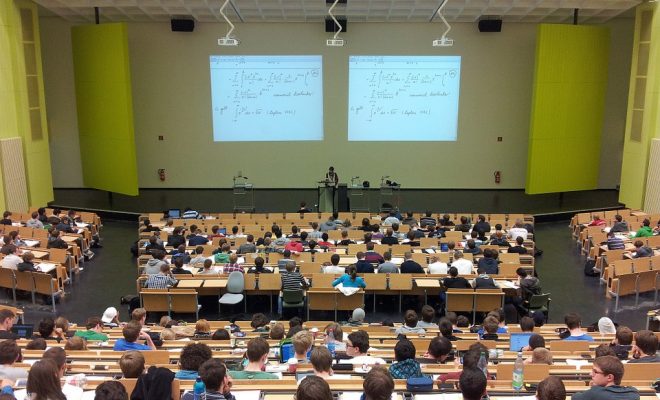
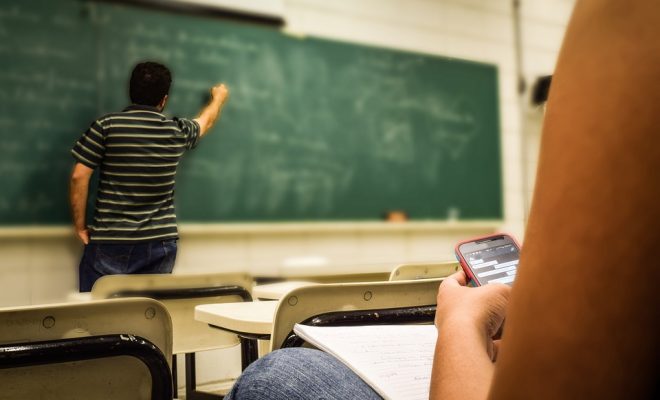
Take a peek from the back of most large lecture theatres, and you’ll discover that many of those students conscientiously tapping away at their laptops are chatting on Facebook or, more depressingly, shopping on ebay.
And those are just the students who bothered to turn up. The uncomfortable truth is, many students vote with their feet and simply don’t go to class.
Some lecturers argue that this is a reason not to put content online in the first place. But the more pertinent question is: if students can pass a subject without turning up to class, then why should they?
As for the Socratic approach, I always wonder what people mean by this. Most of the examples we have of Socrates’ practice comes to us via Plato. In Plato’s writings, as the Slovenian philosopher Slavoj Žižek notes in Organs without Bodies, Socrates asks the questions, his companions politely answer and occasionally offer a few feeble challenges, before everyone agrees with Socrates, gushing “The matter never struck me before; but I quite recognise the truth of your remark”.
As a model for challenging ideas or nutting through complex issues, the example of the Socratic method that has come down to us doesn’t have much to recommend it. It seems better suited to starting a cult. And while that might be good for student retention, I’m not sure that’s what the advocates of the Socratic method were aiming at.
The choice offered by traditionalists and the technologists is a false one. In almost every sphere of life, the online and the face-to-face merge almost seamlessly.
Our personal lives are plastered all over Facebook and Twitter, yet the pervasiveness of cafes suggests that people still want the embodied presence of others. Why should we expect education to be any different?
A more productive conversation is not to insist on the primacy of online or the face-to-face, but rather to wholeheartedly embrace both. This is to leverage different modes of delivery to create more effective learning and teaching experiences.
One way to do so is to harness technology to make more effective use of the valuable time teachers and students meet face-to-face. The guiding principle should be that any transmissible material should be delivered online. It should be put into bite-sized chunks and presented to students to be read/watched/listened to in their own time.
Doing so frees up valuable face-to-face teaching time to engage in active learning exercises, in-class discussions, and practicals.
While wholly online subjects and ones that are delivered predominantly in the face-to-face will continue, the bulk of courses in higher education will begin to resemble the rest of contemporary social life: a complex blending of both the online and face-to-face.
Rather than devoting more time and effort wrestling with the debate between face-to-face and technology, our efforts would be better spent exploring the best practices of education using all the tools at our disposal.

Christopher Scanlon, Academic Director, Learning Focus Area Hub, La Trobe University
This article was originally published on The Conversation. Read the original article.