The Tech Edvocate

Top Menu

  • Advertisement
  • Apps
  • Home Page
  • Home Page Five (No Sidebar)
  • Home Page Four
  • Home Page Three
  • Home Page Two
  • Home Tech2
  • Icons [No Sidebar]
  • Left Sidbear Page
  • Lynch Educational Consulting
  • My Account
  • My Speaking Page
  • Newsletter Sign Up Confirmation
  • Newsletter Unsubscription
  • Our Brands
  • Page Example
  • Privacy Policy
  • Protected Content
  • Register
  • Request a Product Review
  • Shop
  • Shortcodes Examples
  • Signup
  • Start Here
    • Governance
    • Careers
    • Contact Us
  • Terms and Conditions
  • The Edvocate
  • The Tech Edvocate Product Guide
  • Topics
  • Write For Us
  • Advertise

Main Menu

  • Start Here
    • Our Brands
    • Governance
      • Lynch Educational Consulting, LLC.
      • Dr. Lynch’s Personal Website
      • Careers
    • Write For Us
    • The Tech Edvocate Product Guide
    • Contact Us
    • Books
    • Edupedia
    • Post a Job
    • The Edvocate Podcast
    • Terms and Conditions
    • Privacy Policy
  • Topics
    • Assistive Technology
    • Child Development Tech
    • Early Childhood & K-12 EdTech
    • EdTech Futures
    • EdTech News
    • EdTech Policy & Reform
    • EdTech Startups & Businesses
    • Higher Education EdTech
    • Online Learning & eLearning
    • Parent & Family Tech
    • Personalized Learning
    • Product Reviews
  • Advertise
  • Tech Edvocate Awards
  • The Edvocate
  • Pedagogue
  • School Ratings

logo

The Tech Edvocate

  • Start Here
    • Our Brands
    • Governance
      • Lynch Educational Consulting, LLC.
      • Dr. Lynch’s Personal Website
        • My Speaking Page
      • Careers
    • Write For Us
    • The Tech Edvocate Product Guide
    • Contact Us
    • Books
    • Edupedia
    • Post a Job
    • The Edvocate Podcast
    • Terms and Conditions
    • Privacy Policy
  • Topics
    • Assistive Technology
    • Child Development Tech
    • Early Childhood & K-12 EdTech
    • EdTech Futures
    • EdTech News
    • EdTech Policy & Reform
    • EdTech Startups & Businesses
    • Higher Education EdTech
    • Online Learning & eLearning
    • Parent & Family Tech
    • Personalized Learning
    • Product Reviews
  • Advertise
  • Tech Edvocate Awards
  • The Edvocate
  • Pedagogue
  • School Ratings
  • Your Home Insurance Bill Just Exploded: 5 Reasons Why — And What Comes Next

  • Your Home Insurance Premiums Are Skyrocketing: Is Your State On This List?

  • The Brutal Truth: Why 30-Year vs. 15-Year Fixed Mortgage Rates in 2026 Could CRUSH Your Homeownership Dreams

  • 7 Things First-Time Homebuyers MUST Know About the New 6.89% Mortgage Rates

  • Your Dream Home Just Got Pricier: Why Mortgage Rates 2026 Are Soaring Toward 7%

  • Unbelievable: The True Cost of CRISPR Anti-Aging Will Absolutely Shock You

  • Your Genes Hold The Key: How CRISPR Could Restore Youthful Function

  • The Mind-Blowing Way CRISPR Could End Aging As We Know It

  • Why Millions Are Rushing to Install Home Battery Storage Now

  • Google’s €13 Billion Bet: The Unseen Renewable Energy Funds Quietly Reshaping Your Portfolio

Digital & Mobile Technology
Home›Digital & Mobile Technology›100% Disk Usage in Windows 10? Tips and Tricks to Fix This Issue

100% Disk Usage in Windows 10? Tips and Tricks to Fix This Issue
By Matthew Lynch
June 22, 2023
0
Spread the love

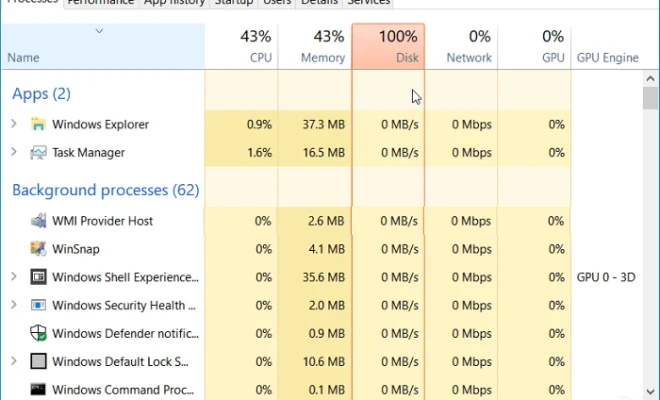
If you are experiencing 100% disk usage in Windows 10, then you might be frustrated with how slow your computer is functioning. Fortunately, there are several tips and tricks that you can follow to fix this issue. In this article, we will explore 17 of them.

  1. Disable Windows Search Service: You can disable the Windows Search service to reduce disk usage. Press the Windows + R keys to open the Run dialog box. Type “services.msc” and click OK. Find “Windows Search” in the list of services, right-click it, and select “Properties.” Click “Stop” to stop the service and select “Disabled” as the startup type. Click OK to save the changes.
  2. Change Virtual Memory: You can change the virtual memory settings to reduce disk usage. Go to Control Panel > System and Security > System > Advanced System Settings > Performance > Settings > Advanced. Under “Virtual memory,” click “Change.” Uncheck “Automatically manage paging file size for all drives” and select the “Custom size” radio button. Set the initial size and maximum size, then click OK.
  3. Disable Superfetch: Superfetch is a Windows service that preloads frequently used applications into memory. However, it can also cause high disk usage. To disable Superfetch, press the Windows + R keys, type “services.msc,” and click OK. Find “Superfetch” in the list of services, right-click it, and select “Properties.” Click “Stop” to stop the service and select “Disabled” as the startup type. Click OK to save the changes.
  4. Disable Windows Tips and Tricks: Windows Tips and Tricks is a feature that provides helpful tips to users. However, it can also cause high disk usage. To disable Windows Tips and Tricks, go to Settings > System > Notifications & actions. Turn off “Get tips, tricks, and suggestions as you use Windows.”
  5. Uninstall Memory-Intensive Programs: Some programs consume a lot of memory, which can cause high disk usage. To determine which programs are causing this issue, go to Task Manager > Processes. Sort processes by “Disk” to see which programs are using the most disk resources. Uninstall any memory-intensive programs that you don’t need or use.
  6. Check for Viruses and Malware: Viruses and malware can cause high disk usage. To check for viruses and malware, use an antivirus or antimalware program. Perform a full system scan and remove any detected malware or viruses.
  7. Disable Antivirus Scans: Antivirus scans can cause high disk usage. To reduce disk usage during antivirus scans, schedule scans at a time when you are not using your computer. Alternatively, you can temporarily disable the antivirus during scans.
  8. Update Device Drivers: Outdated device drivers can cause high disk usage. To update device drivers, go to Device Manager, find the device that needs an update, right-click it, and select “Update driver.” You can also use a driver update software to update all your drivers automatically.
  9. Disable Windows Defender: Windows Defender is a built-in antivirus program in Windows 10. However, it can cause high disk usage. To disable Windows Defender, go to Settings > Update & Security > Windows Security. Click “Virus & threat protection,” then “Manage settings.” Turn off “Real-time protection” and “Cloud-delivered protection.”
  10. Clear Thumbnails Cache: Thumbnails cache can accumulate over time, causing high disk usage. To clear the thumbnails cache, go to Disk Cleanup > Clean up system files. Select “Thumbnails” and click OK.
  11. Disable Automatic Windows Updates: Automatic Windows updates can cause high disk usage. To disable automatic Windows updates, go to Settings > Update & Security > Windows Update > Advanced Options. Click “Pause updates for 7 days” or “Pause updates for 30 days.”
  12. Disable OneDrive Sync: OneDrive sync can cause high disk usage. To disable OneDrive sync, right-click the OneDrive icon in the system tray and select “Settings.” Click the “Account” tab and click “Unlink this PC.” This will stop OneDrive from syncing with your computer.
  13. Disable Background Apps: Background apps can cause high disk usage. To disable background apps, go to Settings > Privacy > Background apps. Turn off any apps that you don’t need running in the background.
  14. Adjust Power Settings: Power settings can cause high disk usage. To adjust power settings, go to Control Panel > Power Options. Select a power plan and click “Change plan settings.” Click “Change advanced power settings” and adjust settings under “Hard disk,” “Processor power management,” and “System cooling policy.”
  15. Run Disk Check: Disk errors can cause high disk usage. To run Disk Check, go to File Explorer, right-click the drive that you want to check, and select “Properties”. Click the “Tools” tab and click “Check” under “Error checking.”
  16. Adjust Indexing Options: Indexing can cause high disk usage. To adjust indexing options, go to Control Panel > Indexing Options. Click “Modify,” then uncheck any folders that you don’t need indexed.
  17. Reset Your PC: If all else fails, you can reset your PC to factory settings. Go to Settings > Update & Security > Recovery. Click “Get started” under “Reset this PC.” Follow the instructions to reset your PC.
Previous Article

Post-It to Your Screen: Sticky Note Apps ...

Next Article

How to Disable or Turn Off the ...

Matthew Lynch

Related articles More from author

  • Digital & Mobile Technology

    How to Manage Your YouTube Account Settings

    June 9, 2023
    By Matthew Lynch
  • Digital & Mobile Technology

    Best Places to Search for 3D Printing Models

    June 15, 2023
    By Matthew Lynch
  • Digital & Mobile Technology

    How to Install and Use Dashlane on Windows

    August 1, 2023
    By Matthew Lynch
  • Digital & Mobile Technology

    What Is a Purple Team in Cybersecurity?

    June 15, 2023
    By Matthew Lynch
  • Digital & Mobile Technology

    What Is USB 3.0?

    May 14, 2023
    By Matthew Lynch
  • Digital & Mobile Technology

    The Best Microsoft Edge Themes to Switch up Your Browser

    June 14, 2023
    By Matthew Lynch

Search

Login & Registration

  • Log in
  • Entries feed
  • Comments feed
  • WordPress.org

Newsletter

Signup for The Tech Edvocate Newsletter and have the latest in EdTech news and opinion delivered to your email address!

About Us

Since technology is not going anywhere and does more good than harm, adapting is the best course of action. That is where The Tech Edvocate comes in. We plan to cover the PreK-12 and Higher Education EdTech sectors and provide our readers with the latest news and opinion on the subject. From time to time, I will invite other voices to weigh in on important issues in EdTech. We hope to provide a well-rounded, multi-faceted look at the past, present, the future of EdTech in the US and internationally.

We started this journey back in June 2016, and we plan to continue it for many more years to come. I hope that you will join us in this discussion of the past, present and future of EdTech and lend your own insight to the issues that are discussed.

Newsletter

Signup for The Tech Edvocate Newsletter and have the latest in EdTech news and opinion delivered to your email address!

Contact Us

The Tech Edvocate
910 Goddin Street
Richmond, VA 23231
(601) 630-5238
[email protected]

Copyright © 2026 Matthew Lynch. All rights reserved.