The Tech Edvocate

Top Menu

  • Advertisement
  • Apps
  • Home Page
  • Home Page Five (No Sidebar)
  • Home Page Four
  • Home Page Three
  • Home Page Two
  • Home Tech2
  • Icons [No Sidebar]
  • Left Sidbear Page
  • Lynch Educational Consulting
  • My Account
  • My Speaking Page
  • Newsletter Sign Up Confirmation
  • Newsletter Unsubscription
  • Our Brands
  • Page Example
  • Privacy Policy
  • Protected Content
  • Register
  • Request a Product Review
  • Shop
  • Shortcodes Examples
  • Signup
  • Start Here
    • Governance
    • Careers
    • Contact Us
  • Terms and Conditions
  • The Edvocate
  • The Tech Edvocate Product Guide
  • Topics
  • Write For Us
  • Advertise

Main Menu

  • Start Here
    • Our Brands
    • Governance
      • Lynch Educational Consulting, LLC.
      • Dr. Lynch’s Personal Website
      • Careers
    • Write For Us
    • The Tech Edvocate Product Guide
    • Contact Us
    • Books
    • Edupedia
    • Post a Job
    • The Edvocate Podcast
    • Terms and Conditions
    • Privacy Policy
  • Topics
    • Assistive Technology
    • Child Development Tech
    • Early Childhood & K-12 EdTech
    • EdTech Futures
    • EdTech News
    • EdTech Policy & Reform
    • EdTech Startups & Businesses
    • Higher Education EdTech
    • Online Learning & eLearning
    • Parent & Family Tech
    • Personalized Learning
    • Product Reviews
  • Advertise
  • Tech Edvocate Awards
  • The Edvocate
  • Pedagogue
  • School Ratings

logo

The Tech Edvocate

  • Start Here
    • Our Brands
    • Governance
      • Lynch Educational Consulting, LLC.
      • Dr. Lynch’s Personal Website
        • My Speaking Page
      • Careers
    • Write For Us
    • The Tech Edvocate Product Guide
    • Contact Us
    • Books
    • Edupedia
    • Post a Job
    • The Edvocate Podcast
    • Terms and Conditions
    • Privacy Policy
  • Topics
    • Assistive Technology
    • Child Development Tech
    • Early Childhood & K-12 EdTech
    • EdTech Futures
    • EdTech News
    • EdTech Policy & Reform
    • EdTech Startups & Businesses
    • Higher Education EdTech
    • Online Learning & eLearning
    • Parent & Family Tech
    • Personalized Learning
    • Product Reviews
  • Advertise
  • Tech Edvocate Awards
  • The Edvocate
  • Pedagogue
  • School Ratings
  • 77% of Employees Believe They Can Outperform AI in Their Jobs

  • Rethinking Recruitment Strategies in Higher Education

  • 1 in 4 Gen Z Are Considering Ditching Corporate for Content Creation

  • This One Flaw Just Blew Up the Guardian Smart Baby Monitor

  • The AI Race: Why Doomsday Warnings Can’t Stop the Train

  • XBOX: Activision takes over Halo, Obsidian joins Bethesda, and Ninja Theory is going

  • White House Arcade: 2nd Japan Protest, Nintendo Feud [2026]

  • One-Fifth of White-Collar Jobs Could Vanish by 2030, New Report Claims

  • Is a ‘Pacing’ AI Slowdown Really Possible? This Week’s AI News Roundup Reveals the Truth

  • California’s Bold Move: AB 1709 Social Media Restrictions Could Banish Teen Addiction

Assistive Technology
Home›Assistive Technology›What is Passive Component?

What is Passive Component?
By Matthew Lynch
May 25, 2023
0
Spread the love

Passive components are essential elements of electronic circuits that are used to store, distribute, or process electrical energy without actively adding any power to the circuit. These components, unlike active components like transistors and diodes, do not require any external power source to function, hence the name passive components.

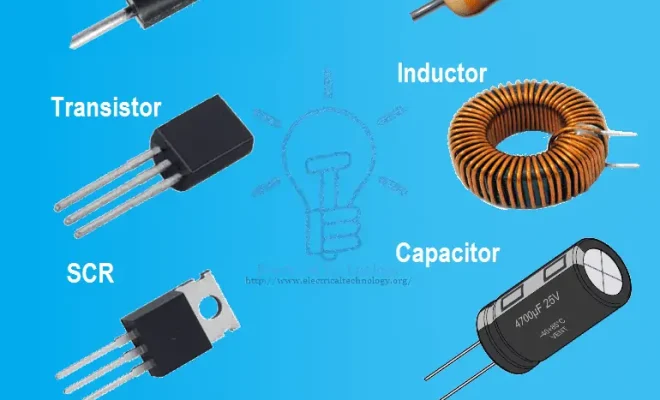
Passive components are categorized into two major classes: capacitors, inductors, and resistors. They are further subcategorized based on their specific electrical characteristics and usage. Some examples of passive components include resistors, capacitors, inductors, transformers, and diodes.

Resistance, capacitance, and inductance are the three fundamental electrical properties that every passive component must exhibit. Resistors resist or impede the flow of electricity in a circuit, which is determined by the component’s resistance value, measured in ohms. Capacitors store and release electrical energy, while inductors store energy in a magnetic field.

Passive components are widely used in various electronic devices and systems. For instance, resistors are used in signal processing circuits to limit current flow and prevent damage to sensitive components. Capacitors, on the other hand, are used to filter out unwanted signals and stabilize voltage in power supplies, among other applications. Inductors are used in transformers, which convert AC voltage to DC, as well as in power supplies to filter out high-frequency noise.

Passive components come in different sizes, shapes, and forms, including surface-mounted devices, through-hole components, and chip resistors. The choice of component depends on the specific application and design requirements of the electronic circuit.

In summary, passive components form an integral part of electronic circuits, providing the necessary functions of energy storage, distribution, and control. Their use is essential to ensuring the reliable and efficient operation of electronic devices and systems.


Previous Article

What Is Patch Tuesday for Windows, and ...

Next Article

What is Out-of-Band Management?

Matthew Lynch

Related articles More from author

  • Assistive Technology

    How to Translate a PDF File Into Any Language

    June 10, 2023
    By Matthew Lynch
  • Assistive Technology

    How to Connect Google Home to Your TV

    June 15, 2023
    By Matthew Lynch
  • Assistive Technology

    Learn to Easily Recover a Forgotten AOL Mail Password

    June 8, 2023
    By Matthew Lynch
  • Assistive Technology

    How to Restore Tabs in Chrome

    June 8, 2023
    By Matthew Lynch
  • Assistive Technology

    How to Start a YouTube Channel without a Proper Camera

    June 5, 2023
    By Matthew Lynch
  • Assistive Technology

    Tips for Making Your Photos Look Vintage

    June 6, 2023
    By Matthew Lynch

Search

Login & Registration

  • Log in
  • Entries feed
  • Comments feed
  • WordPress.org

Newsletter

Signup for The Tech Edvocate Newsletter and have the latest in EdTech news and opinion delivered to your email address!

About Us

Since technology is not going anywhere and does more good than harm, adapting is the best course of action. That is where The Tech Edvocate comes in. We plan to cover the PreK-12 and Higher Education EdTech sectors and provide our readers with the latest news and opinion on the subject. From time to time, I will invite other voices to weigh in on important issues in EdTech. We hope to provide a well-rounded, multi-faceted look at the past, present, the future of EdTech in the US and internationally.

We started this journey back in June 2016, and we plan to continue it for many more years to come. I hope that you will join us in this discussion of the past, present and future of EdTech and lend your own insight to the issues that are discussed.

Newsletter

Signup for The Tech Edvocate Newsletter and have the latest in EdTech news and opinion delivered to your email address!

Contact Us

The Tech Edvocate
910 Goddin Street
Richmond, VA 23231
(601) 630-5238
[email protected]

Copyright © 2026 Matthew Lynch. All rights reserved.