The Tech Edvocate

Top Menu

  • Advertisement
  • Apps
  • Home Page
  • Home Page Five (No Sidebar)
  • Home Page Four
  • Home Page Three
  • Home Page Two
  • Home Tech2
  • Icons [No Sidebar]
  • Left Sidbear Page
  • Lynch Educational Consulting
  • My Account
  • My Speaking Page
  • Newsletter Sign Up Confirmation
  • Newsletter Unsubscription
  • Our Brands
  • Page Example
  • Privacy Policy
  • Protected Content
  • Register
  • Request a Product Review
  • Shop
  • Shortcodes Examples
  • Signup
  • Start Here
    • Governance
    • Careers
    • Contact Us
  • Terms and Conditions
  • The Edvocate
  • The Tech Edvocate Product Guide
  • Topics
  • Write For Us
  • Advertise

Main Menu

  • Start Here
    • Our Brands
    • Governance
      • Lynch Educational Consulting, LLC.
      • Dr. Lynch’s Personal Website
      • Careers
    • Write For Us
    • The Tech Edvocate Product Guide
    • Contact Us
    • Books
    • Edupedia
    • Post a Job
    • The Edvocate Podcast
    • Terms and Conditions
    • Privacy Policy
  • Topics
    • Assistive Technology
    • Child Development Tech
    • Early Childhood & K-12 EdTech
    • EdTech Futures
    • EdTech News
    • EdTech Policy & Reform
    • EdTech Startups & Businesses
    • Higher Education EdTech
    • Online Learning & eLearning
    • Parent & Family Tech
    • Personalized Learning
    • Product Reviews
  • Advertise
  • Tech Edvocate Awards
  • The Edvocate
  • Pedagogue
  • School Ratings

logo

The Tech Edvocate

  • Start Here
    • Our Brands
    • Governance
      • Lynch Educational Consulting, LLC.
      • Dr. Lynch’s Personal Website
        • My Speaking Page
      • Careers
    • Write For Us
    • The Tech Edvocate Product Guide
    • Contact Us
    • Books
    • Edupedia
    • Post a Job
    • The Edvocate Podcast
    • Terms and Conditions
    • Privacy Policy
  • Topics
    • Assistive Technology
    • Child Development Tech
    • Early Childhood & K-12 EdTech
    • EdTech Futures
    • EdTech News
    • EdTech Policy & Reform
    • EdTech Startups & Businesses
    • Higher Education EdTech
    • Online Learning & eLearning
    • Parent & Family Tech
    • Personalized Learning
    • Product Reviews
  • Advertise
  • Tech Edvocate Awards
  • The Edvocate
  • Pedagogue
  • School Ratings
  • The Hidden Cost of EVs: Why Your Battery Could Cost More Than Your Car in 2026

  • Jensen Huang’s Shock Exit: This Unbelievable Scandal Just Rocked Nvidia and the AI World

  • Big Walk developer House House Confirms ‘Sparing’ Use of Gen AI – Press Start

  • Baffling: How a Cyber Breach at South Korea’s Top Security Watchdog Exposed Millions

  • Wenn Ordnung den Bildschirm beruhigt: Warum klare Abläufe Casino-Unterhaltung einladender machen

  • Reddit AI Reviews: The Quiet Reshaping of Online Opinion

  • The Chilling Truth: Iran Cyberattacks Europe’s Food and Blood Supplies

  • Anthropic’s $3.4 Billion Bet on Gas: The Unseen Cost of AI’s Future

  • Tribit FlyBuds C3 Earbuds: Premium Features at a Budget-Friendly Price

  • Is AuraCam Pro’s Emotional AI a Privacy Nightmare or Security Breakthrough?

Digital & Mobile Technology
Home›Digital & Mobile Technology›What is Out of Band?

What is Out of Band?
By Matthew Lynch
May 25, 2023
0
Spread the love

In the context of computer networking, Out of Band (OOB) refers to a communication channel or mechanism that is independent of the primary communication channel. The primary channel is normally the one used for the transmission of data between devices or systems. The out of band mechanism provides an alternative route for accessing and managing devices and network infrastructure.

In modern computer networks, OOB management has become essential for efficient and effective management and operation of the entire network. This approach provides a layer of abstraction between the primary communication channel and the management plane, which is used to monitor and control the network.

The primary use of OOB is to provide a separate and isolated environment that enables the network administrators to perform critical operations and troubleshoot common problems without interfering with regular network traffic. This approach ensures that network management functions are not hindered, delayed, or impacted by high levels of network traffic, data transfers, or other network activity.

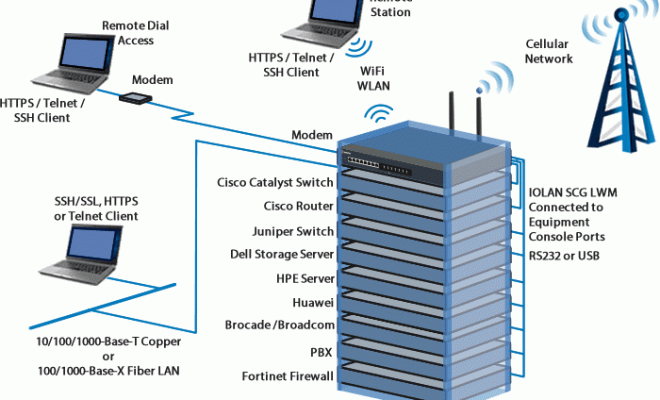
OOB communication mechanisms can take different forms, including dedicated management ports, serial connections, remote console access, and even wireless networks. These mechanisms provide an alternative path for accessing and managing network devices, switches, routers, servers, and storage devices.

One of the major benefits of OOB management is the increased security and resilience of the network. Since the out of band channel is isolated and independent, it is less vulnerable to attacks and malicious activities that may target the primary communication channel. For instance, a hacker who gains access to the primary channel may not be able to interact with the management plane through the OOB channel, which enhances the network’s overall security posture.

Another advantage of OOB management is faster problem resolution. Since network administrators can access the network devices and infrastructure independently of the primary communication channel, they can quickly and efficiently troubleshoot issues and perform maintenance tasks, reducing downtime and minimizing network disruptions.

In conclusion, Out of Band (OOB) is a communication mechanism used in modern computer networks to provide an alternative path for accessing and managing network infrastructure. OOB management enhances network security, resilience, and efficiency, and is critical for efficient network operation. By providing a separate and isolated environment from the primary communication channel, OOB management enables faster problem resolution, enhances network security, and promotes optimal network performance.


Previous Article

What is OSS Notes?

Next Article

What is Organic Search Engine Optimization (Organic ...

Matthew Lynch

Related articles More from author

  • Digital & Mobile Technology

    History of the iPod: From the First iPod to the iPod Classic

    June 6, 2023
    By Matthew Lynch
  • Digital & Mobile Technology

    Network Interface Cards (NICs) Explained

    June 6, 2023
    By Matthew Lynch
  • Digital & Mobile Technology

    Apps to Identify a Song by Humming, Tapping on Keyboard, or Asking Others

    June 13, 2023
    By Matthew Lynch
  • Digital & Mobile Technology

    What is Cloud File Sharing?

    May 5, 2023
    By Matthew Lynch
  • Digital & Mobile Technology

    What Is Unified Memory and How Much Do You Need?

    June 22, 2023
    By Matthew Lynch
  • Digital & Mobile Technology

    What is Windows Vista?

    May 15, 2023
    By Matthew Lynch

Search

Login & Registration

  • Log in
  • Entries feed
  • Comments feed
  • WordPress.org

Newsletter

Signup for The Tech Edvocate Newsletter and have the latest in EdTech news and opinion delivered to your email address!

About Us

Since technology is not going anywhere and does more good than harm, adapting is the best course of action. That is where The Tech Edvocate comes in. We plan to cover the PreK-12 and Higher Education EdTech sectors and provide our readers with the latest news and opinion on the subject. From time to time, I will invite other voices to weigh in on important issues in EdTech. We hope to provide a well-rounded, multi-faceted look at the past, present, the future of EdTech in the US and internationally.

We started this journey back in June 2016, and we plan to continue it for many more years to come. I hope that you will join us in this discussion of the past, present and future of EdTech and lend your own insight to the issues that are discussed.

Newsletter

Signup for The Tech Edvocate Newsletter and have the latest in EdTech news and opinion delivered to your email address!

Contact Us

The Tech Edvocate
910 Goddin Street
Richmond, VA 23231
(601) 630-5238
[email protected]

Copyright © 2026 Matthew Lynch. All rights reserved.