The Tech Edvocate

Top Menu

  • Advertisement
  • Apps
  • Home Page
  • Home Page Five (No Sidebar)
  • Home Page Four
  • Home Page Three
  • Home Page Two
  • Home Tech2
  • Icons [No Sidebar]
  • Left Sidbear Page
  • Lynch Educational Consulting
  • My Account
  • My Speaking Page
  • Newsletter Sign Up Confirmation
  • Newsletter Unsubscription
  • Our Brands
  • Page Example
  • Privacy Policy
  • Protected Content
  • Register
  • Request a Product Review
  • Shop
  • Shortcodes Examples
  • Signup
  • Start Here
    • Governance
    • Careers
    • Contact Us
  • Terms and Conditions
  • The Edvocate
  • The Tech Edvocate Product Guide
  • Topics
  • Write For Us
  • Advertise

Main Menu

  • Start Here
    • Our Brands
    • Governance
      • Lynch Educational Consulting, LLC.
      • Dr. Lynch’s Personal Website
      • Careers
    • Write For Us
    • The Tech Edvocate Product Guide
    • Contact Us
    • Books
    • Edupedia
    • Post a Job
    • The Edvocate Podcast
    • Terms and Conditions
    • Privacy Policy
  • Topics
    • Assistive Technology
    • Child Development Tech
    • Early Childhood & K-12 EdTech
    • EdTech Futures
    • EdTech News
    • EdTech Policy & Reform
    • EdTech Startups & Businesses
    • Higher Education EdTech
    • Online Learning & eLearning
    • Parent & Family Tech
    • Personalized Learning
    • Product Reviews
  • Advertise
  • Tech Edvocate Awards
  • The Edvocate
  • Pedagogue
  • School Ratings

logo

The Tech Edvocate

  • Start Here
    • Our Brands
    • Governance
      • Lynch Educational Consulting, LLC.
      • Dr. Lynch’s Personal Website
        • My Speaking Page
      • Careers
    • Write For Us
    • The Tech Edvocate Product Guide
    • Contact Us
    • Books
    • Edupedia
    • Post a Job
    • The Edvocate Podcast
    • Terms and Conditions
    • Privacy Policy
  • Topics
    • Assistive Technology
    • Child Development Tech
    • Early Childhood & K-12 EdTech
    • EdTech Futures
    • EdTech News
    • EdTech Policy & Reform
    • EdTech Startups & Businesses
    • Higher Education EdTech
    • Online Learning & eLearning
    • Parent & Family Tech
    • Personalized Learning
    • Product Reviews
  • Advertise
  • Tech Edvocate Awards
  • The Edvocate
  • Pedagogue
  • School Ratings
  • JisuLife Ultra2 Portable Fan: A Powerful Multi-Function Cooling Solution

  • A Visitors Guide to Viña del Mar, Chile

  • A Visitors Guide to Århus, Denmark

  • A Visitors Guide to Bakersfield (CA), United States

  • A Visitors Guide to Aurora (CO), United States

  • A Visitor’s Guide to Toledo (OH), United States

  • A Visitors Guide to Cincinnati (OH), United States

  • The MagicEagle Cam 5: Revolutionizing Wildlife Monitoring with Smart 4G Technology

  • A Visitors Guide to Pittsburgh (PA), United States

  • A Visitors Guide to Colorado Springs (CO), United States

Digital & Mobile Technology
Home›Digital & Mobile Technology›What Is GSM in Cellular Networking?

What Is GSM in Cellular Networking?
By Matthew Lynch
May 31, 2023
0
Spread the love

GSM, or Global System for Mobile Communications, is a standard and network technology used primarily in cellular networking. It was first introduced in 1987 and has since been implemented worldwide, becoming one of the most popular cellular network technologies.

So, what is GSM? GSM is a digital cellular network technology that uses a combination of time division multiple access (TDMA) and frequency division multiple access (FDMA) to provide voice and data services to mobile devices. TDMA allows multiple users to share the same frequency channel by dividing the channel into time slots, while FDMA divides the frequency channel into sub-bands allowing more users to simultaneously use the network.

GSM has a number of advantages over other cellular network technologies. For one, it is highly efficient in terms of spectrum usage. This means that it can handle a large number of users without requiring too much radio spectrum. Additionally, GSM also provides a high level of security, thanks to its algorithms for encrypting voice and data transmissions.

Another advantage of GSM is that it is highly interoperable. Devices that use GSM can be used anywhere in the world, as long as they are compatible with the local carriers. This makes it easy for people to travel with their mobile devices and continue using them in different locations.

GSM also paved the way for the development of newer technologies, such as 3G and 4G LTE. These technologies build on the foundation laid by GSM, while also improving on some of its limitations, such as limited data speeds and coverage.

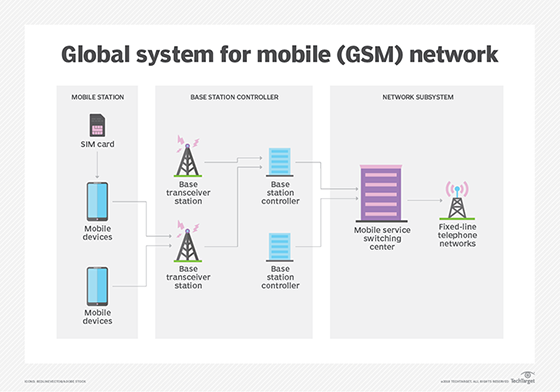
In terms of coverage, GSM networks are typically divided into cells, with each cell consisting of a base station and a set of mobile devices that can communicate with that base station. By dividing the network into cells, the coverage area can be greatly increased while reducing the number of base stations required, making it a more cost-effective solution.

Overall, GSM is a highly effective and reliable cellular network technology that has been used by billions of people over the years. While newer technologies have surpassed it in terms of data speeds and some other features, GSM remains a popular and widely used standard for mobile communication. Its legacy can be seen in the way it paved the way for the development of newer technologies, and it continues to play an important role in the world of mobile communication.


Previous Article

How to Fix It When a PS4 ...

Next Article

How to Fix a 401 Unauthorized Error

Matthew Lynch

Related articles More from author

  • Digital & Mobile Technology

    How to Fix an iPhone Calendar Not Syncing With Outlook

    June 1, 2023
    By Matthew Lynch
  • Digital & Mobile Technology

    How to Rotate and Flip Your Computer Screen

    May 5, 2023
    By Matthew Lynch
  • Digital & Mobile Technology

    How to Undelete Voicemails on iPhone

    June 1, 2023
    By Matthew Lynch
  • Digital & Mobile Technology

    Save Up to $675 on Top Tech at Dell With These Year-End Deals

    January 31, 2024
    By Matthew Lynch
  • Digital & Mobile Technology

    5G Spectrum and Frequencies: Everything You Need to Know

    July 31, 2023
    By Matthew Lynch
  • Digital & Mobile Technology

    What is a LaserJet?

    April 18, 2023
    By Matthew Lynch

Search

Login & Registration

  • Register
  • Log in
  • Entries feed
  • Comments feed
  • WordPress.org

Newsletter

Signup for The Tech Edvocate Newsletter and have the latest in EdTech news and opinion delivered to your email address!

About Us

Since technology is not going anywhere and does more good than harm, adapting is the best course of action. That is where The Tech Edvocate comes in. We plan to cover the PreK-12 and Higher Education EdTech sectors and provide our readers with the latest news and opinion on the subject. From time to time, I will invite other voices to weigh in on important issues in EdTech. We hope to provide a well-rounded, multi-faceted look at the past, present, the future of EdTech in the US and internationally.

We started this journey back in June 2016, and we plan to continue it for many more years to come. I hope that you will join us in this discussion of the past, present and future of EdTech and lend your own insight to the issues that are discussed.

Newsletter

Signup for The Tech Edvocate Newsletter and have the latest in EdTech news and opinion delivered to your email address!

Contact Us

The Tech Edvocate
910 Goddin Street
Richmond, VA 23231
(601) 630-5238
[email protected]

Copyright © 2025 Matthew Lynch. All rights reserved.