UNM Astronomers Uncover TOI-201: A Unique Multi-Planet System
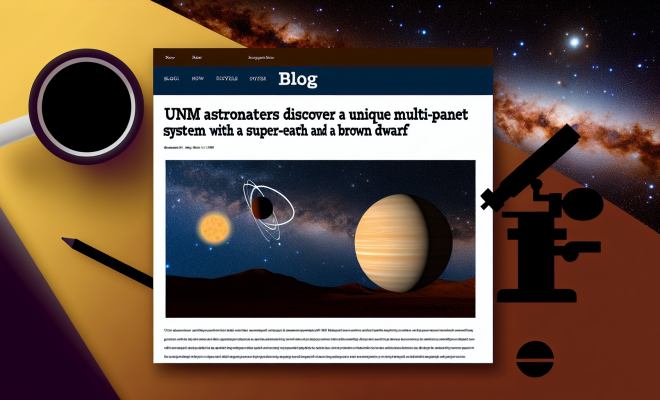
A team of astronomers at the University of New Mexico (UNM) has made a significant contribution to the field of exoplanet research by unveiling a dynamic multi-planet system known as TOI-201. This discovery, which includes a super-Earth, a warm Jupiter, and a brown dwarf, sheds light on the complexities of planetary systems beyond our own and the gravitational interactions that govern them.
Exploring TOI-201: A Closer Look
The TOI-201 system has captured the attention of astronomers due to its diverse array of celestial bodies. The system hosts three main components:
- TOI-201 d: A super-Earth approximately 1.4 times the size of Earth and possessing around six times its mass. This intriguing planet completes an orbit around its star every 5.85 days.
- TOI-201 b: A warm Jupiter that adds to the system’s diversity.
- TOI-201 c: A brown dwarf, which is the most massive body in the TOI-201 system and has a highly elliptical orbit lasting about eight years.
The Role of the Brown Dwarf
Among the three bodies, TOI-201 c, the brown dwarf, plays a crucial role in the dynamics of the system. The brown dwarf’s significant mass and gravitational influence are responsible for driving much of the system’s behavior. This gravitational pull affects the orbits of the other two bodies, providing a compelling glimpse into the complex interactions that can occur in multi-planet systems.
The Longest-Period Transiting Object
One of the most remarkable aspects of TOI-201 c is that it is the longest-period transiting object ever discovered. Transiting objects are those that pass in front of their host star from our perspective, causing a temporary dimming of the star’s light. The next predicted transit of TOI-201 c is set to occur on March 26, 2031, making it a significant event for astronomers and enthusiasts alike, as it offers an opportunity to observe the effects of the brown dwarf’s gravity on the surrounding planets.
Research and Methodology
The research team at UNM utilized a combination of observational data and modeling to confirm the existence and characteristics of the TOI-201 system. Their work involved analyzing data from NASA’s Transiting Exoplanet Survey Satellite (TESS) and other observational tools to track the orbits and interactions of the three bodies in the system.
By employing sophisticated modeling techniques, the astronomers were able to predict the future behavior of the system, including the timing of the next transit of TOI-201 c. This predictive capability is essential for planning future observations and enhancing our understanding of multi-planet systems.
Implications for Exoplanet Research
The discovery of TOI-201 and its unique features has several implications for the field of exoplanet research. First and foremost, it highlights the diversity of planetary systems beyond our own. The presence of both a super-Earth and a brown dwarf in close proximity challenges existing theories about planet formation and migration.
Additionally, the dynamics of TOI-201 provide insights into the gravitational interactions that can occur in systems with multiple bodies. Understanding these interactions is crucial for developing more accurate models of planetary system evolution.
The Future of Exoplanet Studies
As astronomers continue to explore systems like TOI-201, the potential for new discoveries remains vast. Future observations, particularly of the upcoming transit of TOI-201 c, will likely yield valuable data that could further enhance our understanding of these distant worlds.
Moreover, advancements in telescopic technology and observational techniques are expected to facilitate the discovery of even more complex systems. With each new finding, the picture of how planets form and interact becomes clearer, offering new perspectives on the evolution of the universe.
Conclusion
The UNM astronomers’ research on the TOI-201 multi-planet system not only enriches our understanding of exoplanet systems but also sets the stage for future inquiries into the cosmos. As we anticipate the next transit of TOI-201 c in 2031, the scientific community remains eager to unravel the mysteries of this dynamic system and explore the implications it holds for our understanding of the universe.