NASA Confirms Two Asteroids to Safely Pass Earth in 2026
Introduction
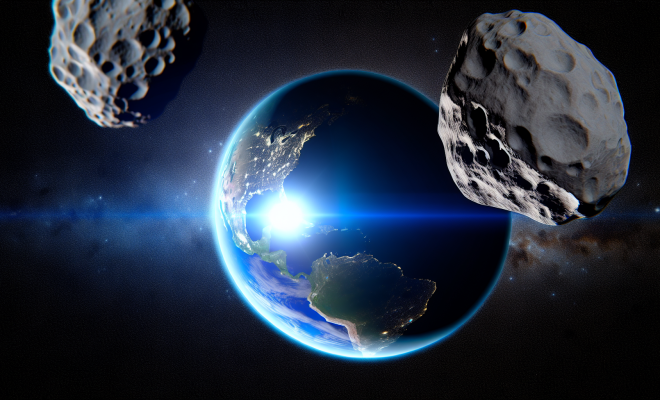
In an exciting development for astronomers and space enthusiasts alike, NASA has confirmed that two significant near-Earth asteroids will make their approach to our planet on April 2, 2026. These celestial bodies, designated as 2026 FD4 and 2026 FQ8, are being closely monitored for their trajectory and speed as they zip past Earth. While both asteroids will safely clear our planet, their close approach highlights the importance of ongoing monitoring of near-Earth objects (NEOs).
Details of the Asteroids
The first asteroid, 2026 FD4, measures approximately 31 feet (9.5 meters) in diameter, making it comparable in size to a large bus. This relatively smaller object will pass at a distance of about 1,890,000 miles (3,045,000 kilometers) from Earth, which is a significant distance in astronomical terms, equating to roughly seven times the distance between the Earth and the Moon.
The second asteroid, 2026 FQ8, is notably larger, although specific measurements of its size have not been disclosed. However, it is classified as a potentially hazardous object due to its trajectory and size. Both asteroids will pass well beyond the orbit of the Moon, ensuring that they pose no threat to Earth.
NASA’s Monitoring Efforts
The close approach of these asteroids has prompted NASA and various astronomical organizations to ramp up their observational efforts. Using a variety of telescopes and radar facilities, scientists are gathering data to better understand the characteristics and composition of these celestial bodies.
- Asteroid 2026 FD4: 31 feet (9.5 meters) in diameter
- Distance from Earth: 1,890,000 miles (3,045,000 kilometers)
- Size comparison: Similar to a large bus
- Asteroid 2026 FQ8: Size not specified, but classified as potentially hazardous
- Distance from Earth: Well beyond the Moon’s orbit
The Importance of Monitoring Near-Earth Objects
The monitoring of near-Earth objects is critical for planetary defense. Even though both asteroids are not on a collision course with our planet, they provide valuable opportunities for research into their anatomy, structure, and potential impact on Earth in the future.
NASA’s Near-Earth Object Observations (NEOO) program plays a crucial role in identifying and tracking these celestial bodies. By studying asteroids like 2026 FD4 and 2026 FQ8, scientists can enhance their understanding of the origins of our solar system and the potential threats posed by larger asteroids.
Future Implications
As technology advances, our ability to detect and track asteroids has improved significantly. The close approaches of asteroids like 2026 FD4 and 2026 FQ8 serve as a reminder of the ongoing need for vigilance in monitoring the sky.
In addition to enhancing our knowledge of asteroids, these encounters can help scientists develop better methods for planetary defense. If an asteroid were ever found to be on a collision course with Earth, timely detection and tracking would be essential for devising potential mitigation strategies.
Public Interest and Awareness
The public’s fascination with asteroids and space exploration continues to grow, fueled by media coverage and educational initiatives. Events like the close approaches of 2026 FD4 and 2026 FQ8 provide an opportunity for educational outreach, encouraging interest in science, technology, engineering, and mathematics (STEM) fields.
NASA and various educational organizations often hold public events, webinars, and discussions to engage the community and share knowledge about these celestial events. By informing the public about the nature of asteroids and the importance of monitoring them, we can foster a greater appreciation for our place in the universe.
Conclusion
As two massive asteroids make their way past Earth on April 2, 2026, the event serves both as a reminder of the dynamic nature of our solar system and as an opportunity for scientific research. With NASA’s vigilant monitoring efforts, we can ensure that any potential threats are identified well in advance, allowing for appropriate measures to be taken. The study of asteroids not only enriches our understanding of space but also enhances our ability to protect our planet in the face of cosmic challenges.