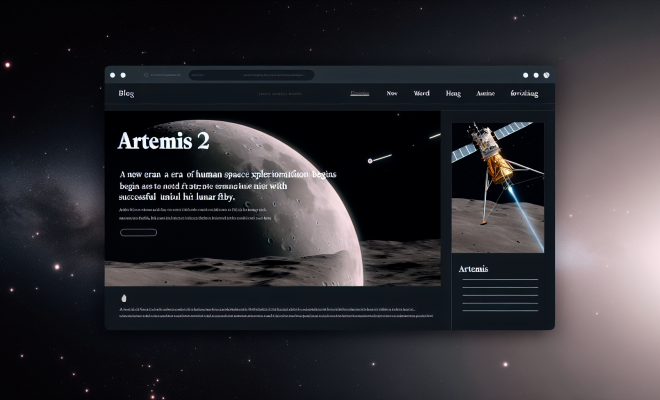
Artemis 2: Historic Lunar Flyby Ignites New Space Era in 2026
On April 1, 2026, at 6:24 p.m. EDT, NASA marked a historic milestone in space exploration with the launch of the Artemis 2 mission. This mission is particularly noteworthy as it represents the first crewed lunar flyby since the Apollo program concluded in 1972. The Orion capsule, carrying a crew of four astronauts, embarked on a ten-day journey around the Moon, setting the stage for future lunar exploration and potential missions to Mars.
The Launch: A Moment of Anticipation
The atmosphere at Kennedy Space Center was electric as the countdown to launch approached. NASA had been preparing for this moment for years, and as the clock ticked down, the excitement among the team and spectators was palpable. The weather conditions improved significantly, reaching a 90% likelihood of favorable launch conditions just hours before liftoff. This was a crucial factor, as weather had previously posed challenges leading up to the launch date.
Key Maneuvers: Successfully Raising the Apogee
Following its successful launch, the Orion capsule performed a series of critical maneuvers. One of the most significant was an 18-minute burn that raised its apogee to an impressive 43,730 miles above Earth. This maneuver is essential for setting the spacecraft on its trajectory towards the Moon, allowing it to orbit our natural satellite effectively.
Moreover, the mission faced an unexpected challenge early on when the crew encountered a battery temperature issue. However, the team adeptly managed this instrumentation glitch, showcasing the astronauts’ training and the mission control team’s expertise. This incident highlights the complexities and unpredictabilities of space travel, even on well-prepared missions.
A Diverse Crew Ready for the Challenge
The crew of Artemis 2 is composed of four highly trained astronauts, each bringing unique skills and experiences to the mission:
- Commander – The mission’s leader, responsible for overall mission success and the safety of the crew.
- Pilot – Assists the commander and handles spacecraft systems during critical phases of flight.
- Mission Specialist – Focuses on specific mission objectives, including scientific experiments and operations.
- Payload Specialist – Oversees the experiments and equipment carried aboard Orion, ensuring they function as intended.
This diverse crew not only represents a mix of skills but also highlights NASA’s commitment to inclusivity and representation in space exploration.
What Lies Ahead: Goals of Artemis 2
The Artemis 2 mission is not merely a test flight; it serves as a stepping stone for NASA’s broader goals in lunar exploration and beyond. The mission aims to:
- Evaluate the performance of the Orion spacecraft in a crewed environment.
- Test life support systems and crew safety protocols during extended missions.
- Prepare for future Artemis missions, including Artemis 3, which aims to land astronauts on the lunar South Pole.
- Gather data that will inform future deep space missions, including potential manned missions to Mars.
Each of these objectives is crucial for ensuring the safety and success of astronauts as they venture into deeper space.
The Importance of the Artemis Program
The Artemis program signifies a renewed commitment by NASA to explore the Moon and prepare for human exploration of Mars. The missions are designed to establish a sustainable human presence on the Moon, which is viewed as a critical step towards understanding how to sustain human life on other planets.
Moreover, the Artemis missions aim to inspire a new generation of scientists, engineers, and explorers. By returning humans to the lunar surface and eventually to Mars, NASA seeks to ignite interest in STEM (Science, Technology, Engineering, and Mathematics) fields, encouraging young minds to pursue careers in these areas.
Looking Beyond: The Future of Space Exploration
The successful launch of Artemis 2 is just the beginning of an exciting era in space exploration. As the mission progresses, the data gathered and the experiences shared by the crew will provide invaluable insights into the challenges of deep space exploration.
NASA’s vision extends beyond the Moon, with plans for future missions that may include establishing permanent lunar habitats and eventually sending humans to Mars. The Artemis program is a testament to human ingenuity and the relentless pursuit of knowledge, paving the way for future generations to explore the cosmos.
As the world watches the Artemis 2 mission unfold, it is clear that humanity’s quest for space exploration is far from over. With each mission, we are one step closer to unraveling the mysteries of the universe and expanding our presence beyond Earth.