This Company Just Raised $20 Million to Kickstart Asteroid Mining
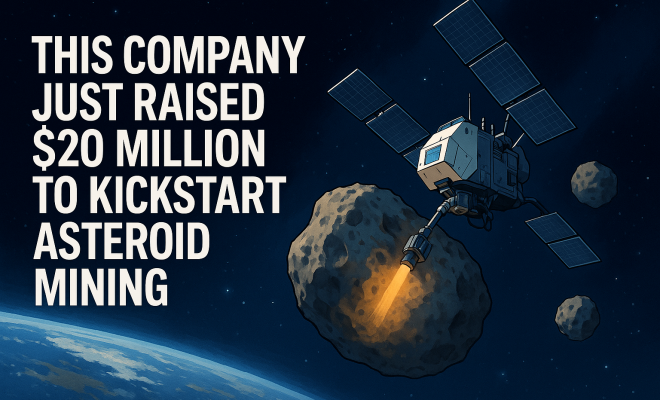
Imagine a future where the rarest, most valuable elements aren’t dug from the scarred landscapes of Earth, but plucked from the cold, silent expanse between planets. It sounds like science fiction, doesn’t it? Yet, the once-distant dream of asteroid mining is rapidly transforming into a tangible, multi-billion-dollar industry, attracting serious capital and some of the brightest minds on the planet. We’re on the cusp of a new resource frontier, one that promises to redefine global economics and power humanity’s expansion into the cosmos.
The latest jolt to this burgeoning sector comes from a company called Karman+, which recently secured a significant $20 million in seed funding. This isn’t just a handful of enthusiasts tinkering in a garage; this is serious money backing a serious venture. Their goal? To develop and demonstrate the technology needed to extract valuable resources from near-Earth asteroids, with an ambitious timeline to start supplying the burgeoning space economy by 2027. It’s an aggressive target, but one that underscores the palpable excitement and perceived urgency driving the modern space industry. This isn’t just about ‘what if,’ it’s about ‘when,’ and the ‘when’ is looking a lot closer than many of us ever imagined.
The New Gold Rush: Why Asteroid Mining is Attracting Serious Investors
To understand why investors are pouring millions into ventures like Karman+, you need to look beyond the immediate thrill of space exploration and focus on the cold, hard economics. Our planet’s resources, particularly rare earth elements and platinum group metals (PGMs), are finite and increasingly difficult to access. These aren’t just obscure industrial components; they’re the bedrock of modern technology, essential for everything from your smartphone and electric vehicle batteries to advanced aerospace components and medical devices. Terrestrial supply chains for these critical materials are often fragile, geographically concentrated, and politically fraught.
Enter asteroids. These celestial wanderers are believed to be veritable treasure troves, remnants from the early solar system that harbor vast quantities of these exact elements. We’re talking about potential reserves that could be worth trillions of dollars. Imagine a single asteroid containing more platinum than has ever been mined on Earth. That’s the kind of potential we’re discussing, and it’s a prospect that’s hard for any forward-thinking investor to ignore. The narrative isn’t just about space; it’s about securing the future of our technological civilization, diversifying supply chains, and potentially ushering in an era of unprecedented material abundance. This builds on Spacex IPO insights.
This isn’t just speculative fantasy. Market analysts are taking notice. The global space mining market, for instance, was valued at a respectable $2.6 billion in 2025 – which, let’s be honest, is already a significant figure for an industry still largely in its infancy. But the projections are truly eye-opening: experts predict this market could skyrocket to $10 billion by 2034. That’s a nearly four-fold increase in less than a decade, indicating a rapid acceleration of investment, technological development, and operational capability. North America, with its robust private space sector and deep-pocketed venture capitalists, is currently leading this charge, positioning itself at the forefront of this extraterrestrial resource acquisition.
Karman+’s Ambitious Vision and Technology Roadmap
Karman+’s recent $20 million seed funding round in February 2025 isn’t just a headline; it’s a concrete step towards making asteroid mining a reality. This capital is earmarked for a critical phase: the development of their first technology demonstration mission. Think of this as the initial proving ground, a crucial step before full-scale operations can even be considered. They’re not going to be hauling back tons of platinum on this first outing, but they will be testing the fundamental technologies and methodologies necessary for future missions.
The company’s stated goal to begin supplying the space economy by 2027 is incredibly ambitious, but it also provides a clear, near-term objective. What does ‘supplying the space economy’ actually mean in this context? Initially, it might not be about bringing rare earth elements back to Earth. Instead, it could involve extracting water ice from asteroids, which can then be processed into rocket propellant (hydrogen and oxygen). This ‘in-situ resource utilization’ (ISRU) is a cornerstone of sustainable space exploration. Imagine refueling missions directly from an orbiting gas station made of asteroid water! This dramatically reduces the cost and complexity of deep-space missions, making everything from lunar bases to Mars expeditions far more feasible. It’s a stepping stone, a way to build out the infrastructure in space using resources found in space, before tackling the more complex challenge of terrestrial markets. (See: Asteroid mining overview on Wikipedia.)
The Role of In-Situ Resource Utilization (ISRU) in Asteroid Mining
When we talk about asteroid mining, it’s easy to immediately jump to visions of precious metals being shipped back to Earth. While that’s certainly a long-term goal, the immediate, and perhaps most impactful, application lies in ISRU. Water ice, a surprisingly common component of certain asteroid types (C-type asteroids, for instance), is an incredibly versatile resource in space. It’s not just for drinking; it’s a fundamental building block.
By extracting water, we can produce breathable air for habitats, shielding against radiation, and, crucially, rocket fuel. This capacity to ‘live off the land’ in space changes the entire calculus of space exploration. Instead of launching every single kilogram of propellant and life support from Earth – an incredibly expensive endeavor – we can source it locally. This dramatically lowers the ‘tyranny of the rocket equation,’ allowing for larger payloads, more frequent missions, and the establishment of permanent outposts beyond Earth orbit. Companies like Karman+ understand that the quickest way to create a self-sustaining space economy is by enabling its inhabitants and vehicles to refuel and resupply themselves without constant reliance on Earth.
The Types of Asteroids and Their Potential Resources
Not all asteroids are created equal, and understanding their classifications is key to appreciating the strategic approach to asteroid mining. Scientists generally categorize asteroids into a few main types, each with its own unique resource profile:
- C-type (Carbonaceous) Asteroids: These are the most common type, making up about 75% of known asteroids. They are rich in carbon, but more importantly for ISRU, they often contain significant amounts of water and other volatile compounds. They’re like cosmic sponges, holding the key to cheap rocket fuel and life support for future space settlements.
- S-type (Stony) Asteroids: Comprising about 17% of the asteroid population, S-types are primarily composed of silicates and nickel-iron. These are the ones that might eventually yield valuable structural materials and some metals, though perhaps not the rare earth elements or PGMs in the quantities found elsewhere.
- M-type (Metallic) Asteroids: These are the true prize for precious metal hunters. M-type asteroids are rare, but they are thought to be remnants of the metallic cores of protoplanets that were shattered by collisions. They are incredibly rich in nickel, iron, cobalt, and, most excitingly, platinum group metals (PGMs) like platinum, palladium, rhodium, ruthenium, iridium, and osmium. These are the elements driving the ‘trillions of dollars’ valuation you often hear about.
The initial focus for companies like Karman+ will likely be on C-type asteroids for water, as this is the most immediate and impactful resource for building out space infrastructure. However, the long-term vision undoubtedly includes M-type asteroids, whose metallic riches could fundamentally alter terrestrial markets and create unprecedented wealth.
Challenges and Hurdles on the Path to Commercial Asteroid Mining
While the potential for asteroid mining is immense, the path isn’t paved with stardust and easy victories. There are significant challenges that must be overcome, both technological and economic. First and foremost is the sheer technical complexity. We’re talking about developing autonomous or semi-autonomous robots capable of traveling millions of miles, rendezvousing with an asteroid, anchoring to it (a non-trivial task on a rotating, low-gravity body), and then extracting material. This isn’t digging a hole; it’s precision engineering in an unforgiving vacuum, often with significant communication delays back to Earth.
Then there’s the question of processing. How do you refine raw asteroid material into usable components or pure elements in space? Developing compact, energy-efficient processing plants that can operate autonomously is a monumental task. The materials mined will also need to be transported, either to orbital depots, lunar outposts, or eventually, back to Earth. Each step introduces new layers of engineering and logistical complexity that need to be addressed before asteroid mining can move beyond demonstration missions to truly commercial endeavors.
Cost is another enormous hurdle. Launching anything into space is incredibly expensive, and while reusable rockets are helping, the initial investment for these missions is still substantial. Karman+’s $20 million is a great start for a seed round, but full-scale mining operations will require orders of magnitude more capital. Furthermore, establishing clear legal frameworks for ownership and extraction of extraterrestrial resources is crucial. Who owns an asteroid? What happens if two companies target the same one? These are questions that international law is only just beginning to grapple with, and they need clear answers to provide stability for investors and operators.
The Geopolitical and Economic Impact of Extraterrestrial Resources
The prospect of asteroid mining isn’t just about new materials; it’s about a fundamental shift in global geopolitics and economics. Imagine a world where critical rare earth elements, currently controlled by a handful of nations, become abundant and accessible from space. This could democratize access to vital resources, reducing geopolitical tensions over terrestrial supply chains and potentially leveling the economic playing field for developing nations that currently lack these resources. (See: NASA's asteroid exploration initiatives.)
On the flip side, it also raises questions about who will control this new wealth. Will it be a handful of powerful corporations or nations that establish early dominance in space mining? The ‘new gold rush’ analogy is apt, not just for the wealth it promises, but for the potential for unregulated competition, resource conflicts, and the rapid accumulation of power. Establishing international treaties and regulatory bodies now, before the industry fully matures, will be critical to ensuring equitable and sustainable development of space resources for the benefit of all humanity, rather than just a select few.
Economically, the influx of asteroid-derived materials could either stabilize or drastically disrupt existing markets. If platinum group metals become abundant, their price on Earth could plummet, impacting terrestrial mining industries and the economies that rely on them. However, the sheer demand for these materials in an increasingly technological world suggests that new supply might simply meet growing needs rather than causing a crash. The ultimate impact will depend on the scale of extraction, the cost of bringing materials to market, and the regulatory environment that governs their distribution.
Legal and Ethical Frameworks for Space Resource Utilization
This brings us to one of the most complex and often overlooked aspects of asteroid mining: the legal and ethical dimensions. Unlike the relatively clear-cut laws governing resource extraction on Earth, space is largely a legal wild west. The 1967 Outer Space Treaty, while a landmark agreement, broadly states that outer space is the ‘province of all mankind’ and prohibits national appropriation of celestial bodies. But it doesn’t explicitly address the commercial extraction and ownership of resources by private entities.
Several nations, including the United States and Luxembourg, have passed domestic laws attempting to clarify the rights of their citizens and companies to extract and own space resources. For example, the U.S. Space Act of 2015 explicitly grants U.S. citizens the right to possess, own, transport, use, and sell asteroid resources. However, these national laws do not constitute international law and are viewed with skepticism by some other nations, who argue they could violate the spirit, if not the letter, of the Outer Space Treaty.
The ethical considerations are equally profound. Do we have a right to exploit celestial bodies? What about potential contamination or damage to pristine environments? While asteroids might seem like sterile rocks, the long-term implications of large-scale industrialization in space need careful consideration. Establishing a robust, internationally recognized legal framework, perhaps through an updated or new treaty, is paramount to ensuring stability, preventing conflict, and fostering responsible development of space resources. Without it, the ‘new gold rush’ could quickly devolve into a chaotic free-for-all.
The Role of Private Investment and Startups in the Space Economy
Karman+’s $20 million funding round is a prime example of a broader trend: the increasing role of private investment and nimble startups in driving the space economy. For decades, space exploration was largely the domain of government agencies like NASA, ESA, and Roscosmos. While these agencies continue to play a vital role, especially in fundamental research and exploration, the commercial sector has exploded, fueled by venture capital and the promise of disruptive technologies. (See: Scientific research on asteroid resource potential.) We covered Investing in the space economy in more detail.
This shift has brought several advantages. Private companies are often more agile, driven by market forces, and can innovate at a faster pace than large bureaucratic organizations. They’re willing to take calculated risks that might be too politically sensitive for government programs. This has led to rapid advancements in areas like reusable rockets, satellite constellations, and now, resource extraction. Investors are looking for the next ‘unicorn,’ and the potential returns from successfully pioneering asteroid mining could be astronomical, making it an attractive, albeit high-risk, proposition.
Beyond asteroid mining, the broader space economy encompasses satellite manufacturing and launch services, space tourism, in-orbit servicing, and Earth observation. Each of these sectors is seeing significant private investment, creating a vibrant ecosystem that supports and is supported by ventures like Karman+. The ability to source materials and fuel in space, for example, will undoubtedly benefit satellite operators and space tourism providers by lowering operational costs and enabling more ambitious missions. It’s a truly symbiotic relationship that’s pushing the boundaries of what’s possible off-world.
The Future of Asteroid Mining: A Long-Term Vision
The vision for asteroid mining extends far beyond securing rare metals for Earth. In the long term, it’s about enabling humanity to become a multi-planetary species. Imagine self-sufficient colonies on the Moon or Mars, built with materials sourced from nearby asteroids and powered by asteroid-derived fuels. This isn’t just about survival; it’s about expansion, about creating new frontiers for human endeavor, innovation, and economic activity.
The resources found in asteroids could be used to construct massive orbital habitats, solar power satellites to beam clean energy back to Earth, or even entirely new industries that operate exclusively in space, free from the constraints of Earth’s gravity and atmosphere. The initial steps of companies like Karman+ might seem small – a demonstration mission here, a few kilograms of extracted water there – but they are foundational. They are laying the groundwork for a future where humanity’s resource base is no longer limited to a single planet, but extends across our solar system. It’s a bold vision, one that demands patience, significant investment, and sustained innovation, but the rewards could be truly transformative.
The journey to fully realize the potential of asteroid mining is still long and fraught with challenges. But the recent influx of private capital, exemplified by Karman+’s impressive funding round, signals a critical turning point. This isn’t just theoretical speculation anymore; it’s a rapidly developing industry with real companies, real money, and real deadlines. As the global space economy continues its meteoric rise, the prospect of tapping into the solar system’s vast wealth of resources is becoming less of a distant dream and more of an inevitable next step for humanity. We’re witnessing the dawn of a new era, one where the riches aren’t just under our feet, but also just beyond our atmosphere, waiting to be claimed.
Trending Now
Frequently Asked Questions
What is asteroid mining?
Asteroid mining is the process of extracting valuable resources such as rare metals and minerals from asteroids. This emerging industry aims to tap into the vast resources available in space, potentially providing a sustainable supply of materials that are becoming increasingly scarce on Earth.
Why is there interest in asteroid mining?
Interest in asteroid mining stems from the finite nature of Earth's resources, particularly rare earth elements and platinum group metals, which are essential for modern technology. As these resources become harder to access, asteroid mining presents a promising alternative to meet global demand.
How much funding has Karman+ raised for asteroid mining?
Karman+ has recently raised $20 million in seed funding to develop technology for extracting resources from near-Earth asteroids. This significant investment highlights the growing confidence in the potential of asteroid mining as a viable industry.
When is asteroid mining expected to start supplying resources?
Karman+ aims to begin supplying resources from asteroid mining by 2027. This ambitious timeline reflects the urgency and excitement surrounding the development of technology needed to make asteroid mining a reality.
What are the implications of asteroid mining for global economics?
Asteroid mining could significantly impact global economics by providing a new source of valuable materials, reducing reliance on terrestrial supply chains, and potentially lowering costs for high-tech industries. This new resource frontier may redefine how we access and utilize essential elements for modern technology.
What did we miss? Let us know in the comments and join the conversation.