The Cosmic Physics Questions That Could Define Our Understanding of the Universe
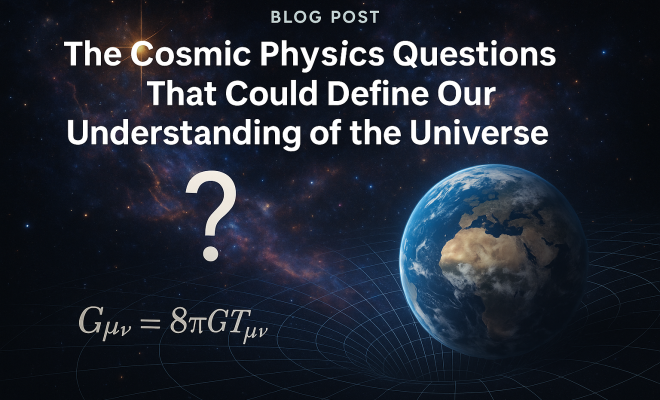
“`html
The universe is a vast, enigmatic frontier that captivates the imagination of scientists and laypeople alike. As we probe deeper into its mysteries, one area of research stands out: cosmic physics. This branch of physics explores the fundamental nature of the universe and its underlying phenomena. With ongoing missions and groundbreaking discoveries constantly reshaping our understanding, it’s an exciting time to delve into the complex questions surrounding cosmic physics.
The Role of NASA’s Physics of the Cosmos Program
At the heart of cosmic physics research is NASA’s Physics of the Cosmos program. This initiative is dedicated to uncovering some of the deepest questions in science, from the characteristics of black holes to the puzzle of dark matter. By employing advanced technologies and innovative scientific methodologies, NASA aims to decode the fundamental processes that govern the cosmos.
The program is part of a comprehensive effort to expand our understanding of astrophysics, which is the branch of astronomy that deals with the physical properties and processes of celestial bodies. Through various missions and research projects, NASA is at the forefront of cosmic physics, addressing pivotal issues that could redefine our grasp on the universe itself.
What Are the Biggest Questions in Cosmic Physics?
Cosmic physics is often intertwined with profound questions that have puzzled humanity for centuries. Here are some of the most pressing inquiries:
- What is the nature of dark matter? Despite comprising about 27% of the universe, dark matter remains one of the most elusive subjects in cosmic physics. Its presence is inferred from gravitational effects on visible matter, but its composition is still unknown.
- How do black holes form and evolve? Black holes challenge our understanding of physics, particularly regarding how they warp space and time. Understanding their formation, particularly the mysterious black holes that form from the collapse of massive stars, is a key area of research.
- What occurred during the Big Bang? The origins of the universe continue to be one of the most fascinating topics in cosmic physics. Investigating the conditions of the early universe could provide insights into how the cosmos evolved.
- Are there other universes? The concept of a multiverse presents intriguing possibilities for cosmic physics, raising questions about the fundamental nature of reality and the parameters governing our universe.
The Quest for Dark Matter
The search for dark matter exemplifies the challenges of cosmic physics. Although it’s a crucial component of our universe, scientists have yet to detect it directly. Instead, its existence is inferred from the effects it has on visible matter, radiation, and the large-scale structure of the universe.
NASA’s missions, such as the Fermi Gamma-ray Space Telescope and the James Webb Space Telescope, are designed to gather data that could shed light on the properties of dark matter. For instance, Fermi observes high-energy gamma rays that might arise from dark matter interactions, while Webb provides high-resolution images of distant galaxies, helping us understand how dark matter influences galaxy formation.
Current theories posit that dark matter is made up of Weakly Interacting Massive Particles (WIMPs) or axions, but proving these hypotheses remains a monumental task. As instruments become more advanced, the potential for discovery widens, and scientists are hopeful that we’ll soon bridge the gap between theory and observation.
Understanding Black Holes
Black holes stand as one of the most remarkable phenomena in cosmic physics. These regions of spacetime exhibit gravitational forces so strong that nothing—not even light—can escape their grasp. The study of black holes challenges our conception of physics and raises questions about the limits of our understanding.
NASA has made significant strides in black hole research, particularly with the Event Horizon Telescope, which captured the first image of a black hole in 2019. This groundbreaking achievement proved the existence of supermassive black holes at the centers of galaxies and opened up new avenues for research.
Researchers are particularly interested in the interactions between black holes and their surroundings, including the accretion disks of gas and dust that spiral into them. Studying these interactions can provide valuable insights into the mechanics of black holes and the nature of gravity in extreme conditions.
The Big Bang: Probing the Universe’s Origins
The Big Bang theory posits that the universe began as a singularity about 13.8 billion years ago. This cataclysmic event set off a rapid expansion, leading to the universe’s current state. Understanding this critical moment is fundamental to cosmic physics since it lays the groundwork for the laws governing our universe.
NASA’s Cosmic Background Explorer (COBE) and the more recent Planck satellite have played crucial roles in studying the cosmic microwave background radiation, a remnant of the Big Bang. This radiation provides a snapshot of the universe when it was just 380,000 years old, offering insights into its early conditions.
Researchers aim to answer key questions related to the Big Bang, such as why the universe appears to be flat or how the primordial soup of particles evolved into the complex structures we see today. By unraveling these mysteries, scientists hope to construct a more comprehensive picture of cosmic evolution.
The Multiverse Theory: Beyond Our Universe
The multiverse theory presents a captivating view of cosmic physics, suggesting that our universe might just be one of many. This idea challenges traditional notions of reality and has implications for understanding fundamental forces and constants. (See: NASA's Physics of the Cosmos program.)
While the multiverse remains a hypothetical concept, it has gained traction due to advancements in string theory and quantum mechanics. Some scientists argue that different universes could have varying physical laws, leading to a rich tapestry of possible realities.
NASA’s ongoing research in cosmic physics may one day provide indirect evidence of the multiverse. For example, variations in cosmic background radiation could hint at interactions between our universe and others. As researchers continue to explore this frontier, the implications of the multiverse could redefine our understanding of existence itself.
Technological Advancements Driving Cosmic Physics
The exploration of cosmic physics heavily relies on cutting-edge technology. NASA has continually pushed the envelope with its spacecraft and telescopes, enabling scientists to gather unprecedented data about the universe.
Recent advancements include the James Webb Space Telescope, which is designed to observe the universe in infrared wavelengths. This capability allows it to peer through cosmic dust and observe distant galaxies, stars, and potentially habitable exoplanets. The data collected from Webb could lead to breakthroughs in our understanding of dark matter and black holes.
Another critical advancement is in gravitational wave astronomy, spurred by the LIGO and Virgo collaborations. These facilities detect ripples in spacetime caused by events like black hole mergers. Understanding these phenomena can reveal new aspects of cosmic physics, providing insights into the nature of gravity and spacetime.
The Emotional Pull of Cosmic Discovery
The allure of cosmic physics lies not only in its scientific challenges but also in its emotional resonance. Discoveries in this field evoke a sense of wonder, igniting curiosity about our place in the universe. The questions surrounding dark matter, black holes, and the Big Bang tap into humanity’s innate desire to understand the cosmos.
When NASA announces new findings, the public often responds with excitement and intrigue. For instance, the 2019 image of the black hole in the galaxy M87 captured global attention, sparking discussions about the nature of reality and the fabric of spacetime. Such moments bridge the gap between scientific discovery and public fascination, creating a shared sense of awe.
This emotional connection is crucial for inspiring the next generation of scientists, engineers, and thinkers. By fostering curiosity and wonder, cosmic physics can encourage young minds to explore STEM fields, potentially leading to future discoveries that reshape our understanding of the universe.
Future Directions in Cosmic Physics
As we look to the future, cosmic physics holds immense potential for groundbreaking discoveries. Upcoming missions, including NASA’s Euclid and NASA’s Roman Space Telescope, promise to deepen our understanding of dark energy and the expansion of the universe.
These missions aim to explore the geometry of the universe and map out the distribution of dark matter and energy across cosmic time. As scientists analyze the data gathered from these missions, they may unlock answers to enduring questions and uncover new mysteries.
Moreover, collaboration between international space agencies and research institutions is vital for advancing cosmic physics. Sharing knowledge and resources can expedite the discovery process, ensuring that we make the most of our exploration of the universe.
Why Cosmic Physics Matters
In the grand scheme of science, cosmic physics is more than just a niche area of study; it’s fundamental to our understanding of existence itself. The answers to the questions that plague cosmic physics could redefine our grasp of reality, offering insights that resonate far beyond the confines of the cosmos.
The research conducted by NASA and other international organizations has the power to inspire, educate, and ignite curiosity in people of all ages. As we uncover the mysteries of dark matter, black holes, and the origins of the universe, we approach a deeper understanding of not only the cosmos but also our own place within it.
Exploring Cosmic Physics Through Citizen Science
The field of cosmic physics isn’t limited to professional scientists; citizen science projects have become an exciting way for the public to engage with cosmic phenomena. Initiatives like Galaxy Zoo allow volunteers to contribute to the classification of galaxies based on their shapes and features. This collaborative effort not only aids researchers but also fosters a community of astronomy enthusiasts.
Involving the public in scientific research can lead to unexpected discoveries. For example, the Planet Hunters project has enabled citizen scientists to identify new exoplanets by analyzing light curves from stars, proving that the combined efforts of many can yield significant results in our understanding of cosmic physics.
The Intersection of Cosmic Physics and Philosophy
Cosmic physics not only informs scientific inquiry but also intertwines with philosophical questions about existence, consciousness, and the nature of reality. The implications of theories like the multiverse challenge our understanding of what it means to exist in a universe. Philosophers often debate the ramifications of these theories, pondering whether we are merely one of infinite realities or if our universe holds a unique significance.
Discussions about the fine-tuning of physical constants and the anthropic principle—suggesting that the universe is calibrated for the emergence of life—typically surface in both scientific and philosophical conversations. These dialogues enrich our pursuit of knowledge, emphasizing the importance of interdisciplinary exploration. (See: NASA's ongoing missions and discoveries.)
Statistics and Trends in Cosmic Physics Research
To appreciate the growth of cosmic physics, it’s essential to analyze trends and statistics surrounding research and discoveries. Since the launch of the Hubble Space Telescope in 1990, the field has experienced exponential growth. Over the last decade alone, the number of published papers on cosmic physics has doubled, reflecting heightened interest and advancements in technology.
Recent surveys indicate that public interest in astronomy and cosmic physics continues to rise, with attendance at planetariums and observatories increasing significantly. Organizations like NASA report that their educational outreach programs have engaged millions, fostering a new generation of scientists.
According to a recent study, 70% of people express interest in learning more about cosmic physics, highlighting the role of effective communication in scientific discovery. This interest has prompted more universities and institutions to invest in astronomy and physics programs, ensuring that education in these fields remains strong.
Frequently Asked Questions About Cosmic Physics
What is cosmic physics?
Cosmic physics is a branch of physics that studies the fundamental aspects of the universe, including the properties and behaviors of celestial bodies, dark matter, black holes, and the origins of the universe.
Why is dark matter important to cosmic physics?
Dark matter constitutes a significant portion of the universe’s total mass. Understanding its properties and behaviors is crucial to explaining the gravitational effects observed in galaxies and the universe’s large-scale structure.
How do scientists study black holes?
Scientists study black holes through various methods, including analyzing the behavior of stars near them, observing emissions from accretion disks, and using advanced instruments like the Event Horizon Telescope to capture images of their event horizons.
What evidence supports the Big Bang theory?
Evidence for the Big Bang theory includes the observed redshift of galaxies, the abundance of light elements in the universe, and the cosmic microwave background radiation, which is a remnant of the early universe.
What is the significance of the multiverse theory?
The multiverse theory proposes that there may be many universes, each with different physical laws and constants. This has profound implications for our understanding of reality and the nature of existence itself.
How does technology aid cosmic physics research?
Advancements in technology, such as powerful telescopes and satellites, allow scientists to gather data about distant celestial objects and phenomena, improving our understanding of the universe and its components.
Can anyone participate in cosmic physics research?
Yes! Many citizen science projects invite the public to contribute to cosmic physics research, allowing individuals to participate in activities like galaxy classification and exoplanet detection.
What are some upcoming missions in cosmic physics?
Upcoming missions such as NASA’s Euclid and Roman Space Telescope aim to explore dark energy and further investigate cosmic phenomena that could reshape our understanding of the universe.
The Future of Cosmic Physics
The future of cosmic physics is bright, with exciting possibilities on the horizon. It’s a field that continuously evolves, driven by technological advancements and an ever-growing body of knowledge. As scientists continue to unravel the mysteries of the cosmos, we can expect new theories, discoveries, and collaborations that push the boundaries of what we know.
As we continue to explore cosmic physics, it becomes increasingly evident that our understanding of the universe is just the beginning. The questions we ask today will pave the way for future generations of scientists who will carry on this important work, driving humanity’s quest for knowledge forward into the great unknown.
Current Challenges in Cosmic Physics
The journey through cosmic physics is fraught with challenges that can be both daunting and exhilarating. One significant challenge is the need for better detection methods for dark matter. As scientists search for innovative ways to detect WIMPs or axions, they are also exploring new theories that could explain dark matter’s elusive nature. (See: Research on cosmic physics topics.)
In addition, understanding the precise mechanics of black holes poses a challenge. Theories of gravity and quantum mechanics often clash in black hole territory, leading to the quest for a unified theory that can reconcile these ideas. Research is ongoing, and with each new discovery, we get a step closer to untangling the complexities of these cosmic giants.
Another area of challenge is the vastness of space itself. As we study more distant galaxies and phenomena, the light we observe is often millions or even billions of years old. This means that our understanding of cosmic events is based on historical data, leaving room for new observations to redefine our comprehension of cosmic evolution.
Global Collaboration in Cosmic Physics
The pursuit of knowledge in cosmic physics thrives on collaboration. International partnerships among scientists and institutions have led to significant advancements. Projects like the Event Horizon Telescope involved teams from across the globe, showcasing how combined expertise can lead to groundbreaking discoveries.
Collaboration extends beyond data sharing and research initiatives; it includes educational outreach and public engagement. By working together, institutions can inspire and educate the next generation of scientists, fostering diverse perspectives and ideas that propel the field forward.
The Societal Impact of Cosmic Physics
Cosmic physics has far-reaching implications for society as a whole. It has the power to inspire innovation and technological advancements. For instance, technologies developed for space exploration often find applications in everyday life, from medical imaging to telecommunications.
Moreover, the discoveries made in cosmic physics encourage critical thinking and curiosity about the universe. As people learn more about cosmic phenomena, they often develop a greater appreciation for science and the scientific method. This fascination can enhance science literacy, leading to a better-informed public that values and supports scientific inquiry.
As humanity grapples with complex global challenges, the principles of cosmic physics—such as collaboration and exploration—can serve as guiding philosophies. They remind us of our shared existence within a vast universe and the importance of working together to uncover its secrets.
Innovative Projects and Initiatives in Cosmic Physics
Several innovative projects are currently shaping the landscape of cosmic physics research. One such initiative is the Large Synoptic Survey Telescope (LSST), which aims to produce a comprehensive survey of the night sky. This ground-based telescope will provide valuable data on transient events such as supernovae and gravitational waves, enhancing our understanding of cosmic phenomena.
Another noteworthy project is the Laser Interferometer Space Antenna (LISA), a proposed space-based gravitational wave observatory. LISA aims to detect gravitational waves emitted by massive black hole mergers and other cosmic events, offering a new perspective on the universe’s dynamics.
These endeavors showcase the innovative spirit driving cosmic physics research, highlighting the ongoing commitment to uncovering the mysteries of the universe.
“`
Trending Now
Frequently Asked Questions
What are the main goals of NASA's Physics of the Cosmos program?
NASA's Physics of the Cosmos program aims to explore fundamental questions about the universe, including the nature of dark matter and the characteristics of black holes. By utilizing advanced technologies and methodologies, the program seeks to decode the processes that govern cosmic phenomena and expand our understanding of astrophysics.
What is dark matter and why is it important?
Dark matter constitutes about 27% of the universe, yet its nature remains largely unknown. It is crucial for understanding the universe's structure and formation, as its presence is inferred from gravitational effects on visible matter. Unraveling the mysteries of dark matter could significantly impact our comprehension of cosmic physics.
How do black holes form?
Black holes form when massive stars collapse under their own gravity at the end of their life cycles. This process warps space and time, creating regions with gravitational pulls so strong that not even light can escape. Understanding their formation and evolution is a key area of research in cosmic physics.
What are the key questions in cosmic physics?
Key questions in cosmic physics include the nature of dark matter, the formation and evolution of black holes, and the fundamental processes that govern the universe. These inquiries aim to deepen our understanding of astrophysics and the underlying principles of cosmic phenomena.
Why is cosmic physics important?
Cosmic physics is vital for understanding the fundamental nature of the universe and its processes. By addressing profound questions about dark matter, black holes, and cosmic phenomena, researchers can gain insights that redefine our knowledge of the cosmos and our place within it.
What did we miss? Let us know in the comments and join the conversation.