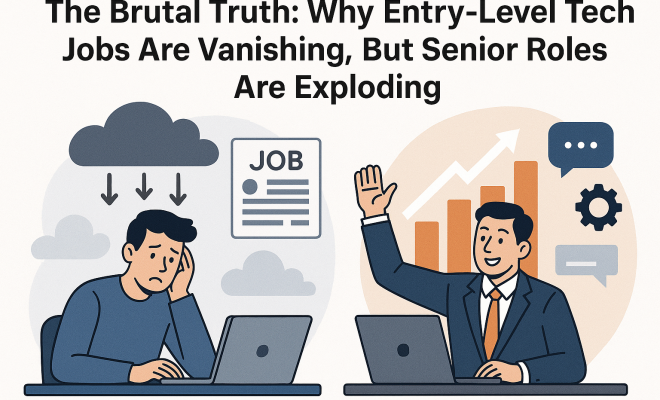
The Brutal Truth: Why Entry-Level Tech Jobs Are Vanishing, But Senior Roles Are Exploding
“`html
Alright, let’s talk about something that’s got a lot of aspiring tech professionals, recent grads, and even seasoned developers scratching their heads, and frankly, a bit worried. You’ve probably seen the chatter online, maybe even felt the squeeze yourself. The landscape for entry-level tech jobs vs senior roles job market trends is undergoing a seismic shift, and it’s not just a minor tremor; it’s a full-blown earthquake.
A recent report from Stanford University’s 2026 AI Index dropped a bombshell that really put this into perspective. We’re seeing a nearly 15% increase in overall U.S. software development job postings since early 2025. That sounds great, right? More jobs! But here’s the kicker, the truly unsettling part: during the same period, employment for young developers, specifically those aged 22-25, has plummeted by almost 20%. Let that sink in. We’re adding software jobs, but the youngest among us are getting squeezed out. This isn’t just an anomaly; it’s a stark indicator that AI’s growing capabilities are fundamentally reshaping the industry, concentrating demand in very specific areas, and making it incredibly tough for new talent to get a foot in the door.
This isn’t just a statistical blip; it’s a profound change that’s sparking widespread concern. Social media is ablaze with discussions about the future career prospects for aspiring tech professionals, and rightly so. What does this mean for the next generation of engineers, designers, and data scientists? And what are the ethical implications of an AI-driven automation wave that seems to be favoring experience and specialized skills over fresh perspectives? It’s a complex, emotionally charged topic, and understanding these trends is absolutely critical if you’re looking to build or pivot a career in tech right now.
1. The AI Paradox: More Jobs, Fewer Opportunities for New Grads
Let’s unpack this paradox. On the surface, a 15% rise in software development job postings seems like fantastic news for the tech sector. It suggests growth, innovation, and a robust demand for skilled professionals. Historically, an increase in overall job listings would eventually trickle down, creating more entry points for new graduates. But that’s just not happening this time around, and it’s primarily because of AI.
AI isn’t just a tool anymore; it’s a co-worker, a project manager, and in some cases, a replacement. What AI excels at is automating repetitive tasks, analyzing vast datasets, and even generating code snippets or testing protocols. These are precisely the kinds of tasks that entry-level developers often cut their teeth on. If an AI can handle the initial grunt work, the need for a human to perform those basic functions diminishes significantly. This means companies are looking for individuals who can manage, guide, and innovate with AI, rather than those who simply execute predefined tasks. This dynamic is a major driver behind the contrasting fortunes of entry-level tech jobs vs senior roles job market trends.
2. The Experience Chasm: Why Seniority is King
So, if entry-level roles are shrinking, where are all these new job postings going? They’re predominantly for senior roles, specialized positions, and, increasingly, roles with a strong AI component. Think about it: when AI takes over the more straightforward coding or data analysis tasks, what’s left for humans? The complex problem-solving, the architectural design, the strategic thinking, the ethical considerations of AI deployment, and the nuanced understanding of business needs that only years of experience can provide.
Companies aren’t just looking for someone who can code; they’re looking for someone who can lead a team that codes, design a system that works, or troubleshoot a complex issue that even AI can’t quite untangle. They want individuals who understand the broader implications of technology, who can mentor junior staff (if they can even find them), and who can navigate the political and technical complexities of large-scale projects. This creates a widening ‘experience chasm’ where those with 5-10+ years of specialized experience are in high demand, while those with zero to two years are finding themselves on the outside looking in.
The implications of this experience chasm extend beyond just job hunting. It impacts salary expectations, career progression, and even the types of companies that are thriving. Startups, often seen as breeding grounds for new talent, are now feeling pressure to hire experienced professionals who can immediately contribute at a high level. They can’t afford the time or resources to extensively train entry-level hires when AI tools offer immediate productivity boosts. This shift fundamentally alters the career ladder in tech, making the initial rungs much harder to grasp.
3. The AI Specialization Imperative: Beyond Basic Coding
It’s no longer enough to just know Python or JavaScript. While those skills remain foundational, the market is screaming for specialization, particularly in AI. We’re talking about roles in machine learning engineering, prompt engineering, AI ethics, data science with a heavy ML focus, and even AI-driven cybersecurity. These aren’t entry-level positions by any stretch of the imagination.
This means that if you’re an aspiring developer, your education can’t stop at a basic computer science degree. You need to be actively pursuing certifications, bootcamps, and personal projects that demonstrate a deep understanding of AI principles, algorithms, and applications. The ability to integrate AI into existing systems, or to build entirely new AI-powered solutions, is becoming the gold standard. Without this specialized knowledge, you’re competing against a much larger pool of candidates for a shrinking number of generic roles, and potentially against AI itself.
Consider the rise of prompt engineering, for example. Just a couple of years ago, this wasn’t even a widely recognized job title. Now, companies are paying top dollar for individuals who can effectively communicate with large language models (LLMs) to achieve specific outcomes. This isn’t about traditional coding; it’s about a deep understanding of language models, their limitations, and how to coax the best performance out of them. It’s a prime example of a hyper-specialized skill that’s sprung up almost overnight, demonstrating the rapid pace of change and the need for continuous, targeted learning in the AI space.
4. The Social Media Reckoning: Anxiety Among Aspiring Techies
You don’t need to look far to see the impact of these trends. Just scroll through LinkedIn, X (formerly Twitter), or Reddit forums dedicated to tech careers, and you’ll find a torrent of anxiety. Recent graduates are expressing immense frustration, feeling like they’ve been sold a dream of a booming tech industry, only to find the doors slammed shut in their faces. (See: latest news on job market trends.)
Many are questioning the value of their expensive degrees when they can’t even land an interview for an entry-level position. This isn’t just about jobs; it’s about shattered expectations, financial burdens, and a growing sense of disillusionment among a generation that was told tech was the sure path to success. The debate isn’t just about economics; it’s deeply personal, touching on self-worth and future security. This widespread concern highlights the urgency of understanding the evolving dynamics of entry-level tech jobs vs senior roles job market trends.
One common sentiment you’ll find is the “experience trap” – how can you get experience if no one will hire you without it? This isn’t a new problem in the job market, but AI’s acceleration of the trend has made it particularly acute in tech. The sheer volume of highly qualified applicants for the few remaining entry-level roles means that even stellar academic records and impressive personal projects might not be enough to stand out. It’s creating a mental health crisis for some, as the pressure to succeed in a field they were told was a sure bet clashes with the harsh reality of the current market. For more context, see AI Security Incident Reporting.
5. Pivoting Your Path: Strategies for Aspiring Developers
So, what’s an aspiring developer to do? Give up? Absolutely not. But you do need to pivot your strategy. The old playbook of ‘get a CS degree, build a basic portfolio, and apply everywhere’ isn’t cutting it anymore. You need to be strategic, proactive, and relentlessly focused on acquiring the skills that are actually in demand.
This means going beyond the basics. Don’t just learn to code; learn to build with AI. Don’t just learn data structures; learn machine learning algorithms. Don’t just build a simple web app; build an AI-powered tool that solves a real-world problem. Networking is more critical than ever, not just for job leads, but for mentorship and insight into emerging trends. Consider internships, even unpaid ones, if they offer exposure to AI or highly specialized projects. The goal is to bridge that experience chasm as quickly and effectively as possible.
When we talk about building with AI, think about specific use cases. Could you develop a small application that uses an LLM to summarize complex documents? Or a tool that employs computer vision to identify defects in images? These kinds of projects demonstrate not just your coding prowess, but your ability to apply AI to practical problems. They show you’re thinking beyond the textbook and engaging with the cutting edge. Also, don’t underestimate the power of open-source contributions. Contributing to AI-related open-source projects can be a fantastic way to gain real-world experience, build a reputation, and connect with experienced developers.
6. Upskilling for Survival: What Existing Developers Need to Know
It’s not just new grads who need to pay attention. If you’re an existing developer, especially one in a more generalized role, you need to be actively upskilling. The skills that got you hired five or ten years ago might not be enough to sustain your career in the coming years. AI isn’t just pushing new grads out; it’s also automating parts of more experienced roles.
Think about how AI can enhance your current role, not replace it. Can you leverage AI tools to be more efficient? Can you learn to integrate AI models into your projects? Are you familiar with the ethical considerations of AI development? The developers who will thrive are those who can adapt, learn new paradigms, and work alongside AI, rather than seeing it as a threat. This continuous learning is crucial for navigating the shifting landscape of entry-level tech jobs vs senior roles job market trends.
For mid-career professionals, this might mean a more formal approach to learning, like pursuing a Master’s degree in AI or Data Science, or specialized certifications from platforms like Coursera, edX, or even directly from tech giants like Google, AWS, or Microsoft. These certifications often carry significant weight with employers, demonstrating a validated skill set. Consider niche areas like MLOps (Machine Learning Operations), which bridges the gap between traditional software development and machine learning, ensuring that AI models are deployed and maintained effectively. This kind of cross-disciplinary skill set is becoming incredibly valuable.
7. The Future of Tech Education: A Call for Reform
This situation also raises serious questions about the state of tech education, from universities to bootcamps. Are these institutions adequately preparing students for the current realities of the job market? If young developers are struggling to find work, it suggests a disconnect between academic curricula and industry demand.
There’s a pressing need for educational programs to integrate more advanced AI, machine learning, and specialized topics earlier and more deeply into their offerings. Generic computer science degrees might need to evolve into more specialized tracks, or at least offer robust minors and concentrations in AI-related fields. Furthermore, there’s an opportunity for online education platforms and specialized bootcamps to step up, offering targeted training that can quickly equip individuals with the high-demand skills needed to navigate this new employment landscape. The goal isn’t just to teach coding; it’s to teach relevant, future-proof skills.
Take, for instance, the traditional computer science curriculum. Many still heavily emphasize theoretical concepts and foundational algorithms, which are important, but sometimes at the expense of practical, industry-relevant AI application. Universities need to rapidly update their courses to include hands-on projects with modern AI frameworks like TensorFlow or PyTorch, ethical AI development principles, and the deployment of AI models in cloud environments. Bootcamps, with their agile nature, have a unique opportunity to lead here, offering intensive, focused programs in areas like AI engineering or advanced data science that can get students job-ready in months, not years.
8. Ethical Quandaries: The Human Cost of AI Automation
Beyond the immediate job market implications, we have to talk about the ethical questions. If AI continues to automate tasks traditionally performed by entry-level workers, what does that mean for social mobility and economic equality? How do we ensure that the benefits of AI are widely distributed, rather than concentrated among a select few with highly specialized skills?
There’s a moral imperative to consider the human cost of this technological advancement. Policy makers, industry leaders, and educators need to collaborate on solutions that mitigate the negative impacts on new entrants to the workforce. This could involve government-sponsored upskilling programs, incentives for companies to invest in human-AI collaboration training, or even a re-evaluation of what constitutes a ‘good’ entry-level job in an AI-dominated world. Ignoring these ethical considerations would be a grave mistake. (See: BBC coverage on technology employment.)
The concept of Universal Basic Income (UBI) has re-entered discussions as a potential societal safety net in an increasingly automated world. While controversial, its resurgence reflects growing concerns about widespread job displacement across various sectors, not just tech. For the tech industry specifically, fostering a culture of “AI for good” is critical. This means developing AI responsibly, with human oversight, fairness, and transparency built in from the start. Companies that prioritize ethical AI development might also find themselves with a competitive advantage, attracting talent and customers who value responsible innovation.
9. Navigating the New Normal: A Path Forward
The stark contrast in entry-level tech jobs vs senior roles job market trends isn’t just a temporary blip; it’s the new normal. The tech industry is maturing, and AI is accelerating that maturation process. This means a higher barrier to entry for generalized roles, and a premium on highly specialized, experienced talent. But it’s not all doom and gloom. For those who are willing to adapt, to specialize, and to continuously learn, there are immense opportunities.
The path forward involves a deep commitment to continuous learning, a strategic focus on AI and other in-demand specializations, and a willingness to think beyond traditional career trajectories. Network relentlessly, build projects that showcase your advanced skills, and be prepared to demonstrate not just what you know, but how you can leverage cutting-edge tools to solve complex problems. The tech world is still brimming with innovation, but the rules of engagement have undeniably changed. For more context, see AI in Higher Education.
10. Expert Perspectives: What Industry Leaders Are Saying
It’s not just academics and social media users who are noticing these shifts. Many industry leaders and prominent figures in the tech world are openly discussing the evolving job market. Satya Nadella, CEO of Microsoft, has spoken extensively about the need for a “skilling revolution,” emphasizing that individuals and companies must adapt to an AI-first world. He points to the rise of “co-pilots” as a way to augment human capabilities, rather than entirely replace them, but this still requires a different skill set from users.
Similarly, thought leaders like Andrew Ng, a pioneer in AI and co-founder of Coursera, consistently advocate for specialized AI education. He stresses that foundational AI knowledge, coupled with practical application, is the key to navigating this new landscape. These leaders aren’t just observing the trends; they’re actively shaping the discussion and, in many cases, investing heavily in educational initiatives to bridge the skill gap. Their consensus seems to be that while AI will create new jobs, it will also demand a significant pivot in existing roles and a higher baseline of technical proficiency.
On the flip side, some economists are sounding alarms about potential long-term unemployment if the rate of new job creation doesn’t keep pace with automation. While tech leaders remain optimistic about AI’s net positive impact, they also acknowledge the transitional pain. This highlights the urgent need for a societal conversation about how to support individuals through this transformation, ensuring that the benefits of technological progress are shared broadly.
11. Comparison to Past Tech Shifts: Is This Different?
Some might argue that this isn’t the first time the tech industry has faced a major disruption. We’ve seen shifts from mainframe to client-server, from desktop to web, and then to mobile. Each transition brought new opportunities and made old skills less relevant. So, is the AI revolution truly different, or is it just another cycle?
While analogies to past shifts are tempting, many experts believe AI presents a more profound and rapid transformation. Previous shifts often involved learning new programming languages or platforms, but the fundamental nature of software development remained largely the same. AI, particularly generative AI, changes the very act of creation and problem-solving. It’s not just a new tool; it’s a new paradigm for how work gets done. It can generate code, analyze complex data patterns, and even design user interfaces, tasks that previously required significant human cognitive effort.
The speed of adoption is also unprecedented. The internet took years to become ubiquitous; mobile apps took a decade. Generative AI tools like ChatGPT reached millions of users in months. This rapid integration means the job market has less time to adapt, making the current squeeze on entry-level roles feel more sudden and intense than previous transitions. This isn’t just a new technology; it’s a technology that learns, adapts, and automates at a scale and speed we haven’t witnessed before, truly setting it apart from historical tech shifts.
12. The Gig Economy and Fractional Roles: A New Entry Point?
With traditional entry-level roles shrinking, could the gig economy or fractional employment offer a workaround for new talent? It’s a possibility gaining traction. Companies might be hesitant to hire full-time, entry-level staff for basic tasks that AI can handle, but they might be open to hiring freelancers or contractors for specialized, short-term projects that require human oversight or unique problem-solving skills.
This could mean a rise in project-based work for aspiring AI engineers, data scientists, or prompt engineers. Platforms connecting freelancers with specialized tech projects could become more vital. For new grads, this might mean foregoing the traditional full-time junior role in favor of building a portfolio through multiple smaller contracts. While it offers flexibility and a way to gain experience, it also comes with less stability and benefits than traditional employment. It requires a different mindset, one focused on personal branding, continuous self-marketing, and managing multiple client relationships. This shift could redefine what “getting started” in tech looks like for the next generation.
13. Building a “T-Shaped” Skill Set for the AI Era
To really thrive in this new environment, aspiring and existing tech professionals should aim for a “T-shaped” skill set. What does that mean? The horizontal bar of the ‘T’ represents a broad understanding of various tech domains, including general programming, cloud computing basics, data fundamentals, and an awareness of AI’s capabilities and limitations across different applications. For more context, see AI in Medicine. (See: New York Times on tech job market.)
The vertical bar, on the other hand, signifies deep expertise in one or two highly specialized areas. In the current climate, these deep specializations should ideally be AI-related, like machine learning engineering, natural language processing, computer vision, or ethical AI governance. Having a broad base helps you communicate across teams and understand the bigger picture, while deep specialization makes you indispensable in a particular niche where human expertise is still paramount. This combination makes you adaptable to new challenges and highly valuable to employers navigating complex AI integrations.
FAQs on Entry-Level Tech Jobs vs Senior Roles Job Market Trends
Q1: Is a Computer Science degree still worth it for entry-level tech jobs?
Yes, absolutely, but with a significant caveat. A Computer Science degree still provides a strong theoretical foundation in algorithms, data structures, and computational thinking, which are crucial. However, it’s no longer sufficient on its own. To be competitive for entry-level roles, you must supplement your degree with practical, specialized skills in AI, machine learning, or related fields through personal projects, internships, certifications, or specialized bootcamps. The degree gets your foot in the academic door, but your specialized skills get you into the industry.
Q2: What specific AI skills are most in demand for someone starting out?
For someone starting out, focusing on practical application is key. This includes proficiency in a machine learning framework (like TensorFlow or PyTorch), understanding core machine learning algorithms (supervised, unsupervised learning), data preprocessing and analysis (using libraries like Pandas, NumPy), and cloud platforms (AWS, Azure, GCP) for deploying models. Prompt engineering is also a rapidly growing, accessible skill. Ethical AI considerations are increasingly important too, demonstrating you can build responsibly.
Q3: How can I gain experience if no one hires entry-level?
This is the classic “experience trap.” To break it, focus on creating your own experience:
- Personal Projects: Build complex AI-powered projects that solve real-world problems. Host them on GitHub, write about your process.
- Open Source Contributions: Contribute to AI-related open-source projects. This gives you collaborative experience and a public code record.
- Internships: Even if unpaid or short-term, internships in AI-focused teams are invaluable.
- Freelancing/Gig Work: Look for smaller, project-based work on platforms like Upwork or Fiverr to build a portfolio and client experience.
- Volunteer Work: Offer your skills to non-profits or community projects that could benefit from AI.
These alternatives demonstrate initiative and practical application of skills.
Q4: Will AI eventually replace all tech jobs, including senior roles?
It’s highly unlikely AI will replace *all* tech jobs. AI is excellent at automating repetitive, predictable tasks and analyzing vast datasets. However, senior roles often involve complex problem-solving, strategic thinking, innovation, managing human teams, navigating ambiguous situations, and ethical decision-making – areas where human intuition and creativity still far surpass AI. Instead of replacement, we’ll likely see a shift where AI becomes a powerful tool that augments human capabilities, allowing senior professionals to focus on higher-level, more impactful work.
Q5: What role does networking play in this new job market?
Networking is more crucial than ever. With fewer traditional entry points, warm introductions and referrals can make a massive difference. Attend industry conferences (virtual or in-person), join online communities, participate in hackathons, and connect with professionals on LinkedIn. Don’t just ask for a job; seek mentorship, advice, and insights into emerging trends. Building genuine relationships can lead to opportunities that aren’t publicly advertised, helping you bypass the crowded application queues.
Q6: Should I consider a non-traditional path, like a bootcamp, over a university degree?
Both paths have merits. A university degree offers theoretical depth and a broad education, while a bootcamp offers focused, hands-on training for specific, in-demand skills in a shorter timeframe. For the current market, a blend is often ideal. If you have a degree, supplement it with specialized bootcamp training or certifications. If you’re considering a bootcamp, ensure it has a strong career services component, focuses on AI or other highly specialized areas, and has a proven track record of placing graduates in relevant roles. The best path depends on your learning style, financial situation, and career goals.
Q7: How can existing senior developers stay relevant?
Existing senior developers need to continuously upskill, focusing on how AI can enhance their current work and open new opportunities. This means:
- Learning AI/ML Fundamentals: Understand how AI works, its capabilities, and limitations.
- Tool Adoption: Become proficient with AI-powered development tools (e.g., GitHub Copilot, AI-driven testing tools).
- AI Integration: Learn how to integrate AI models into existing systems or build AI-powered features.
- Ethical AI: Understand the ethical implications and governance of AI.
- Mentorship: Leverage your experience to mentor junior AI talent, which builds leadership skills in a new domain.
The goal is to become an expert at leveraging AI to solve complex problems, not just writing code.
“`
Trending Now
Frequently Asked Questions
Why are entry-level tech jobs disappearing?
Entry-level tech jobs are vanishing primarily due to the growing capabilities of AI, which has shifted demand towards more experienced candidates. As companies increasingly seek specialized skills, young developers find it difficult to secure positions, despite an overall increase in software job postings.
What is the current job market trend for tech roles?
The job market for tech roles is experiencing a paradoxical trend: while there has been a 15% increase in software development job postings, employment for young developers aged 22-25 has decreased by nearly 20%, indicating a shift towards senior roles.
How is AI affecting job opportunities for new graduates?
AI is reshaping the job landscape by favoring experienced professionals over new graduates. As automation and specialized skills become more prevalent, new entrants face significant challenges in finding entry-level positions, leading to a concerning decline in their employment opportunities.
What does the future look like for aspiring tech professionals?
The future for aspiring tech professionals appears challenging as the industry increasingly prioritizes experience and specialized skills. This trend raises concerns about career prospects for new graduates, urging them to adapt and upskill to remain competitive in the evolving job market.
What are the implications of the tech job market changes?
The changes in the tech job market suggest ethical implications surrounding AI-driven automation, particularly in how it impacts diversity of thought and innovation. As companies lean towards experienced hires, the potential loss of fresh perspectives from new talent could hinder creativity and progress in the industry.
Agree or disagree? Drop a comment and tell us what you think.